Back to School with Integrity: Getting our Priorities Straight

August 28, 2020

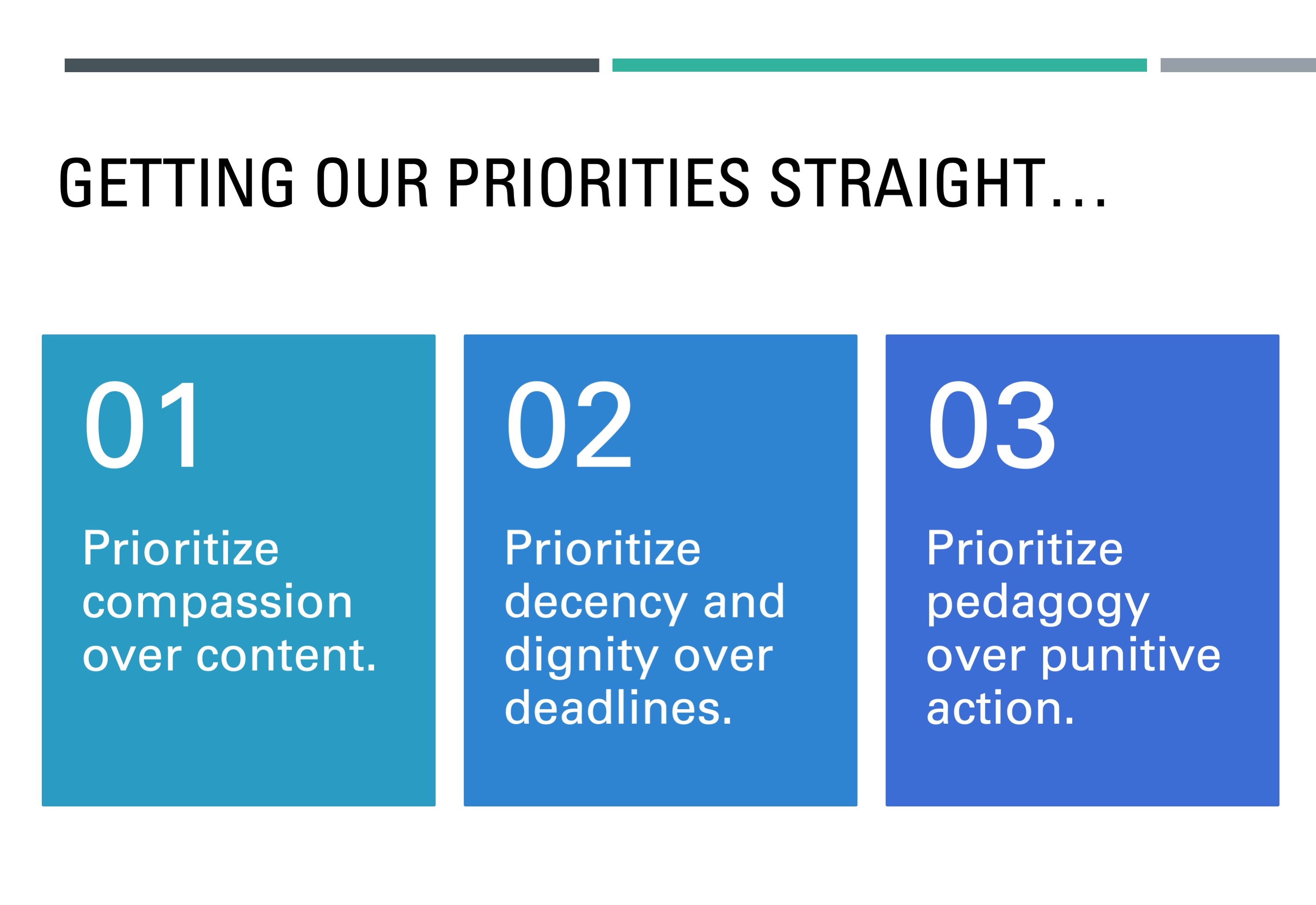
This morning I did a keynote address for Humber College (Ontario, Canada) for their Faculty Ed-Venture Days offered through their teaching and learning centre. One of the slides that resonated most with participants was around getting our priorities straight as we head back to classes for a new school year in the ongoing global pandemic. Here’s what I shared:

3 prioritiesBack to school with integrity - 2020-08-28

#1: Prioritize compassion over content.

When possible let’s back off on overwhelming students with more content than they can handle. There have been repeated stories from academics, educators, and students that our ability to focus, process content and “produce” has diminished during the pandemic. Of course, there’s not much “hard data” that has been collected on this yet, but there are enough repeated stories to know that we (as in, humans) are coping with new stresses, and often multiple and competing stressors at once. So, students may simply not have the capacity to process the same volume of content as they did last year. That’s nobody’s fault; that’s just how is. So given the choice between cramming in more content, and being compassionate with the amount we expect them to reasonably learn, let’s err on the side of compassion.

#2: Prioritize decency and dignity over deadlines.

I have been teaching for more than 25 years; and I used to be the most militant person you’ve every met when it came to deadlines. Through my work in academic integrity I’ve learned that students can be at a higher risk for engaging in misconduct when they are under tight deadlines. So now, if students ask me for an extension, I give it to them (within reason, and within the boundaries of the administrative requirements of when I have to submit grades.)

I don’t make students beg for an extension. I don’t make them tell me their life story. I trust that if they are asking for an extension, then they need it. I aim to let them keep their dignity by not forcing or coercing them to tell me their life story.

#3: Prioritize pedagogy over punitive action.

There will be breaches of academic integrity, but before we get to that point, let’s do everything we can to educate students. That means teaching them everything from time management skills, to how to plan out their assignments, to learning skills like citing, referencing, paraphrasing, and whatever else they need.

We became educators because we believe in pedagogy, rather than policing, so let’s do whatever we can to ensure students are learning.

____________________

Share or Tweet this: Back to School with Integrity: Getting our Priorities Straight – https://drsaraheaton.wordpress.com/2020/08/28/back-to-school-with-integrity-getting-our-priorities-straight/(opens in a new tab)

This blog has had over 2 million views thanks to readers like you. If you enjoyed this post, please “like” it or share it on social media. Thanks!

Sarah Elaine Eaton, PhD, is a faculty member in the Werklund School of Education, and the Educational Leader in Residence, Academic Integrity, University of Calgary, Canada. Opinions are my own and do not represent those of the University of Calgary.


Understanding Academic Integrity from a Teaching and Learning Perspective: Engaging with the 4M Framework

August 27, 2020

This post situates academic integrity within the scholarship of teaching and learning (SoTL) discourse. The 4M framework frames integrity through a four interrelated organizational lenses: (a) micro (individual); (b) meso (departmental); (c) macro (institutional); and (d) mega (community).

Keywords: academic integrity, scholarship of teaching and learning (SoTL), pedagogy, 4M framework, systems theory.

Introduction

Using a framework to understand complex issues, such as those relating to academic integrity, can be helpful while avoiding being overly reductionist. For a long time scholars and educators haven calling for more pro-active and pedagogical approaches to academic integrity (Eaton et al., 2017; Howard, 2002; Morris, 2016). One scholar has even called academic integrity a “teaching and learning imperative” (Bertram Gallant, 2008). In addition, the position that academic integrity is solely a student responsibility is now considered outdated, as advocates call for multi-stakeholder approaches that engage various members of the learning community including students, educators, and administrators, in different but interconnected ways (Eaton et al., 2017; Morris, 2016).

To help us understand how all these different stakeholders play a role, a systems approach to academic integrity can be helpful (Bertram Gallant, 2016; Bertram Gallant & Kalichman, 2011; Drinan & Bertram Gallant, 2008).

Systems thinking is not new; it has been around for more than half a century, if not longer (Bronfenbrenner, 1976; 1981; von Bertalanffy, 1968).

The 4M Framework

Systems theory helped to inform the conceptualization of the 4M Framework, which was developed within the Scholarship of Teaching and Learning (SoTL) community to help educators understand teaching and learning inquiry (Friberg 2016; Kalu et al., 2018; Kenny et al., 2016; Poole & Simmons, 2013; Simmons, 2016; Williams et al., 2013). The framework consists of four nested levels: micro, meso, macro, and mega.

The 4M Framework: Micro, Meso, Macro, and Mega Levels

The 4M Framework: Micro, Meso, Macro, and Mega Levels

The Micro Level: Individual

Individual students and educators are at the heart of the 4M framework. Each person’s conceptual understanding of academic integrity, as well as practical skills such as paraphrasing, citing, and referencing, develop at an individual level. But this learning does not happen in isolation. It is impacted by other individuals within the system, as well as the system itself.

Individual educators also operate at the micro level when they are preparing course content, lessons and activities. Research has shown over and over again that students are more likely to care about academic integrity when educators show that it matter to them, too (Bertram Gallant, 2018; McCabe et al., 2012; Eaton et al., 2017). It is at this level that educators can have a direct and lasting impact on teaching students how to engage in ethical decision making and also how to build practical skills such as paraphrasing, citing and referencing.

The Meso Level: Departmental

At this level, academic departments and support units, such as the library or the student affairs office, provide resources and learning opportunities that allow academic integrity to be operationalized. At this level support for academic integrity can be hands-on and pro-active in the form of workshops, tutorials, and practical resources.

The Macro Level: Learning Organization

The learning organization (e.g., college or school) is responsible for setting the institutional direction and culture for academic integrity. This includes having clearly articulated policies and procedures that can be applied fairly and equitably across the institution. Leaders at this level can also act as champions who set the tone for the entire school (McCabe et al, 2012).

The Mega Level: Community

This level includes stakeholders who are connected with the school, but who may not be involved on a day-to-day basis. This includes government bodies, alumni, parents and others who can be engaged to as partners in promoting academic integrity and ethical conduct in a variety of ways.

It is important to engage with colleagues from other institutions to form networks of professional practice (Kenny et al., 2016). This helps us to expand our understanding, push our boundaries and learn with and from one another. When we engage with colleagues outside of our institutions, we are engaging at the mega level. This is essential for those working in academic integrity contexts, where there might be only a handful of individuals directly engaged with this work on a day-to-day basis. Ongoing engagement with a network of like-minded professionals is key to continuing our professional learning in a sustained and sustainable way.

Conclusions

The 4M lens helps us to understand who the various stakeholders are and how they can play a role in upholding and enacting academic integrity in our learning communities. Creating a culture of integrity cannot happen if only certain individuals are engaged (McCabe et al., 2012). Instead, creating a culture of integrity requires intentional and sustained effort across a variety of different stakeholder groups within the institution.

Discussion Questions

  • Who are some of the stakeholders actively engaged in promoting academic integrity at your school?
  • How are you engaging stakeholders at every level of your school to uphold and enact academic integrity?
  • How are you creating a culture of integrity at your school?

References

Bertram Gallant, T. (2008). Academic integrity in the twenty-first century: A teaching and learning imperative. Hoboken, NJ: Wiley.

Bertram Gallant, T. (2016). Systems approach to going forward: Introduction. In T. Bretag (Ed.), Handbook of Academic Integrity (pp. 975-977). Singapore: Springer Singapore.

Bertram Gallant, T., & Kalichman, M. (2011). Academic ethics: A systems approach to understanding misconduct and empowering change in the academy. In T. Bertram Gallant (Ed.), Creating the ethical academy: A systems approach to understanding misconduct and empowering change in higher education (pp. 27-44). New York: Routledge.

Boyer, E. L. (1990). Scholarship reconsidered: Priorities of the professoriate. New York: The Carnegie Foundation for the Advancement of Teaching.

Bronfenbrenner, U. (1976). The Experimental Ecology of Education. Paper presented at the American Educational Research Association (AERA), San Francisco, CA

Bronfenbrenner, U. (1981). The ecology of human development: Experiments by nature and design. Cambridge: Cambridge: Harvard University Press.

Drinan, P. M., & Bertram Gallant, T. (2008). Plagiarism and academic integrity systems. Journal of Library Administration, 47(3-4), 125-140. doi:10.1080/01930820802186472

Eaton, S. E., Guglielmin, M., & Otoo, B. (2017). Plagiarism: Moving from punitive to pro-active approaches. In A. P. Preciado Babb, L. Yeworiew, & S. Sabbaghan (Eds.), Selected Proceedings of the IDEAS Conference 2017: Leading Educational Change Conference (pp. 28-36). Calgary, Canada: Werklund School of Education, University of Calgary. https://prism.ucalgary.ca/handle/1880/52096

Friberg, J. C. (2016). Might the 4M Framework Support SoTL Advocacy? (July 11). Retrieved from https://illinoisstateuniversitysotl.wordpress.com/2016/07/11/might-the-4m-framework-support-sotl-advocacy/

Howard, R. M. (2002). Don’t Police Plagiarism: Just TEACH! The Education Digest, 67(5), 46-49.

Kenny, N., Watson, G. P. L., & Desmarais, S. (2016). Building sustained action: Supporting an institutional practice of SoTL at the University of Guelph. New Directions for Teaching and Learning, 2016(146), 87-94. doi:10.1002/tl.20191

Kalu, F., Dyjur, P., Berenson, C., Grant, K. A., Jeffs, C., Kenny, N., & Mueller, R. (2018). Seven voices, seven developers, seven one things that guide our practice. To Improve the Academy, 37(1), 111-127. doi:10.1002/tia2.20066

McCabe, D. L., Butterfield, K. D., & Treviño, L. K. (2012). Cheating in college: Why students do it and what educators can do about it. Baltimore, MD: Johns Hopkins University Press.

Morris, E. J. (2016). Academic Integrity: A Teaching and Learning Approach. In T. Bretag (Ed.), Handbook of Academic Integrity (pp. 1037-1053). Singapore: Springer Singapore.

Poole, G., & Simmons, N. (2013). Contributions of the scholarship of teaching and learning to quality enhancement in Canada. In R. Land & G. Gordon (Eds.), Enhancing quality in higher education international perspectives (pp. 278-298). London: London: Routledge.

Simmons, N. (2016). Synthesizing SoTL institutional initiatives toward national impact. New Directions for Teaching and Learning, 2016(146), 95-102. doi:10.1002/tl.20192

von Bertalanffy, L. (1968). General system theory: Foundations, development, applications. New York: George Braziller.

Williams, A. L., Verwoord, R., Beery, T. A., Dalton, H., McKinnon, J., Strickland, K., . . . Poole, G. (2013). The Power of social networks: A model for weaving the scholarship of teaching and learning into institutional culture. Teaching & Learning Inquiry: The ISSOTL Journal, 1(2), 49-62. doi:10.2979/teachlearninqu.1.2.4

_____________________

To cite this post in your own work, refer to the original report archived online:

Eaton, S. E. (2020). Understanding Academic Integrity from a Teaching and Learning Perspective: Engaging with the 4M Framework. Calgary: University of Calgary. http://hdl.handle.net/1880/112435

For a deeper dive into this topic, read more in:

Eaton, S. E. (2021). Plagiarism in higher education: Tackling tough topics in academic integrity. Santa Barbara, CA: Libraries Unlimited.

_________________________________

Share or Tweet this: Understanding Academic Integrity from a Teaching and Learning Perspective: Engaging with the 4M Framework https://drsaraheaton.wordpress.com/2020/08/27/understanding-academic-integrity-from-a-teaching-and-learning-perspective/

This blog has had over 2 million views thanks to readers like you. If you enjoyed this post, please “like” it or share it on social media. Thanks!

Sarah Elaine Eaton, PhD, is a faculty member in the Werklund School of Education, and the Educational Leader in Residence, Academic Integrity, University of Calgary, Canada. Opinions are my own and do not represent those of the University of Calgary.


Coming in 2021! New book: Plagiarism in Higher Education: Tackling Tough Topics in Academic Integrity

August 10, 2020

Plagiarism in Higher Education: Tackling Tough Topics in Academic IntegrityPretty excited to see that my upcoming book now has an official webpage on the publisher site! The manuscript has been officially approved by my editor, the wonderful Jessica Gribble. The next steps are for it to move into production. The scheduled release date is early 2021.

The book is not yet available for sale though. You’ll have to wait until closer to the publication date for that. In the meantime, you can send the book info to your friendly neighbourhood librarian, and ask them to put it in their ordering queue!

Plagiarism in Higher Education: Tackling Tough Topics in Academic Integrity

Libraries Unlimited

Pages: 230

The book will be available in paperback and e-book formats.

Description

Plagiarism is a complex issue that affects many stakeholders in higher education, but it isn’t always well understood. This text provides an in-depth, evidence-based understanding of plagiarism with the goal of engaging campus communities in informed conversations about proactive approaches to plagiarism.

Offering practical suggestions for addressing plagiarism campus-wide, this book tackles such messy topics as self-plagiarism, plagiarism among international students, essay mills, and contract cheating. It also answers such tough questions as:

  • Why do students plagiarize, and why don’t faculty always report it?
  • Why are plagiarism cases so hard to manage?
  • What if researchers themselves plagiarize?
  • How can we design better learning assessments to prevent plagiarism?
  • When should we choose human detection versus text-matching software?

This book focuses on academic integrity from a teaching and learning perspective, offering comprehensive insights into various aspects of plagiarism with a particular lens on higher education to benefit the entire campus community.

_________________________________

Share or Tweet this: Coming in 2021! New book: Plagiarism in Higher Education: Tackling Tough Topics in Academic Integrity https://wp.me/pNAh3-2xI

This blog has had over 2 million views thanks to readers like you. If you enjoyed this post, please “like” it or share it on social media. Thanks!

Sarah Elaine Eaton, PhD, is a faculty member in the Werklund School of Education, and the Educational Leader in Residence, Academic Integrity, University of Calgary, Canada. Opinions are my own and do not represent those of the University of Calgary.

This blog has had over 2 million views thanks to readers like you. If you enjoyed this post, please “like” it or share it on social media. Thanks!

Sarah Elaine Eaton, PhD, is a faculty member in the Werklund School of Education, and the Educational Leader in Residence, Academic Integrity, University of Calgary, Canada. Opinions are my own and do not represent those of the University of Calgary.


Degrees of Deceit: A Webinar

August 5, 2020

Degrees of Deceit: Understanding the landscape of counterfeit credentials and university admissions fraud – Webinar

Overview

Join Jamie Carmichael and Sarah Elaine Eaton for a provocative session about counterfeit credentials such as fake degrees and tampered transcripts. Admissions fraud remains an understudied area of academic integrity and educational ethics. Learn about some of the telltale signs of admissions fraud in higher education.

This session will be of particular interest to those who handle admissions files for post-secondary institutions, including: academic leaders, registrarial staff, administrative staff, and academics who sit on admissions committees. Although this session is framed within the context of Canadian higher education, many of the concepts and tips will likely apply to those in other jurisdictions, as admissions fraud is a global concern.

This session will take place from 10:00 a.m. to 11:30 a.m. Mountain Time (Calgary, Canada) via Zoom. Login instructions will be sent to registered participants within one day of the live event. The live session can accommodate 300 participants, but everyone who registers will receive a link to watch a recorded version of the presentation after the live event.

This event is part of the Academic Integrity: Urgent and Emerging Topics webinar series, hosted by the Taylor Institute for Teaching and Learning at the University of Calgary, which addresses timely and emergent topics that are cutting edge, provocative or high profile in nature.

Learning Objectives

By the end of this session, participants will:

  • Understand foundational concepts related to admissions fraud.
  • Be aware of the business models that thrive in this landscape, and the potential for blackmail with counterfeit credentials.
  • Assess how those involved with admissions processes can better identify fraudulent documents.

Presenter bios

Jamie Carmichael is the Associate Registrar, Carleton University, and is completing her Master’s research on contract cheating and academic integrity. She has presented or co-presented her work at the International Society for Professional Innovation Management (ISPIM) conference (2019) and the International Center for Academic Integrity annual conference (2020).

Jamie Carmichael, Carleton University, Ottawa, Canada

Sarah Elaine Eaton is an Associate Professor, Werklund School of Education and the inaugural Educational Leader in Residence, Academic Integrity at the Taylor Institute of Teaching and Learning, University of Calgary. She is an award-winning educator and researcher whose work focuses on academic integrity in Canadian higher education. Her work can be found in the British Educational Research Journal, the Journal of Academic Ethics, and the International Journal for Educational Ethics, among other places. Her book, Plagiarism in Higher Education: Tackling Tough Topics in Academic Integrity will be published by ABC Clio/Libraries Unlimited in 2021.

Sarah Elaine Eaton

Registration

Registration is required, as login instructions will only be sent to registered participants.

Register here: https://conted.ucalgary.ca/search/publicCourseSearchDetails.do?method=load&courseId=56681459&expandSectionId=57027207&parentSite=TI#courseSectionDetails_57027149

Each webinar can accommodate 300 live participants. All registrants will be e-mailed a link to the recorded version of the webinar for viewing after the live event.

Registration deadline: September 10, 2020 by 1:00 p.m. Mountain Time

Related posts:

_________________________________

Share or Tweet this: Degrees of Deceit: A Webinar – https://wp.me/pNAh3-2xr

This blog has had over 2 million views thanks to readers like you. If you enjoyed this post, please “like” it or share it on social media. Thanks!

Sarah Elaine Eaton, PhD, is a faculty member in the Werklund School of Education, and the Educational Leader in Residence, Academic Integrity, University of Calgary, Canada. Opinions are my own and do not represent those of the University of Calgary.

This blog has had over 2 million views thanks to readers like you. If you enjoyed this post, please “like” it or share it on social media. Thanks!

Sarah Elaine Eaton, PhD, is a faculty member in the Werklund School of Education, and the Educational Leader in Residence, Academic Integrity, University of Calgary, Canada. Opinions are my own and do not represent those of the University of Calgary.


Planning for school re-closure: We can’t say we weren’t warned

July 26, 2020

Alberta Education Pandemic Planning GuideThe in the Pandemic Planning Guide for Alberta School Authorities, published by the Alberta government there is ample helpful guidance for school administrators and other educational leaders.

Of particular interest right now is Schedule K of the guide: Draft letter to inform parents schools are reopened. We want to pay particular attention to this statement: “… If more people get sick, schools may need to close again.” (p. 64).

So if (when?) schools are closed down again sometime in the 2020-2021 school year, we can’t say we were not warned. This was anticipated in the pandemic planning guide.

Published 7 years ago.

That’s right. This guide was published in 2013, long before most of us even knew what a coronavirus was. In the draft letter to parents, school administrators were guided to prepare parents for the possibility schools needing to close again after re-opening (p. 64).

Other points of note:

“… it is possible employee absenteeism could be in the 30% to 40% range, with at least 20% absenteeism being likely.” (p. 10)

Your influenza pandemic plan is a living document. It needs to be reviewed and revised regularly.” (p. 12) (Note: To the best of my knowledge, the guide has never been updated since it was written.)

Employers could be liable, through possible claims in negligence. Lawsuits could be initiated by students, staff, or third parties who have been harmed.” (p. 14)

the plan should provide for significant staff absences and assess whether the School Authority could provide educational services in the event of staff/student absences. The plan should also take into consideration how the School Authority would continue to operate without a full complement of staff.” (p. 24)

Also important is what is missing from the planning guide. The words “Indigenous”, “First Nations” or “Aboriginal” (with the latter two terms being more common at the time the document was published) are utterly absent from the document. This indicates that at the time the plan was developed, there were no particular considerations made for Alberta’s Indigenous communities.

So, as we are preparing for re-opening, we would be wise to prepare for the possibility of re-closing again, too.

Read the whole planning guide here:

Government of Alberta. (2013). Pandemic Planning Guide for Alberta School Authorities. Retrieved from https://education.alberta.ca/media/1477307/pandemicplanningguide.pdf

_________________________________

Share or Tweet this: Planning for school re-closure: We can’t say we weren’t warned https://wp.me/pNAh3-2×2

This blog has had over 2 million views thanks to readers like you. If you enjoyed this post, please “like” it or share it on social media. Thanks!

Sarah Elaine Eaton, PhD, is a faculty member in the Werklund School of Education, and the Educational Leader in Residence, Academic Integrity, University of Calgary, Canada. Opinions are my own and do not represent those of the University of Calgary.