What’s the difference between a manuscript and an article?

May 8, 2017

One of the questions students in a graduate course I teach called “Writing Educational Research” is: What is the difference between a manuscript and an article?

The simplest way to understand it is this:

Manuscript = Written paper pre-publication

Article = Written paper that has been published

Now, scholars love to debate and I’m quite sure that there are academics out there who would delight in a robust debate on this topic. I agree that my definition may be simplistic. My purpose here is not to be reductionist, but rather to demystify the publication process for graduate students and novice researchers.

What's the difference between a manuscript and an aritcle

Examples of manuscripts include:

  • Drafts
  • Writing-in-progress
  • Work submitted to a publisher that is under review or not yet published
  • Term papers or elements of your thesis that you are crafting for submission to a journal.

The term “article” usually refers to work published in:

  • Newsletters
  • Professional publications
  • Edited journals
  • Peer-reviewed scholarly or scientific journals

If you are looking at publishing your work in the proceedings of a conference, refer to it as a manuscript until the proceedings have been released.

There can be a delay between when your work is accepted for publication and when it actually appears in print. During this phase, you can call your work a “pre-publication article” or an “article in press”. At this point, you can call it an article because it has been accepted for publication.

Graduate students and novice researchers and scholars present themselves as uninformed and inexperienced when they run around referring to term papers and drafts of their work as “articles”, when the work has not yet been published. You will present yourself as more humble and knowledgeable about the publication process when you refer to your own work as a manuscript when it is in the pre-publication phase.

Related posts:

___________________________________________________

Share this post: What’s the difference between a manuscript and an article? http://wp.me/pNAh3-1SV

This blog has had over 3.6 million views thanks to readers like you. If you enjoyed this post, please “like” it or share it on social media. Thanks!

Sarah Elaine Eaton is a faculty member in the Werklund School of Education, University of Calgary, Canada.


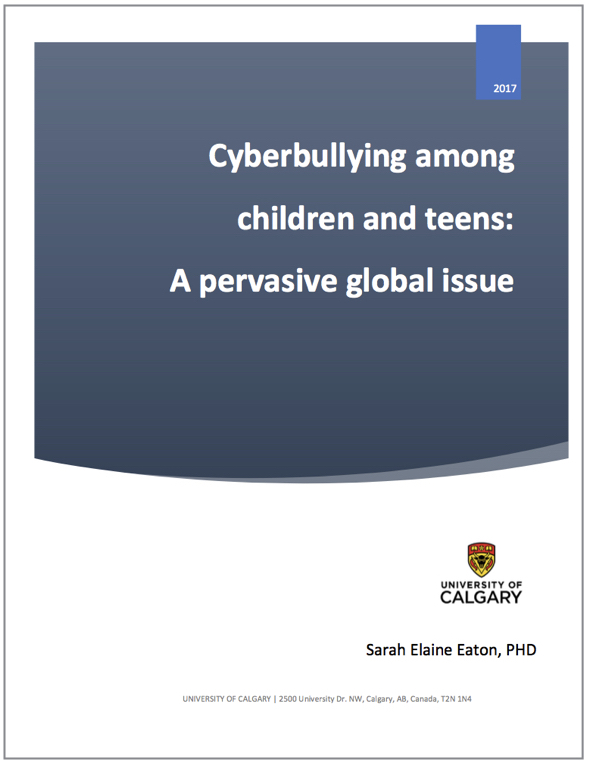
Cyberbullying: A pervasive global issue

May 6, 2017

Cyberbulling cover.001A few years ago I wrote a series of blog posts on cyberbulling. They became some of the most highly read posts on my blog. I have compiled and updated these posts into a single report that be useful for researchers, educators, parents, children and a broad general readership.

This is a highly complex issue and I am by no means an expert in this field. Nevertheless, the topic is an important one. The more conversation we can generate about it and the more awareness we can raise, the better.

This report is intended to serve as a point of departure for further discussion and research for those interested in the topic.

The report is now available as a free, Open Access download from the University of Calgary’s digital repository: http://prism.ucalgary.ca//handle/1880/51974.

____________________________________________________

Share this post: Cyberbullying: A pervasive global issue http://wp.me/pNAh3-1SD

This blog has had over 1.8 million views thanks to readers like you. If you enjoyed this post, please “like” it or share it on social media. Thanks!

Sarah Elaine Eaton is a faculty member in the Werklund School of Education, University of Calgary, Canada.


Journal of Educational Thought – Celebrating 50 Years

April 18, 2017

When I first started in my role as an Assistant PrJET 50(1)ofessor in the Werklund School of Education, one of my former professors, Dr. Ian Winchester, approached me about being a book review editor for the Journal of Educational Thought. I accepted immediately. I set to work acquiring titles and recruiting people to write book reviews for the journal.

It has been a fabulous experience so far, as I’ve had the opportunity to meet other scholars, re-connect with former students, and mentor a couple of current students, too.

Today, the editorial assistant, the fabulous Aber Abulhassn, stopped by my office with a copy of the latest issue of the journal. This issue is special for a few reasons. Firstly, I’m named as the Book Review Editor (a position previously vacant). I am thrilled about that. Secondly, I actually have a book review published in this issue, wish is lovely in a “meta” kind of way. Finally — and this is what’s most inspiring — this is volume 50, issue 1 of the journal. That’s right, this journal has been around for half a century.

Dr. Winchester’s opening editorial is “Fifty Years of the Journal of Educational Thought“. In it, he traces the history of the journal, with its origins starting at the University of Calgary. He discusses how the landscape for journals has changed and the how “this is not any easy time for journals” (p. 3), but closing on a high note by inviting readers to “raise a glass to the first fifty years” (p. 3).

I feel honoured to be part of a publication with half a century of tradition and quality. I recognize that I share a special path of those who have come before me, contributing to a long-standing publication in the field of academia.

Related article:

Werklund School’s Journal of Educational Thought turns 50 – https://wcm.ucalgary.ca/utoday/issue/2017-12-07/werklund-schools-journal-educational-thought-turns-50

____________________________________________________

Share this post: Journal of Educational Thought – Celebrating 50 Years http://wp.me/pNAh3-1RM

This blog has had over 1.8 million views thanks to readers like you. If you enjoyed this post, please “like” it or share it on social media. Thanks!

Sarah Elaine Eaton is a faculty member in the Werklund School of Education, University of Calgary, Canada.


7 Ways to Celebrate the End of the Semester

April 12, 2017

hands hope sunCongratulations! You have made it to the end of another semester in one piece. You deserve to catch your breath and celebrate. Here are some ways to do just that:

1. Thank your loved ones. They have put up with your grumpiness, your tantrums and your anxiety all term. They’ve done chores for you that you should have been doing yourself, but turned a blind eye to because of school work. They’ve listened to you, given you advice or bitten their tongue to refrain from giving you too much advice. Seriously, they deserve some appreciation. Show your love with some flowers, a nice dinner out or some other special thank you for the loved ones who have been there for you all term.

2. Thank your classmates. Was there a classmate who really supported you this term? Was there a fellow student who listened when you needed a shoulder to cry on? Or someone who gave you awesome feedback on your work? Learning is not a solitary endeavour. Send your classmate a note of appreciation and tell them how much he or she means to you.

3. Book some self-care. Whether it is a massage, a chiropractic treatment, or a spa day, plan on rejuvenating your health and well-being. Book your wellness appointment today.

4. Go outside! You’ve likely been glued to your computer screen for weeks now, as you wrap up your final papers and projects. Go for a walk. Do some work in the garden. Just go outside and listen to the birds chirp. It’s time to expand your world beyond your own little work space again.

5. Re-connect with friends. Have you been ignoring your friends all term because of school work? Have you declined invitations or backed out of social engagements at the last minute because you’ve had too much work to do or just felt too stressed out? Your friends are waiting for you! Send your favourite pals a text or an e-mail today to make plans to get together.

6. Take a bath. There’s nothing like a hot, soothing bath to wash away the stress of a semester. Use bubbles, candles, music or whatever will help you relax. Take some to soak in the success of having completed another term.

7. Prepare a healthy meal. Have you been eating food out of boxes and cans these past few weeks, as you madly finish up projects? If so, your body is probably crying for some fresh vegetables and fruit. Why not take the time to prepare your favourite meal? Even better, make supper for your family or friends to thank them for supporting you.

These are just a few suggestions to celebrate the end of your semester. You probably have some ideas of your own. The important point here is to actually take the time to pause and celebrate your achievement. By completing another semester, you have reached another milestone towards your goals. Taking time to celebrate along the way is important and helps you to remember why you are doing all this.

Related post: 5 Ways to Show Teachers Appreciation http://wp.me/pNAh3-a5

____________________________________________________

Share this post: 7 Ways to Celebrate the End of the Semester http://wp.me/pNAh3-1R7

This blog has had over 1.8 million views thanks to readers like you. If you enjoyed this post, please “like” it or share it on social media. Thanks!

Sarah Elaine Eaton is a faculty member in the Werklund School of Education, University of Calgary, Canada.


Writing resources for educational researchers

April 10, 2017

I have taught a Master’s level course for educational researchers called Writing Educational Research more than a dozen times now. Every semester, I find great new resources to share with students. Sometimes students share resources they have found during their learning journey, too. In this blog post, I collect, curate and share information about the required readings, along with some excellent supplementary resources to help you learn to improve your academic writing.

I offer a big shoutout of appreciation and acknowledgement to the students who have added resources to this list over the years.

Required Readings

  1. Belcher, W. L. (2009). Writing your journal article in 12 weeks: A guide to academic publishing success. SAGE Publications, Inc.
  2. American Psychological Association. (2010). Publication manual of the American Psychological Association (6th ed.). Washington, DC: Author.

Online resources (Available at no cost. Also, see the course outline for resources specific to the University of Calgary)

  1. Basics of APA Style (Tutorial): http://www.apastyle.org/learn/tutorials/basics-tutorial.aspx
  2. Workbook to accompany Belcher’s text: http://www.wendybelcher.com/pages/WorkbookForms.htm

General writing resources

  1. King, S. (2000). On writing: A memoir of the craft. New York: Scribner.

Recommended readings on writing for publication in research and professional journals

  1. Bednar, J. A. (n.d.). Tips for Academic Writing and Other Formal Writing.   Retrieved from http://homepages.inf.ed.ac.uk/jbednar/writingtips.html

  2.  Fisher, J. P., Jansen, J. A., Johnson, P. C., & Mikos, A. G. (n.d.). Guidelines for writing a research paper for publication. Retrieved from https://www.liebertpub.com/media/pdf/English-Research-Article-Writing-Guide.pdf

  3. Hartley. (2008). Academic writing and publishing: A practical handbook. Retrieved from http://inf.ucv.ro/~mirel/courses/MIAM114/docs/academicwriting.pdf

  4. Hess, D. R. (2004). How to write an effective discussion. Respiratory Care, 49(10), 1238-1241. Retrieved from http://site.ufvjm.edu.br/ppgodonto/wp-content/uploads/2012/04/Artigo_6-1.pdf

  5. Liumbruno, G. M., Velati, C., Pasqualetti, P., & Franchini, M. (2013). How to write a scientific manuscript for publication. Blood Transfusion, 11(2), 217-226. doi:10.2450/2012.0247-12

  6. Lowe, C., & Zemliansky, P. (Eds.). Writing spaces: Readings on writing (Vol. 1). West Lafayette, IN: Parlor Press. Retrieved from http://writingspaces.org/sites/default/files/writing-spaces-readings-on-writing-vol-1.pdf

  7. Pautasso, M. (2013). Ten simple rules for writing a literature review.   Retrieved from http://journals.plos.org/ploscompbiol/article?id=10.1371/journal.pcbi.1003149

  8. Rocco, T. S., & Hatcher, T. (2011). The handbook of scholarly writing and publishing. San Francisco, CA: Jossey-Bass.
  9. John Wiley & Sons Inc. (2014). Writing for publication. Retrieved from http://www.wiley-docs.com/HSJ-14-63694_Writing_for_Publication_lowres.pdf

Recommended readings on how to give (and receive) peer review and peer feedback (and deal with rejection)

  1. Durso, T. (1997). Editors’ advice to rejected authors: Just try, try again. The Scientist. Retrieved from http://www.the-scientist.com/?articles.view/articleNo/18603/title/Editors–Advice-To-Rejected-Authors–Just-Try–Try-Again/
  2. Hattie, J., & Timperley, H. (2007). The power of feedback. Review of Educational Research, 77(1), 81-112. Retrieved from http://education.qld.gov.au/staff/development/performance/resources/readings/power-feedback.pdf doi:10.3102/003465430298487
  3. Seals, D. R., & Tanaka, H. (2000). Manuscript peer review: a helpful checklist for students and novice referees. Advances in physiology education, 23(1), 52-58.
  4. Shashok, K. (2008). Content and communication: How can peer review provide helpful feedback about the writing? BMC Medical Research Methodology, 8(1), 3. doi:10.1186/1471-2288-8-3.

Recommended supplementary readings on how to get published

  1. Belcher, W. L. (2009). Reflections on ten years of teaching writing for publication to graduate students and junior faculty. Journal of scholarly publishing, 40(2), 184-200. doi:10.3138/jsp.40.2.184
  2. Lovejoy, T. I., Revenson, T. A., & France, C. R. (2011). Reviewing Manuscripts for Peer-Review Journals: A Primer for Novice and Seasoned Reviewers. Annals of Behavioral Medicine, 42(1), 1-13. doi:10.1007/s12160-011-9269-x

  3. McGrail, M. R., Rickard, C., & Jones, R. (2006). Publish or perish: a systematic review of interventions to increase academic publication rates. Higher Education Research and Development.
  4. Parsons, J. (2016). How to write an article for The Canadian Journal for Teacher Research (CJTR) from your graduate work? The Canadian Journal for Teacher Research. Retrieved from http://www.teacherresearch.ca/blog/article/2016/02/01/292-how-to-write-an-article-for-the-canadian-journal-for-teacher-research-cjtr-from-your-graduate-work
  5. Pearce II, J. A. (2012). Revising manuscripts for premier entrepreneurship journals. Entrepreneurship Theory and Practice, 36(2), 193-203. doi:10.1111/j.1540-6520.2012.00502.x

  6. Zwaaf, E. (2013). 8 Reasons I accepted your article. Elsevier. Retrieved from https://www.elsevier.com/connect/8-reasons-i-accepted-your-article

A note to other professors and educators: I am happy for you to share this list with your own students. Instead of copying and pasting this blog post into your own course outline (because that would be plagiarism), please put a link to this blog post in your syllabus.

Related posts:

How to provide peer review feedback http://wp.me/pNAh3-1qH

How writers can learn to accept criticism http://wp.me/pNAh3-1oA

What’s the difference between a citation and a reference? http://wp.me/pNAh3-1F9

Why APA formatting matters http://wp.me/pNAh3-1Hc

12 Phrases to Avoid in Your Academic Research Papers http://wp.me/pNAh3-1JX

How many sources do you need in a literature review?  http://wp.me/pNAh3-1Hu

What’s the difference between a manuscript and an article? http://wp.me/pNAh3-1SV

Why “as cited in” should be avoided in academic writing  http://wp.me/pNAh3-1BH

10 Great writing resources for grad students – http://wp.me/pNAh3-1Bc

How to create a research paper outline: 5 great resources http://wp.me/pNAh3-1y6

Template for a 10-page graduate research paper in social sciences http://wp.me/pNAh3-1s2

____________________________________________________

Share this post: Writing resources for educational researchers http://wp.me/pNAh3-1OJ

This blog has had over 1.8 million views thanks to readers like you. If you enjoyed this post, please “like” it or share it on social media. Thanks!

Sarah Elaine Eaton is a faculty member in the Werklund School of Education, University of Calgary, Canada.