Best resources of the week (Nov. 13 to 19, 2011)

November 20, 2011

Here are my favorite resources of the week, curated from my Twitter account.

Social Media

Social media increasingly used to guage public health – by Christine Moyer, American Medical News

How to Create a Social Media Marketing Schedule – by John D. Leavy

Literacy and Essential Skills

What have you learned about teaching others to read? Share your story – Educational Leadership seeks 200-word stories of wisdom from educators. Add yours.

What You Don’t Know Can Hurt You: Literacy’s Impact on Workplace Health and Safety by Alison Campbell, Conference Board of Canada

Education News

Foreign languages ‘essential for our children’s future’ – Published by The Financial

More Foreign Language Classes Use Online Education – by Catherine Groux, U.S. News

Exam approach fails many – Edmonton Journal

____________________________

Share this post: Best resources of the week (Nov. 13 to 19, 2011) http://wp.me/pNAh3-11B

Update – January 2018 – This blog has had over 1.8 million views thanks to readers like you. If you enjoyed this post, please “like” it or share it on social media. Thanks!

Sarah Elaine Eaton is a faculty member in the Werklund School of Education, University of Calgary, Canada.


How technology has changed reading in the 21st century

November 18, 2011

Alice in WonderlandWhat would you do if your favorite little child begged you to write down the story you had told him or her orally? Would you go to the computer and start typing? Would you print it out on paper? Turn it into a slide presentation with engaging visuals? Put it onto an iPad to share together as you sit on the sofa?

C.M. Rubin ponders this question in her fascinating article “How Will We Read? – The Book Given”. She writes:

“On November 26, 1864, Lewis Carroll gave my relative, Alice Pleasance Liddell, a book he had written for her… If the book given to Alice in 1864 was given today, just imagine the variety of different ways a creative chap like Lewis Carroll might have presented it to his Alice.  Quantum leaps in technology have completely changed the way we write, illustrate, publish, market, promote and consume books.” Read the full article.

There is no question that the act of reading is changing. Just over a year ago, I blogged about an article from the Smithsonian about how digital technologies physically change the act of reading.

While bibliophiles like me may love to hold a paper book in their hand, the children of the twenty first century will also need to know how to understand and work with written text presented in a digital format. If you’re a language or literacy teacher, or even a parent who snuggles up with your little one to read a bedtime story, are you incorporating digital technologies to help the children you care about learn how to read with technology?

Related post: Teaching reading the 21st century way http://wp.me/pNAh3-cb

___________

Share this post: How technology has changed reading in the 21st century http://wp.me/pNAh3-11P

Update – January 2018 – This blog has had over 1.8 million views thanks to readers like you. If you enjoyed this post, please “like” it or share it on social media. Thanks!

Sarah Elaine Eaton is a faculty member in the Werklund School of Education, University of Calgary, Canada.


Modern Languages Experience Week helps students build confidence

November 12, 2011

In a small corner of Wales this week 200 students have been taking part in a commendable initiative designed to boost their interest and confidence in using foreign languages. The Modern Languages Experience Week is a joint initiative between Cardiff University’s School of European Studies and eleven local schools. The project brings students to the university for activities around language learning designed to increase their curiosity, practice their skills and increase their cultural awareness.

The Health Canal reports on the benefits of the initiative to the students sense of self-confidence and overall attitude.

This is a brilliant initiative, not only to increase students’ curiosity and awareness, but also to generate positive links between the school system and the post-secondary system, where the students are the ones benefitting.

___________

Share this post: Modern Languages Experience Week helps students build confidence http://wp.me/pNAh3-11g

Update – January 2018 – This blog has had over 1.8 million views thanks to readers like you. If you enjoyed this post, please “like” it or share it on social media. Thanks!

Sarah Elaine Eaton is a faculty member in the Werklund School of Education, University of Calgary, Canada.


U.S. School district asks for public input on world language program

November 6, 2011

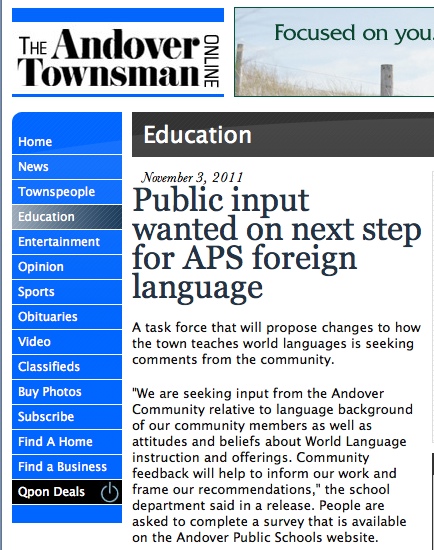
Andover public schools seek public inputThe Andover Public School board in Massachusetts, U.S.A. has established a World Language Task Force, reports the Andover Townsman. The purpose of the task force is to seek input from the community on what languages they would like to see taught in their schools and why. The task force is comprised of teachers, parents, community members, and administrators. The purpose of the task force is to:

Study the K-12 programming model and trends in world language teaching and learning.

Develop goals and strategies for a K-12 World Language program for inclusion in the Andover Public Schools Strategic Plan.

Produce recommendations relative to which one language will be taught on the elementary school level, which two languages will be taught on the middle school level, and which languages will be taught at Andover High School.

The task force is soliciting input from the public through a public online survey developed by the school board. The survey asks respondents to rank the importance of such factors as cultural competence, writing and testing skills in a first language and preparing students for global society. It also asks for input on what languages the board should offer, including popular languages such as Spanish and Chinese, as well as less popular languages such as Hmong, Khmer and Creolo Haitian.

I believe that this is a commendable initiative for a variety of reasons:

  1. Generating dialogue between school boards and the community promotes a culture of open communication. It gives a voice to parents, grandparents and even students about that is important to them. It gives a voice to the community.
  2. In addition to giving a voice to the community, it also seeks to uncover what is important to the community, digging deeper into the values, beliefs and opinions of those who live in the local area. Then, it would assume, the task force would consider these values as part of its criteria when it comes to making its decisions.
  3. It downplays the traditional authoritarian nature of school boards. Instead of propagating the ideas that “school boards know best”, it levels the playing field (at least in terms of the optics) and sends the message that “We’re here to serve you, not dictate to you.” This is a strategy that the Calgary Board of Education would have done well to employ when it arbitrarily decided to cut French programs without engaging the community in any dialogue about it.
  4. It generates community involvement and interest in language programs at the local schools. At a time when cutbacks to language programs, particularly in the United States, are mercilessly targeting world language programs, initiatives such as this will draw importance to language programs. After people have contributed to the discussion and have had some say into the decision-making process they are emotionally and psychologically invested in the outcome and are more likely to support foreign and world language programs in general.

One comment posted on the Andover news article pointed out that the survey is an imperfect tool, since respondents can answer as many times as they like, potentially skewing the results. This is relatively easy to overcome, depending on which survey tool is used. Nevertheless, the concept is brilliant. Opening up discussions about education and in particular, language learning, to the public and ultimately involving the community in the decision making process is innovative, respectful of the community and downright brilliant.

________________

Share this post: U.S. School district asks for public input on world language program http://wp.me/pNAh3-ZV

Update – January 2018 – This blog has had over 1.8 million views thanks to readers like you. If you enjoyed this post, please “like” it or share it on social media. Thanks!

Sarah Elaine Eaton is a faculty member in the Werklund School of Education, University of Calgary, Canada.


How to Use Webinars for Literacy: PD, Programming and Promotion

October 28, 2011

A huge thank you to our participants and speakers today who participated in the online discussion on how to use webinars for professional development, programming and promotion in the literacy field.

Our speakers

Allison Mullin is the manager of communications and marketing at the Ontario Literacy Coalition (OLC), after previously working in the communications departments of Mount Sinai Hospital in Toronto and the City of Calgary. As part of it’s strategy to provide professional development opportunities for those working in the literacy field in Ontario, the OLC has been hosting a webinar series for the past year on a wide variety of topics.

 Courtney Hare is a Financial Literacy Facilitator for the non-profit organization in Calgary called Momentum. She is a certified Training Practitioner and holds an MA in Education from the University of Calgary where she got her start moderating and facilitating E-learning and online presentations. She is now looking for ways to further engage learners who may have barriers to accessing face-to-face workshops or learners who prefer to engage online. She is in the process of establishing the first E-learning module for a Momentum’s program called “StartSmart.”

Laura Godfrey is the Manager of Learning Links Resource Centre in Calgary, where she manages the development and operations of the centre. A graduate of the Southern Alberta Institute of Tecnology’s Library and Information Technology program, LearningLinks is the fifth library she has had a hand in setting up and running.

Each of the speakers is at a different point along the “continuum of development” for webinars. Allison heads up a successful webinar series that regularly has sessions filled over capacity. Courtney is beginning to prepare webinars for her organization. Laura is just starting to ask questions about webinars for literacy.

Laura provided a number of questions to guide today’s discussion:

  1. We’re a non-profit. How do we cover the costs of doing a webinar?
  2. Do we have to buy special software?
  3. How do we pick a topic to cover in a webinar?
  4. How long does it need to be?
  5. Can we record it and how can we make it available to others later?
  6. How tech savvy do you need to be in order to do this?
  7. Do you need to hire a speaker or can anyone do the speakers job?
  8. Who else is doing webinars in the literacy and adult education field?
  9. Why should we do this?
  10. Are there chances to collaborate with other groups?

Check out the webinar recording

In addition to our pre-arranged speakers, kudos also go to Dr. Jenny Horsman and Dr. Peggy Albers, both of whom shared insights from their own experiences about doing webinars in the literacy field.

Resources that were shared by participants today

Global Conversations in Literacy Research – A webinar series presented by Dr. Peggy Albers and hosted at Georgia State University

Camtasia – a video-capture software

RGK Foundation – Learning grants (USA only)

MacArthur Foundation Granting agency (USA only)

Techsoup – Technology resources for non-profits

Ontario Literacy Coalition Spotlight on Learning – OLC’s archived webinars

Learning and Violence – This site contains resources and archived webinars

Center for Interactive Learning and Collaboration (CILC) – Clearing house of e-learning, video conferencing and webinars for K-12, educator PD and community education

Stock Exchange – Free stock photography site (requires registration)

Nancy Duarte – Best practices and resources for slide presentations

Twitter handles of some of today’s participants

@englishwob

@ontarioliteracy

@LLRCLibrary

@LandVdotnet

I enjoyed the resources and information that everyone shared today. It was an open group who was willing to give ideas and share what they knew.

For me, this was one of the most technically challenging webinars I’ve done in a while. For some reason, I couldn’t hear participants while my own mic was turned on, which meant that I ended up “talking over” people without even knowing that they were trying to speak. My apologies for the rudeness! I can assure it that it was not at all intentional.

I am so grateful to everyone for their participation today. YOU made it worthwhile!

___________

Share this post: How to Use Webinars for Literacy: PD, Programming and Promotion http://wp.me/pNAh3-Z6

Update – January 2018 – This blog has had over 1.8 million views thanks to readers like you. If you enjoyed this post, please “like” it or share it on social media. Thanks!

Sarah Elaine Eaton is a faculty member in the Werklund School of Education, University of Calgary, Canada.