Appreciative Inquiry: A brief overview

May 22, 2011

In research and in leadership, it’s good to know what your biases and values are. In my own work, I take an asset-based approach, finding the strengths and building on them. I’ve grounded much of my professional, leadership and research work on this philosophy, which is grounded in Appreciative Inquiry (AI). The other day, someone asked me what AI is, so I’m posting a brief overview that I wrote up for another project about a year ago. It’s a “quick and dirty” overview, with some references:

Appreciative Inquiry: An Overview

hands hope sunAppreciative Inquiry (AI) is an approach used in academia, business and the not-for-profit sectors. The main pioneer of  AI is widely recognized to be David Cooperrider.

Traditional methods of assessing and evaluating a situation and then proposing solutions are based on a deficiency model. Traditional methods ask questions such as “What are the problems?”, “What’s wrong?” or “What needs to be fixed?” Sometimes such questions are sugar-coated in trendy jargon. Instead of asking “What’s the problem?”, which can seem a little harsh, the question may be couched in terms of ‘challenges’: “What are the challenges?” Regardless of whether the question is asked harshly or softened with less antagonistic language, the model remains as one of deficiency. The thinking behind the questions assumes that there is something wrong, that something needs to be ‘fixed’ or ‘solved’. Business people (especially consultants) like to say they ‘can provide solutions’. The underlying belief is that there is something wrong and it needs to be fixed.

Appreciative Inquiry flips all that on its head. It is an asset-based approach. It starts with the belief that every organization, and every person in that organization, has something good about it. Each person has something valuable to contribute and the organization itself has merit of some kind. It asks questions like “What’s working?”, “What’s good about what you are currently doing?”

AI seeks to uncover the best of what an organization is currently doing, using interviews with its members. The interviews challenge participants to examine and discuss what is good about their current situation and explore what works well within the organization. This approach then utilizes the data collected from those interviews to construct a plan for enriching the organization by building on what is already working and what is already considered to be successful.

An initial reaction for some people is to balk when they hear questions like “What’s working?” An retaliatory answer may follow of “Nothing is working! It’s all a mess!”. People are so used to working within a deficiency framework, that it is almost like the brain can not process questions that are rooted in an asset-based approach. It may take some time for people to come up with an answer to questions based on an AI approach. This is because AI challenges us to shift our paradigm from deficiency thinking to asset thinking. Changing paradigms takes some time, but the results can be worth it.

Appreciative inquiry can be particularly useful in organizations where individuals or group of people are polarized over major issues. Rather than exacerbating the polarization between or among the parties, it assumes that a core of positive traits exist which can be highlighted and expanded up on to create even more success in an organization.

Bibliography

Cooperrider, D. L. (2007). Business as an agent of world benefit: Awe is what moves us forward.   Retrieved February 21, 2008, from http://appreciativeinquiry.case.edu/practice/executiveDetail.cfm?coid=10419

Cooperrider, D. L., & Whitney, D. (2008). A positive revolution in change: Appreciative inquiry.   Retrieved March 27, 2008, 2008, from http://appreciativeinquiry.case.edu/uploads/whatisai.pdf

Cooperrider, D. L., Whitney, D., & Stavros, J. M. (2003). Appreciative inquiry handbook. Bedford Heights, OH: Lakeshore Publishers.

Eliot, C. (1999). Locating the Energy for Change: An Introduction to Appreciative Inquiry. Winnipeg: International Institute for Sustainable Development / Insitut International du Developpment Durable.

Faure, M. (2006). Problem solving was never this easy: Transformational change through appreciative inquiry. Performance Improvement, 45(9), 22-31.
Murrell, K., L. (1999). International and intellectual roots of appreciative inquiry. Organization Development Journal, 17(3), 49-61.

Download this document from Scribd:

View this document on Scribd

__________________

Share this post: Appreciative Inquiry: A brief overview http://wp.me/pNAh3-FR

Update – January 2018 – This blog has had over 1.8 million views thanks to readers like you. If you enjoyed this post, please “like” it or share it on social media. Thanks!

Sarah Elaine Eaton is a faculty member in the Werklund School of Education, University of Calgary, Canada.


Panel Speaker at Metropolis 2011 – Vancouver, British Columbia

March 14, 2011

If you’re in Vancouver, BC, come and join us at the Metropolis 2011: Bringing the World to Canada, March 23-26 at the Sheraton Vancouver Wall Centre.

This National Metropolis Conference focuses on “the role of immigration in connecting Canada with the rest of the world.” Organizers are expecting over 1000 participants from Canada and abroad. The main conference website says:

A recent report by Statistics Canada projects that, by 2031, at least one in four Canadians will have been born in another country. With this remarkable feature of our society as a backdrop, the conference will discuss the scale and nature of Canada’s immigration system and the policies and practices that have emerged to foster the socio-economic inclusion of new Canadians. Immigration and emigration are transforming the populations of most countries, and in this conference we will consider the place of Canada in this global process by asking speakers from elsewhere in the world to explain the migration and integration dynamics of their regions, thereby allowing us to understand better the effects of these trends on Canada.

I’m delighted to be speaking on a panel on Saturday, March 26. Here are the details:

E4 WORKSHOP | ATELIER (English | Anglais) Junior Ballroom D – Level 3 – North Tower | Niveau 3 – Tour Nord

Family Literacy and the New Canadian

This Workshop will bring together a panel of language experts from across Canada that will outline the importance and value of heritage / international languages and illustrate how schools, academics, community organizations and government policies can assist in maintaining and developing the multiple literacies of all Canadians.

Organizer | Organisateur
Bernard Bouska, Canadian Languages Association
Khatoune Temisjian, Québec Heritage Languages Association / Association québécoise des langues d’origine

Participants

Sarah Eaton, University of Calgary
Formal, Non-Formal and Informal Learning: The Case of Literacy, Essential Skills and Language Learning in Canada

Maria Makrakis, TESOL International and International Languages Educators’ Association (ILEA), Ontario
Language and Literacy for New Canadian Families

Constantine Ioannou, Government of Ontario
Ontario Schools and Communities Can Reflect the Languages of our Families

Khatoune Temisjian, Québec Heritage Languages Association / Association québécoise des langues d’origine
Literacy and Heritage/international Languages in Quebec: An Overview

Michael Embaie, Southern Alberta Heritage Languages Association (SAHLA)
Successful Implementation of Heritage / International Language Programs in Canada: Selected Strategies and Case-Studies

Chair | Modérateur
Marisa Romilly, Society For The Advancement of International Languages (SAIL British Columbia)

Discussant | Commentateur
Bernard Bouska, Canadian Languages Association

If you’re planning to attend the conference, please come and join us at the session!

_________________________

Share this post: Panel Speaker at the Metropolis Conference 2011 – Vancouver, British Columbia http://wp.me/pNAh3-A4

Update – January 2018 – This blog has had over 1.8 million views thanks to readers like you. If you enjoyed this post, please “like” it or share it on social media. Thanks!

Sarah Elaine Eaton is a faculty member in the Werklund School of Education, University of Calgary, Canada.


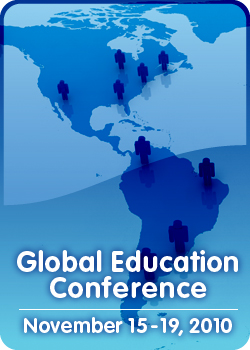
Global Education Conference

November 16, 2010

The Global Education Conference, November 15-19, 2010 brings together educators from over 62 countries. Over 300 general sessions are being held, all on line, during a variety of time zones. There is no formal registration required for the conference, as all the sessions will be open and public, broadcast live using the Elluminate platform, and available in recorded formats afterward.

Presenters are sharing their slides on the conference’s Slideshare site.

Today I gave a session on Global Trends in Language Learning in the 21st Century. I’ve posted my slides there, too. Here’s a quick link to them, too.

__________________

Share or Tweet this: Global Education Conference http://wp.me/pNAh3-nA

Update – January 2018 – This blog has had over 1.8 million views thanks to readers like you. If you enjoyed this post, please “like” it or share it on social media. Thanks!

Sarah Elaine Eaton is a faculty member in the Werklund School of Education, University of Calgary, Canada.


What is “Globish”? Why should we care?

November 15, 2010

The search term “Globish” returns over 100,000 hits on Google. What is it and why should language teachers care?

The term itself is a combination of “global” and “English”.

One site describes Globish as a simplified, yet standard version of English, based on a core vocabulary of 1500 words. The word itself and the concept behind it are the brain child of Jean-Paul Nerriere, a business man who speaks English, and his own version of it, Globish, as additional languages.

The premise? That if everyone in the world who wanted to speak English learned this simplified form of it, that they’d all learn much faster and be more effective.

This is a seductive concept… Fewer vocabulary words theoretically means less work. Less work always sounds attractive to language learners desperate to gain fluency.

The work of Dr. Hetty Roessingh, a senior researcher at the University of Calgary, reveals that by Grade 1, students who are native English speakers normally have a vocabulary of 5000 words. By grade 12, that number has increased to 80,000 to 100,000 words. She argues that we should be trying to enrich the vocabulary of English as a Second Language (ESL) and English as a Foreign Language (EFL) students, not whittle it down.

What do you think? Is 1500 words enough to be considered a complete understanding of a language?

____________

Share or Tweet this post: What is “Globish”? Why should we care? http://wp.me/pNAh3-nu

Update – January 2018 – This blog has had over 1.8 million views thanks to readers like you. If you enjoyed this post, please “like” it or share it on social media. Thanks!

Sarah Elaine Eaton is a faculty member in the Werklund School of Education, University of Calgary, Canada.


OECD Report: Doing more with less

September 3, 2010

Check out this new report OECD that will be presented at the upcoming OECD conference in Paris:

Higher Education in a World Changed Utterly: Doing More with Less – Discussion Paper

by Mary-Louise Kearney and Richard Yelland

OECD/IMHE Conference, 13 – 15 September 2010, Paris, France

This is an insightful and timely paper that covers issues of post-secondary education during an economic recovery, post-crisis world.

_________________________________

Share this post: OECD Report: Doing more with less https://wp.me/pNAh3-j1

Update – January 2018 – This blog has had over 1.8 million views thanks to readers like you. If you enjoyed this post, please “like” it or share it on social media. Thanks!

Sarah Elaine Eaton is a faculty member in the Werklund School of Education, University of Calgary, Canada.