What’s the difference between a manuscript and an article?

May 8, 2017

One of the questions students in a graduate course I teach called “Writing Educational Research” is: What is the difference between a manuscript and an article?

The simplest way to understand it is this:

Manuscript = Written paper pre-publication

Article = Written paper that has been published

Now, scholars love to debate and I’m quite sure that there are academics out there who would delight in a robust debate on this topic. I agree that my definition may be simplistic. My purpose here is not to be reductionist, but rather to demystify the publication process for graduate students and novice researchers.

What's the difference between a manuscript and an aritcle

Examples of manuscripts include:

  • Drafts
  • Writing-in-progress
  • Work submitted to a publisher that is under review or not yet published
  • Term papers or elements of your thesis that you are crafting for submission to a journal.

The term “article” usually refers to work published in:

  • Newsletters
  • Professional publications
  • Edited journals
  • Peer-reviewed scholarly or scientific journals

If you are looking at publishing your work in the proceedings of a conference, refer to it as a manuscript until the proceedings have been released.

There can be a delay between when your work is accepted for publication and when it actually appears in print. During this phase, you can call your work a “pre-publication article” or an “article in press”. At this point, you can call it an article because it has been accepted for publication.

Graduate students and novice researchers and scholars present themselves as uninformed and inexperienced when they run around referring to term papers and drafts of their work as “articles”, when the work has not yet been published. You will present yourself as more humble and knowledgeable about the publication process when you refer to your own work as a manuscript when it is in the pre-publication phase.

Related posts:

___________________________________________________

Share this post: What’s the difference between a manuscript and an article? http://wp.me/pNAh3-1SV

This blog has had over 3.6 million views thanks to readers like you. If you enjoyed this post, please “like” it or share it on social media. Thanks!

Sarah Elaine Eaton is a faculty member in the Werklund School of Education, University of Calgary, Canada.


How to develop your Knowledge Mobilization Plan

March 8, 2017

This week in one of my courses, I’m working with doctoral students to help them understand and figure out how to develop a Knowledge Mobilization Plan (KMP) for their research projects. The KMP is a required element of their project this term.

Here are some resources I shared to help them understand what KMPs are and how to build one:

https://research.usask.ca/documents/Knowledge_Mobilization.pdf

http://www.oise.utoronto.ca/research/UserFiles/File/Amanda%20Cooper%20Building%20KM%20Plans%20UT%20Final%20Post%20Version.pdf

https://www.edu.uwo.ca/research/documents/Thinking_About_Knowledge_Mobilization_Plans.pdf

http://www.sshrc-crsh.gc.ca/funding-financement/policies-politiques/knowledge_mobilisation-mobilisation_des_connaissances-eng.aspx

http://www.slideshare.net/sreibling/how-to-write-a-knowledge-mobilization-plan

https://www.mta.ca/uploadedFiles/Community/Research_and_creative/Research_Office/Mount_Allison_Connects/Institute_events/Building%20a%20Knowledge%20Mobilization%20Strategy.pdf

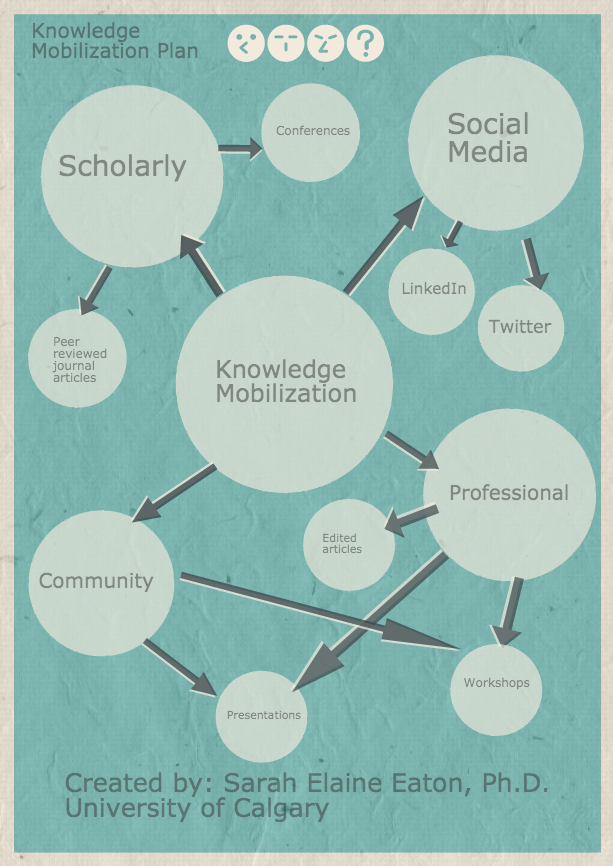
I also shared my approach to knowledge mobilization for my own research. I use a multi-dimensional approach that includes four different audiences:

  1. Academic – Academic (peer-reviewed) articles, academic conferences
  2. Professional – Professional journal articles (edited); Professional reports; professional conferences (e.g. teachers’ conventions); professional development workshops
  3. Social media – My blog Twitter (@DrSarahEaton); LinkedIn; Research Gate & Academia.edu. (Note: Those last two are are like LinkedIn, but directed towards those working in research).
  4.  Community – This can include public presentations or workshops. The key is to tailor these to a broad general audience.

I am to get my work out to as many different audiences as possible and to create a digital footprint for the work, so that if someone comes across it years down the road and they are interested long after I have moved on to new projects, they can still find out about the project.

I also look for ways to link the “products” or “outputs” of my projects. For example, I just led a project on signature pedagogies for e-learning in Higher education. I had the report archived on the University’s digital repository, so the citation looks like this:

Eaton, S. E., Brown, B., Schroeder, M., Lock, J. & Jacobsen, M. (2017). Signature pedagogies for e-learning in higher education and beyond. Calgary: University of Calgary. Retrieved from http://hdl.handle.net/1880/51848

I then blogged about the report on this blog: Signature pedagogies for e-learning in higher education and beyond http://wp.me/pNAh3-1MP

I then Tweeted about the report, which then got Re-tweeted:

Brown RT.jpg

I also posted or submitted a copy of the report at:

  • Research Gate:
  • Academia.edu
  • LinkedIn.
  • ERIC (When there is a full report available).

Basically, I try to get the word out in any many ways as possible.

All this, by the way, took less than two hours to do. I have had these accounts set up for some years now and this has been a fairly consistent process for me when I want to mobilize knowledge about a project.

Here is an infographic I created to help you visualize how you might develop your own KMP. Not all the elements I talked about in this post fit onto the infographic, so don’t think of the visual as exhaustive:KMP.jpg

____________________________________________________

Share this post: How to develop your Knowledge Mobilization Plan https://wp.me/pNAh3-1N2

This blog has had over 1.8 million views thanks to readers like you. If you enjoyed this post, please “like” it or share it on social media. Thanks!

Sarah Elaine Eaton is a faculty member in the Werklund School of Education, University of Calgary, Canada.


Signature pedagogies for e-learning in higher education and beyond

March 6, 2017

http://hdl.handle.net/1880/51848

This report explores the notion of signature pedagogies within the field of e-learning for higher education. We build on previous work that examined signature pedagogies in education, linking the concepts of signature pedagogies, the profession of education and e-learning as a means to help educators develop their practice and understanding of the profession.

Background

In November 2016, approximately thirty scholars, practitioners, industry leaders and government officials assembled at The White House for the “Technology in English” event, which was a collaborative effort between The White House Office of Global Engagement and the U.S. Department of State, Bureau of Educational and Cultural Affairs, Office of English Language Programs. The event was part of the inter-agency English for All initiative, announced by President Obama earlier in 2016 (United States Department of State, 2016). The purpose of the event was to gather together individuals with combined expertise in educational technology and English language learning and teaching. Sarah Elaine Eaton, one of the authors of this report, was among those invited to take part in The White House event.

One outcome of the meeting was a commitment to develop a prototype or resource that would serve as an Open Educational Resource (OER), not only for participants of programs sponsored by the U.S Department of State, and educators generally. The project is to be presented at the TESOL 2017 International Convention and English Language Expo in Seattle, Washington State.

In addition, experts were invited to develop and contribute additional resources that would benefit educators in their professional development. This report was prepared as an additional Open Educational Resource for use by those interested in developing their knowledge of signature pedagogies for e-learning in education.

Here is a citation for the report, which you can download for free online:

Eaton, S. E., Brown, B., Schroeder, M., Lock, J. & Jacobsen, M. (2017). Signature pedagogies for e-learning in higher education and beyond. Calgary: University of Calgary. Retrieved from http://hdl.handle.net/1880/51848

____________________________________________________

Share this post: Signature pedagogies for e-learning in higher education and beyond http://wp.me/pNAh3-1MP

This blog has had over 1.8 million views thanks to readers like you. If you enjoyed this post, please “like” it or share it on social media. Thanks!

Sarah Elaine Eaton is a faculty member in the Werklund School of Education, University of Calgary, Canada.


EDER 708.01 Collaboratory of Practice II: Post-Secondary Leadership

February 15, 2017

U of C logo - 2015I usually post copies of my course outlines here on the blog, both for current students and for future ones. I realized that I forgot to post this earlier, so I am adding it now. This winter I have the pleasure to work with an awesome cohort of students specializing in post-secondary leadership. Here’s what the course is about:

Course Description:

Collaboratories of Practice represent a fusion of two important developments in contemporary research: communities of practice and collaboratories.  A collaboratory is a new-networked organizational form involving structured experiences of authentic, real-world practice that serve as sources of active inquiry and professional learning.  Using a studio or “collaborative laboratory” learning design, this course facilitates the application of knowledge in real world settings and to investigate and learn from inquiry in the field.

The goal of this second collaboratory is to promote critical inquiry that addresses high-leverage problems of practice related to teaching, learning, and leading in order that service and collaboration among colleagues and the professional communities can be enhanced.  It will provide students the opportunity to critically apply theoretical and technical knowledge, to develop and refine professional skills, and to integrate theoretical, research, and practical knowledge through a focus on data collection and analysis.

Learner Outcomes:

By the conclusion of this course each learner will:

  1. evaluate and select a research methodology to address the research questions.
  1. determine a setting, sample and data sources applicable to the research problem and purpose.
  2. develop methods of data collection and data analysis to address the research problem and purpose within the ethical requirements of the Research Ethics Board.
  3. write a draft Research Methods and Methodology section for an EdD Research Proposal.

Throughout this course each learner will:

  1. contribute to an online scholarly community;
  2. provide constructive feedback on colleagues’ work in collaboratory (studio) groups and incorporate feedback into one’s own work; and
  3. develop and enhance scholarly writing skills through ongoing cycles of feedback from peers, the instructor and the supervisor.

Here’s a copy of the course outline: eder_708-01_l01_eaton_w2017-final-approved

____________________________________________________

Share this post: Course outline EDER 708 – CoLaboratory of Practice https://goo.gl/m5DH99

This blog has had over 1.6 million views thanks to readers like you. If you enjoyed this post, please “like” it or share it on social media. Thanks!

Sarah Elaine Eaton is a faculty member in the Werklund School of Education, University of Calgary, Canada.


Focus Groups: Training Manual for Research Assistants

February 13, 2017

ra-training-manual-cover-001As the research project on academic integrity and plagiarism gets underway, I prepared a training manual for the research assistants I am working with.

This manual is an open source document and I am making it freely available as a .pdf for other scholars and research assistants.

Here is the link to the manual: ra-training-manual-focus-groups-2017-02-10

Here is the complete citation for the manual:

Eaton, S. E. (2017). Research assistant training manual: Focus groups. Calgary: University of Calgary. Retrieved from http://hdl.handle.net/1880/51811

The research team is grateful to the Office of Teaching and Learning, Werklund School of Education, University of Calgary, who awarded funding for this project under the Scholarship of Teaching and Learning Grant, 2016-2017.

I have to give a special shoutout of appreciation to Yvonne Kjorlien, Research Facilitator, Werklund School of Education, and Benedict “Kojo” Otoo, Research Assistant, for their review of drafts of this manual and feedback for improvement.

____________________________________________________

Share this post: Focus groups: Training Manual for Research Assistants http://wp.me/pNAh3-1Me

This blog has had over 1.6 million views thanks to readers like you. If you enjoyed this post, please “like” it or share it on social media. Thanks!

Sarah Elaine Eaton is a faculty member in the Werklund School of Education, University of Calgary, Canada.