10 Free e-learning tools and tech programs for language and literacy learning

June 2, 2011

A few months ago I did a post sharing my favorite sites to create your own crossword puzzles. I’ve found some more free tools and tech downloads for learning and teaching second or foreign languages. Many of them might also be useful in ELL adult literacy programs.

CAPL (Culturally Authentic Pictoral Lexicon) This is a brilliant site with tons of free, culturally authentic images that teachers and students can use for educational purposes.

Eclipse – A free crossword maker in English.

Forvo – A multilingual pronunciation library, with entries in dozens of different languages.

Hell0 World – A language learning site for 15 different languages that includes games, songs and activities.

Hot Potatoes – Freeware authoring tool to create language learning activities in a variety of languages.

Lyrics training – A fun way to learn songs in foreign languages.

Memerise – A multi-lingual vocabulary-building game.

Selingua – columns – A Tetris-style game for learning French, German, Spanish or Swedish.

Sephonics – Learn the English and International Phonetic Alphabet.

Wordsteps – Helps you learn vocabulary in a new language.

__________________________

Share this post: 10 Free e-learning tools and tech programs for language and literacy learning https://wp.me/pNAh3-Hi

Update – January 2018 – This blog has had over 1.8 million views thanks to readers like you. If you enjoyed this post, please “like” it or share it on social media. Thanks!

Sarah Elaine Eaton is a faculty member in the Werklund School of Education, University of Calgary, Canada.


How to Market Your Literacy or Language Program (Free 5-part video series)

May 30, 2011

I’m happy to share this 5-part video series that was recorded live at the 2010 Spotlight on Learning Conference, held in Toronto, Canada by the Ontario Literacy Coalition.

I did a one-hour presentation on how to promote literacy and language programs. The conference organizers videotaped the session and are sharing it publicly. You can consider this a one-hour crash course in marketing:

Low-cost High-Impact Marketing for Literacy Programs – Part 1

Low-cost High-Impact Marketing for Literacy Programs – Part 2

Low-cost High-Impact Marketing for Literacy Programs – Part 3

Low-cost High-Impact Marketing for Literacy Programs – Part 4

Low-cost High-Impact Marketing for Literacy Programs – Part 5

Related posts:

______________

Share this post: How to Market Your Literacy or Language Program (Free 5-part video series) http://wp.me/pNAh3-Gq

Update – January 2018 – This blog has had over 1.8 million views thanks to readers like you. If you enjoyed this post, please “like” it or share it on social media. Thanks!

Sarah Elaine Eaton is a faculty member in the Werklund School of Education, University of Calgary, Canada.


My Calgary Includes Both Official Languages in Schools

April 27, 2011

School girl on stairsI was astounded when I saw the headline tweet from the Calgary Herald: “French classes no longer mandatory in Calgary schools“. I read the article and astonishment turned to dismay.

It used to be that in Calgary, children in grades four to six had to learn French, Canada’s other official language. It seems that the Calgary Board of Education has now made it the choice of each individual school whether or not they choose to teach French to their students. The school may make its decision based on demand and interest. This decision comes just days after another announcement that the school board will cut hundreds of teaching jobs this year.

Is this a coincidence? I hardly think so.

While there is ample research that demonstrates the benefits of language learning on overall cognitive development, including math and problem solving skills, our local public school board has effectively said “if there’s no demand, there’s no reason to have these classes.” Just because I personally had no desire to take math in school, that didn’t make it optional.

Canada is a bilingual country. While many of us may never achieve full bilingual fluency, leaving cultural and linguistic exposure up to “school choice” and “student choice” won’t help us build a twenty-first century global citizenry. Nor will it help those children later in life if they ever want a job with the federal government. A job with the feds requires functional fluency… and our students won’t even get exposure to our country’s other official language.

The idea of making language learning choice-driven is akin to making it market driven. I’m all for marketing of language programs and promoting second language learning. I literally did a PhD thesis on marketing of language programs. In fact, I’m not even a huge proponent of mandatory language learning.

If it was really about “choice” or “market demand”, the board could have hired a market research firm to determine what classes would be among students’ first choice… Would the sciences be among most students’ favorites? Or phys ed? The answer is… no one knows. Because no one in Calgary has actually done any research to find out what students want now… and what skills they will need for their jobs later in life.

But this isn’t really about market demand or choice is it? This is about finding ways to cut programs, cut costs, cut jobs. It’s about balancing a budget in the short term… and doing it slyly and indirectly by making mandatory classes optional. No one’s thinking about making sciences optional here… just our country’s other official language.

And it’s gob-smackingly short sighted.

We don’t ask children if they’d like the choice to study math or English or science when they’re in grades four to six. It’s part of our job as responsible adults, parents and community leaders to provide them opportunities for learning that will serve as the foundation for more learning into the high school years… and later as the foundation for skills that will get them jobs and provide them with critical thinking skills as they then become the guardians of the next generation. It’s our job to get them excited about learning, keep their minds open and their motivation levels soaring so they engage in learning in new and innovative ways.

In Calgary, we seem to have forgotten that. Mon dieu…. Père, pardonne-leur car ils ne savent pas ce qu’ils font.

______________________

Share this post: My Calgary Includes Both Official Languages in Schools http://wp.me/pNAh3-DJ

Update – January 2018 – This blog has had over 1.8 million views thanks to readers like you. If you enjoyed this post, please “like” it or share it on social media. Thanks!

Sarah Elaine Eaton is a faculty member in the Werklund School of Education, University of Calgary, Canada.


Lifelong Language Learning: Benefits for 21st Century Global Citizens

April 1, 2011

University of CalgaryApril 2 – 9, 2001 is International Adult Learners’ Week. The Language Research Centre, in conjunction with Alberta Advanced Education and Technology and UNESCO, is hosting a panel discussion on the importance of lifelong language learning, mutilingualism and multiculturalism.

This panel brings together thought leaders from a variety of organizations in Calgary who are experts on language learning, multilingualism and multiculturalism. They will share their views on the importance of language learning in the 21st century and its relevance to us as Calgarians, Canadians and global citizens.

Expert panelists include:

  • Mr. Wayne Cao, MLA Calgary Fort (to be confirmed)
  • Dr. Mary O’Brien, Director, Language Research Centre
  • Dr. Rahat Naqvi, Associate Director, Language Research Centre
  • Dr. Jürgen Meisel, Distinguished Fellow, Language Research Centre
  • Mr. Michael Gretton, Southern Alberta Heritages Language Association (SAHLA)
  • Ms. Shaheen Murji, Mount Royal University, International Education and Past President, Alberta Teachers of English as a Second Language

    Wayne Cao, MLA, Calgary Fort and Dr. Sarah Eaton

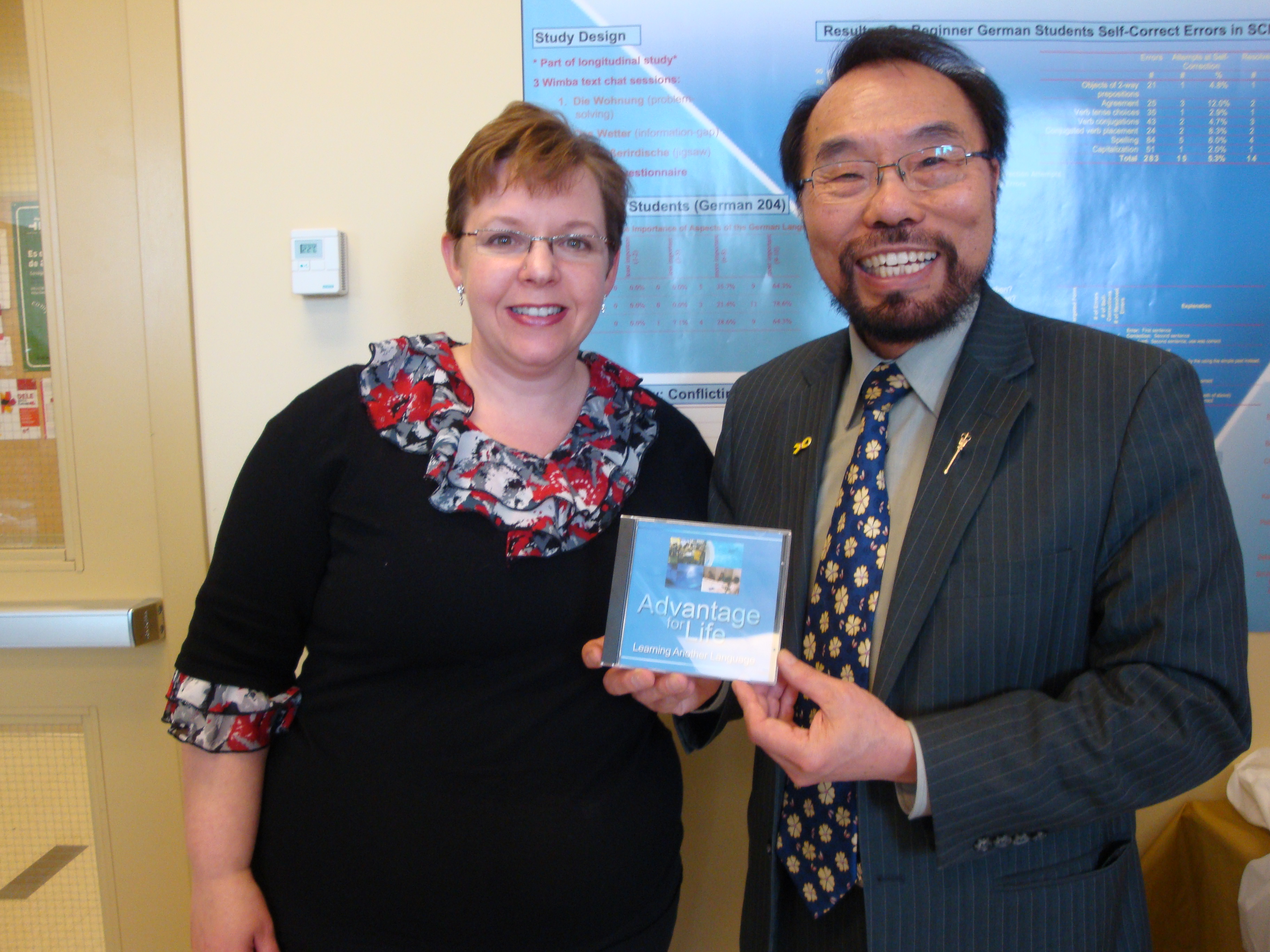
    Mr. Wayne Cao, MLA, Calgary Fort with me, holding the “Advantage for Life” CD produced by the Language Research Centre. This photo was taken at the IALW event.

Student Discussant: Ms. Jacqueline Warrell, PhD Candidate, Graduate Division of Educational Research

Event host: Dr. Sarah Eaton, Research Associate, Language Research Centre

The Institute for Innovation in Second Language Education (IISLE) will join us via videoconference from Edmonton.

For more information, visit these websites:

Alberta Advanced Education and Technology (AAET)
Language Research Centre

View this document on Scribd

_________________

Share this post: Lifelong Language Learning: Benefits for 21st Century Global Citizens http://wp.me/pNAh3-Bv

Update – January 2018 – This blog has had over 1.8 million views thanks to readers like you. If you enjoyed this post, please “like” it or share it on social media. Thanks!

Sarah Elaine Eaton is a faculty member in the Werklund School of Education, University of Calgary, Canada.


Notos Journal: Call for Submissions

March 17, 2011

Do you have research, expertise or classroom best practices on language learning and intercultural education to share? Does your work have a focus on Alberta? If yes, listen up!

Recently I was invited to take on the position of Guest Editor for Notos, the official journal of the Second Languages and Intercultural Council (SLIC) of the Alberta Teachers’ Association (ATA).

Notos is a peer reviewed scholarly journal that links the academy with the classroom. The contents include an eclectic range of conventional articles, reviews and creative writing.

The Journal invites manuscripts for its upcoming issue. Of particular interest are submissions that:

  • highlight the issues of culture and second languages in Alberta;
  • enhance the knowledge, skills and understanding of teachers in the areas of second languages and culture;
  • discuss existing practices, programs and resources;
  • showcase research being done in Alberta on second languages, language pedagogy, innovation in second languages and intercultural education; and
  • offer advice and expertise to both in-service and pre-service language teachers in the province of Alberta.

Submissions should be between 2500 and 10,000 words. In keeping with the mandate of the Council, articles appear in several languages (preferrably those languages taught in Alberta schools). All submissions are reviewed by the Editorial board, who reserve the right to select those submissions they feel are the most appropriate for the journal.

Deadline for Winter 2011 submissions is April 15, 2011.

Direct queries and manuscripts to:
Sarah Elaine Eaton, PhD, Guest Editor, Notos
University of Calgary, Language Research Centre
seaton (at) ucalgary.ca

Please help me share this call for submissions with language professionals all over Alberta. Forward this post, tweet it or download a .pdf copy of the call for submissions from Scribd and share it around!

Thanks!

View this document on Scribd

_______________
Share this post: Notos Journal: Call for Submissions http://wp.me/pNAh3-Am