A Formula for Pricing Educational and Training Programs

January 21, 2011

Many people ask me how to price their programs. There are a number of ways to approach this. One simple, straightforward formula for pricing educational programs:

Work out your costs. Double the total. That’s the price you charge for your program.

This is just one method used by “big institutions”. It ensures that you really have covered all your costs (including the ones that you sometimes forget to factor in such as insurance, etc.) Surpluses go back into your organization for future programming and capacity building.

When you calculate your costs, here is a partial checklist of items to consider:

Instructor salary – How much are you paying your instructor per hour? Remember to add in benefits, vacation pay and any prep time you pay.

Management and administrative support – How much of your time as a manager is put into each course? Ask your coordinators or admin staff to calculate how much time they spend prepping for and working on a given course. Multiply that by their hourly wage. That’s your cost for admin support for the course.

Rent – If you lease a space or pay rent, work out how much your space will cost you for each hour of your course. Take the square footage of your classroom and then add in all public areas accessed by students and staff during the course including the reception area, bathrooms and lunch room. What do those spaces cost you per hour? Multiply that by the number of hours in your course. That’s an approximate cost for your rent.

Utilities – What do you pay for phone, Internet, heat, hot water, etc.? If you work in a large institution it may not be easy to work out these numbers. Figure out an estimate though. You’re still paying for these things, even if it is only indirectly.

Insurance – What insurance do you cover for your premises (fire, theft, etc.) and for your staff (liability, workers’ compensation, etc.) – Although the amount may be small, allot a portion of these costs to each course. Without them, you can’t run your programs.

In my experience, the first time managers figure out their real costs to run a course, they are surprised. They want to go back and check the numbers. “That can’t be right…” they say. In most cases, the number is right. As educators, we often underestimate our real costs to run programs. Become aware of your actual costs. When you double them to arrive at a price for your programs, you are becoming fiscally responsible by making sure there’s money left in the pot to keep your programs and your organization sustainable over the long term. You’ll have some extra in case of emergencies (and there are always emergencies), to subsidize a course you believe in strongly and enough to stay afloat when the economy tanks.

__________

Share or Tweet this post: A Formula for Pricing Educational and Training Programs http://wp.me/pNAh3-sb

Update – January 2018 – This blog has had over 1.8 million views thanks to readers like you. If you enjoyed this post, please “like” it or share it on social media. Thanks!

Sarah Elaine Eaton is a faculty member in the Werklund School of Education, University of Calgary, Canada.


How curiosity spices up learning

January 20, 2011

While “curiosity may have killed the cat”, as the saying goes, it certainly livens up our learning. Ever thought of how anxiety blocks our desire to learn and curiosity heightens it?

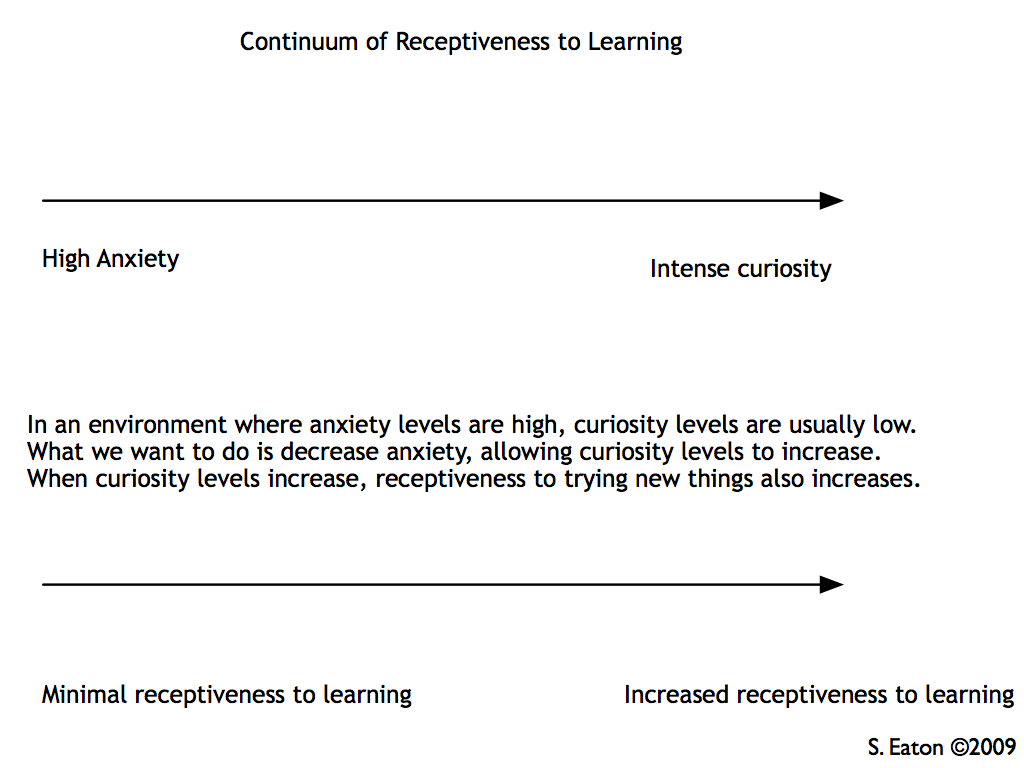
Think of anxiety and curiosity as being at two ends of a continuum.

When anxiety levels are high, our receptiveness to learning new things is low. We resist because we are full of panic and doubt.

At the other end of the spectrum from anxiety is intense curiosity. When curiosity levels are high, we are incredibly receptive to learning new things because we are motivated by our own hunger to learn.

Here’s a diagram to show what I mean.

Continuum of Receptiveness to Learning

This works whether you’re dealing with learners or members of your own staff. A student who is curious learns more. A staff member who is highly anxious when it comes to technology is unlikely to embrace Web 2.0 or mobile technologies for teaching.

Keep providing strategies to decrease anxiety. At the same time, encourage their natural curiosity and you’ll keep people learning. It’s that simple.

____________________

Share or Tweet this Post: How curiosity spices up learning http://wp.me/pNAh3-s4

Update – January 2018 – This blog has had over 1.8 million views thanks to readers like you. If you enjoyed this post, please “like” it or share it on social media. Thanks!

Sarah Elaine Eaton is a faculty member in the Werklund School of Education, University of Calgary, Canada.


Cold-Handed Collaboration: Why it Worked

January 17, 2011

When I talk about “cold-handed collaboration”, I mean it literally, not metaphorically. I live in a condominium townhouse in Calgary, Alberta. I’ve been on the board of directors for our condo association for three years now. I love working with other owners who live in our community on projects to improve the complex.

In Calgary there is a municipal recycling program, which means that the City will collect recycling from homes, just as it picks up garbage. The problem is that right now, that program does not extend to condominiums. We pay for private garbage pick-up in our complex, just as all condominiums in the city do.

Last year, we decided to bring recycling to our condo complex. We started with a pilot project. Four of the board members (including me) tested out the services of Harvest Recycling for a couple of months. At our regular board meetings we reported back with feedback. We were pleased with the results and decided to extend the program to the entire complex.

We arranged with Harvest Recycling to deliver bins to our complex, which would be paid for by the condominium corporation. Our plan was to deliver one bin to each house hold. Since the bins were paid for out of the “common pot” so to speak, one board member had the idea of writing the unit number of each house on the bins. We agreed this was a good idea.

We sent letters to every unit, with details of the new program and how to participate.

We arranged with the company to purchase and drop off the bins for us. We agreed to make time in our schedules to deliver the bins to each unit, writing the house number on each bin as we went along. One board member bought markers to tag the bins.

The bins arrived on Saturday. For those of you who don’t live in Calgary, we’ve been having a bit of a cold snap lately. On Saturday, the temperature was -23 C (that’s -9 Farenheit). Once you factored in the wind chill, it felt like -30C (that’s -22 Farenheit).

Jan 15 2011 weather

The truck arrived with the big blue bins. Not only did they need to be delivered, they needed to be assembled. The lids came separately from the bins. We had to snap a lid on to each bin, deliver it to a unit and tag the bin with the unit number.

Five board members and one other volunteer all bundled up and went outside into the frigid temperatures to tackle the project. As I reflect on this, I can see some reasons why it worked so well:

We made a commitment

We had previously agreed to work together on the day the bins were delivered. We had no idea that it would be so cold on Saturday, but we had all said we would be there.

We kept our word

Despite the cold, no one reneged on their commitment. I don’t think any of us particularly wanted to be doing our volunteer work outside that day, but we did it anyway. We had an agreement and we kept it.

We had a purpose

We were committed not only to our date and time, but also to our recycling project. We had been talking about it for months at our board meetings, working on our pilot project for several weeks and we knew that we wanted this.

We worked together

When you’re outside in -30 Celcius windchill, there isn’t much point in standing around. You stay much warmer if you keep moving. We hustled. We collaborated. We figured out what had to be done and we did it.

We grumbled, but not about each other

Really, how could you not complain about the cold? We commiserated about the weather and fantasized about summer coming. There’s a difference between being a complainer and commiserating. The complainer stands out by being grouchy when no one else is. Commiserating, on the other hand, actually means “to be miserable together”. We bonded through a shared (and thankfully, temporary) experience. We were in it together, by choice – and that didn’t change the fact that it was freezing outside.

We socialized

All work and no play makes for miserable working conditions. We took the opportunity to chat as we worked, catching up with one another. It made the time pass faster and gave us a chance to bond on a personal level, too. We laughed. We smiled. We joked about our eyelashes freezing. We had a good time. A few of the neighbors who saw us working said hello and we chatted about the recyling program that will start next week.

We took breaks

There was no one cracking a whip out there in the cold. As directors of the board, we all have leadership positions and we’re all adults. When one person said, “I’m going to go inside and put on some long underwear”, we saw the good sense in that. Someone else chimed in and said, “Why don’t we all go inside for a few minutes and warm up?” Heads in hoods, toques and other hats nodded in agreement. Within a few minutes, three of us sat in my kitchen drinking warm chai lattes and hot chocolate. We reconvened after our break, during which many of us had donned additional clothing.

We acknowledged a job well done

At the end of it all, we acknowledged the efforts of the others by saying things like “Good job, guys!” or “Nice work, team!” The acknowledgment was brief and sincere. That’s all it needed to be. Then we all returned to our respective homes to warm up and carry on with our day.

To do the job alone would have been utter misery. To collaborate and have six of us working together was effective and efficient. By the end of it all, we had cold-hands, but warm hearts, as they say.

_________________________________________

Share this post: Cold-Handed Collaboration: Why it Worked https://wp.me/pNAh3-rP

Update – January 2018 – This blog has had over 1.8 million views thanks to readers like you. If you enjoyed this post, please “like” it or share it on social media. Thanks!

Sarah Elaine Eaton is a faculty member in the Werklund School of Education, University of Calgary, Canada.


2010 Recap: Literacy and Language Professionals who Lead by Example

January 14, 2011

In 2010 I started a new series to showcase the amazing work of some Literacy and Language Professionals who Lead by Example. Last year, I featured the work of 6 amazing educators in Canada and the United States, whose work focused on:

Brent David Novodvorski, a Deaf teacher of ASL and ESL.

  • Literacy, ESL literacy and Deaf literacy
  • American Sign Language
  • ESL
  • German
  • Spanish
  • French
  • Mandarin

I encourage you to check out their profiles and see the difference these people make to our profession:

Cheryl Haga (USA: French, Mandarin and Spanish)

Meike Thomson, German bilingual educator

Brent Novodvorski (Canada: American Sign Language (ASL), English as a Second Language (ESL), Deaf Literacy)

Paul Rogers (USA: ESL)

Martha Urquhart (Canada: Literacy, ESL Literacy)

Meike Thomsen (Canada: German, German-English bilingual education)

Felix Wöhler (Canada: English as a Second Language)

I’m now looking for suggestions for the 2011 series.

Here are the criteria I use for the series:

  • Literacy or language professionals should have practical classroom experience.
  • Their daily practice sets them apart as people who lead by example.
  • Their work inspires you and will likely inspire others.

Send me an e-mail at saraheaton2001 (at) yahoo.ca to nominate someone today. (I prefer nominations of others to self-nominations.)

____________

Share or Tweet this post: 2010 Recap: Literacy and Language Professionals who Lead by Example http://wp.me/pNAh3-rC

Update – January 2018 – This blog has had over 1.8 million views thanks to readers like you. If you enjoyed this post, please “like” it or share it on social media. Thanks!

Sarah Elaine Eaton is a faculty member in the Werklund School of Education, University of Calgary, Canada.


Language Associations: Spice Up Your Newsletters for Free

January 13, 2011

Are you part of a professional language learning, language teaching or literacy association? Does your association have a newsletter or website with resources for its members? These two items together can add value to an association, making it more attractive for members to belong, pay their dues and take part in activities.

The problem is that it can be difficult to get fresh, relevant content for your newsletter or websites. Many associations rely solely on members or a web master to produce content. This can lead to the same people getting published over and over again, or very little content for your newsletter or site because so few people contribute.

There’s an answer!

Did you know that there are services designed specifically to provide free, high-quality content for your newsletter, website or blog? Yup. No cost to you. The only catch is that you credit the original authors with their work and publish a link to their websites. In return, they agree to share their content at no cost to you. Here are some sites where you can get free content for your website, blog or newsletter:

EzineArticles.com

GoArticles.com

ArticleAlley.com

ArticleDashboard.com

How does it work? Go to one of these sites and enter a search term into their database. Something like “Teaching ESL”, or “Managing EFL schools” or “Promoting Literacy”. The database returns a list of articles written on the topic. I write for a number of these services and give the articles away to anyone who wants them.

Some of these sites screen the articles and others don’t. Most will spell check at the very least.

Here is a checklist of things to look for:

Author credibility – Who wrote the article? What qualifications and experience does he or she have? Some sites have an “Expert Author” category. This usually means that the articles are written by someone with a degree or a specialization in the field.

Content – Does the article meet your readers’ needs? It’s all about your readers and giving them good, solid content they can learn from. “How to” articles are especially popular on these sites. I wrote one called How to Find the Perfect Host Family that readers seemed to enjoy.

Writing – Read over the article before you publish it. Is it well-written? Does it make sense? Is it free of language or spelling errors? Only publish articles that meet your standards.

When you find an author whose work meets your needs and writes in a way that your members will appreciate, you’ll start looking for more of their work. You’ll find other authors whose work you like, too. Before you know it, your website, blog or newsletter will be full of solid content that your members will appreciate.

_______________

Share this post: Language Associations: Spice Up Your Newsletters for Free http://wp.me/pNAh3-qS

Update – January 2018 – This blog has had over 1.8 million views thanks to readers like you. If you enjoyed this post, please “like” it or share it on social media. Thanks!

Sarah Elaine Eaton is a faculty member in the Werklund School of Education, University of Calgary, Canada.