Summer 2020 Course – EDER 705: Doctoral Seminar in Educational Leadership

June 18, 2020

EDER 705 L01 2020I am excited to be teaching two summer courses starting at the end of June. One of them is this course:

EDER 705: Doctoral Seminar in Educational Leadership

Course Description:

Provides doctoral students with a contemporary Canadian focus on significant issues in educational leadership.

Extended Course Description:

This course is an introduction to educational leadership as a specialized field of scholarship and professional practice. It provides a historical overview of the study of educational leadership to develop understandings of significant perspectives, concepts, and theories as they pertain to current educational organizations.

Learner Outcomes:

The course readings, topics, and learning tasks have been chosen to help students to:

  • familiarize themselves with diverse historical and contemporary theoretical perspectives/paradigms in educational administration and leadership;
  • critically examine educational issues using current research literature to understand differing assumptions, values, and methods that are used to study and understand education; and
  • develop an in-depth understanding of their own assumptions and beliefs about the value and role of leadership practice in public education.

Course Design and Delivery: 

This course will be offered fully online, using D2L and Zoom.

This course is only available to students enrolled in the Doctor of Education program. If you are interested in learning more about our graduate program offerings, check out the Werklund School of Education web page.

Applications for next year open in September 2020. It’s not too early to start planning for 2021!

_________________________________

Share or Tweet this: Summer 2020 Course – EDER 705: Doctoral Seminar in Educational Leadership https://wp.me/pNAh3-2uO

This blog has had over 2 million views thanks to readers like you. If you enjoyed this post, please “like” it or share it on social media. Thanks!

Sarah Elaine Eaton, PhD, is a faculty member in the Werklund School of Education, and the Educational Leader in Residence, Academic Integrity, University of Calgary, Canada. Opinions are my own and do not represent those of the University of Calgary.


Race-based data in student conduct: A call to action – Report now available

June 8, 2020

Cover - Race-based data in student conductIt is essential to take a strong stand against systemic racism and discrimination. This includes a commitment to identify and address racism and discrimination in matters relating to academic and non-academic student misconduct. In this report I synthesize existing resources and issue a call to action to collect more race-based data relating to student conduct for the purposes of identifying and addressing systemic injustices perpetuated by existing higher education reporting, policies and procedures.

Abstract

Purpose: This report highlights ways in which race-based data can be used to combat systemic racism in matters relating to academic and non-academic and student misconduct.

Methods: Information synthesis of available information relating to race-based data and student conduct.

Results: A summary and synthesis of how and why race-based data can be used to identify and combat discrimination of students with regards to academic and non-academic misconduct.

Implications: Through this report, an argument is made for more attention to fair and equitable treatment of students in matters relating to academic and non-academic misconduct regardless of race, colour, language or country of origin.

Additional materials: 21 references.

Document type: Report

Keywords: equity, diversity, inclusion, racism, discrimination, student conduct, student affairs, academic integrity, race-based data

This report is available free of charge as an open access resource. Download your complete copy of this report here: http://hdl.handle.net/1880/112157

Related posts:

_________________________________________

Share or Tweet this: Race-based data in student conduct: A call to action – Report now available  https://wp.me/pNAh3-2uD

This blog has had over 2 million views thanks to readers like you. If you enjoyed this post, please “like” it or share it on social media. Thanks!

Sarah Elaine Eaton, PhD, is a faculty member in the Werklund School of Education, and the Educational Leader in Residence, Academic Integrity, University of Calgary, Canada. Opinions are my own and do not represent those of the University of Calgary.


Academic Integrity: Combating Systemic Racism – A Free Resource for Everyone

June 5, 2020

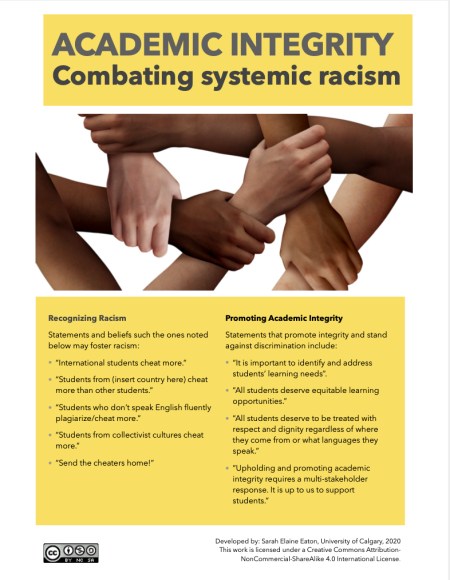
Yesterday the Alberta Council on Academic Integrity (for which I serve as a Steering Committee member) released its formal Statement Against Racism. I was sad, but not suprised that we started getting pushback almost immediately about the statement.  As a result, I have developed this one-page resource to help educate others about how racism is pervasive in discussions about academic misconduct:

Academic Integrity- Combating Systemic Racisim (.jpg)

I am aware that resources do not solve problems. I intend for this resource to be a tool that can help start meaningful conversations about how racism manifests in our beliefs and responses to academic integrity.

Here is a free, downloadable .pdf of this resource. It has a Creative Commons license, so feel free to share it.

Possible uses for this resource:

Poster

  • Discussion tool for staff, educators and administrators
  • Digital resource for sharing
  • Other uses that advocate anti-discrimination and anti-racism in student conduct.

Remember: Academic integrity cannot co-exist with injustice. If discrimination and racism enter into the conversation, we aren’t talking about academic integrity anymore. Academic integrity is based around a set of six fundamental values, as articulated by the International Center for Academic Integrity:

  1. Courage
  2. Fairness
  3. Honesty
  4. Respect
  5. Responsibility
  6. Trust

Inherent in all of this is an underlying respect for persons and human rights. Injustice is antithetical to academic integrity.

I look forward to moving this conversation forward in the coming days, months and years.

Related posts:

_________________________________________

Share or Tweet this: Academic Integrity: Combating Systemic Racism – A Free Resource for Everyone https://wp.me/pNAh3-2uu

This blog has had over 2 million views thanks to readers like you. If you enjoyed this post, please “like” it or share it on social media. Thanks!

Sarah Elaine Eaton, PhD, is a faculty member in the Werklund School of Education, and the Educational Leader in Residence, Academic Integrity, University of Calgary, Canada. Opinions are my own and do not represent those of the University of Calgary.


CSSHE 2020 Award for Research and Scholarship

June 2, 2020

2020 CSSHE Awards

There are moments that mark a career. Today was one of those moments. At the Annual General Meeting (AGM) of the Canadian Society for the Study of Higher Education (CSSHE), the society conferred their 2020 Research and Scholarship Award on me.

I am excited by this for three reasons:

  1. It recognizes and celebrates academic integrity as a field of research that is important in Canadian higher education. This energizes me a lot! I have heard over and over and over again that academic integrity is not research field, even though there are journals and conferences dedicated to it and there is quite an active research community outside Canada. Awards such as this recognize the importance of researching this area.
  2. I get to follow in the footsteps of a selected few researchers who have won awards for their work on academic integrity, most notably, Julia Christensen Hughes, who together with the late Don McCabe, won the Canadian Journal of Higher Education (CJHE) Sheffield Award for their 2006 seminal article Academic Misconduct within Higher Education in Canada.
  3. Although I have been a member of CSSHE for a few years and have presented at their conferences, I am just a regular member of the society. The award was conferred by my scholarly peers, but not my “cronies”. In fact, there were some members of the executive I met today for the first time. Unlike some societies where members of the adjudication committee give awards to their friends or their own students, the society based their selection on the quality of my research portfolio. To me, this speaks volumes about the integrity of the award and the internal ethics of the organization.

This was a particularly meaningful year to receive this award, as the society celebrated its 50th anniversary this year. I am truly grateful for this award and I look forward to living up to its reputation.

Hearty congratulations to the recipients of the other awards conferred this year, too. I have included a screen shot of the slide presented at the AGAM today showing the names of all of the award recipients.

Thank you, CSSHE!

_________________________________________

Share or Tweet this: CSSHE 2020 Award for Research and Scholarship – https://wp.me/pNAh3-2ui

This blog has had over 2 million views thanks to readers like you. If you enjoyed this post, please “like” it or share it on social media. Thanks!

Sarah Elaine Eaton, PhD, is a faculty member in the Werklund School of Education, and the Educational Leader in Residence, Academic Integrity, University of Calgary, Canada. Opinions are my own and do not represent those of the University of Calgary.


How to Deal with Contract Cheating: A Collection of Resources

June 1, 2020

Last updated: 20 October 2021

I have been getting a lot more requests lately about how to determine if a student has outsourced their academic work. I am noticing a need for more practical hands-on tools, particularly for educators who work at institutions that do not have an academic integrity office or staff with roles dedicated to academic misconduct investigations.

Resources for educators and administrators

Here are some of my favourite free, open-access resources to help educators and administrators:

  1. Substantiating contract cheating for symbol-dense, logical responses in any discipline, particularly mathematics A guide for investigators (from TEQSA, Australia)  https://www.teqsa.gov.au/sites/default/files/substantiating-contract-cheating-for-symbol-dense-logical-responses.pdf?v=1634700092
  2. Contract cheating detection for markers: checklist (from the UK-based LSEAIN Contract Cheating Working Group) https://rise.articulate.com/share/dPC3F7wAQgeKahu71aUg0vBKfEUg8vsj#/
  3. Bretag, T., & Harper, R. (n.d.). Impossible to prove? Substantiating contract cheating. Retrieved from https://cheatingandassessment.edu.au/wp-content/uploads/2018/07/EDUCATOR-RESOURCE-Substantiating-contract-cheating.pdf
  4. Deakin University: CRADLE. (2018). How to detect contract cheating. Retrieved from https://www.deakin.edu.au/__data/assets/pdf_file/0007/1853881/01-cradle-detect-contract-cheating.pdf
  5. Eaton, S. E. (2020). 15 Strategies to Detect Contract Cheating. Retrieved from http://hdl.handle.net/1880/112660
  6. Eaton, S. E. (2019). U Have Integrity: Educator Resource – How to Lead a Discovery Interview About Contract Cheating. Retrieved from http://hdl.handle.net/1880/111077
  7. Ellis, C. (2015). Know the signs of contract cheating (Fact sheet). Retrieved from http://www.apfei.edu.au/wp-content/uploads/2016/08/Contract-Cheating-Factsheet-UNSW-2015.pdf
  8. Sambell, K., Brown, S., & Race, P. (n.d.). ENhance QUICK GUIDE: Combatting Contract Cheating. Retrieved from https://staff.napier.ac.uk/services/dlte/Documents/14%20Combatting%20Contract%20Cheating.pdf
  9. UC San Diego. (n.d.). Detecting Contract Cheating in Narrative Assessments. Retrieved from https://academicintegrity.ucsd.edu/_files/Detecting%20Contract%20Cheating.pdf
  10. University of California – San Diego. (n.d.). Excellence with Integrity: Combating Contract Cheating. Retrieved from https://humber.ca/staff/sites/default/files/sub-attachments/Combating%20Contract%20Cheating.pdf
  11. University of New South Wales. (n.d.). Have you contact cheated? Retrieved from https://www.arc.unsw.edu.au/uploads/Yellow%20poster_v2.pdf

Resources for Institutions

  1. International Center for Academic Integrity. (2016). Institutional toolkit to combat contract cheating. Retrieved from http://integrity.fiu.edu/pdfs/Contract%20Cheating.pdf

Resources for Quality Assurance Agencies

  1. International Network for Quality Assurance Agencies in Higher Education (INQAAHE). (2020). Toolkit to support quality assurance agencies to address academic integrity and contract cheating. Retrieved from https://www.teqsa.gov.au/latest-news/publications/toolkit-support-quality-assurance-agencies-address-academic-integrity

I hope you find these helpful. It is important to have practical tools to be able to identify if a third party has completed work on the student’s behalf. I will update this post with more tool as I find them, review them and then assess their quality and utility, as I have done with all of the resources included in this post.

Related posts:

_________________________________________

Share or Tweet this: How to Deal with Contract Cheating: A Collection of Resources – https://wp.me/pNAh3-2u5

This blog has had over 2 million views thanks to readers like you. If you enjoyed this post, please “like” it or share it on social media. Thanks!

Sarah Elaine Eaton, PhD, is a faculty member in the Werklund School of Education, and the Educational Leader in Residence, Academic Integrity, University of Calgary, Canada. Opinions are my own and do not represent those of the University of Calgary.