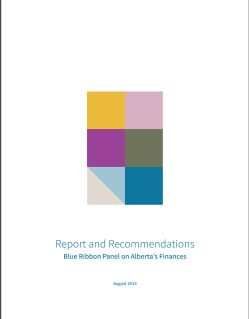
 When I reviewed my Twitter feed this morning, I saw comments and questions about how recommendations in a recently-released report from the Alberta government might impact academic integrity in our province. The document is the “Report and recommendations: Blue Ribbon Panel on Alberta’s Finances“. It was released by the Treasury Board and Finance branch of the Alberta government on September 3, 2019.
Naturally, when I saw the chatter on social media, my immediate reaction was concern. I looked at some of the news stories that had been released on the report over the past few days and my concern escalated into alarm. But before engaging in the social media debate, I opted first to consult the original report myself. After all, since I blog about the importance of consulting original sources, I thought it only fair to find and read the document before offering my commentary.
I reviewed the report this morning over two rather large mugs of coffee. I focused my attention on what the report said about education, casting a particular lens on the implications for academic integrity.
The report presents an overview of recommendations for K-12 education and advanced education:
On Education: The Panel recommends that the government should:
Recommendation 5: Work with education stakeholders to decrease the percentage of government funding that goes to administration and governance (currently 24 .6%) to a level comparable to British Columbia (17%).
Recommendation 6: Completely review and revise the current education funding formula to ensure enrolment growth is addressed and to provide incentives for sharing services and achieving better education outcomes for students.
On Advanced Education: The Panel recommends that the government should:
Recommendation 7: Consult with post-secondary stakeholders to set an overall future direction and goals for the post-secondary system along with appropriate governance models.
Recommendation 8: Work with post-secondary stakeholders to achieve a revenue mix comparable to that in British Columbia and Ontario, including less reliance on government grants, more funding from tuition and alternative revenue sources, and more entrepreneurial approaches to how programs are financed and delivered. This includes lifting the current freeze on tuition fees.
Recommendation 9: Assess the financial viability of Alberta’s post-secondary institutions. The government should move quickly to address the future of those post-secondary institutions that do not appear to be viable in future funding scenarios. (p. 6-7)
More details are provided on pages 33-38 for K-12 education and pages 39-43 for advanced education. As I read through the details of the report, I would say it seems clear that deep cuts to education funding seem imminent, including cuts to educators’ salaries.
With regards to K-12 education the report states, “A number of school boards that have very high to high expenses per student have student achievement outcomes that are below 50%” (p. 36). The report seems to indicate that a shift from a funding model that would fund schools based on enrolment numbers alone might shift to one based on “outcomes achieved” (p. 37). The report does not explicitly say this would be a pay-for-performance model. Nor does it elaborate on what these “outcomes” might look like.
The objection that has arisen in the media seems to centre around Recommendation #6 which talks about “achieving better outcomes for students”. I find the high-level language vague and leaves much open to interpretation.
When I turned my attention to the section on Advanced Education, I found this point jumped out at me:
Not all Alberta’s post-secondary institutions are successful at getting students to complete their studies and graduate over a seven-year period subsequent to beginning their course of study . Nine of twenty-six institutions fell below an average completion rate of 60% and one institution had a completion rate of 40%. (p. 40)
This would seem to indicate that we might expect a more intense focus on students completing their programs as a measure of success. If anything, I might be concerned that program quality or standards might end up being lowered in advanced education programs to ensure more students complete their programs, but I am speculating.
There are other aspects of the report that I found interesting (even concerning), but I will refrain from commenting on those, because I examined the report specifically through the lens of academic integrity.
In short, I think we need to pay attention. Funding cuts to education seem imminent. From what I read, it would seem that our government will put a more intense focus on institutional and student outcomes and achievement, but how that will unfold is unclear. In terms of the potential impact of all this on academic integrity, I was unable to draw informed conclusions at this point.
Let me be clear though, that I unequivocally support a commitment to student learning — and students having opportunities to learn — no matter where they live, how much money they (or their parents) have, or what their age is. Those are my values as an educator, a researcher and a human being, so naturally, I will be keeping an eye on this. I am interested to know how the report is interpreted and used as a tool for the government to make decisions. I believe the content of this report, as it relates to education, will no doubt impact students, parents, educators, educational researchers and administrators at every level.
I would encourage all Albertans, and educators in particular, to read the original report. Fill up your coffee cup (twice if you need to) and dig into it. There are places we can read between the lines, speculate and surmise. At the very least, the report seems to provide the government with a clear mandate to cut costs to the public sector, including education, but don’t believe me (or the media). Read the report for yourself and draw your own conclusions.
Reference:
MacKinnon, J., & Percy, M. (2019, September 3). Report and recommendations: Blue Ribbon Panel on Alberta’s Finances. Edmonton: Treasury Board and Finance, Government of Alberta. Retrieved from https://open.alberta.ca/publications/report-and-recommendations-blue-ribbon-panel-on-alberta-s-finances
______________________________________________________
Share or Tweet this: Alberta’s MacKinnon Report: Academic Integrity Implications?
This blog has had over 2 million views thanks to readers like you. If you enjoyed this post, please “like” it or share it on social media. Thanks!
Sarah Elaine Eaton is a faculty member in the Werklund School of Education, University of Calgary, Canada. Opinions are my own and do not represent those of the Werklund School of Education or the University of Calgary.
 This program is situated as one component of a course-based Master of Education (MEd) Interdisciplinary. Students will undertake a 4-course topic in Academic Integrity to earn a Master’s level certificate qualification.


 Posted by Sarah Elaine Eaton, Ph.D.
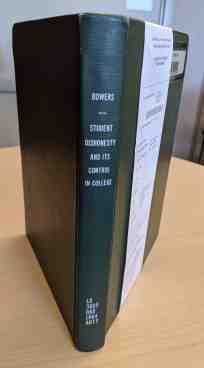 I am always telling my students to find and cite the original sources rather than relying on secondary sources. In the work I do on academic misconduct, the work of William Bowers is often cited as a seminal study in the field. The problem is that Bowers’s original work is hard to get your hands on. I was able to find a copy of his 1966 doctoral dissertation, but the original 1964 book seemed almost impossible to find. The two sources have exactly the same title. Although both texts are based on the same content, it is presented in different ways in both texts.
 Like many others, I have been eagerly awaiting the release of the the


You must be logged in to post a comment.