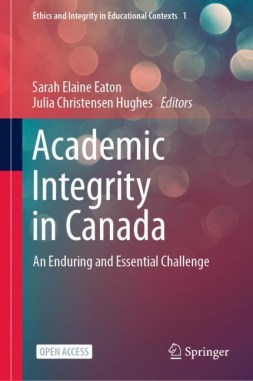
 I’m pleased to share that Academic Integrity in Canada: An Enduring and Essential Challenge (Eaton & Christensen Hughes, eds.) has been published. This edited volume spans almost 600 pages, including 31 chapters contributed by 40+ authors.
Don’t be misled by the title. Although all the contributors are from Canada, we purposely kept a global audience in mind when crafting the chapters. We wanted this book to be relevant and useful for readers well beyond our own borders.
Tis book is Open Access and freely available to download. Here is the link: https://link.springer.com/book/10.1007/978-3-030-83255-1
Table of Contents (Overview)
Ch. 01: Academic Integrity in Canada: Historical Perspectives and Current Trends (Sarah Elaine Eaton & Julia Christensen Hughes)
Ch. 02: Academic Integrity Across Time and Place: Higher Education’s Questionable Moral Calling (Julia Christensen Hughes)
Ch. 03: Student Integrity Violations in the Academy: More Than a Decade of Growing Complexity and Concern (Julia Christensen Hughes & Sarah Elaine Eaton)
Ch. 04: Academic Misconduct in Higher Education: Beyond Student Cheating (Julia Christensen Hughes & Sarah Elaine Eaton)
Ch. 05: Re-Defining Academic Integrity: Embracing Indigenous Truths (Yvonne Poitras Pratt & Keeta Gladue)
Ch. 06: Accountability, Relationality and Indigenous Epistemology: Advancing an Indigenous Perspective on Academic Integrity (Gabrielle Lindstrom)
Ch. 07: Understanding Provincial and Territorial Academic Integrity Policies for Elementary and Secondary Education in Canada (Brenda M. Stoesz)
Ch. 08: Contract Cheating in Canada: A Comprehensive Overview (Sarah Elaine Eaton)
Ch. 09: Ethics, EdTech, and the Rise of Contract Cheating (Brenna Clarke Gray)
Ch. 10: Pay-To-Pass: Evolving Online Systems That Undermine the Integrity of Student Work (Nancy Chibry & Ebba Kurz)
Ch. 11: Education as a Financial Transaction: Contract Employment and Contract Cheating (Katherine (Katie) Crossman)
Ch. 12: Academic Integrity in Work-Integrated Learning (WIL) Settings (Jennifer B. Miron)
Ch. 13: Canadian Open Digital Distance Education Universities and Academic Integrity (Cheryl A. Kier & Jill Hunter)
Ch. 14: Visual Plagiarism: Seeing the Forest and the Trees (John Paul Foxe, Allyson Miller, Glen Farrelly, Vincent Hui, Dianne Nubla, & Colleen Schindler-Lynch)
Ch. 15: Managing Academic Integrity in Canadian Engineering Schools (David deMontigny)
Ch. 16: Teaching the Teachers: To What Extent Do Pre-service Teachers Cheat on Exams and Plagiarise in Their Written Work? (Martine Peters, Sylvie Fontaine, & Eric Frenette)
Ch. 17: The Distinctive Nature of Academic Integrity in Graduate Legal Education (Jonnette Watson Hamilton)
Ch. 18: Student Insight on Academic Integrity (Kelley A. Packalen & Kate Rowbotham)
Ch. 19: Helping Students Resolve the Ambiguous Expectations of Academic Integrity (Susan L. Bens)
Ch. 20: How to Talk About Academic Integrity so Students Will Listen: Addressing Ethical Decision-Making Using Scenarios (Lee-Ann Penaluna & Roxanne Ross)
Ch. 21: Revisioning Paraphrasing Instruction (Silvia Rossi)
Ch. 22: Supporting Academic Integrity in the Writing Centre: Perspectives of Student Consultants (Kim Garwood)
Ch. 23: Beyond the Traditional: Academic Integrity in Canadian Librarianship (Leeanne Morrow)
Ch. 24: The Barriers to Faculty Reporting Incidences of Academic Misconduct at Community Colleges (Melanie Hamilton & Karla Wolsky)
Ch. 25: Changing “Hearts” and Minds: Pedagogical and Institutional Practices to Foster Academic Integrity (Laurie McNeill)
Ch. 26: Promotion of Academic Integrity Through a Marketing Lens for Canadian Post-secondary Institutions (Nazanin Teymouri, Sheryl Boisvert, & Katrina John-West)
Ch. 27: Using Quality Assurance Frameworks to Support an Institutional Culture of Academic Integrity at Canadian Universities (Emma J. Thacker & Amanda McKenzie)
Ch. 28: Student Academic Misconduct Through a Canadian Legal Lens (Melissa Morrison & Philip Zachariah)
Ch. 29: Building a Culture of Restorative Practice and Restorative Responses to Academic Misconduct (Paul Sopcak & Kevin Hood)
Ch. 30: Academic Integrity Through a #SoTL Lens and 4M Framework: An Institutional Self-Study (Natasha Kenny & Sarah Elaine Eaton
Ch. 31: Conclusions and Future Directions for Academic Integrity in Canada (Sarah Elaine Eaton & Julia Christensen Hughes)
_________________________________
Share or Tweet this: New book: Academic Integrity in Canada – https://drsaraheaton.wordpress.com/2022/03/22/10808/
This blog has had over 3 million views thanks to readers like you. If you enjoyed this post, please “like” it or share it on social media. Thanks!
Sarah Elaine Eaton, PhD, is a faculty member in the Werklund School of Education, and the Educational Leader in Residence, Academic Integrity, University of Calgary, Canada. Opinions are my own and do not represent those of the University of Calgary.


 Posted by Sarah Elaine Eaton, Ph.D.
  Last week Alicia Adlington and I presented our work on possible legislative options to address contract cheating in Canada. We did our presentation via webinar with 70+ registrants and launched our report, which is publicly available online:
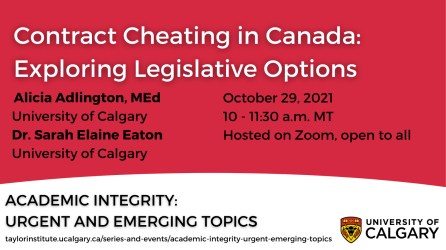 Join us for an introductory discussion about the commercial contract cheating industry (e.g., term paper mills, homework completion services, and paid imposters who take exams on behalf of students). One question people often ask is, “Why aren’t these services illegal?” The short answer is: Academic cheating services are not currently illegal in Canada, but they are in other countries. In this session we’ll provide an overview of which countries have successfully enacted legislation against predatory industry that profits from academic misconduct. We will provide an overview of the legal structures in Canada that might facilitate or present barriers to such legislation being enacted in this country. We do not promise answers or solutions to the complex issue of contract cheating, but instead provide an evidence-base for deeper discussion.
 Excited to share this long-overdue annotated bibliography. We started working on this one a while ago and then COVID hit. We are excited to have completed this and be able to share this with you. We hope it will be particularly helpful for those studying academic integrity in STEM fields.
 Learning, Teaching and Leadership
You must be logged in to post a comment.