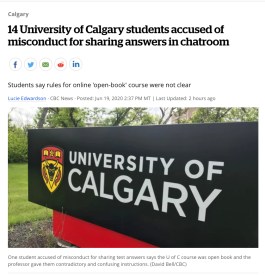
 I regularly post news about academic misconduct cases in Canada. Yesterday, a story about academic cheating at the University of Calgary was released by CBC. The story focused on 14 students taking Geology 305, a third-year course.
I imagine that more than one critic of my work is eagerly preparing to start wagging a finger at me and say, “You’ll post about academic misconduct at other schools, but when a news story comes out about your own university, you keep mum. How is that ethical? Hmmmm?!”
So I am going to post about it. At length. So hold on to your hats, people. I’m going to give you the inside scoop that the media didn’t cover.
But before I do, let’s get a few things straight. To the best of my knowledge, I do not personally know any of the students involved in this alleged case. I do, however, know many members of the Department of Geoscience, as well as the Associate Dean Undergraduate Programs and Student Affairs, Professor Nancy Chibry. And I have insider information that I am about to share with all of you.
The Department of Geoscience
I know many members of the Department of Geoscience, not only because I run into them as colleagues at meetings here and there, but also because they have invited me into their shop to talk specifically about academic integrity. As of July 2019, I took on a part-time secondment role as the Educational Leader in Residence (ELR), Academic Integrity. The purpose of the role, in part, is to support campus stakeholders, including faculty members, to learn more about academic integrity.
Last fall, the department chair, Dr. Bernhard Mayer, who now serves as the Interim Dean of the Faculty of Science, invited me to a departmental meeting on November 21, 2019 as a guest to talk about academic integrity in my role as the educational leader in residence on the topic. The room was full without an empty seat to be found, with thirty (30) faculty members in attendance. We talked about the new academic misconduct policy or procedure that came into effect July 1, 2019. We talked about teaching and learning approaches to support learning with integrity, ethical assessment, and contract cheating.
Faculty members leaned in as I gave a brief presentation. Then they asked questions, offered ideas, and engaged in generative brainstorming about how to support students’ learning. Faculty members were intensely interested in helping students learn with integrity.
After that, several members of the department contacted me individually to ask more questions, seek advice, and bounce ideas off me. In other words, I didn’t just parachute in to offer a one-off workshop and then parachute out, never to be heard from again. The conversations have continued over time. I can tell you, there are some pretty dedicated educators in that department, including recipients of the University of Calgary Teaching Awards such as Professor David Pattison (Award for Full-Time Academic Staff (Professor), 2020) and Professor Rajeev Nair (Award for Experiential Learning Initiatives, 2018).
The Associate Dean, Undergraduate Affairs and Student Experience
The article states, “The university says academic misconduct decisions are made by the associate dean and not the individual departments.” To be fair, this is pretty standard operating practice at most Canadian universities.
The article does not name the Associate Dean, Undergraduate Affairs and Student Experience, but let’s talk about her for a minute. In addition to her academic and administrative roles, Professor Nancy Chibry has been a campus champion of academic integrity. For her, this work is not only about academic misconduct case management. She takes academic integrity to a whole new level, way above and beyond just about any other administrator I’ve ever known.
Together with Dr. Ebba Kurz, Cumming School of Medicine, Chibry co-developed and co-facilitates, “Pay-to-pass: Knowledge as a Commodity”, a workshop designed to teach faculty members about academic file-sharing site and contract cheating. They give this workshop every year on campus, and also presented it at a national symposium on academic integrity in 2019.
Professor Chibry has also co-published a paper on contract cheating in an international peer-reviewed journal, together with colleagues from two other institutions. (In the interest of transparency, I declare I am also a co-author on the same paper.) To put this in perspective, Professor Chibry is one of the only professors anywhere in Canada to have a peer-reviewed journal article on contract cheating, which is also called academic outsourcing and includes practices such as unethical tutoring and predatory file-sharing by commercial entities.
She has also been a regular contributor to the University of Calgary’s International Day of Action Against Contract Cheating since 2017, when we began participating. In 2019, she served alongside me as the academic co-chair for the day, which was a voluntary service role, in addition to her administrative, teaching, and research responsibilities. As part of that role, she liaised directly with students from the Faculty of Science who designed and delivered their own set of academic integrity events that day. Nancy offered students space to store materials for their activities that day. She wrangled up swag for student prizes. She lent students the faculty’s prize wheels to use during their events. She hauled around boxes of supplies. To say this woman is dedicated to upholding and enacting academic integrity on our campus is an understatement.
Why is this relevant? Well, because the associate dean named in the article is not simply some bureaucrat who hands out penalties for academic misconduct. Her administrative responsibilities are deeply informed by research and scholarly expertise in academic integrity, with a further specialization in file-sharing and contract cheating in particular. And she does more volunteer service work around academic integrity on campus than any other faculty member I can think of.
Am I suggesting that all faculty members and administrators at the University of Calgary are saints? Gosh, no. I am saying that many of them care deeply about students and about academic integrity. Many of them show up at meetings to talk about it. Some of them volunteer their time at events. By and large, faculty members actually do give a damn about students.
Guilty?
The article concludes with this statement, “In addition to getting failing grades for the tutorials in question, students who accept guilt or are found guilty following an appeal are also required to take academic integrity workshops.”
Words matter. And in this case, I take issue with the word “guilt”. Nowhere in the university’s academic misconduct policy or procedure is the word “guilt” used! Not once. We use the word “responsible”. Students can be found responsible for academic misconduct. Guilt is a word used in criminal law. At the university we hold students (and all members of the academic community) responsible for their actions. So, more accurate reporting would reflect the approach taken by the university itself. We do not “find students guilty” of anything.
Don’t get me wrong. I am not casting judgement on this alleged case or anyone involved. It’s not my place to investigate or judge the alleged case at hand. I’ll leave that up to those who are responsible for investigating and addressing allegations of academic misconduct. I can say that the university has worked pretty tirelessly over the past several years to develop policies, procedures, and processes that are fair, just, and equitable.
Let’s talk about the bigger picture
Let’s be honest. This isn’t really a story about the University of Calgary. This isn’t actually a story about one course at one university. This is actually the story of many courses at many universities during the coronavirus pandemic. It’s not particular to any one university.
Sure, the University of Calgary is featured in this story. Just like the Brandon University was featured in a story about file-sharing last fall. Just like Simon Fraser University was in the news last fall for another case of academic misconduct. With all due respect to reporters, they tend to zoom in on micro-stories that highlight single incidences of misconduct at a particular school. Last term it was Brandon University and SFU who were in the news. Today it is the University of Calgary. Tomorrow it will be some other school.
I’m sorry, journalists, but many of you are missing the real story: Academic misconduct doesn’t just happen at one school, it happens at all of them. In your efforts to capture all the minute details of one particular case, you’re missing the big story that is happening across the nation, and across the world, in fact. You’re not seeing the forest for the trees… And it’s a pretty big landscape.
Last week I was talking with Giacomo Panico, who wrote a story about how faculty members are being challenged to think about assessment in new ways during the pandemic. Damn straight we are. And to be honest, most of my colleagues are working their behinds off already to prepare for the fall 2020 term. Faculty members I talk with are committed to providing the best possible learning experiences for their students in the fall… And let’s not forget, we’re still trying to do this in the midst of a global pandemic! That’s a key point here. The world is still in crisis… but higher education (in Canada at least) goes on.
During our interview last week, Giacomo commented to me that he was having a hard time getting anyone from a university to grant him an interview for his story. I replied, “Well, can you blame them? When reporters zoom in on a particular school, of course professors and administrators get nervous about their school’s name being dragged through the mud.” Time and time again, we’ve been contacted by reporters who want to talk about a particular incident at a particular school. Of course professors and leaders get nervous about reputational damage to their school.
Quite frankly, academic misconduct is a systemic problem, so let’s start telling that story instead. And it’d be a heck of a lot easier to get professors and higher education administrators to comment on the problem if they didn’t have to worry about their own particular school’s reputation being at risk.
And, reporters, when you’re investigating stories about academic misconduct, let’s not propagate moral binaries that pit students against their professors or students against their schools. For Pete’s sake, we (students, faculty, administrators, and the whole gosh darn educational system) are all in this together. Honestly, as a professor and an educator, I care about my students. And I’m not alone. I’ve said it before and I’ll say it again, in the game of “Gotcha!” no one wins.
There is a story to be told, but it’s way, way bigger than any one course at any one university. And I’ll say that on the record.
Related posts:
_________________________________
Share or Tweet this: This is not a story about academic cheating at the University of Calgary https://wp.me/pNAh3-2uV
This blog has had over 2 million views thanks to readers like you. If you enjoyed this post, please “like” it or share it on social media. Thanks!
Sarah Elaine Eaton, PhD, is a faculty member in the Werklund School of Education, and the Educational Leader in Residence, Academic Integrity, University of Calgary, Canada. Opinions are my own and do not represent those of the University of Calgary.
 We are excited to share this new article:


 Posted by Sarah Elaine Eaton, Ph.D.
  This session will bring to fore (or highlight) the oft-neglected discord between equity and integrity in high-stakes standardized language tests. The equity issues surrounding these so-called standardized language tests can potentially precipitate and predispose academic dishonesty. This presentation will discuss the ramifications of inherent inequities in high stakes language proficiency tests for academic integrity and will call for a more critical consideration of commercialized high stakes language tests. Redressing equity issues in language assessment can serve to promote academic integrity and reduce academic dishonesty.
 Ismaeil Fazel is a Lecturer at the Faculty of Education of Simon Fraser University. He has a PhD in TESL and a sub-specialization in Measurement and Evaluation from the University of British Columbia. His main research interests include English for Academic and Professional Purposes, academic discourse socialization, and language assessment. His publications have appeared in the Journal of English for Academic Purposes, English for Specific Purposes Journal, and TESL Canada Journal, among others.
 Soroush Sabbaghan is a Senior Instructor at the Werklund School of Education at the University of Calgary. He holds two PhDs, one in TESL and the other in Curriculum and Learning with a focus in Mathematics Education. His main research interests include language and mathematics education of bilingual and multilinguals, Language Learning and Technology, and ecological complexity discourses. He has publications in both Language and mathematics education journals and books.
 It is essential to take a strong stand against systemic racism and discrimination. This includes a commitment to identify and address racism and discrimination in matters relating to academic and non-academic student misconduct. In this report I synthesize existing resources and issue a call to action to collect more race-based data relating to student conduct for the purposes of identifying and addressing systemic injustices perpetuated by existing higher education reporting, policies and procedures.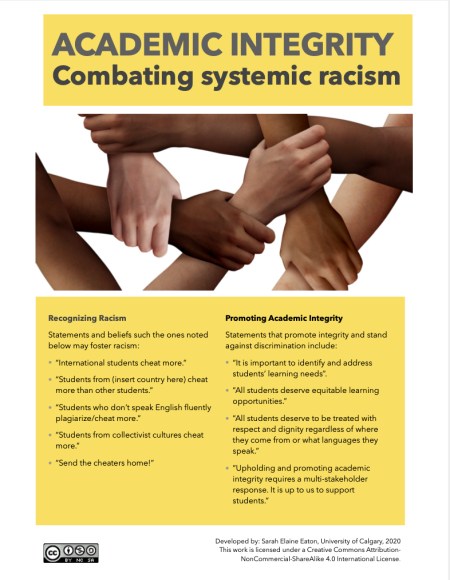

 Learning, Teaching and Leadership
You must be logged in to post a comment.