The foundations of scholarship: Original sources

September 3, 2019

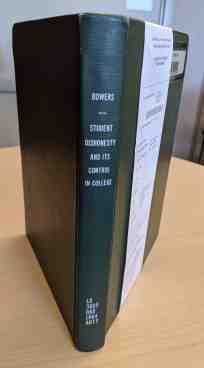
Bowers 1964-sm.jpgI am always telling my students to find and cite the original sources rather than relying on secondary sources. In the work I do on academic misconduct, the work of William Bowers is often cited as a seminal study in the field. The problem is that Bowers’s original work is hard to get your hands on. I was able to find a copy of his 1966 doctoral dissertation, but the original 1964 book seemed almost impossible to find. The two sources have exactly the same title. Although both texts are based on the same content, it is presented in different ways in both texts.

I can say this because I’ve now read both sources in their entirety.

Thanks to our amazing librarians at the University of Calgary, who were able to track down a copy of Bowers’s original 1964 work. Through the inter-library loan system, they were able to request the book from another library (thanks, University of Waterloo!) and have it sent to the university where I work so I could read it.

It is a beautiful volume, obviously produced on a typewriter with painstaking detail. This work was a true labour of love. I so appreciate having the opportunity to read it for myself. I now understand Bowers’s work much better. (I purposely do not offer a synopsis of his work in this blog post, so as to encourage others to go read the original works themselves, rather than relying on someone else’s summary!) Although more updated studies have been published since then, this nevertheless remains an important foundational book in my field. I am delighted to have had the privilege to read it.

I encourage anyone who wants to undertake deep scholarship in a particular field to find the original works upon which the field was built. If you can’t find the books, ask your friendly neighbourhood librarian for help. You might be surprised how they can help you be a better scholar.

References:

Bowers, W. J. (1964). Student dishonesty and its control in college. New York: NY: Bureau of Applied Social Research, Columbia University.

Bowers, W. J. (1966). Student dishonesty and its control in college. (Doctor of Philosophy). Columbia University, New York.

______________________________________________________

Share or Tweet this: The foundations of scholarship: Original sources https://wp.me/pNAh3-2ol

This blog has had over 2 million views thanks to readers like you. If you enjoyed this post, please “like” it or share it on social media. Thanks!

Sarah Elaine Eaton is a faculty member in the Werklund School of Education, University of Calgary, Canada. Opinions are my own and do not represent those of the Werklund School of Education or the University of Calgary.


7th Ed. APA Manual – An Academic Integrity Response

August 9, 2019

APA 7th cover.jpgLike many others, I have been eagerly awaiting the release of the the 7th edition of the Publication Manual of the American Psychological Association (affectionally known by millions as the APA Manual). I was thrilled to read the press release saying its launch has been scheduled for October 2019. Then it occurred to me that this may be problematic from an academic integrity perspective. It is important for educators and institutions to take a supportive, ethical, and instructive approach to the adoption of the latest edition of the manual. Here are some ways to do that:

Recommendations for Instructors

  1. Talk to your students about the release of the 7th edition. This is an excellent reason to review citing and referencing expectations with students.
  2. Talk to administrators about what is expected of you with regards to when and how to adopt the 7th edition of the manual. It may make more sense to start and finish the term with consistent use of the same edition of the manual and transition to a new manual at the start of a new term.

Recommendations for Institutions

  1. Develop and deliver campus-wide training programs on the differences between the 6th and 7th editions of the manual. Students, faculty and others will need explicit and supportive instruction on what’s new and how to adapt to the norms of the new edition.
  2. Develop a systematic plan for campus-wide adoption of the 7th edition. Neither instructional staff nor students should be expected to buy a new manual and adopt it during the middle of a term. This could result in both a financial burden and unnecessary stress for everyone involved. It should be OK to stick with the 6th edition of the manual for the fall term (or the spring 2019 semester for the southern hemisphere), so everyone is using the same version consistently in courses. There can (and should) be a period of transition while students and others can learn the details of the latest version in time for start of the next term. There should be clear communication to students about when they are expected to fully adopt the 7th edition, and it should not be in the middle of term.
  3. Develop a unified and supportive institutional stance towards ethical adoption of the latest edition, casting a particular lens to academic integrity breaches and policy. It is imperative that students not be penalized for academic misconduct for failing follow 7th edition in the fall 2019 semester. (This includes not being penalized for having two spaces after a period!) It is important to give students, educators, administrators and others time to learn the new conventions that with come with the latest edition.

This is an exciting time for everyone whose work intersects with the APA manual in a variety of ways, including citing, referencing and academic writing. It is important to create supportive and planned approaches to adoption of the new edition in ways that emphasize teaching, learning and the development of research and writing skills.

______________________________________________________

Share or Tweet this: 7th Ed. APA Manual – An Academic Integrity Response https://wp.me/pNAh3-2nQ

This blog has had over 2 million views thanks to readers like you. If you enjoyed this post, please “like” it or share it on social media. Thanks!

Sarah Elaine Eaton is a faculty member in the Werklund School of Education, University of Calgary, Canada. Opinions are my own and do not represent those of the Werklund School of Education or the University of Calgary.


Multilingual essay mills – New article

August 6, 2019

Notos coverMy colleague, Roswita Dressler and I have just had a new paper published. It all started when I was at an academic integrity conference a couple of years back. I was sitting next to a colleague who works in a language other than English (LOTE). The colleague suggested that contract cheating (e.g. essay mills and other forms of outsourced academic work) was a problem of the English-speaking world, asserting that there simply wouldn’t be enough of a market in other languages.

I thought to myself, “Challenge accepted!” I recruited Roswita Dressler to help me undertake a small-scale pilot study. We both have a background in language teaching and between us, we have some level of proficiency in about four languages. We were also curious about the market for academic outsourcing for younger audiences, in elementary, middle and high school.


The questions that guided our project were:

  1. What evidence exists that online providers offer academic work in languages other than English?
  2. To what degree are K-12 students targeted by these online providers?

We framed our study specifically within the Canadian context.

Our results showed that not only do commercial contract cheating companies market to specifically to students in Canada, they target children as young as Grade six (approximately 11-12 years old). And yes, we found strong evidence that contract cheating happens in languages other than English (ten of them, in fact).

To the best of our knowledge, this is the first study on contract cheating published in Canada.

The Alberta Teachers Association is the publisher and copyright holder of this article. They have given us permission to post the article in our university’s digital repository. You can access a copy of it free of charge from here:

Eaton, S. E., & Dressler, R. (2019). Multilingual essay mills: Implications for second language teaching and learning. Notos, 14(2), 4-14. Retrieved from http://hdl.handle.net/1880/110695

______________________________________________________

Share or Tweet this: Multilingual essay mills – New article

This blog has had over 2 million views thanks to readers like you. If you enjoyed this post, please “like” it or share it on social media. Thanks!

Sarah Elaine Eaton is a faculty member in the Werklund School of Education, University of Calgary, Canada. Opinions are my own and do not represent those of the Werklund School of Education or the University of Calgary.


Seeking early-stage feedback about proposed MEd Certificate in Academic Integrity

June 21, 2019

Note: This is an early-stage concept draft intended for sharing for developmental feedback.

Direct questions about this proposal to Dr. Sarah Elaine Eaton – seaton (at) ucalgary.ca.

Background

The MEd certificate in Academic Integrity is an opportunity for those interested in this topic to develop as scholars of the profession in a learning community of like-minded students. Situated within the Leadership specialization, students will explore academic integrity through a leadership, policy and governance lens, while also developing an evidence-informed approach to the pragmatic aspects of academic integrity such as case management. Students will examine their personal and professional notions of academic integrity, as situated concepts within institutional and systemic contexts, deepening their understanding of how professional practice related to academic integrity is nested within institutional policies and procedures and how these are related to quality assurance from a systemic perspective, such as ministries of education and/or higher education.

MEd Certificate

The MEd (Master of Education) is a course-based pathway which provides students with a systematic understanding of knowledge, and a critical awareness of current problems and/or new insights, much of which is at, or informed by, the forefront of their academic discipline, field of study or area of professional practice in two topic areas, plus additional research methods courses.

Each certificate is based on a topic area comprised for four (4) courses. The MEd Certificate is a pathway to a Master of Education (MEd), Interdisciplinary route, but a graduate level certificate is awarded upon the successful completion of a 4-course certificate, so even if participants choose only to undertake the 4-course topic, they can still be awarded a graduate-level certificate.

Learning Goals and Expected Outcomes

There are three overarching learning goals of this proposed certificate:

  1. This certificate will increase awareness of the role of academic integrity in educational contexts.
  2. It will assist those who have academic integrity as a component of their professional portfolio in furthering discussion and learning about integrity, ethical decision-making, case management and policy.
  3. It will assist current and future educational leaders to envision and develop a personal theory of integrity that enhances the learning experiences of students, while remaining cognizant of institutional policies and procedures, as well as larger systemic realities.

The four (4) courses for this certificate will be developed in consultation with internal and external stakeholders.

Possible formats

Option 1: Completely online format – All four (4) courses offered online using asynchronous (D2L) and synchronous (Zoom) learning technologies. Students could be physically located anywhere in the world and would not be required to come to the University of Calgary for any component of the certificate.

Option 2: Blended – Two (2) courses offered on-campus during an intensive two-week residency in July. This would require students to physically be in Calgary during the mandatory two-week residency. The residency would be followed by two (2) additional courses offered online in the subsequent fall and winter terms.

Anticipated timeline

We do not have an exact timeline for the launch of this program yet, as it would need to receive approval at a number of levels. However, given the amount of interest and support we have at this early stage, it is reasonable to anticipate that it may be available by September 2020.

Feedback Questions

At this point, we are seeking feedback from various stakeholders on these particular points:

  1. Which of the two possible formats (online or blended) is most appealing? Why?
  2. What are some key topics or courses you would like to see included in this program? Why?
  3. What resources (books, articles, etc.) do you see as being foundational for courses offered in this certificate?

For questions about this proposal or to add your name to the mailing list contact:

Dr. Sarah Elaine Eaton, Werklund School of Education, University of Calgary, seaton (at) ucalgary.ca

Further information about the Master of Education: https://werklund.ucalgary.ca/gpe/med-interdisciplinary

______________________________________________________

Share or Tweet this: Seeking early-stage feedback about proposed MEd Certificate in Academic Integrity https://wp.me/pNAh3-2nv

This blog has had over 2 million views thanks to readers like you. If you enjoyed this post, please “like” it or share it on social media. Thanks!

Sarah Elaine Eaton is a faculty member in the Werklund School of Education, University of Calgary, Canada. Opinions are my own and do not represent those of the Werklund School of Education or the University of Calgary.


Canadian Symposium on Academic Integrity: Archive of Sessions

May 7, 2019

CSAI logo copy

I am pleased to share this digital archive of materials and artefacts from the Canadian Symposium on Academic Integrity, which took place April 17-18, 2019 at the University of Calgary

The program contains the full schedule from the 1.5-day event, along with information on the keynote and feature sessions; 23 peer-reviewed papers; 5 posters; and 3 interactive workshops. Unlike other programs that include only a schedule and brief description, our program also includes full abstracts for each presentation, making this a useful artefact from the conference that serves to document the topics discussed and the research occurring across Canada on various topics related to academic integrity.

The slide decks archived here are shared with the permission of the author(s). We have only posted those we received permission to share, so it is not a complete list as some authors opted not to share their slides.

We are grateful to everyone who presented and shared their knowledge at the symposium. We also offer our thanks to colleagues at the University of Calgary Library and Cultural Resources who took the time to post these materials in our institutional digital repository.

Program and Abstracts

Canadian Symposium on Academic Integrity: Program and Abstracts. (2019). In S. E. Eaton, J. Lock, & M. Schroeder (Eds.). Calgary, Canada: University of Calgary. Retrieved from http://hdl.handle.net/1880/110293

Pre-conference session

Bretag, T. (2019). Academic integrity and embracing diversity. Pre-conference keynote  presented at the Canadian Symposium on Academic Integrity, Calgary, Canada. Retrieved from http://hdl.handle.net/1880/110278

Keynote presentations

Bretag, T. (2019). Contract cheating research: Implications for Canadian universities. Keynote address presented at the Canadian Symposium on Academic Integrity, Calgary, Canada. Retrieved from http://hdl.handle.net/1880/110279

Bretag, T. (2019). Academic integrity: A global community of scholars. Keynote address  presented at the Canadian Symposium on Academic Integrity, Calgary, Canada. Retrieved from http://hdl.handle.net/1880/110280

Feature presentation

Lancaster, T. (2019). Social Media Enabled Contract Cheating. Feature session  presented at the Canadian Symposium on Academic Integrity, Calgary, Canada. https://www.slideshare.net/ThomasLancaster/social-media-enabled-contract-cheating-canadian-symposium-on-academic-integrity-calgary-18-april-2019

Peer-reviewed presentations

Blackburn, J. (2019). A question of trust? Educator’s views of contract cheating. Paper presented at the Canadian Symposium on Academic Integrity, Calgary, Canada. Retrieved from https://www.slideshare.net/JamesBlackburn7/a-question-of-trust-educators-views-of-contract-cheating

Crossman, K., Paul, R., Behjat, L., Trifkovic, M., Fear, E., Eaton, S. E., & Yates, R. (2019). Engineering integrity: Using text-matching software in a graduate-level engineering course. Paper presented at the Canadian Symposium on Academic Integrity, Calgary, Canada. http://hdl.handle.net/1880/110670

Dressler, R. & Eaton, S.E. (2019). Multilingual essay mills: And other forms of contract cheating in languages other than English. Paper presented at the Canadian Symposium on Academic Integrity, Calgary, Canada. Retrieved from http://hdl.handle.net/1880/110327

McKenzie, A. (2019). Enhancing academic integrity through quality assurance. Paper presented at the Canadian Symposium on Academic Integrity, Calgary, Canada. Retrieved from http://hdl.handle.net/1880/110296

Openo, J. (2019). The international dimension of academic integrity: An integrative literature review. Paper presented at the Canadian Symposium on Academic Integrity, Calgary, Canada. Retrieved from http://hdl.handle.net/1880/110295

Workshops

Ridgley, A., Miron, J. B., & McKenzie, A. (2019). Building a regional academic integrity network: Profiling the growth and action of the Academic Integrity Council of Ontario. Paper presented at the Canadian Symposium on Academic Integrity, Calgary, Canada. Retrieved from http://hdl.handle.net/1880/110308

Singleton, P., & Ricksen, M. (2019). Your guide to recognizing various forms of plagiarism and gaining insights from technology. Workshop presented at the Canadian Symposium on Academic Integrity, Calgary, Canada. Retrieved from http://hdl.handle.net/1880/110294

Related posts:

______________________

Share or Tweet this: Canadian Symposium on Academic Integrity: Archive of Sessions – https://wp.me/pNAh3-2nh

This blog has had over 2 million views thanks to readers like you. If you enjoyed this post, please “like” it or share it on social media. Thanks!

Sarah Elaine Eaton is a faculty member in the Werklund School of Education, University of Calgary, Canada. Opinions are my own and do not represent those of the Werklund School of Education or the University of Calgary.