The Best Time of Day to Tweet, When to Post to Facebook and other Social Media Insights

September 25, 2011

KISS Metrics has done some serious research into social media. Their stats are for the U.S., but they make those of us in Canada and other parts of the world think about when we tweet, too. KISS metrics notes that nearly 50% of the US population lives in the Eastern Time Zone. If you add in those who live in the Central time zone, you get to 80% of the population.

So what? For maximum effectiveness, post to Twitter and other social media when people in the Eastern and Central Time Zones are likely to be on line.

Top Facts about Twitter

If you want to be re-Tweeted, the best time to Tweet is 5:00 p.m. Eastern Time. That’s 3:00 p.m. for those of us living in Calgary and other parts of Alberta. Figure that out in your local time zone by converting the time at TimeandDate.com.

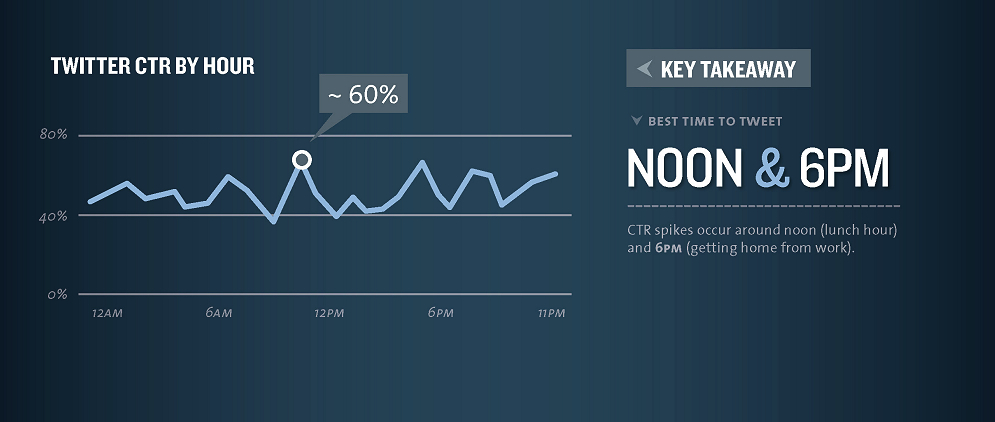
If your purpose isn’t to be re-Tweeted, but rather to have followers click on your links, the statistics change a bit. The report says that the highest click through rate (CTR) is noon and 6:00 p.m., Eastern time.
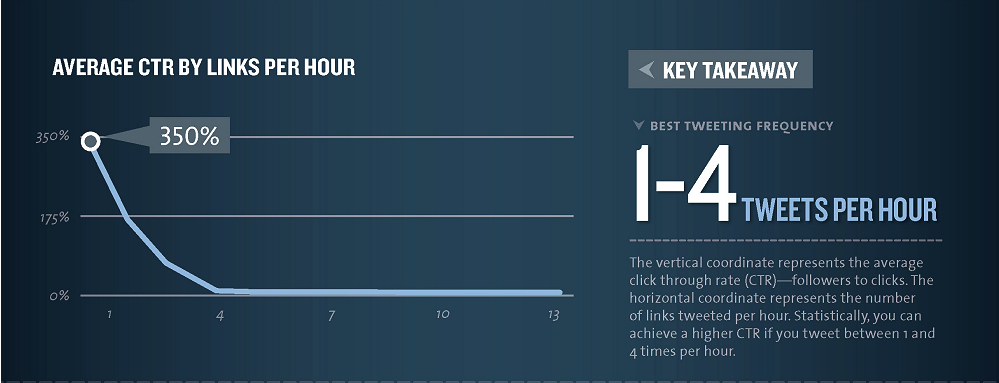
How often should you Tweet if you want people to click through to your links? Survey says… 1 to 4 times per hour. The click through rate (CTR) is apparently highest for those who Tweet their links every 15 to 60 minutes. If you tweet links more than 4 times per hour, your followers are likely to become numbed to your barage of Tweets. Personally, I never Tweet with links that much. I guess I need to start Tweeting more!
KISS Metrics2

People are most likely to click on your links mid-week and on the weekends. That is when the click through rate (CTR) is highest.

Top Facts about Facebook

The best day to share on Facebook is Saturday. That’s when the most sharing is done. This offers good food for thought for companies, schools and non-profits who only share on Facebook during the work week. Maybe it is worth using a tool such as Hootsuite to schedule your FB updates so you are sharing when employees are off the clock.

And if you’re wondering when on Saturday (or any day) to post things that are most likely to be shared, the best time of day to post on Facebook is at noon.

If you have a Facebook page, the KISS metrics show that one post every day will help you build the most “likes”.

Check out the full post by KISS Metrics.

So, what’s the moral of the story? Use social media regularly and consistently, but don’t jam it down anyone’s throat. Share information when others are likely to share your links. Pay attention to when people are on line and post at times when your links and “shareables” are likely to be seen.

_______________

Share this post: The Best Time of Day to Tweet, When to Post to Facebook and other Social Media Insights http://wp.me/pNAh3-TN

Update – January 2018 – This blog has had over 1.8 million views thanks to readers like you. If you enjoyed this post, please “like” it or share it on social media. Thanks!

Sarah Elaine Eaton is a faculty member in the Werklund School of Education, University of Calgary, Canada.


6 Things You Probably Didn’t know About Social Media and the WWW

September 23, 2011

Did you know…?

In 1978 authors Roxanne Hiltz and Murray Toroff envisioned a future in which computer-mediated communication (CMC) would have a major effect on people’s every day lives. Their book,”The Network Nation”, is published by MIT Press in Cambridge, MA. It has been updated and revised since its original printing and is now considered a classic book in the field of CMC.

In 1992 the World Wide Web was officially launched to the public. (Can you believe that the Web is only 20 years old?!)

In 1997 SixDegrees was established as the first social networking site that most resembles the sites we use today, but users were skeptical and reluctant to interact with strangers. The company was sold in 2000 and today many people believe that the original company was too ahead of its time.

LinkedIn was created in 2002 and publicly launched in 2003 (before Facebook!)

In 2004 Facebook was launched.

Two years later, in 2006, Twitter was launched.

______________

Share this post: 6 Things You Probably Didn’t know About Social Media and the WWW http://wp.me/pNAh3-Qi

Update – January 2018 – This blog has had over 1.8 million views thanks to readers like you. If you enjoyed this post, please “like” it or share it on social media. Thanks!

Sarah Elaine Eaton is a faculty member in the Werklund School of Education, University of Calgary, Canada.


Social media: A catalyst for revolt and revolution

September 22, 2011

Protesters shout anti-government slogans during a protest in Suez, Egypt., AP

In January of this year, Egyptian activist turned to Facebook to increase awareness and invite participation in public protests held in the streets of major cities there. People from around the world watched with both horror and curiosity and the events in Egypt unfolded. It was the first time (as far as I know) that social media had been used on such a large scale to promote political and social protests. But it was not the last.

Here is just one example of a news article about how Egyptian activists used Facebook to inform, educate and invite support. Social media has become a force for social change… And not just in Egypt.

Over 3600 Air Canada flight attendants are reportedly participating in a Facebook page (limited to Air Canada employees) to vent their anger at the company, as well as union leaders who are representing them in current negotiations.  That’s over half of all the flight attendants who work for the company, who are spread out across the country. Sixty percent (60%) of the company’s pilots have joined a private website, limited only to pilots, to dialogue on related issues. (Check out the news story here).

Management and the union at Air Canada are in the middle of talks to negotiate a new contract. It is reported that a six-page letter written by Susan Welscheid, Air Canada’s senior vice-president of customer service, sparked a wave of rage among the company’s workers, causing them to join the Facebook group and vent their frustrations.

The employees voted last month on a new contract. Eighty eight per cent (88%) of unionized flight attendants members who cast ballots rejected the contract, one that had been endorsed by their  negotiating team. By way of a comparison, less than 60% of Canadians voted in the 2008 federal election. Canadians tend to be a bit of an apathetic lot when it comes to voting in anything, really. Getting 88% of a Canadian group out to vote on something is startling in and of itself, really.

Union leaders and management say they are floored by the Facebook outburst, saying that it is making negotiations difficult.

So what do the cases in Egypt and Canada have in common? We can see some commonalities, as both groups

  • chose Facebook pages as their medium
  • united people who are spread out across a nation
  • gave voice to a group who felt that those who were supposed to represent and protect them were not fulfilling their responsibilities
  • created a space for people to express anger and talk about what actions to take
  • sparked interest by the media by the very fact that they used (and continue to use) social media as a catalyst for change, driven by the people themselves

The use of social media as a social force to rally ordinary citizens joined by a common cause, ready and willing to fight for something they believe in — seems to be a growing phenomenon. My guess is that we’ll continue to see social media used by people for causes, concerns and as a catalyst for change.

_______

Share this post: Social media: A catalyst for revolt and revolution http://wp.me/pNAh3-Te

Update – January 2018 – This blog has had over 1.8 million views thanks to readers like you. If you enjoyed this post, please “like” it or share it on social media. Thanks!

Sarah Elaine Eaton is a faculty member in the Werklund School of Education, University of Calgary, Canada.


21 Photos You Should Never Post on Social Media

July 12, 2011
Sarah Eaton

Share photos on social media that are crisp, clean and professional.

I have been working with a variety of organizations on social media strategies, tactics and plans this year. Part of the learning curve involves getting a handle on exactly what we should post on social media. The flip side is knowing what not to post.

One of the toughest questions relates to photographs. Staff at every level, as well as students and volunteers need to be very, very clear that once their photos are posted on line, they immediately leave a “digital footprint”.

In Vancouver earlier this year there was a riot after the city’s hockey team lost the final game of the 2011 Stanley Cup. Photos posted online have been used to identify those involved in the incident. There’s even a Facebook page called “Vancouver Riot Pics: Post Your Photos” and a similar website that police are reportedly scanning to gather evidence against alleged rioters.

In addition to photos taken of just about anyone, by anyone else, at a public event, pictures can also be copied by just about anyone, saved and then re-shared again via e-mail or other postings. Oh yeah, and in between the point when they are saved and re-distributed, they can also be Photoshopped. Think about that for a minute… That means anything you post on line can be saved by someone else and altered in any number of ways beyond your wildest dreams.

Last month, in the United States, the federal government essentially condoned a new start-up company whose core business is to screen prospective employees for companies, by scouring their digital and social media footprints.

That doesn’t mean that you shouldn’t post photos. It just means that you want to be very savvy about what you put out there in cyberspace. Avoid photos that could be considered questionable by prospective employers, program funders or other professional contacts. But what does that mean, exactly? Let me give you some examples of the types of photos (and videos) to avoid:

  1. You, in a swimsuit. Seriously, unless you are a swimsuit model and you’re looking for modelling gigs, leave the beach photos off social media.
  2. You, in your underwear (especially if it’s in a public setting and that’s all you happen to be wearing).
  3. Boudoir shots (Unless you’re a boudoir photographer or a nude model, don’t post these.)
  4. Drunk / tipsy photos.
  5. Photos of you – or anyone – lighting up a reefer or doing any kind of drugs. (See #12).
  6. You leaning over a toilet bowl (or anywhere else) vomiting.
  7. Actually… any photos of bodily functions are best left off social media.
  8. You engaging in frisky behaviour with your boss’s, colleague’s or friend’s significant other.
  9. Smoochy stuff of any kind — unless it’s your own wedding photo, and even then, I’d err on the side of caution.
  10. “Ferris Bueller’s Day Off” photos – That means, photos of you having a good time, when you should have been at work or school. (Bosses and teachers use Facebook too, you know.)
  11. You with a .49 shotgun, a machine gun, a handgun or any kind of weapon, for that matter. (Again, unless you are a firearms instructor.)
  12. You, engaged in any kind of criminal or illicit activities. (I’m sure the Vancouver riot seemed innocent enough at the time…)
  13. You, acting out your anger or frustrations by walloping your kid with a big ol’ wooden spoon or kicking the dog.
  14. You, taking out your frustrations or loneliness by cutting your wrists, hanging yourself by a noose, or even staging or pretending a suicide attempt. That’s just disturbing. Call the local help line. Don’t post a photo.
  15. You, being arrested, being hauled off in a police car or in jail.
  16. Similarly, you, in a straight jacket, handcuffed or otherwise restrained. Even if it’s part of a Halloween costume, just think what a prospective employer might think when they Google you and see that photo out of context. You won’t get the job.
  17. Photos of your house, that clearly show your address. (Seriously, do you really want to make it that easy for the whole world — and I mean, the whole world — to know where you live?)
  18. Photo renditions (scanned copies) of your driver’s license, passport or other ID. Even if you just got your first ever driver’s license, do not scan it and post it on Facebook. Ever.
  19. Photo renditions (scanned copies) of prescriptions. (Despite what you may believe, your Facebook friends don’t need to know what meds you’re on.)
  20. Photos of other people’s children – taken or posted without their permission. A friend of mine recently found a photo of her daughter posted on a government website. In an attempt to save money, the web designer found photos of cute kids on Google and used them as generic art on the website. (It’s not legal, but it happens). She got the photo removed, but prior to that incident, she had no idea the photo was even on line.
  21. Photos of your friends or loved ones that may compromise their future. You can inadvertently jeopardize others’ safety and job prospects by posting inappropriate photos of them.

Think about the repercussions of every single photo you post. The general rule is to keep it clean and professional. If you wouldn’t show it to your boss, your grandma, your favorite teacher AND the local preacher, don’t post it on line. What seems funny today could cost you a job, a contract or a college admission tomorrow.

_____________________

Share this post: 21 Photos You Should Never Post on Social Media http://wp.me/pNAh3-O2

Update – January 2018 – This blog has had over 1.8 million views thanks to readers like you. If you enjoyed this post, please “like” it or share it on social media. Thanks!

Sarah Elaine Eaton is a faculty member in the Werklund School of Education, University of Calgary, Canada.


Social Media in a Family Literacy Program

May 21, 2011

Yesterday I was in Edmonton for the Food for Thought conference put on by the Centre for Family Literacy. A group of 42 literacy coordinators, practitioners and other professionals packed the workshop room to learn about how to use social media in a family literacy program. We talked about:

  • How to set up a Facebook page
  • What to put on your Facebook page
  • How to use Twitter including how the “@” and “#” or hashtags work
  • How to use Hootsuite

I gave a live demo of Twitter and Hootsuite. I showed how to mention other people and how to use hashtags to find topics you’re interested in. We also shared tips on how to use programs like Hootsuite to schedule updates and tweets and make social media more effective.

We also had a wonderful discussion about how to have a Facebook page without having it tied to a personal Facebook account. That was new for me. I have a couple of Facebook pages for different things that I do, and the only way I’ve ever built them was through my personal account.

For me, it was great learning to know that there are newer options available that don’t require an individual to have an organizational page tied to their name.

Here are the juiciest tips I shared from my own experience using social media:

Top Tips for using Social Media in a Literacy Program

Use social media as a way to reach more learners

There are some learners, particularly younger ones, who are digital natives. They have grown up with technology and may even be turned off by the idea of “old school” reading and writing. By stepping into the world of social media, you can meet those learners where they are today. You won’t reach all learners that way, of course. But it does open the doors to reaching those who might otherwise dismiss traditional literacy programs because they don’t relate to them.

Decide where you want to be on the “privacy continuum”.

Different people have different needs and comfort levels with posting personal information on the Internet. It is OK to be private… or even fib just a little bit, while still being authentic. We talked about how to figure out where people fit along the continuum and that no matter where that is, it’s OK.

Post regularly

Using a service such as Hootsuite can help you to streamline your social media activity, so it takes less time. I shared that had scheduled a number of Tweets before I left Calgary so that I was covered until I got home.

Think about sharing and helping others

We talked about how to use social media as a way to give and share resources. We looked at pages from a variety of literacy organizations. I pointed out how social media is meant to be a social, and reciprocal, activity. I recommend that people “like” pages of other organizations they support.

Avoid the “Incessant Ask” or “push”

One mistake non-profit organizations make when they use social media is to post a constant barage of requests for funding or donations, or just post about their own programs. The idea of social media is to engage with others, not push information on them, or worse yet, push unending requests for money at them. Re-posting, re-tweeting and sharing others’ information is a good thing!

Create conversations

Social media is just that – social. It’s a place to engage with others… talk with them. Ask questions. Be interested. Keeping a good balance between giving and taking, as well as giving and asking, are key points to keep in mind.

Say “Thank You”

I showed how to track “@” mentions and why it is important to say thank you when others re-post or re-Tweet your material. You may miss the odd one here and there, but overall, making a concerted effort to show appreciation when others like and share what you do, goes a long way in creating positive relationships and making you a good digital citizen.

I just loved working with this group. They’re passionate, engaged and ready to help one another out at a moment’s notice. Thanks to everyone who attended the session, shared and engaged with us!

_________________

Share this post: Social Media in a Family Literacy Program http://wp.me/pNAh3-FI

Update – January 2018 – This blog has had over 1.8 million views thanks to readers like you. If you enjoyed this post, please “like” it or share it on social media. Thanks!

Sarah Elaine Eaton is a faculty member in the Werklund School of Education, University of Calgary, Canada.