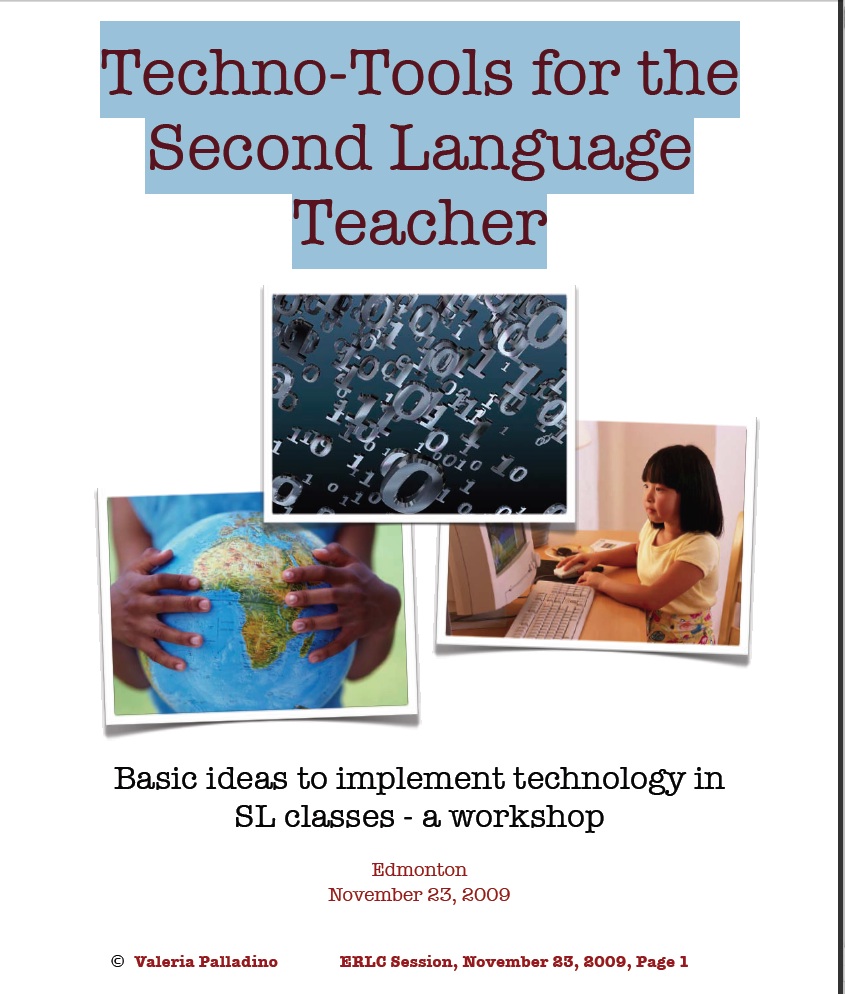
Techno-Tools for the Second Language Teacher

June 27, 2011

Valeria Palladino, a language teacher in Edmonton, Canada, has a great wiki on technology tools for second languages: http://technotoolsforslclasses.wikispaces.com/

She has also done a useful and easy to follow 29-page guide called “Techno-Tools for the Second Language Teacher“. It contains ideas on how to implement technology into second language classes. This guide is particularly useful for teachers who want to integrate tech into their second language classrooms, but are not sure where to start. Palladino explains the basics in language that is easy to understand and easy to follow.

_____________

Related posts:

Cool Apps for Language Learning http://wp.me/pNAh3-mQ

MALL (Mobile-Assisted Language Learning) http://wp.me/pNAh3-6U

__________

Share this post: Techno-Tools for the Second Language Teacher http://wp.me/pNAh3-M7

Update – January 2018 – This blog has had over 1.8 million views thanks to readers like you. If you enjoyed this post, please “like” it or share it on social media. Thanks!

Sarah Elaine Eaton is a faculty member in the Werklund School of Education, University of Calgary, Canada.

7 Ways to Maintain or Improve Your Foreign Language Skills Every Day During the Summer

June 13, 2011

Build your learning skillsSchool’s almost out! How are you going to retain all the language skills you’ve learned over the school year? Or better yet, build on them?

Formal language programs (the kind delivered in classrooms around the world) are often highly structured and follow a prescribed curriculum. We know that language learning doesn’t just happen in a classroom! The summer is a fantastic way to build on that by incorporating informal learning and exposure to authentic language.

Here are some ideas to help you maintain — and even build — your abilities in all four skill areas (reading, writing, speaking and listening) in the languages you love to learn. There are seven suggestions for weekly activities. If you do rotate through them, committing to doing one every day, by the time you’re at the end of the list, you can start the list over the next week.

1. Learn a song a week

Think about a song you really love in the language you’re learning. Look it up. Find the lyrics on the Internet and print them out. Listen to the song and sing along with the words. Then, challenge yourself to try and remember the words without looking at the lyrics sheet. Play the song every day at least once. Listen to it while you’re driving, waiting for the bus, making breakfast or out for a run. Listen to it over and over again until you can sing it all the way through without looking at the lyrics.  The next week, choose a new song and repeat the process. By the end of the summer, you’ll have a decent repertoire of songs in your target language! (Skill area: listening)

2. Watch a movie a week in the target language

Watching movies is a great way to get exposure to authentic language. Turn on the sub-titles if you need to. If you’re up for a challenge, leave the sub-titles off and just enjoy the film. Set yourself a goal such as: Watching movies by the same director or watching a different genre of movie every week. Watch an action movie one week and a comedy the next, for example. Keep notes about the movies you watch and any new words or phrases you’ve picked up. (Skill area: listening)

3. Read one news article a week once a week in the target language

News is a fantastic way to get exposure to authentic language – and learn what’s going on in the world. There are a few different ways to read the news. You can buy a foreign language newspaper and choose one article a week to work on. Or once a week, you can go on line and find a news article on a topic you’re interested in and read it through. Read for content and meaning, trying to get the gist of what it is saying. Then read it again to get the deeper meaning and the details. If you prefer a more structured approach, dissect the article to find the “5 Ws” (Who? What? When? Where? Why?) in the article and write them down on a separate sheet of paper. Find one or two new vocabulary words an add them to your list. (Skill areas: reading and possibly writing, if you choose to incorporate it).

4. Volunteer an hour or two a week for a language exchange with a native speaker

Language learners really benefit from working with native speakers. Check out programs at your local library or immigrant services organization to see if they have language exchange programs. These programs match people of two different languages so they can enjoy informal conversation and learn from each other. You spend an hour with that person speaking your native language in order to help them learn it. They, in turn, spend an hour with you teaching you their native language. It’s a great way to meet new friends and build your conversation skills. Having a regularly scheduled weekly appointment helps to ensure that you’ll commit to each other and to learning. (Skill area: speaking)

5. Once a week, use a self-directed activity book or online exercises

To help you practice your skills in a more structured way, get yourself a self-directed activity book or find an Internet site that has free online activities. (One of my favorites is Spanish Now.) Be sure to look for a resource that includes answers so you can check your own work. Once a week, sit down with your work book or at the computer, complete one unit in the activity book. Check your answers. If you made errors, challenge yourself to figure out what they were and how to build on those areas. It’s OK to review concepts you already know and it’s even better if you try to build on your current skills by delving into new areas such as more complex verb conjugations or sentence structures. (Skill areas: Reading and writing)

6. Build your own vocabulary list

Many of the activities listed above give you the chance to pick out new words, write them down and learn them. You can write them in a notebook, create your own flash cards or do whatever works best for you. It is important to write them down, say them aloud and try to incorporate them into your speech. If you’re stuck for ideas, look around your house. Do you know all of the words for household items? Food? Clothing? You can build your own theme lists, if the idea appeals to you. Take the time to learn words that may not appear in your course textbooks. Chances are, those words will come in handy some day! (Skill areas: Reading and writing)

7. Once a week, check out a new restaurant, store or cultural event that specializes in your target culture or language

Choose one day a week, say, Thursday, where you make a point to try a restaurant you’ve never been to where they serve authentic food from someplace where your target language is spoken. Try to speak to the staff in the target language. Ask questions about the menu. Alternately, find the shops around your city that import food an other goods from the countries where your target language is spoken. Find out where they are located and go there. Explore the store and find one or two new products to try. Talk to the staff and tell them you are curious and want to learn. Chances are, they’ll be pleased to help. Finally, make a point to find out about cultural events such as festivals, concerts, dance performances or plays in your target language. Go. Have fun. Soak it all in. Experience authentic sounds, smells and tastes and make these part of your language experience. Find out what’s going on in your local community and become a part of it. This may be easier to do in urban areas than in smaller towns, but it may be worth a trip into town, too. (Skill areas: Reading, writing, speaking and listening.)

We know that the more time we invest in learning, the more successful we’ll be over the long run. This summer, make your language learning experience your own. Have fun with it!

Related posts

How Long Does it Take to Learn a New Language?

Formal, Non-formal and Informal Learning: What Are the Differences?

The many faces of non-formal learning

Formal, non-formal and informal learning: The case of literacy and language learning in Canada

________________

Share this post: 7 Ways to Maintain or Improve Your Foreign Language Skills Every Day During the Summer http://wp.me/pNAh3-K7

Update – January 2018 – This blog has had over 1.8 million views thanks to readers like you. If you enjoyed this post, please “like” it or share it on social media. Thanks!

Sarah Elaine Eaton is a faculty member in the Werklund School of Education, University of Calgary, Canada.


27 Great Resources on Using Portfolios for Language Learning and Literacy

June 10, 2011

Some of my favorite resources for using portfolios, strength-based and asset-based evaluation and assessment for language learning. I’ve divided them into practical resources for the classroom language teachers, video resources and research resources for students and scholars. The resources cover a range of topics related to languages and literacy including:

  • portfolios for younger learners
  • portfolios for adult learners
  • foreign and second language teaching
  • literacy and ESL

Practical Resources for Language Teachers

Portfolio Assessment in the Foreign Language Classroom

An amazing online resource that’s part of the Portfolio Assessment Project conducted by the The National Capital Language Resource Center (NCLRC), a consortium of Georgetown University, The George Washington University, and the Center for Applied Linguistics.

Assessment and Independent Language Learning

This site is a veritable cornucopia of resources on strength-based assessment from the Subject Centre for Languages, Linguistics and Area Studies in the UK.

Global Language Portfolio

A project headed up by Patricia Cummins, the Global Language Portfolio (GLP) is an electronic document used by learners, teachers, educational institutions, employers and other organizations to present information about language. It promotes language learning and the development of cultural competence, and it is modeled on the European Language Portfolio (ELP).

Independent Language Learning

This site by the University of Manchester covers a number of aspects of independent language learning, including assessment. But it goes further than that. It also talks about how learners can set goals and stay motivated.

Portfolios in English Language Teaching (ELT)

A site from the BBC that talks mostly about using portfolios to use English, but the principles can be applied to any language. They also reference the Council of Europe’s portfolio page.

A Resource for Integrating Collaborative Language Portfolio Assessment (CLPA) into the Teaching-Learning Cycle of Adult ESL Instruction (Manitoba Best Practices)

A 68-page downloadable .pdf that includes best practices and examples. It is directed towards adult ESL learners, but the principles could be applied for any language.

The European Language Portfolio: A Guide for Learners (15+)

An 8-page downloadable .pdf on the European Language Portfolio. I love the simple, plain language approach of this resource.

Junior European Language Portfolio

The junior version of the European Language Portfolio is a Council of Europe initiative, launched in the 2001 European Year of Languages. The ELP provides pupils with a record of their achievements and progress in languages. Junior European Languages Portfolio.

Downloadable e-copy of European Language Portfolio – Junior version

A 36-page .pdf resource teachers can use with their junior students. Hard copies are available for sale from the National Centre for Languages, but this electronic version is free.

Downloadable Teachers’ Guide on Using the European Language Portfolio – Junior version

This teachers’ guide accompanies the Junior Language Portfolio. Like the portfolio itself, hard copies are available for sale from the National Centre for Languages. This 26-page .pdf version is free.

Student Portfolios in the Foreign Language Classroom – FLTEACH FAQ

A great synopsis prepared by Lee Risley that includes topics such as the purpose of a portfolio, contents of a portfolio, assessment of portfolios and resources.

Video Resources

World Language Assessment: Using Feedback in Assessment (15:06)

A production of Wisconsin Public Television. Jennifer Block, Kari Ewoldt, and Jaci Collins use literature circles, LinguaFolio, and student portfolios to provide students with the crucial feedback they need as they continue to learn and grow.

European Language Portfolios

A series of five videos. This series is a recording of a webinar of a live presentation on the European Language Portfolio by Margarete Nezbeda, project coordinator of the ECML-project Training Teachers to use the European Language Portfolio. I recommend watching them in order, otherwise it seems a bit disjointed. Here are the links to: Part 1 (09:58), Part 2 (09:48), Part 3 (09:59), Part 4 (07:03), Part 5 (07:16)

Research Materials

Student Reflection in Portfolio Assessment: Making Language Learning More Visible

By Viljo Kohonen at the University of Tampere, this article was published in Babylonia in 2000. It’s available as a 6-page .pdf download and it addresses topics such as visible and invisible outcomes in language learning, how to increase visibility of learning using portfolios, how to get started, and how to get students thinking about learning processes.

Portfolio Assessment and English Language Learners: An Annotated Bibliography

By Emily Lynch Gómez, published by the Northeast and Islands Regional Educational Laboratory at Brown University. This 25-page .pdf download addresses topics such as performance assessment, using portfolios at the state and district levels and classroom-based use of portfolios.

An Introduction to Electronic Portfolios in the Language Classroom

An article by Sadia Yasser Ali in the Internet TESL Journal. This research article gives an introduction to portfolios before offering ideas on how to use electronic portfolios in language classrooms; the steps of developing electronic portfolios and the technological requirements for developing them.

Portfolio Assessment in Simulation for Language Learning

By Amparo García-Carbonell, Frances Watts and Beverly Rising, this 6-page article published by the Tilburg University Press discusses experiences from two different universities in three different fields of study. The principal purpose of the simulations used is to learn English as a second or foreign language within a specific field of study.

Enhancing the pedagogical aspects of the European Language Portfolio (ELP)

This document (in .doc format) is published by the Council of Europe. More of a research document than for classroom practical use.

Development and Implementation of Student Portfolios in Foreign Language Programs

Developed by the California Foreign Language Project, this website contains a variety of pages including: purpose of a portfolio, audience of a portfolio, method, analysis and results, conclusions and recommendations.

Using a Literacy Portfolio in a Third-Grade Class

A 30-page .pdf download by Caroline Kuperschmid, Third-Grade Teacher, and Sandra Cerulli, Reading Specialist. Contains information on how to implement reading-writing portfolios in class and authentic examples from grade 3 students.

Literacy Portfolio Assessment: A Resource for Literacy Workers

Don’t be fooled by the “older” look of the front page of resource. It’s a solid 71-page resource by Maurice Taylor, University of Ottawa. Includes topics such as testing and assessment in adult education, alternative assessment, and how to develop a literacy portfolio.

Portfolios: Assessment in Language Arts

A brief overview of using portfolios for assessment in language arts courses by Roger Farr, archived by the ERIC Clearninghouse on Reading and Communication Skills.

A Case Study of Using Portfolios to Make Language Learning More Visible at a Japanese Senior High School

A 6-page research article by Kenji Nakayama. (You may need to install Japanese character fonts on your Adobe reader to access this resource.)

The European Language Portfolio and its Potential for Canada

By Rehorick, S., & Lafargue, C. (2005) this paper is from the Proceedings of a conference held at the University of New Brunswick.

Related posts:

Student portfolios for Language Learning: What They Are and How to Use Them

Also, you can check out my Diigo list on Learning Portfolios.

_________________

Share this post: 21 Great Resources on Using Portfolios for Language Learning http://wp.me/pNAh3-HZ

Update – January 2018 – This blog has had over 1.8 million views thanks to readers like you. If you enjoyed this post, please “like” it or share it on social media. Thanks!

Sarah Elaine Eaton is a faculty member in the Werklund School of Education, University of Calgary, Canada.


Job Opportunity: Summer Research Assistant – Specialist in Second Languages

June 2, 2011

June 15, 2011 – Update – This position has been filled. Thanks for the many responses and queries!

_________

I have a project on the go that examines questions around second language education, L2 acquisition and language learning and pedagogy. I’m looking for a part-time research assistant / associate to collaborate on this project over the summer months. Here’s what I’m looking for:

Research Assistant / Associate (Term position)

Summary statement

The Research Assistant / Associate is responsible for assisting the Principal Investigator (PI) in the collection, formatting, analysis and reporting of information on topics relating to second and other language acquisition, language pedagogy and related topics.

Major Responsibilities

  • Plans, organizes and coordinates his or her own schedule to ensure that deliverables are met by due dates.
  • Liaises with the PI for the collection, formatting, analysis and reporting of information.
  • Conducts a literature review using primarily online academic, government and other databases.
  • Data entry of bibliographic information using Endnote.
  • Maintains electronic and hard copy data files and reports.
  • Maintains up-to-date documentation of work completed.
  • Produces written materials for research reports.
  • Proofreads and edits documents generated by the PI.
Meets with the PI on a regular basis to review the work in progress.
  • Deliver work completed on a weekly basis. These deliverables will generally consist of research articles, government reports, applied research articles and professional materials that can contribute to the research report.

Education

Post-secondary degree. Candidates who are currently enrolled in a Master’s or PhD program will be given preference.

A background in second language learning or second language education is highly desirable.

Experience and Skills

  • Experience working with electronic research databases.
  • Previous research experience (e.g. conducting a literature review) is desirable.
  • High levels of personal motivation, self-management and detail-orientation. The incumbent will have the ability to take responsibility to meet deadlines and make progress with minimal supervision.
  • Strong spoken and written communication skills.
  • Rigorous research methods.

Other qualifications

  • You have access to academic research databases through the library of an accredited institution.
  • Strong existing technology skills with MS Word (or Pages), Endnote and general Internet and electronic communications.
  • You are comfortable navigating the Internet to conduct research.
  • You are able to meet face-to-face in the Calgary area on a regular basis or via Skype if you are not located in the Calgary area.
  • You have access to your own computer and the Internet.
  • Must be legally entitled to work in Canada and have a valid Social Insurance Number.

Position Details

Start date: Monday, June 13, 2011
End date: Friday, August 5, 2011

Hours: Generally flexible hours – 5 to 15 hours per week, with a minimum of 5 hours per week.

Wage: $25 / hour, to a maximum of 80 hours ($2000) during the term of the project. Wages are subject to the usual CPP and EI deductions.

Work site: You will work from your own home, on campus or anywhere the work can be completed.

To apply send a brief resume and cover letter via e-mail to:

Dr. Sarah Elaine Eaton
Eaton International Consulting Inc.
sarahelaineeaton (at) gmail.com

Applications are accepted until a suitable candidate is found.

Download a copy of this document for easy printing from:

View this document on Scribd

______________

Share this post: Job Opportunity: Summer Research Assistant – Specialist in Second Languages http://wp.me/pNAh3-HR


How ESL and other Language Schools Can Use Webinar Technology

April 30, 2011

The word webinar is being used today to refer to all kinds of online training and virtual presentations.

More and more literacy and language schools are adding a component of e-learning to their programs. It’s the 21st century way to learn!

Webinars are relatively easy to put on. Some of the language is a bit different from face-to-face environments, so it’s helpful to know that instructors, facilitators and teachers are mostly referred to as “presenters” in the webinar environment. Students, learners and clients are generally called “participants”.

Both presenters and participants need to have basic technology and computer literacy in order to take part in a webinar. This may mean that your current teachers and facilitators require some training before moving into an e-learning environment. Your participants may benefit from an orientation prior to the content to familiarize them with how webinars work.

Assuming that both parties have the technology literacy to move forward, here are some ideas on how you can make the most of webinar technology in your organization.

For Participants

Online group classes

Bring participants together in an e-learning class not only to teach them new content and skills, but also to learn how to work together in an online environment.

Online tutoring

Do you have learners in rural and remote areas? Or single parents who find it hard to get a sitter? Online tutoring provides a way for otherwise isolated learners to connect with tutors from the comfort and convenience of their own home. This is a super way to reach out to people who might otherwise not engage with learning.

Information sessions

If you offer information sessions about your programs in a live setting (your office space, a public library or elsewhere), you can adapt your content and host virtual information sessions. Information sessions are for prospective students and have a slight marketing component. A word of caution though… don’t try to “sell” in a webinar. Instead, demonstrate your expertise and what makes you unique.

Orientation sessions

When you bring new students into your organization, do you give them an orientation on  what to expect and how things work there? Photos, maps, and other materials can also be used in an online environment to give a virtual orientation. Though I’m a big fan of doing live webinars, this is one that you could record and use over again.

Pre-arrival workshops

If you offer classes for international students coming to learn English as a Second Language, an online pre-arrival workshop can be very helpful. Using photos, you can demonstrate what kind of clothes to bring (e.g. warm sweaters and winter boots), photos of the airport and what it will look like when they arrive, photos of what a typical airport arrival day looks like, and whatever other information you’d like them to know before they get to the program.

Follow-up workshops

Webinars are a great way to keep relationships going once the opportunity for face-to-face interaction has passed. A value-added webinar one month after the course ends is a super way to stay connected. Use the next upcoming holiday as a theme for your class and have everyone learn about it in the virtual classroom. In cases where participants already know one another, the online interaction is usually fun and very dynamic.

For staff and volunteers

Volunteer information sessions

Do you like the idea of having virtual teachers or tutors? Then set the stage by offering online information sessions for prospective teachers and volunteers about your organization. Review the programs that you offer, the opportunities you and the benefits of working with your organization. This is a great time to have current staff members and volunteer tutors chime in with what they love about working with you!

Volunteer training

Do you train your staff in intensive sessions that jam in loads of information? You can break it up into a series of online training workshops. The material is easier to absorb if you divide it into “chunks”. If you have ongoing workshops, your volunteers get ongoing training, which keeps building their skills. As an organization, ongoing training for them means you give offering them something back for their time and expertise.

Staff development workshops

Do your staff currently get all their professional development at an annual conference? I love conferences because of the chance to connect with old friends. But wouldn’t it be great to offer ongoing training and development for your staff throughout the year? The cool thing about this is that you don’t have to organize all the sessions yourself. Check out the Centre for Interactive Learning and Collaboration (CILC). They specialize in  offering online PD for educators. They have literally hundreds of programs to choose from, ranging from free to expensive.

For the community

A Virtual Open House

Share what you do with the community, your stakeholders and donors through a virtual open house. Include photos of your facilities and your staff. A video that uses digital storytelling to celebrate the success of your learners makes it even more dynamic.

These are just a few ideas for literacy and language programs to use webinars in their organizations. I’m a big fan of using this technology in the non-profit and educational sectors. It offers a lot of value for everyone – staff, volunteers, learners and students, as well as community stake holders. How many non-profits still lag behind when it comes to their own technology literacy? Implementing the use of webinars positions your organization as a leader in terms of technology. You lead by example, showing others how virtual and online learning is an important part of 21st century of education and professional capacity building.

___________________

Share or Tweet this post: How ESL and other Language Schools Can Use Webinar Technology http://wp.me/pNAh3-sH

Update – January 2018 – This blog has had over 1.8 million views thanks to readers like you. If you enjoyed this post, please “like” it or share it on social media. Thanks!

Sarah Elaine Eaton is a faculty member in the Werklund School of Education, University of Calgary, Canada.