Achieving peace one word, one language at a time

January 4, 2012

I recently posted about how the U.S. military offers bonus pay to soldiers with demonstrated foreign language skills. In the post I suggested that language program managers might cite military examples when lobbying for funding for language programs.

The idea of advocating for language program funding by citing examples of military language training might not sit well with some language program administrators and teachers. In my experience, some of my most beloved colleagues are also peace activists and slightly (if not adamantly) anti-military.

Achieving peace one word at a time

But what if part of the answer to the global issues we face today was increasing, rather than decreasing, the focus we as a society place on communicating and appreciating one another’s languages and cultures? I won’t be so naive to say that learning languages is a panacea to all that is wrong with the world. But I do believe that peace and understanding are built one person at a time. One person, communicating with one person, listening and trying to understand one person. This is how we challenge our assumptions, learn about one another and wrap our minds around different ways of life, sharing, raising our children, worshipping, of thinking… and of living and being.

To speak another’s language is to begin to see the world from his or her point of view. We may never be able to fully understand those whose ways of life and beliefs differ so drastically from ours. But perhaps we do not have to fully understand. Perhaps we need only to begin to understand, in order for things to change for the better. There is a saying in English about how to overcome a seemingly insurmountable problem:

How do you eat an elephant? Answer: one bite at a time.

This could be modified to:

How do you achieve world peace? Answer: One word at a time.

Imagine a peace corps dedicated to global understanding through language learning: Daily verb conjugation drills, vocabulary drills, grammar sequences, language simulations, engaging with the other in one-on-one conversations in real time, with dictionaries and language apps instead of weapons.

What on earth might happen?

_____________

Share or Tweet this post: Achieving peace one word, one language at a time http://wp.me/pNAh3-18h

Update – January 2018 – This blog has had over 1.8 million views thanks to readers like you. If you enjoyed this post, please “like” it or share it on social media. Thanks!

Sarah Elaine Eaton is a faculty member in the Werklund School of Education, University of Calgary, Canada.


Did you know? U.S. soldiers with foreign language skills can earn up to $1000 bonus pay per month

January 3, 2012

On Friday, Dec. 30, 2011, the Army Times posted an article entitled “Foreign language program rules modified“.

The article explained that there is a program in the U.S. military that allows soldiers with foreign language skills to earn monthly bonus pay:

“The Foreign Language Proficiency Bonus program has been modified, allowing payments to certain language-skilled soldiers, regardless of their MOS or duty positions.”

Known as the FLPB program, it offers soldiers the opportunity to earn an extra $400 per month for one additional language and up to $1000 per month for a combination of other languages. There are exceptions to the policy and soldiers must pass language proficiency tests in order to qualify for the program.

The military as an advocate of language learning

When a major organization actually pays employees a bonus for having demonstrated language proficiency, that shows how much the organization values the skill. In other words, they literally put their money where their mouth is. However you might feel about the U.S. military, you have to admit that they are single-handedly demonstrating that learning foreign languages can be beneficial to your career.

Military around the world value language skills

In case you’re thinking that this is just a U.S. phenomenon, think again.

A quick search of “foreign languages Canadian military” turned up a result of over 3 million entries on Google. One of the top hits was for the Canadian Forces Language School.

Googling “foreign languages British military” resulted in over 19 million entries. Among them was a page called “Can I join?” The site answers questions for those considering a career in the military. It states that anyone hoping for a career as an officer must have passed courses in either sciences or foreign languages. The British military also runs the Defense School of Languages.

If you are lobbying for language program funding, salute the soldiers

If you are an administrator or manager lobbying to keep your language program alive, look for news stories about how the military in your country values languages.

Here’s a hint: Don’t use search terms like “international languages” or “world languages”, go old school and look up “foreign languages” or “second languages”.

In your letters and reports, speak to the fact that the military supports, values and encourages learning languages, which demonstrates a need for language programs in schools to thrive. Students of the 21st century need all kinds of skills, and global communication skills are among them.

There are so many languages and so many words. Advocating for the survival of our language programs may actually mean advocating for long-term global peace. But try telling that to a politician and you’d be laughed out of his or her office. Instead, cite the forward thinking of the military in encouraging the development of its staff through foreign languages, noting how much they value language learning as a valuable 21st century skill.

Why do companies ignore multilingualism as a valid skill?

My question is: How can we expand this initiative and get major corporations to follow suit and pay bonuses to multilingual employees?

Over the past year, I have heard from U.S. colleagues that there have been severe funding cuts to language programs at the primary, secondary and post-secondary levels.

If corporate America (and corporate Canada, and corporate Everywhere) said, “Hey, world! We need workers skilled in global communication, world languages and intercultural understanding,” you could bet your bottom dollar that governments wouldn’t be cutting funding to language programs.

Education and language advocates spend time lobbying the government to re-instate funding to language programs. While noble, I wonder if a different approach might be more effective? Conversations with those who work in corporations, in HR departments, in marketing and sales and global business, citing examples of how the military offers bonus pay to bilingual and multilingual solders, might spark ideas on how other organizations can leverage, instead of undervalue, or worse, ignore, the depth of skill and understanding that multilingual employees bring to an organization. Those conversations might take much longer to result in changes, but I wonder if the effort would be worth the investment of time and effort to start that dialogue today?

___________________

This post comes with a caveat.  In no way am I in favour of war, military occupation of foreign territories or activities resulting in the loss of human life through weapons or attack. I don’t care what side you are on. When people you love die due to war, it tears us all apart.

_____________

Share or Tweet this post: Did you know? U.S. soldiers with foreign language skills can earn up to $1000 bonus pay per month http://wp.me/pNAh3-187

Update – January 2018 – This blog has had over 1.8 million views thanks to readers like you. If you enjoyed this post, please “like” it or share it on social media. Thanks!

Sarah Elaine Eaton is a faculty member in the Werklund School of Education, University of Calgary, Canada.


How technology has changed reading in the 21st century

November 18, 2011

Alice in WonderlandWhat would you do if your favorite little child begged you to write down the story you had told him or her orally? Would you go to the computer and start typing? Would you print it out on paper? Turn it into a slide presentation with engaging visuals? Put it onto an iPad to share together as you sit on the sofa?
C.M. Rubin ponders this question in her fascinating article “How Will We Read? – The Book Given”. She writes:

“On November 26, 1864, Lewis Carroll gave my relative, Alice Pleasance Liddell, a book he had written for her… If the book given to Alice in 1864 was given today, just imagine the variety of different ways a creative chap like Lewis Carroll might have presented it to his Alice.  Quantum leaps in technology have completely changed the way we write, illustrate, publish, market, promote and consume books.” Read the full article.

There is no question that the act of reading is changing. Just over a year ago, I blogged about an article from the Smithsonian about how digital technologies physically change the act of reading.

While bibliophiles like me may love to hold a paper book in their hand, the children of the twenty first century will also need to know how to understand and work with written text presented in a digital format. If you’re a language or literacy teacher, or even a parent who snuggles up with your little one to read a bedtime story, are you incorporating digital technologies to help the children you care about learn how to read with technology?

Related post: Teaching reading the 21st century way http://wp.me/pNAh3-cb

___________

Share this post: How technology has changed reading in the 21st century http://wp.me/pNAh3-11P

Update – January 2018 – This blog has had over 1.8 million views thanks to readers like you. If you enjoyed this post, please “like” it or share it on social media. Thanks!

Sarah Elaine Eaton is a faculty member in the Werklund School of Education, University of Calgary, Canada.


Modern Languages Experience Week helps students build confidence

November 12, 2011

In a small corner of Wales this week 200 students have been taking part in a commendable initiative designed to boost their interest and confidence in using foreign languages. The Modern Languages Experience Week is a joint initiative between Cardiff University’s School of European Studies and eleven local schools. The project brings students to the university for activities around language learning designed to increase their curiosity, practice their skills and increase their cultural awareness.

The Health Canal reports on the benefits of the initiative to the students sense of self-confidence and overall attitude.

This is a brilliant initiative, not only to increase students’ curiosity and awareness, but also to generate positive links between the school system and the post-secondary system, where the students are the ones benefitting.

___________

Share this post: Modern Languages Experience Week helps students build confidence http://wp.me/pNAh3-11g

Update – January 2018 – This blog has had over 1.8 million views thanks to readers like you. If you enjoyed this post, please “like” it or share it on social media. Thanks!

Sarah Elaine Eaton is a faculty member in the Werklund School of Education, University of Calgary, Canada.


U.S. School district asks for public input on world language program

November 6, 2011

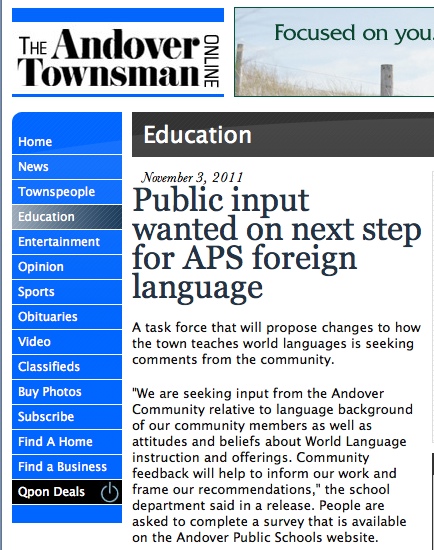
Andover public schools seek public inputThe Andover Public School board in Massachusetts, U.S.A. has established a World Language Task Force, reports the Andover Townsman. The purpose of the task force is to seek input from the community on what languages they would like to see taught in their schools and why. The task force is comprised of teachers, parents, community members, and administrators. The purpose of the task force is to:

Study the K-12 programming model and trends in world language teaching and learning.

Develop goals and strategies for a K-12 World Language program for inclusion in the Andover Public Schools Strategic Plan.

Produce recommendations relative to which one language will be taught on the elementary school level, which two languages will be taught on the middle school level, and which languages will be taught at Andover High School.

The task force is soliciting input from the public through a public online survey developed by the school board. The survey asks respondents to rank the importance of such factors as cultural competence, writing and testing skills in a first language and preparing students for global society. It also asks for input on what languages the board should offer, including popular languages such as Spanish and Chinese, as well as less popular languages such as Hmong, Khmer and Creolo Haitian.

I believe that this is a commendable initiative for a variety of reasons:

  1. Generating dialogue between school boards and the community promotes a culture of open communication. It gives a voice to parents, grandparents and even students about that is important to them. It gives a voice to the community.
  2. In addition to giving a voice to the community, it also seeks to uncover what is important to the community, digging deeper into the values, beliefs and opinions of those who live in the local area. Then, it would assume, the task force would consider these values as part of its criteria when it comes to making its decisions.
  3. It downplays the traditional authoritarian nature of school boards. Instead of propagating the ideas that “school boards know best”, it levels the playing field (at least in terms of the optics) and sends the message that “We’re here to serve you, not dictate to you.” This is a strategy that the Calgary Board of Education would have done well to employ when it arbitrarily decided to cut French programs without engaging the community in any dialogue about it.
  4. It generates community involvement and interest in language programs at the local schools. At a time when cutbacks to language programs, particularly in the United States, are mercilessly targeting world language programs, initiatives such as this will draw importance to language programs. After people have contributed to the discussion and have had some say into the decision-making process they are emotionally and psychologically invested in the outcome and are more likely to support foreign and world language programs in general.

One comment posted on the Andover news article pointed out that the survey is an imperfect tool, since respondents can answer as many times as they like, potentially skewing the results. This is relatively easy to overcome, depending on which survey tool is used. Nevertheless, the concept is brilliant. Opening up discussions about education and in particular, language learning, to the public and ultimately involving the community in the decision making process is innovative, respectful of the community and downright brilliant.

________________

Share this post: U.S. School district asks for public input on world language program http://wp.me/pNAh3-ZV

Update – January 2018 – This blog has had over 1.8 million views thanks to readers like you. If you enjoyed this post, please “like” it or share it on social media. Thanks!

Sarah Elaine Eaton is a faculty member in the Werklund School of Education, University of Calgary, Canada.