Developing the Intercultural Dimension in Language Teaching: A Practical Introduction for Teachers

August 16, 2011

Developing Intercultural Dimension in Language TeachingIn this 42-page guide, available free from the Council of Europe authors Michael Byram, Bella Gribkova and Hugh Starkey offer practical insights for classroom language teachers. The topics covered in this resource include answers to questions such as:

  • What is the intercultural dimension of language teaching?
  • What knowledge, skills, attitudes and values are involved in intercultural competence?
  • Do I need to be a native speaker?
  • How can I promote the intercultural dimension if I have to follow a set curriculum and teach grammar?
  • How do I deal with learners’ stereotypes and prejudices?
  • How do I overcome my own stereotypes and misconceptions?
  • How do I assess intercultural competence?

This is a brilliant piece of work that includes extracts from the Common European Framework of Reference for Languages and an extensive bibliography.

Get yours here: http://www.coe.int/t/dg4/linguistic/source/guide_dimintercult_en.pdf

_____________

Share this post: Developing the Intercultural Dimension in Language Teaching: A Practical Introduction for Teachers http://wp.me/pNAh3-QK

Update – January 2018 – This blog has had over 1.8 million views thanks to readers like you. If you enjoyed this post, please “like” it or share it on social media. Thanks!

Sarah Elaine Eaton is a faculty member in the Werklund School of Education, University of Calgary, Canada.


The 21st century book report: How to make a digital book trailer using free technology

July 26, 2011

Here’s a great article about how to make a book trailer. The idea behind it is to get kids revved up about reading by having them make a book trailer using Photo Story 3 (free software). The idea can easily be transferred to young adults or even adults who are into technology, but not really into reading. The beauty of it is that they reader becomes the creator of the book trailer. As they create, so they become involved and invested in the processes of reading and comprehension.

They’ll need to read the book in order to choose images that properly represent the book.

This is a 21st century form of a book report. It doesn’t have to just be for a book. You can make a book trailer using Photo Story 3 for short stories, too.

The beauty of it is that it can be used for children building their reading skills, teens who need to read more and second and foreign language students of all ages. Apparently the software doesn’t handle all foreign languages very well, so you may want to check it out before using it in your class.

What a great way to get readers engaged with the material they are reading in a modern, creative way.

_____________

Share this post: The 21st century book report: How to make a digital book trailer using free technology http://wp.me/pNAh3-PL

Update – January 2018 – This blog has had over 1.8 million views thanks to readers like you. If you enjoyed this post, please “like” it or share it on social media. Thanks!

Sarah Elaine Eaton is a faculty member in the Werklund School of Education, University of Calgary, Canada.


Common tech abbreviations used in language teaching and literacy

July 15, 2011

Is your mind boggled about all the abbreviations and acronyms you find when it comes to talking about technology and language learning? Here are a few of the more common ones, spelled out:

app – application: a program often used on a mobile device such as a cell phone or a tablet.

b-learning – blended learning (methodology that combines f2f and e-learning)

BLE – blended learning environment

BLL – blended language learning

CALI – Computer-assisted language instruction (this term was later replaced with CALL)

CALL – computer-assisted language learning

CAI – Computer-assisted instruction

CLIL – Content and Language Integrated Learning

CMC – computer-mediated communication

CVRE – collaborative virtual reality environment

e-learning – electronic learning

f2f – face-to-face (i.e. traditional classroom instruction)

m-learning – mobile learning (e.g. learning with mobile phones, iPads, etc.)

MALL – mobile-assisted language learning

MOO –  multi-user object-oriented technology

MMO or MMOG – massively-multiplayer online game

PDA – personal digital assistant

SCA – synchronous cyber-assessment

TELL – Technology-enhanced language learning

TTS – text-to-speech

VOIP – Voice-over Internet Protocol

VR – virtual reality

WELL – Web Enhanced Language Learning

Have I missed any? If so, leave me a comment and we’ll keep adding to the list.

___________________

Share this post: Common tech abbreviations used in language teaching and literacy http://wp.me/pNAh3-OC

Update – January 2018 – This blog has had over 1.8 million views thanks to readers like you. If you enjoyed this post, please “like” it or share it on social media. Thanks!

Sarah Elaine Eaton is a faculty member in the Werklund School of Education, University of Calgary, Canada.


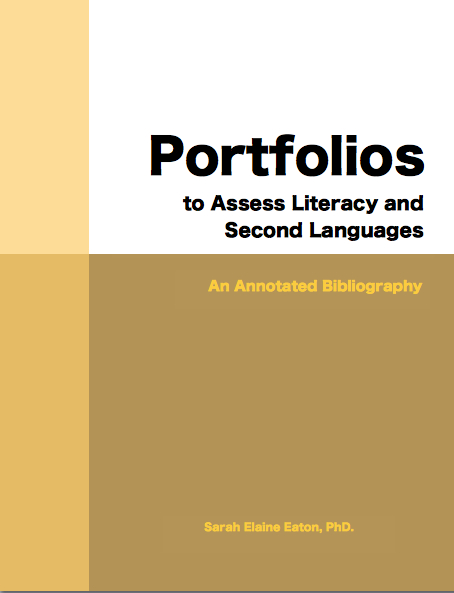
Portfolios to Assess Literacy and Second Languages: An Annotated Bibliography

July 5, 2011

Portfolios to assess literacy and second languages by Sarah EatonFor a few years now I’ve been interested in the topic of using portfolios and asset-based (also known as strength-based) approaches to assessment. Significant theoretical research and applied classroom practice has been done in the field of alternative assessment, and specifically in area of using portfolios and e-portfolios.

The practice of using portfolios for second and foreign language teaching has increased in popularly, with an increased understanding and adoption of the Common European Framework of Reference for Languages. Almost simultaneously, there has been a rise in the use of similar frameworks in the field of literacy. However, there is little collaboration between those who work in literacy and those who teach second and modern languages.

This annotated bibliography is an attempt to collect, select and share resources that may be relevant, helpful and useful to professionals working in both the second language and literacy sectors. The deeper values that guide this work are predicated on the belief that researchers and practitioners working in both fields have much in common and would benefit greatly from increased dialogue and shared resources.

Download a copy here: http://hdl.handle.net/1880/51923

Check out these related posts:

Student portfolios for Language Learning: What They Are and How to Use Them

Using Portfolios for Effective Learning

_____________

Share this post: Portfolios to Assess Literacy and Second Languages: An Annotated Bibliography http://wp.me/pNAh3-NB

Update – January 2018 – This blog has had over 1.8 million views thanks to readers like you. If you enjoyed this post, please “like” it or share it on social media. Thanks!

Sarah Elaine Eaton is a faculty member in the Werklund School of Education, University of Calgary, Canada.