Panel Speaker at Metropolis 2011 – Vancouver, British Columbia

March 14, 2011

If you’re in Vancouver, BC, come and join us at the Metropolis 2011: Bringing the World to Canada, March 23-26 at the Sheraton Vancouver Wall Centre.

This National Metropolis Conference focuses on “the role of immigration in connecting Canada with the rest of the world.” Organizers are expecting over 1000 participants from Canada and abroad. The main conference website says:

A recent report by Statistics Canada projects that, by 2031, at least one in four Canadians will have been born in another country. With this remarkable feature of our society as a backdrop, the conference will discuss the scale and nature of Canada’s immigration system and the policies and practices that have emerged to foster the socio-economic inclusion of new Canadians. Immigration and emigration are transforming the populations of most countries, and in this conference we will consider the place of Canada in this global process by asking speakers from elsewhere in the world to explain the migration and integration dynamics of their regions, thereby allowing us to understand better the effects of these trends on Canada.

I’m delighted to be speaking on a panel on Saturday, March 26. Here are the details:

E4 WORKSHOP | ATELIER (English | Anglais) Junior Ballroom D – Level 3 – North Tower | Niveau 3 – Tour Nord

Family Literacy and the New Canadian

This Workshop will bring together a panel of language experts from across Canada that will outline the importance and value of heritage / international languages and illustrate how schools, academics, community organizations and government policies can assist in maintaining and developing the multiple literacies of all Canadians.

Organizer | Organisateur
Bernard Bouska, Canadian Languages Association
Khatoune Temisjian, Québec Heritage Languages Association / Association québécoise des langues d’origine

Participants

Sarah Eaton, University of Calgary
Formal, Non-Formal and Informal Learning: The Case of Literacy, Essential Skills and Language Learning in Canada

Maria Makrakis, TESOL International and International Languages Educators’ Association (ILEA), Ontario
Language and Literacy for New Canadian Families

Constantine Ioannou, Government of Ontario
Ontario Schools and Communities Can Reflect the Languages of our Families

Khatoune Temisjian, Québec Heritage Languages Association / Association québécoise des langues d’origine
Literacy and Heritage/international Languages in Quebec: An Overview

Michael Embaie, Southern Alberta Heritage Languages Association (SAHLA)
Successful Implementation of Heritage / International Language Programs in Canada: Selected Strategies and Case-Studies

Chair | Modérateur
Marisa Romilly, Society For The Advancement of International Languages (SAIL British Columbia)

Discussant | Commentateur
Bernard Bouska, Canadian Languages Association

If you’re planning to attend the conference, please come and join us at the session!

_________________________

Share this post: Panel Speaker at the Metropolis Conference 2011 – Vancouver, British Columbia http://wp.me/pNAh3-A4

Update – January 2018 – This blog has had over 1.8 million views thanks to readers like you. If you enjoyed this post, please “like” it or share it on social media. Thanks!

Sarah Elaine Eaton is a faculty member in the Werklund School of Education, University of Calgary, Canada.


10 Ways to Excel as a 21st Century Language Teacher

March 3, 2011

This week I’m doing a session at the Greater Edmonton Teachers’ Convention (GETCA) on Global Trends in 21st Century Language Learning.

As a complement to that work, I put together this poster for the teachers at the conference. I’m sharing it here so you can enjoy it, too. It’s a free downloadable poster. Please feel free to share it with other teachers, student teachers an administrators.

10 Ways to Excel as a 21st Century Language Educator – downloadable .pdf poster.

View this document on Scribd

Why not download this poster and use it to spark conversation at your next staff meeting or professional learning day?
_____________________

Share this post: 10 Ways to Excel as a 21st Century Language Teacher (downloadable poster) http://wp.me/pNAh3-zk

Update – January 2018 – This blog has had over 1.8 million views thanks to readers like you. If you enjoyed this post, please “like” it or share it on social media. Thanks!

Sarah Elaine Eaton is a faculty member in the Werklund School of Education, University of Calgary, Canada.


How curiosity spices up learning

January 20, 2011

While “curiosity may have killed the cat”, as the saying goes, it certainly livens up our learning. Ever thought of how anxiety blocks our desire to learn and curiosity heightens it?

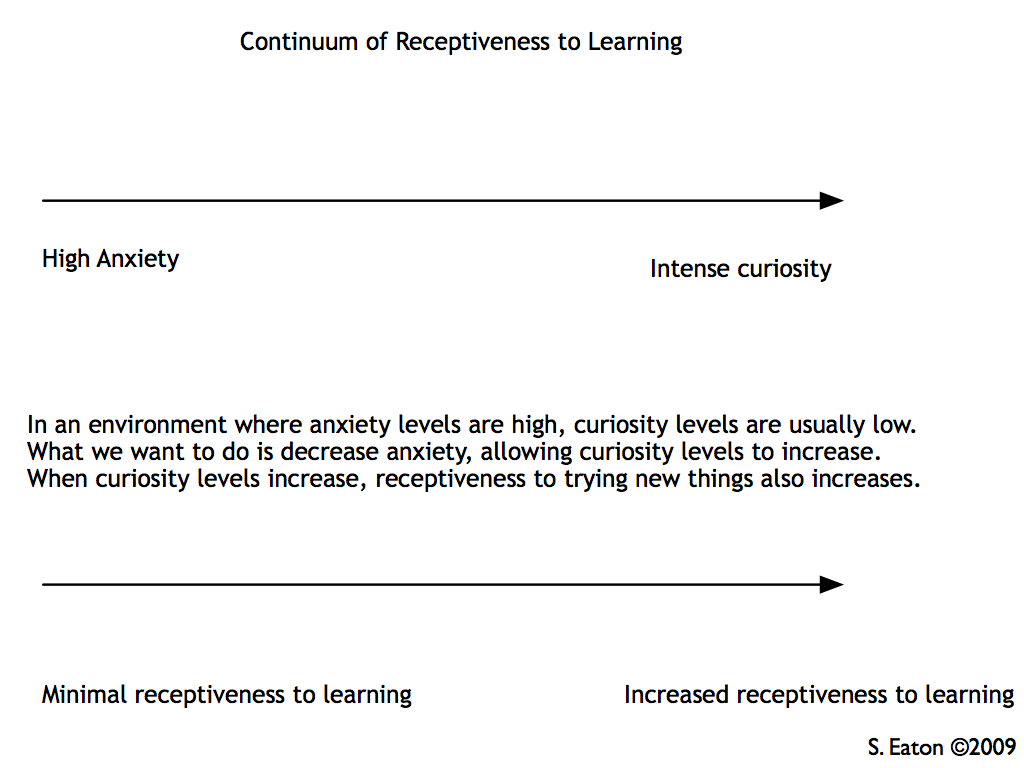
Think of anxiety and curiosity as being at two ends of a continuum.

When anxiety levels are high, our receptiveness to learning new things is low. We resist because we are full of panic and doubt.

At the other end of the spectrum from anxiety is intense curiosity. When curiosity levels are high, we are incredibly receptive to learning new things because we are motivated by our own hunger to learn.

Here’s a diagram to show what I mean.

Continuum of Receptiveness to Learning

This works whether you’re dealing with learners or members of your own staff. A student who is curious learns more. A staff member who is highly anxious when it comes to technology is unlikely to embrace Web 2.0 or mobile technologies for teaching.

Keep providing strategies to decrease anxiety. At the same time, encourage their natural curiosity and you’ll keep people learning. It’s that simple.

____________________

Share or Tweet this Post: How curiosity spices up learning http://wp.me/pNAh3-s4

Update – January 2018 – This blog has had over 1.8 million views thanks to readers like you. If you enjoyed this post, please “like” it or share it on social media. Thanks!

Sarah Elaine Eaton is a faculty member in the Werklund School of Education, University of Calgary, Canada.


Formal, Non-formal and Informal Learning: What Are the Differences?

December 31, 2010

Earlier this year I did some applied research on the differences between formal, non-formal and informal education in both the sciences, as well as literacy and language education.

These terms have been used by the OECD (Organization for Economic Cooperation and Development) as well as researchers and practitioners around the globe. Here’s a simplified explanation:

Formal education – Organized, guided by a formal curriculum, leads to a formally recognized credential such as a high school completion diploma or a degree, and is often guided and recognized by government at some level. Teachers are usually trained as professionals in some way.

Non-formal learning – Organized (even if it is only loosely organized), may or may not be guided by a formal curriculum. This type of education may be led by a qualified teacher or by a leader with more experience. Though it doesn’t result in a formal degree or diploma, non-formal education is highly enriching and builds an individual’s skills and capacities. Continuing education courses are an example for adults. Girl guides and boy scouts are an example for children. It is often considered more engaging, as the learner’s interest is a driving force behind their participation.

Informal learning – No formal curriculum and no credits earned. The teacher is simply someone with more experience such as a parent, grandparent or a friend. A father teaching his child to play catch or a babysitter teaching a child their ABC’s is an example of informal education.

These may be overly simplified explanations. There are times when the lines between each type of learning get blurred, as well. It isn’t always as cut and dry as it seems, but these definitions give you a general idea of each type of learning.

If you’re interested, the two reports (one I wrote and the other I co-authored), they have been archived in 3 countries are available free of charge. There are links to the full reports here:

Formal, Non-formal and Informal Learning in the Sciences http://wp.me/pNAh3-gX

Formal, non-formal and informal learning: The case of literacy and language learning in Canada http://wp.me/pNAh3-C

Related posts:

Formal, Non-formal and Informal Learning (Infographic) https://wp.me/pNAh3-266

Formal, non-formal and informal learning: The case of literacy and language learning in Canada

Formal, Non-formal and Informal Learning: A podcast

Breathtaking Impact of Volunteers’ Contribution to Non-formal and Informal Literacy Education in Alberta

_______________________

If you found this post helpful, please click “Like” below and share it with others.

Here’s a link for sharing: Formal, Non-formal and Informal Learning: What Are the Differences? http://wp.me/pNAh3-q2

Update – January 2018 – This blog has had over 1.8 million views thanks to readers like you. If you enjoyed this post, please “like” it or share it on social media. Thanks!

Sarah Elaine Eaton is a faculty member in the Werklund School of Education, University of Calgary, Canada.


The shocking thing my student said

December 16, 2010

At the end of our last Spanish class for the semester, a few of the students stayed behind to chat and visit for a few minutes. They were an excellent group and had interacted well throughout the semester. Many of them thanked me for a good class, which I always appreciate.

One student, Sam, we’ll call him, said something I’ve never heard before and it shocked me in a way that few comments from a student have in 16 years of teaching.

“You’re the first instructor at university to learn my name,” he said. “I really appreciate that.”

I reeled in disbelief.

“What year are you in?” I asked.

“Third year,” he replied. “I’m on schedule to graduate next year.”

“What’s your major?” I probed further.

“Sciences. This is the only class I’ve ever had that has fewer than 100 people in it. None of the other profs learn our names. I suppose they can’t with that many students.”

I nodded in agreement. My classes have grown in size since I started teaching and with 35 students this year, it took me longer than usual to learn everyone’s name.

He went on to say, “I want to be a science teacher, but not here. I want to work in a place where I can get to know my students. This place is a factory.”

Not wanting to enter a discussion on the state of post-secondary institutions today, I simply remarked that I thought he had many qualities that would make him a good teacher.

He’s got good, solid grades and comes to class on a regular basis. He’s interested and engaged, polite and congenial. He’s got a decent work ethic and works well with other students in class. His classmates like him and he gets along with just about everyone. He’s not a super-duper genius, and nor is he a complete trouble maker. That’s part of the trouble, I suppose. Not being at the far end of either side of the scale, he gets lost in the crowd.

How sad… this student pays thousands of dollars a year in tuition for higher education and even as he approaches graduation, almost no one knows his name. As educators, we make a powerful connection with our students when we learn their names (or at least try).

____________

Share this post: The shocking thing my student said http://wp.me/pNAh3-pu

Update – January 2018 – This blog has had over 1.8 million views thanks to readers like you. If you enjoyed this post, please “like” it or share it on social media. Thanks!

Sarah Elaine Eaton is a faculty member in the Werklund School of Education, University of Calgary, Canada.