How to narrow down your research topic

September 17, 2017
Image courtesy of patrisyu at FreeDigitalPhotos.net

Image courtesy of patrisyu at FreeDigitalPhotos.net

One of the things novice and emerging researchers can struggle with is learning how to narrow down their research topic. Here are some resources that I’ve personally collected and curated to help you tackle this complex element of developing your research project. At the time of writing this post, all the links worked and none of these resources had pop-up ads, paywalls or require any kind of payment. These are freely available and should be widely accessible by students in most areas.

Written resources:

USC Libraries Research Guide – Organizing your social sciences research paper: Narrowing a Topic Idea – http://libguides.usc.edu/writingguide/narrowtopic

USU: Ways to Narrow Down a Topic – http://ocw.usu.edu/English/intermediate-writing/english-2010/-2010/narrowing-topics-skinless_view.html

Thompson Rivers University: How to Narrow Your Research Topic – https://www.tru.ca/__shared/assets/How_to_Narrow_Down_Your_Research_Topic30237.pdf

BYU LibGuide: Step-by-Step Guide & Research Rescue: Finding and Narrowing your Topic – http://guides.lib.byu.edu/c.php?g=216340&p=1428396

Temple University: Narrowing Your Topic from Subject to Thesis (1-page worksheet) – https://www.temple.edu/writingctr/support-for-writers/documents/NarrowingYourTopicfromSubjecttoThesis-Worksheet.pdf

Starting a PhD: Choosing and Developing Your Research Topic – https://100thousandwords.wordpress.com/2010/10/18/starting-a-phd-%E2%80%93-choosing-and-developing-your-research-topic/

U Penn: Plain Talk About Your Dissertation Proposal – http://www.ling.upenn.edu/advice/green_proposal.html

You Tube videos:

Kansas State University Libraries: How to Develop a Good Research Topic – https://youtu.be/nXNztCLYgxc

M. Moilanen: Now to Narrow Down your Research Topic – https://youtu.be/EcYgNV_nQjk

Laurentian University: Narrowing Your Topic – https://youtu.be/JYYQTSXq6RI

Amanda Dinscore: Narrowing Your Topic – https://youtu.be/J1eVTf974R4

Steely Library NKU: Developing a Research Question – https://youtu.be/LWLYCYeCFak

Check out these related posts on this blog:

5 Websites to avoid referencing in your research papers  http://wp.me/pNAh3-1IA

12 Phrases to Avoid in Your Academic Research Papers http://wp.me/pNAh3-1JX

Why APA formatting matters http://wp.me/pNAh3-1Hc

How many sources do you need in a literature review? http://wp.me/pNAh3-1Hu

What’s the difference between a citation and a reference? http://wp.me/pNAh3-1F9

Why “as cited in” should be avoided in academic writing http://wp.me/pNAh3-1BH

10 Great writing resources for grad students – http://wp.me/pNAh3-1Bc

How to create a research paper outline: 5 great resources http://wp.me/pNAh3-1y6

Conceptual and Theoretical Frameworks for Educational Research https://wp.me/pNAh3-1Za

______________________________________________________

Share or Tweet this: How to narrow down your research topic http://wp.me/pNAh3-1Xf

This blog has had over 1.8 million views thanks to readers like you. If you enjoyed this post, please “like” it or share it on social media. Thanks!

Sarah Elaine Eaton is a faculty member in the Werklund School of Education, University of Calgary, Canada.


Summer course – Research Methodology in Education

June 19, 2017

I am pleased to be teaching Research Methodology in Education this summer for our Master of Education students. This is an online course offered from July 4 to August 16, 2017.

Course description

This first course in educational research methodologies provides the background necessary to make intelligent decisions around the kinds of research questions that might be asked and the sort(s) of insights and answers particular methods can provide.

Learner outcomes

Throughout the course of study students will be able to:

  • Identify viable and interesting research questions, both in their own potential research endeavours and in the work of published academics
  • Identify, compare and critique a variety of educational research methodologies based on their primary assumptions and methods
  • Evaluate the relevance of educational research methodologies with special consideration being given to stated research questions and the knowledge being sought
  • Differentiate between the central tenets of qualitative and quantitative data collection and analysis strategies with special consideration being given to the strengths, weaknesses and relevance of each in education
  • Assess the validity of a variety of research methods, both qualitative and quantitative, commonly used in education
  • Examine and interrogate the relationships between research questions, research methods and interpretation of findings in educational studies
  • Demonstrate a critical understanding of ethical issues in educational research, particularly with regard to the use of human participants
  • Formulate and evaluate their own preliminary research questions in response to both their research interests and professional context
  • Understand how action research applies to educational settings and contexts

Required readings

Creswell, J. W. (2014).  Research design: Qualitative, quantitative, and mixed methods approaches (4th ed).  Thousand Oaks, CA: SAGE Publications, Inc.

Hendricks, C. (2016). Improving schools through Action Research: A reflective practice approach (4th ed.), Upper Saddle River, NJ: Pearson Education.

Here’s a copy of the course outline: EDER_603.21_Su2017_Eaton_approved

This marks the tenth time I have taught this course online. I love working with students to help them gain a strong foundation in research methodology. I can’t wait to get started with this year’s group!

____________________________________________________

Share this post: Summer course – Research Methodology in Education http://wp.me/pNAh3-1UJ

This blog has had over 1.8 million views thanks to readers like you. If you enjoyed this post, please “like” it or share it on social media. Thanks!

Sarah Elaine Eaton is a faculty member in the Werklund School of Education, University of Calgary, Canada.


How to develop your Knowledge Mobilization Plan

March 8, 2017

This week in one of my courses, I’m working with doctoral students to help them understand and figure out how to develop a Knowledge Mobilization Plan (KMP) for their research projects. The KMP is a required element of their project this term.

Here are some resources I shared to help them understand what KMPs are and how to build one:

https://research.usask.ca/documents/Knowledge_Mobilization.pdf

http://www.oise.utoronto.ca/research/UserFiles/File/Amanda%20Cooper%20Building%20KM%20Plans%20UT%20Final%20Post%20Version.pdf

https://www.edu.uwo.ca/research/documents/Thinking_About_Knowledge_Mobilization_Plans.pdf

http://www.sshrc-crsh.gc.ca/funding-financement/policies-politiques/knowledge_mobilisation-mobilisation_des_connaissances-eng.aspx

http://www.slideshare.net/sreibling/how-to-write-a-knowledge-mobilization-plan

https://www.mta.ca/uploadedFiles/Community/Research_and_creative/Research_Office/Mount_Allison_Connects/Institute_events/Building%20a%20Knowledge%20Mobilization%20Strategy.pdf

I also shared my approach to knowledge mobilization for my own research. I use a multi-dimensional approach that includes four different audiences:

  1. Academic – Academic (peer-reviewed) articles, academic conferences
  2. Professional – Professional journal articles (edited); Professional reports; professional conferences (e.g. teachers’ conventions); professional development workshops
  3. Social media – My blog Twitter (@DrSarahEaton); LinkedIn; Research Gate & Academia.edu. (Note: Those last two are are like LinkedIn, but directed towards those working in research).
  4.  Community – This can include public presentations or workshops. The key is to tailor these to a broad general audience.

I am to get my work out to as many different audiences as possible and to create a digital footprint for the work, so that if someone comes across it years down the road and they are interested long after I have moved on to new projects, they can still find out about the project.

I also look for ways to link the “products” or “outputs” of my projects. For example, I just led a project on signature pedagogies for e-learning in Higher education. I had the report archived on the University’s digital repository, so the citation looks like this:

Eaton, S. E., Brown, B., Schroeder, M., Lock, J. & Jacobsen, M. (2017). Signature pedagogies for e-learning in higher education and beyond. Calgary: University of Calgary. Retrieved from http://hdl.handle.net/1880/51848

I then blogged about the report on this blog: Signature pedagogies for e-learning in higher education and beyond http://wp.me/pNAh3-1MP

I then Tweeted about the report, which then got Re-tweeted:

Brown RT.jpg

I also posted or submitted a copy of the report at:

  • Research Gate:
  • Academia.edu
  • LinkedIn.
  • ERIC (When there is a full report available).

Basically, I try to get the word out in any many ways as possible.

All this, by the way, took less than two hours to do. I have had these accounts set up for some years now and this has been a fairly consistent process for me when I want to mobilize knowledge about a project.

Here is an infographic I created to help you visualize how you might develop your own KMP. Not all the elements I talked about in this post fit onto the infographic, so don’t think of the visual as exhaustive:KMP.jpg

____________________________________________________

Share this post: How to develop your Knowledge Mobilization Plan https://wp.me/pNAh3-1N2

This blog has had over 1.8 million views thanks to readers like you. If you enjoyed this post, please “like” it or share it on social media. Thanks!

Sarah Elaine Eaton is a faculty member in the Werklund School of Education, University of Calgary, Canada.


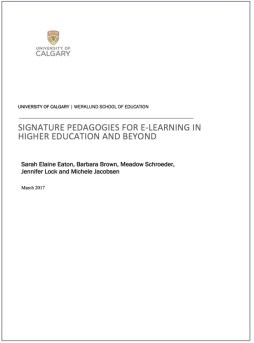
Signature pedagogies for e-learning in higher education and beyond

March 6, 2017

http://hdl.handle.net/1880/51848

This report explores the notion of signature pedagogies within the field of e-learning for higher education. We build on previous work that examined signature pedagogies in education, linking the concepts of signature pedagogies, the profession of education and e-learning as a means to help educators develop their practice and understanding of the profession.

Background

In November 2016, approximately thirty scholars, practitioners, industry leaders and government officials assembled at The White House for the “Technology in English” event, which was a collaborative effort between The White House Office of Global Engagement and the U.S. Department of State, Bureau of Educational and Cultural Affairs, Office of English Language Programs. The event was part of the inter-agency English for All initiative, announced by President Obama earlier in 2016 (United States Department of State, 2016). The purpose of the event was to gather together individuals with combined expertise in educational technology and English language learning and teaching. Sarah Elaine Eaton, one of the authors of this report, was among those invited to take part in The White House event.

One outcome of the meeting was a commitment to develop a prototype or resource that would serve as an Open Educational Resource (OER), not only for participants of programs sponsored by the U.S Department of State, and educators generally. The project is to be presented at the TESOL 2017 International Convention and English Language Expo in Seattle, Washington State.

In addition, experts were invited to develop and contribute additional resources that would benefit educators in their professional development. This report was prepared as an additional Open Educational Resource for use by those interested in developing their knowledge of signature pedagogies for e-learning in education.

Here is a citation for the report, which you can download for free online:

Eaton, S. E., Brown, B., Schroeder, M., Lock, J. & Jacobsen, M. (2017). Signature pedagogies for e-learning in higher education and beyond. Calgary: University of Calgary. Retrieved from http://hdl.handle.net/1880/51848

____________________________________________________

Share this post: Signature pedagogies for e-learning in higher education and beyond http://wp.me/pNAh3-1MP

This blog has had over 1.8 million views thanks to readers like you. If you enjoyed this post, please “like” it or share it on social media. Thanks!

Sarah Elaine Eaton is a faculty member in the Werklund School of Education, University of Calgary, Canada.


Article: Comparative Analysis of Institutional Policy Definitions of Plagiarism: A Pan-Canadian University Study

January 18, 2017

interchange I’m pleased to share the news with you about my latest article, published in Interchange. The title is: “Comparative Analysis of Institutional Policy Definitions of Plagiarism: A Pan-Canadian University Study”.

Here is a link to the online version of the article: http://rdcu.be/oCx2

Funding for this study was provided by  the University of Calgary Werklund School of Education Scholarship of Teaching and Learning Grant.

Here are some other posts related to this research project:

____________________________________________________

Share this post: Comparative Analysis of Institutional Policy Definitions of Plagiarism: A Pan-Canadian University Study https://wp.me/pNAh3-1LD

This blog has had over 1.8 million views thanks to readers like you. If you enjoyed this post, please “like” it or share it on social media. Thanks!

Sarah Elaine Eaton is a faculty member in the Werklund School of Education, University of Calgary, Canada.