21st century definition of plagiarism

January 23, 2018

Not long after I started getting interested in academic integrity, I began wondering how different universities defined plagiarism in their official policy documents. That led me to do an analysis of policy documents from 20 Canadian higher education institutions, and the results were published in the peer-reviewed scholarly journal, Interchange. Basically, what I found was that there was no consistent definition of plagiarism across Canadian post-secondary institutions. In other words, we don’t agree about what actually constitutes plagiarism.

This makes it confusing for students and for professors, especially considering that students might attend one school to do their undergraduate degree and another for their graduate degree, or that professors sometimes change jobs, leaving one institution for another.

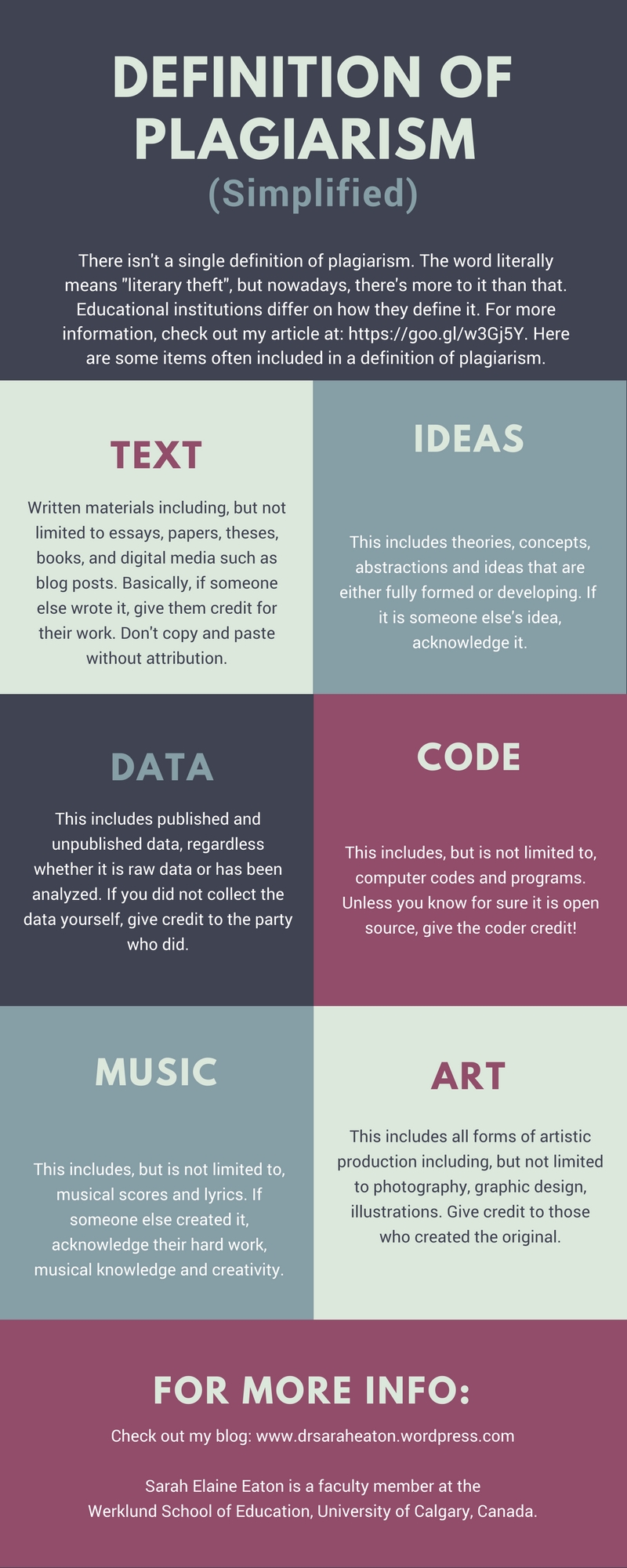
It used to be that the definition of plagiarism was simple: literary theft, but it is a lot more complicated than that in the 21st century, where digital outputs account for as much, if not more than, printed products. Students and professors have asked me, “So, how do you define plagiarism in plain and simple terms?” The answer is actually quite complex and a bit messy. But in the interest of demystifying the issue, here is a straight forward infographic that may help.

Let me say that this resource is simplified — perhaps overly so. My goal here isn’t to be reductionist and I fully acknowledge that not everyone may agree with these simplified explanations. But sometimes it can be easier to wrap your head around something simple to start and then tease out the complexities once you are more comfortable with the basic concepts.  I offer these not as the be-all-and-end-all definition, but rather as a starting point to help educators and students clarify and demystify basic concepts and also to engage in productive conversations about how to cultivate academic integrity and reduce plagiarism.

Definition of plagiarism (jpg)

Here is a free, downloadable .pdf of this infographic that you are welcome to use with your students for teaching purposes. Feel free to use it as a conversation starter to help students understand what plagiarism is and how to prevent it in their own work.

Related post:

Comparative Analysis of Institutional Policy Definitions of Plagiarism: A Pan-Canadian University Study https://wp.me/pNAh3-1LD

______________________________________________________

Share or Tweet this: 21st century definition of plagiarism https://wp.me/pNAh3-2eo

This blog has had over 1.8 million views thanks to readers like you. If you enjoyed this post, please “like” it or share it on social media. Thanks!

Sarah Elaine Eaton is a faculty member in the Werklund School of Education, University of Calgary, Canada.


Formal, Non-formal and Informal Learning (Infographic)

January 16, 2018

A few years ago I started exploring the differences between formal, non-formal and informal learning. The result was a couple of research reports and blog posts, including this one which has been viewed over 250,000 times. For those who like their information in bite-sized pieces, here is a quick synopsis of some of the key points for you in a handy infographic:

Formal, non-formal and informal learning.jpg

Here’s a free, downloadable .pdf of this infographic that you can use for your own research or teaching purposes: Formal, non-formal and informal learning.compressed

It is important to note that this infographic is intended to give a quick snapshot of some of the most basic differences. A quick snapshot like this gives you a quick picture, but not the whole picture. There are more differences than what one infographic can show. Also, the lines between formal, non-formal and informal learning can be blurry sometimes. Understanding the differences deeply will probably require more reading. To help you learn more, I’ve included a number of other posts, some of which link to full-length reports.

Check out these related posts:

______________________________________________________

Share or Tweet this: Formal, Non-formal and Informal Learning (Infographic) https://wp.me/pNAh3-266

This blog has had over 1.8 million views thanks to readers like you. If you enjoyed this post, please “like” it or share it on social media. Thanks!

Sarah Elaine Eaton is a faculty member in the Werklund School of Education, University of Calgary, Canada.


Understanding Language Register

January 2, 2018

A few years ago I wrote a post on language register. It has become one of the most popular and often viewed posts on my blog. It is a long and fairly involved post, so for those who like their information in bite-sized pieces, here is a quick synopsis for you in the form of an infographic:

Language ReGISTER

It is important to understand the differences between registers so you can use language that is appropriate for a particular situation. If your register is too high, you may come across as being snobby, pretentious or arrogant. If your register is too low, you can come across as being inappropriately informal or too friendly.

It is not only English language learners who need to understand the difference between registers, but native speakers do too. One of the things I have observed in my work as a professor is that students sometimes write in a register that is too casual. Sometimes students do this because they do not want to come across as “stuffy” or pretentious. But casual writing in academic and professional papers can backfire. Writing that is overly casual is often not considered professional or terribly credible by the reader. It is important for students, professionals, scientists and academics to know the formal register for writing papers, theses and reports.

Here’s a free .pdf of this infographic that you can use for your own research or teaching purposes: Language Register (.pdf).

Check out these related posts:

Teaching formal and informal language register to native speakers of English http://wp.me/pNAh3-jV

Language Register and Why It Matters (Or: Why You Can’t Write An Academic Paper in Gangsta Slang) http://wp.me/pNAh3-1pr

______________________________________________________

Share or Tweet this: Understanding Language Register https://wp.me/pNAh3-25U

This blog has had over 1.8 million views thanks to readers like you. If you enjoyed this post, please “like” it or share it on social media. Thanks!

Sarah Elaine Eaton is a faculty member in the Werklund School of Education, University of Calgary, Canada.


New article: “Credit where credit is due”

December 19, 2017

Credit where credit is due - coverIn my latest article, “Credit where credit is due: How to prevent plagiarism in the 21st century classroom” I tackle the tricky question of what it means to plagiarize in the age of copy-and-paste. I also offer K-12 teachers five practical tips on how to prevent plagiarism among school-age children.

Most of my research and writing is focusing more and more on academic integrity and plagiarism prevention in higher education contexts. But it is important for K-12 teachers to be able to talk about these topics to their students, too. That’s what inspired me to write this article.

The full article was published by the EdCan Network and it is a web exclusive in their most recent edition. You can check it out here: https://www.edcan.ca/articles/credit-where-credit-is-due/

______________________________________________________

Share or Tweet this: New article: “Credit where credit is due”

This blog has had over 1.8 million views thanks to readers like you. If you enjoyed this post, please “like” it or share it on social media. Thanks!

Sarah Elaine Eaton is a faculty member in the Werklund School of Education, University of Calgary, Canada.


Understanding academic misconduct: Special event

November 21, 2017

University of Calgary logoIn my role as Interim Associate Dean, Teaching and Learning for the Werklund School of Education at the University of Calgary, I am pleased announce we will welcome Dr. Julia Christensen Hughes to our campus for a special visit on November 24, 2017.

We have two events that are open to the public that I wanted to share with all of you:

Lunchtime Keynote: Understanding academic misconduct: Creating robust cultures of integrity

Time: 12:00 pm – 1:00 pm

Location: University of Calgary, Taylor Institute Forum

This keynote will draw from Christensen Hughes’s research with the late Don McCabe, founder of the International Center for Academic Integrity. Their work was published in 2006 the Canadian Journal of Higher Education (see http://journals.sfu.ca/cjhe/index.php/cjhe/article/view/183537 and http://journals.sfu.ca/cjhe/index.php/cjhe/article/view/183525), and they were awarded with the Sheffield Award from the Canadian Society for Studies in Higher Education (CSSHE) for their contribution.

Afternoon workshop: Strengthening a culture of integrity at the University of Calgary

Time: 3:00 pm – 4:00 pm

Location: University of Calgary, Taylor Institute Forum

This workshop will provide a deeper analysis of why academic misconduct is happening on Canadian university campuses, including from the perspectives of faculty and TAs. Working in groups, participants will discuss their experience at the University of Calgary and generate specific suggestions for what the University might do to strengthen its culture of integrity.

About Dr. Julia Christensen Hughes

jch-colour-photoDr. Julia Christensen Hughes is Dean of the College of Business and Economics (CBE) at the University of Guelph. With a career defined by advocacy, Julia has addressed the United Nations General Assembly on the need for business schools to contribute to advancing the UN’s sustainable development goals, including quality education. Previously, Julia served as President of the Society for Teaching and Learning in Higher Education, a predominantly Canadian organization committed to enhancing the quality of teaching and learning in post-secondary institutions. During this same time, she served as the Director of Teaching Support Services at the University of Guelph.

Julia Christensen Hughes’s scholarly work includes the edited book, Taking Stock: Research on Teaching and Learning in Higher Education (2010), McGill-Queen’s University Press. She has also written on ethics and integrity in the academy, with papers published in the Canadian Journal of Higher Education. Julia has received a number of awards and recognitions, including the Gold “educator” award from the Ontario Hostelry Institute (OHI); the Sheffield Award from the Canadian Society for the Study of Higher Education, for excellence in research; the University of Guelph’s John Bell Award, for distinguished educational leadership; and the “Woman of Distinction Award” from the Guelph YMCA, for outstanding contributions to education and training.

These events are open to all members of the campus community and the public.

______________________________________________________

Share or Tweet this: Understanding academic misconduct: Special event https://wp.me/pNAh3-22q

This blog has had over 1.8 million views thanks to readers like you. If you enjoyed this post, please “like” it or share it on social media. Thanks!

Sarah Elaine Eaton is a faculty member in the Werklund School of Education, University of Calgary, Canada.