A few years ago I started exploring the differences between formal, non-formal and informal learning. The result was a couple of research reports and blog posts, including this one which has been viewed over 250,000 times. For those who like their information in bite-sized pieces, here is a quick synopsis of some of the key points for you in a handy infographic:
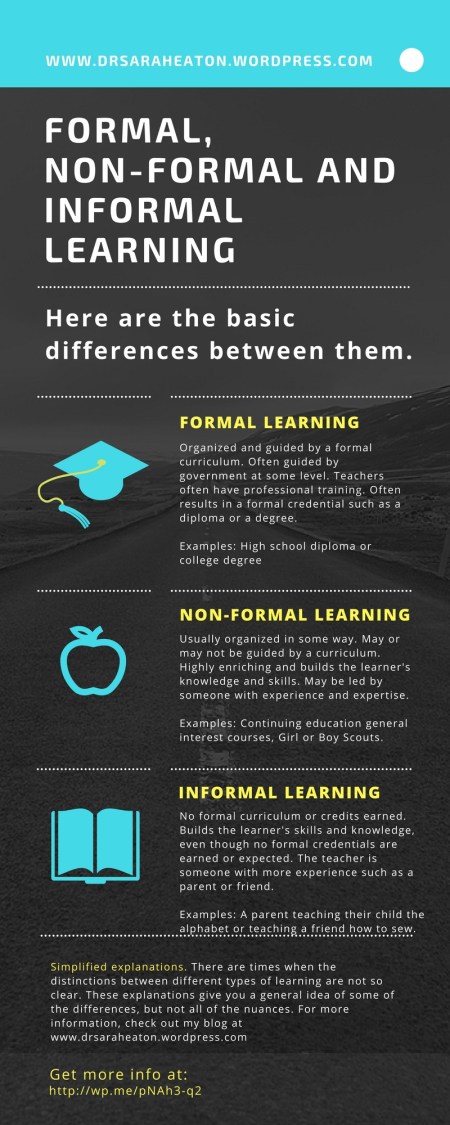
Here’s a free, downloadable .pdf of this infographic that you can use for your own research or teaching purposes: Formal, non-formal and informal learning.compressed
It is important to note that this infographic is intended to give a quick snapshot of some of the most basic differences. A quick snapshot like this gives you a quick picture, but not the whole picture. There are more differences than what one infographic can show. Also, the lines between formal, non-formal and informal learning can be blurry sometimes. Understanding the differences deeply will probably require more reading. To help you learn more, I’ve included a number of other posts, some of which link to full-length reports.
Check out these related posts:
- Formal, Non-formal and Informal Learning: What Are the Differences? http://wp.me/pNAh3-q2
- Formal, Non-formal and Informal Learning in the Sciences http://wp.me/pNAh3-gX
- 10 Characteristics of Informal Learning http://wp.me/pNAh3-1gJ
- The many faces of non-formal learning http://wp.me/pNAh3-b7
- Formal, non-formal and informal learning: The case of literacy and language learning in Canada http://wp.me/pNAh3-C
- Formal, Non-formal and Informal Learning: A podcast http://wp.me/pNAh3-or
- Breathtaking Impact of Volunteers’ Contribution to Non-formal and Informal Literacy Education in Alberta http://wp.me/pNAh3-AK
______________________________________________________
Share or Tweet this: Formal, Non-formal and Informal Learning (Infographic) https://wp.me/pNAh3-266
This blog has had over 1.8 million views thanks to readers like you. If you enjoyed this post, please “like” it or share it on social media. Thanks!
Sarah Elaine Eaton is a faculty member in the Werklund School of Education, University of Calgary, Canada.


 Posted by Sarah Elaine Eaton, Ph.D.
 In my latest article, “Credit where credit is due: How to prevent plagiarism in the 21st century classroom” I tackle the tricky question of what it means to plagiarize in the age of copy-and-paste. I also offer K-12 teachers five practical tips on how to prevent plagiarism among school-age children.
 In my role as Interim Associate Dean, Teaching and Learning for the Werklund School of Education at the University of Calgary, I am pleased announce we will welcome Dr. Julia Christensen Hughes to our campus for a special visit on November 24, 2017.
 Dr. Julia Christensen Hughes is Dean of the College of Business and Economics (CBE) at the University of Guelph. With a career defined by advocacy, Julia has addressed the United Nations General Assembly on the need for business schools to contribute to advancing the UN’s sustainable development goals, including quality education. Previously, Julia served as President of the Society for Teaching and Learning in Higher Education, a predominantly Canadian organization committed to enhancing the quality of teaching and learning in post-secondary institutions. During this same time, she served as the Director of Teaching Support Services at the University of Guelph.
 On the


You must be logged in to post a comment.