Common tech abbreviations used in language teaching and literacy

July 15, 2011

Is your mind boggled about all the abbreviations and acronyms you find when it comes to talking about technology and language learning? Here are a few of the more common ones, spelled out:

app – application: a program often used on a mobile device such as a cell phone or a tablet.

b-learning – blended learning (methodology that combines f2f and e-learning)

BLE – blended learning environment

BLL – blended language learning

CALI – Computer-assisted language instruction (this term was later replaced with CALL)

CALL – computer-assisted language learning

CAI – Computer-assisted instruction

CLIL – Content and Language Integrated Learning

CMC – computer-mediated communication

CVRE – collaborative virtual reality environment

e-learning – electronic learning

f2f – face-to-face (i.e. traditional classroom instruction)

m-learning – mobile learning (e.g. learning with mobile phones, iPads, etc.)

MALL – mobile-assisted language learning

MOO –  multi-user object-oriented technology

MMO or MMOG – massively-multiplayer online game

PDA – personal digital assistant

SCA – synchronous cyber-assessment

TELL – Technology-enhanced language learning

TTS – text-to-speech

VOIP – Voice-over Internet Protocol

VR – virtual reality

WELL – Web Enhanced Language Learning

Have I missed any? If so, leave me a comment and we’ll keep adding to the list.

___________________

Share this post: Common tech abbreviations used in language teaching and literacy http://wp.me/pNAh3-OC

Update – January 2018 – This blog has had over 1.8 million views thanks to readers like you. If you enjoyed this post, please “like” it or share it on social media. Thanks!

Sarah Elaine Eaton is a faculty member in the Werklund School of Education, University of Calgary, Canada.


Secrets Gandhi Knew About Language Learning

July 11, 2011

Regular readers of this blog know about my passion for connecting language learning to leadership. I truly believe that language learning helps us to improve our leadership skills, understand others with a deeper sense of compassion and see the world in wiser ways. I am inspired by the work of Gandhi, who was a strong advocate of learning second and foreign languages.

Here’s a reprint of an article that was published on the topic. It was originally published in Zephyr, the newsletter of the Second Languages and Intercultural Council (SLIC) of the Alberta Teachers’ Association. It is reprinted here with permission:

View this document on Scribd

Related posts:

Share this post: Secrets Gandhi Knew About Language Learning http://wp.me/pNAh3-N7

Update – January 2018 – This blog has had over 1.8 million views thanks to readers like you. If you enjoyed this post, please “like” it or share it on social media. Thanks!

Sarah Elaine Eaton is a faculty member in the Werklund School of Education, University of Calgary, Canada.


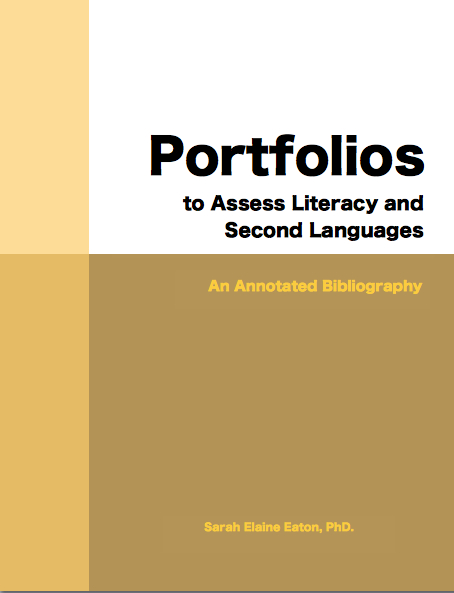
Portfolios to Assess Literacy and Second Languages: An Annotated Bibliography

July 5, 2011

Portfolios to assess literacy and second languages by Sarah EatonFor a few years now I’ve been interested in the topic of using portfolios and asset-based (also known as strength-based) approaches to assessment. Significant theoretical research and applied classroom practice has been done in the field of alternative assessment, and specifically in area of using portfolios and e-portfolios.

The practice of using portfolios for second and foreign language teaching has increased in popularly, with an increased understanding and adoption of the Common European Framework of Reference for Languages. Almost simultaneously, there has been a rise in the use of similar frameworks in the field of literacy. However, there is little collaboration between those who work in literacy and those who teach second and modern languages.

This annotated bibliography is an attempt to collect, select and share resources that may be relevant, helpful and useful to professionals working in both the second language and literacy sectors. The deeper values that guide this work are predicated on the belief that researchers and practitioners working in both fields have much in common and would benefit greatly from increased dialogue and shared resources.

Download a copy here: http://hdl.handle.net/1880/51923

Check out these related posts:

Student portfolios for Language Learning: What They Are and How to Use Them

Using Portfolios for Effective Learning

_____________

Share this post: Portfolios to Assess Literacy and Second Languages: An Annotated Bibliography http://wp.me/pNAh3-NB

Update – January 2018 – This blog has had over 1.8 million views thanks to readers like you. If you enjoyed this post, please “like” it or share it on social media. Thanks!

Sarah Elaine Eaton is a faculty member in the Werklund School of Education, University of Calgary, Canada.


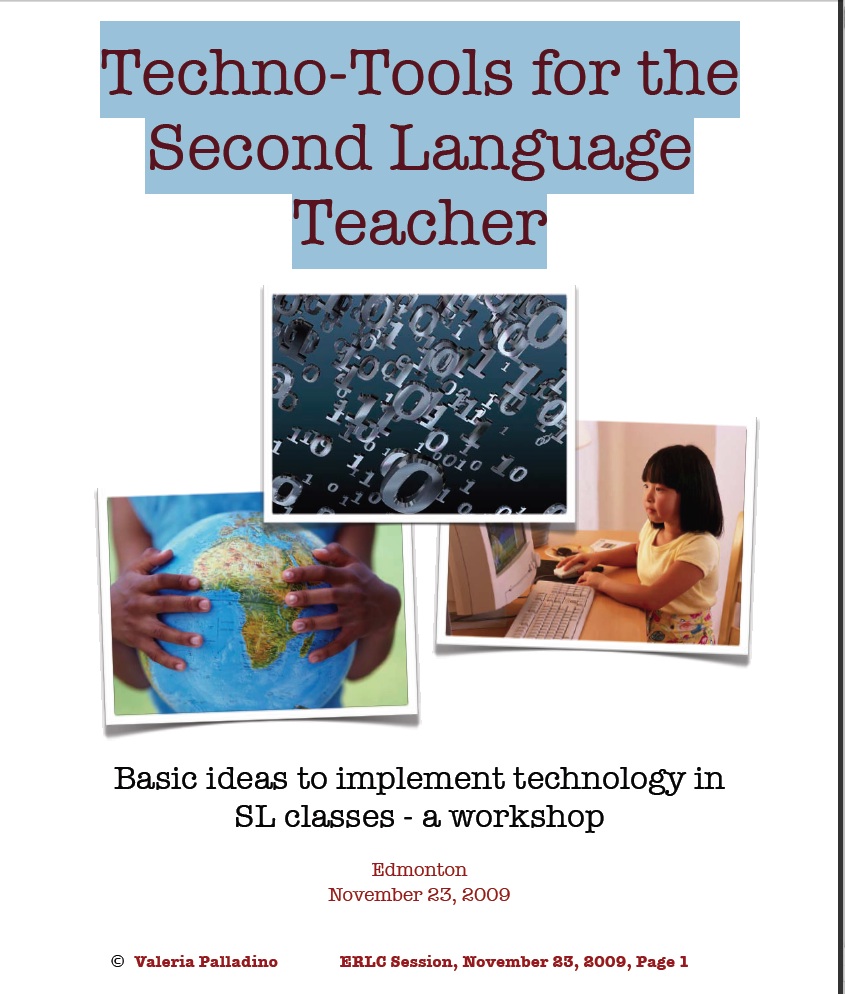
Techno-Tools for the Second Language Teacher

June 27, 2011

Valeria Palladino, a language teacher in Edmonton, Canada, has a great wiki on technology tools for second languages: http://technotoolsforslclasses.wikispaces.com/

She has also done a useful and easy to follow 29-page guide called “Techno-Tools for the Second Language Teacher“. It contains ideas on how to implement technology into second language classes. This guide is particularly useful for teachers who want to integrate tech into their second language classrooms, but are not sure where to start. Palladino explains the basics in language that is easy to understand and easy to follow.

_____________

Related posts:

Cool Apps for Language Learning http://wp.me/pNAh3-mQ

MALL (Mobile-Assisted Language Learning) http://wp.me/pNAh3-6U

__________

Share this post: Techno-Tools for the Second Language Teacher http://wp.me/pNAh3-M7

Update – January 2018 – This blog has had over 1.8 million views thanks to readers like you. If you enjoyed this post, please “like” it or share it on social media. Thanks!

Sarah Elaine Eaton is a faculty member in the Werklund School of Education, University of Calgary, Canada.


Global Issues in Language Teaching and Learning

June 23, 2011

University of Calgary A few colleagues and I at the University of Calgary are collaborating to team teach a block week course this fall:

LANG 599 / 699: Global Issues in Language Teaching and Learning
Block Week Fall 2011: September 6-10, 2011

Course description:

In today’s multilingual society, each of us is both a language learner and a language teacher. In this interdisciplinary course we will discuss current research and its practical implications as they relate to language teaching and learning. Students will engage with real-world data and will have the opportunity to publish course papers.

Instructors: Dr. Mary O’Brien, Dr. Sarah Eaton, Roswita Dressler and Katherine Mueller.

Course location: This course is taught live (face-to-face) at the University of Calgary.

Prerequisites: Senior or graduate student standing.

____________________________

Update – January 2018 – This blog has had over 1.8 million views thanks to readers like you. If you enjoyed this post, please “like” it or share it on social media. Thanks!

Sarah Elaine Eaton is a faculty member in the Werklund School of Education, University of Calgary, Canada.