The Best Time of Day to Tweet, When to Post to Facebook and other Social Media Insights

September 25, 2011

KISS Metrics has done some serious research into social media. Their stats are for the U.S., but they make those of us in Canada and other parts of the world think about when we tweet, too. KISS metrics notes that nearly 50% of the US population lives in the Eastern Time Zone. If you add in those who live in the Central time zone, you get to 80% of the population.

So what? For maximum effectiveness, post to Twitter and other social media when people in the Eastern and Central Time Zones are likely to be on line.

Top Facts about Twitter

If you want to be re-Tweeted, the best time to Tweet is 5:00 p.m. Eastern Time. That’s 3:00 p.m. for those of us living in Calgary and other parts of Alberta. Figure that out in your local time zone by converting the time at TimeandDate.com.

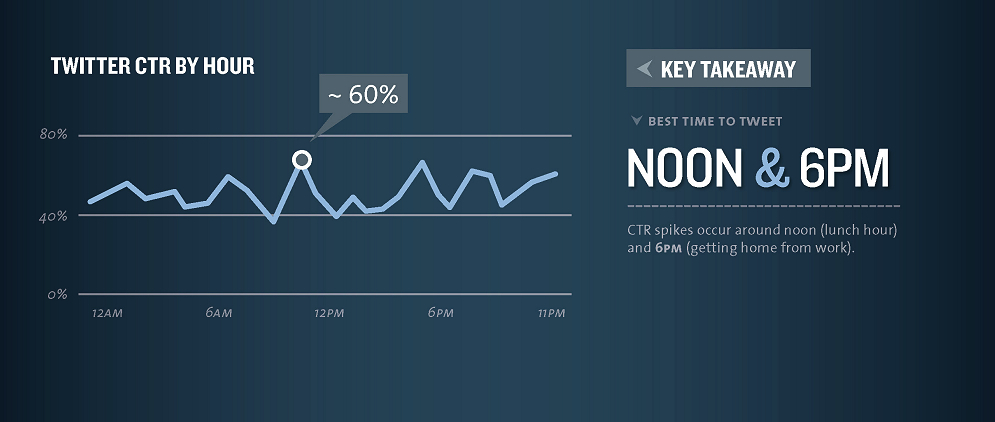
If your purpose isn’t to be re-Tweeted, but rather to have followers click on your links, the statistics change a bit. The report says that the highest click through rate (CTR) is noon and 6:00 p.m., Eastern time.
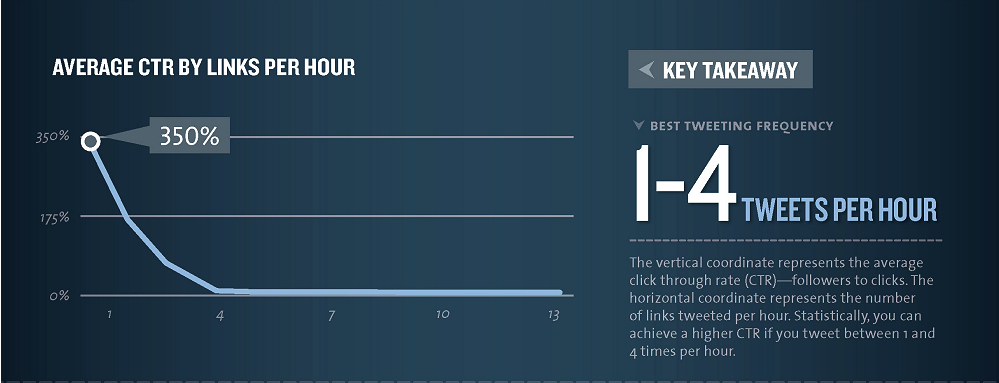
How often should you Tweet if you want people to click through to your links? Survey says… 1 to 4 times per hour. The click through rate (CTR) is apparently highest for those who Tweet their links every 15 to 60 minutes. If you tweet links more than 4 times per hour, your followers are likely to become numbed to your barage of Tweets. Personally, I never Tweet with links that much. I guess I need to start Tweeting more!
KISS Metrics2

People are most likely to click on your links mid-week and on the weekends. That is when the click through rate (CTR) is highest.

Top Facts about Facebook

The best day to share on Facebook is Saturday. That’s when the most sharing is done. This offers good food for thought for companies, schools and non-profits who only share on Facebook during the work week. Maybe it is worth using a tool such as Hootsuite to schedule your FB updates so you are sharing when employees are off the clock.

And if you’re wondering when on Saturday (or any day) to post things that are most likely to be shared, the best time of day to post on Facebook is at noon.

If you have a Facebook page, the KISS metrics show that one post every day will help you build the most “likes”.

Check out the full post by KISS Metrics.

So, what’s the moral of the story? Use social media regularly and consistently, but don’t jam it down anyone’s throat. Share information when others are likely to share your links. Pay attention to when people are on line and post at times when your links and “shareables” are likely to be seen.

_______________

Share this post: The Best Time of Day to Tweet, When to Post to Facebook and other Social Media Insights http://wp.me/pNAh3-TN

Update – January 2018 – This blog has had over 1.8 million views thanks to readers like you. If you enjoyed this post, please “like” it or share it on social media. Thanks!

Sarah Elaine Eaton is a faculty member in the Werklund School of Education, University of Calgary, Canada.


6 Things You Probably Didn’t know About Social Media and the WWW

September 23, 2011

Did you know…?

In 1978 authors Roxanne Hiltz and Murray Toroff envisioned a future in which computer-mediated communication (CMC) would have a major effect on people’s every day lives. Their book,”The Network Nation”, is published by MIT Press in Cambridge, MA. It has been updated and revised since its original printing and is now considered a classic book in the field of CMC.

In 1992 the World Wide Web was officially launched to the public. (Can you believe that the Web is only 20 years old?!)

In 1997 SixDegrees was established as the first social networking site that most resembles the sites we use today, but users were skeptical and reluctant to interact with strangers. The company was sold in 2000 and today many people believe that the original company was too ahead of its time.

LinkedIn was created in 2002 and publicly launched in 2003 (before Facebook!)

In 2004 Facebook was launched.

Two years later, in 2006, Twitter was launched.

______________

Share this post: 6 Things You Probably Didn’t know About Social Media and the WWW http://wp.me/pNAh3-Qi

Update – January 2018 – This blog has had over 1.8 million views thanks to readers like you. If you enjoyed this post, please “like” it or share it on social media. Thanks!

Sarah Elaine Eaton is a faculty member in the Werklund School of Education, University of Calgary, Canada.


Twitter hashtags for language learning and literacy

July 15, 2011

Today is Twitter’s 5th birthday. To celebrate, I’m sharing some of my favorite hash tags for literacy and language learning.

For the uninitiated a hash tag is a way of organizing tweets into subjects or conversation topics. Users can then search for a particular topic, using a hash tag. You start with the symbol “#”, followed by the topic you are interested in. There are obvious ones and then there are those that are less obvious, though often interesting.

Here are a few of my favorite ones for literacy and language learning:

Literacy hashtags

#adulted – Tweets about adult education

#ece – Tweets on early childhood education

#famlit – Tweets about family literacy

#literacy – General Tweets on literacy

#reading – Self-explanatory

Language learning / Language teaching hashtags

#flteach – Tweets about teaching foreign languages

#elt, #eltchat, #ESL, #TESL, #TESOL, #EFL – Tweets about learning and teaching English as a second or foreign language

#langchat – Tweets about learning and teaching languages

#mfl – Tweets about modern foreign languages

________________

Share this post: Twitter hashtags for language learning and literacy http://wp.me/pNAh3-OR

Update – January 2018 – This blog has had over 1.8 million views thanks to readers like you. If you enjoyed this post, please “like” it or share it on social media. Thanks!

Sarah Elaine Eaton is a faculty member in the Werklund School of Education, University of Calgary, Canada.


Social Media in a Family Literacy Program

May 21, 2011

Yesterday I was in Edmonton for the Food for Thought conference put on by the Centre for Family Literacy. A group of 42 literacy coordinators, practitioners and other professionals packed the workshop room to learn about how to use social media in a family literacy program. We talked about:

  • How to set up a Facebook page
  • What to put on your Facebook page
  • How to use Twitter including how the “@” and “#” or hashtags work
  • How to use Hootsuite

I gave a live demo of Twitter and Hootsuite. I showed how to mention other people and how to use hashtags to find topics you’re interested in. We also shared tips on how to use programs like Hootsuite to schedule updates and tweets and make social media more effective.

We also had a wonderful discussion about how to have a Facebook page without having it tied to a personal Facebook account. That was new for me. I have a couple of Facebook pages for different things that I do, and the only way I’ve ever built them was through my personal account.

For me, it was great learning to know that there are newer options available that don’t require an individual to have an organizational page tied to their name.

Here are the juiciest tips I shared from my own experience using social media:

Top Tips for using Social Media in a Literacy Program

Use social media as a way to reach more learners

There are some learners, particularly younger ones, who are digital natives. They have grown up with technology and may even be turned off by the idea of “old school” reading and writing. By stepping into the world of social media, you can meet those learners where they are today. You won’t reach all learners that way, of course. But it does open the doors to reaching those who might otherwise dismiss traditional literacy programs because they don’t relate to them.

Decide where you want to be on the “privacy continuum”.

Different people have different needs and comfort levels with posting personal information on the Internet. It is OK to be private… or even fib just a little bit, while still being authentic. We talked about how to figure out where people fit along the continuum and that no matter where that is, it’s OK.

Post regularly

Using a service such as Hootsuite can help you to streamline your social media activity, so it takes less time. I shared that had scheduled a number of Tweets before I left Calgary so that I was covered until I got home.

Think about sharing and helping others

We talked about how to use social media as a way to give and share resources. We looked at pages from a variety of literacy organizations. I pointed out how social media is meant to be a social, and reciprocal, activity. I recommend that people “like” pages of other organizations they support.

Avoid the “Incessant Ask” or “push”

One mistake non-profit organizations make when they use social media is to post a constant barage of requests for funding or donations, or just post about their own programs. The idea of social media is to engage with others, not push information on them, or worse yet, push unending requests for money at them. Re-posting, re-tweeting and sharing others’ information is a good thing!

Create conversations

Social media is just that – social. It’s a place to engage with others… talk with them. Ask questions. Be interested. Keeping a good balance between giving and taking, as well as giving and asking, are key points to keep in mind.

Say “Thank You”

I showed how to track “@” mentions and why it is important to say thank you when others re-post or re-Tweet your material. You may miss the odd one here and there, but overall, making a concerted effort to show appreciation when others like and share what you do, goes a long way in creating positive relationships and making you a good digital citizen.

I just loved working with this group. They’re passionate, engaged and ready to help one another out at a moment’s notice. Thanks to everyone who attended the session, shared and engaged with us!

_________________

Share this post: Social Media in a Family Literacy Program http://wp.me/pNAh3-FI

Update – January 2018 – This blog has had over 1.8 million views thanks to readers like you. If you enjoyed this post, please “like” it or share it on social media. Thanks!

Sarah Elaine Eaton is a faculty member in the Werklund School of Education, University of Calgary, Canada.


7 Things That Make Me Want to Unfollow You on #Twitter

May 2, 2011

I’ve been on Twitter for just over 2 years now. I had my account for well over a year before I actually got “into” it. For the longest time, I wasn’t really sure what it was all about or why anyone would Tweet. I’ve made a concerted effort over the past six months to learn more about Twitter and to engage others in conversations. It’s been a fabulous way to discover amazing work being done by people! I find Twitter to be a fountain of inspiration and great resources. There, however, a number of things that make me want to “unfollow” others…

1) Tweets that are trying to sell me stuff – all the time.

I don’t mind the occasional sales pitch now and then. But really, if there’s no content there and your tweets are just a barage of “buy my stuff!” it’s a turn-off.

2) Tweets that try to get me to your website – all the time.

Like a sales pitch, I can see that you’re trying to drive traffic to your website. Everyone wants website traffic. I’m OK with Tweets that share new blog posts or offer resources, but messages that just tell me to visit a website for no reason? Yawn… I’m more interested in real content. And there’s plenty of that on Twitter.

3) Tweets that are trying to get me to donate to your cause – all the time.

Much like the Tweets that try to sell me stuff, I get tired of the messages asking me to donate money. I follow a lot of non-profit organizations. I’ve worked with clients in the non-profit sector for the past decade. I believe in the causes of the organizations I follow… and I may already donate money to them. Really, I’m more interested in finding out about the good work you do… Share some success stories. Tell me about that latest grant you just got. Share a news article about something interesting in the non-profit sector or your particular cause.

4) If you follow me… and I follow you back… and then you promptly unfollow me.

Hello?! Do you think people don’t notice that you’re just trying to stack your following that way? If you’re really not interested in my tweets, that’s cool with me. It’s a personal choice that I reciprocate when people follow me. But stacking your followers, meh… Not a game I’m interested in. I will unfollow you back. 🙂

5) Direct messages (DMs) (especially the automated kind) trying to sell me you stuff or get me to your website.

Really? You think you can send me an automated direct message telling me to buy something and I’m really going to rush to your site and do that, just because you DMed me? If you think that, you’re DuMb… and annoying… and it makes me want to unfollow you for presuming I’m that gullible.

6) Foul language.

It’s not that I’m a prude. I’ve been known to make the air blue with my words on occasion. But there’s a time and a place. (You know, like when you get a flat tire in -40 Celcius and your cell phone battery is dead and you have no idea how to change a flat tire.) Twitter is not that place. Take your #%^&( foul language elsewhere.

7) Tweets that are you, pontificating. Incessantly.

There are a few people who can legitimately pontificate. The Pope. The Dalai Lama. But really, if you’re more or less just like me… I’ll probably like you more if you share other interesting stuff you find, too. I am interested in your opinions and what you have to say, but if all you ever Tweet about are your own pearls of wisdom, your own little sayings and your own bits of advice… I will probably lose interest at some point. If you never re-Tweet others or have conversations, you’re not really engaging… Though I do follow the Dalai Lama, overall, I’m not here to be a virtual disciple… Basically, if you’re interested in others, I’m more likely to find you interesting, too.

This post is dedicated to all my wonderful Tweeps… the ones who engage me, inspire me, feed my brain, make me laugh and make the Twitterverse a joy to be part of. You know who you are. 🙂

_____________

Share this post: 7 Things That Make Me Want to Unfollow You on #Twitter http://wp.me/pNAh3-E1

Update – January 2018 – This blog has had over 1.8 million views thanks to readers like you. If you enjoyed this post, please “like” it or share it on social media. Thanks!

Sarah Elaine Eaton is a faculty member in the Werklund School of Education, University of Calgary, Canada.