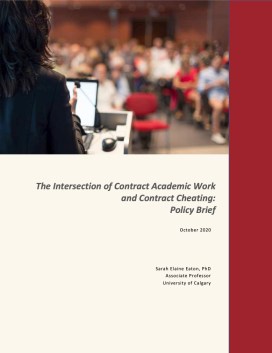
New Report: Contract Academic Work and Contract Cheating: Policy Brief

October 19, 2020

Cover - Contract academic work contract cheatingThe week of October 18-23, 2020 marks Fair Employment Week, hosted by the Canadian Association of University Teachers (CAUT). In many countries, it also marks Integrity Week, built around the International Day of Action Against Contract Cheating. These weeks have coincided for the past several years. A few years ago, I began to study the intersection of contract academic work and contract cheating (e.g., essay mills, term paper mills, etc.)

This report offers a preliminary discussion of the intersection between precarious academic employment and the commercial contract cheating industry. I have written it with the Canadian context in mind, though it may be relevant in other jurisdiction as well. The entire report is available for free download here.

Abstract

Purpose: The goal of this report is to provide substance for an evidence-informed discussion about the intersection of precarious academic employment and the contract cheating industry.

Methods: This is a qualitative report informed by the extant literature. It synthesizes available source material relating to academic staff who also supply services (e.g., essay writing, assignment completion, etc.) to the commercial contract cheating industry.

Results: A summary and synthesis are provided of issues relating to precariously employed academic staff and the contract cheating industry. A key outcome of this work is to highlight how the commercial cheating industry preys on underemployed academic staff. Predatory practices of the contract cheating industry are highlighted including false promises of high pay and meaningful work. Consequences such as disciplinary action and dismissal of academic staff who moonlight as suppliers to the industry are discussed, along with possible counter-measures to raise awareness and protect academic staff.

Implications: This guide is intended to provide guidance on methods used by the commercial contract cheating industry to exploit contract academic staff. Recommendations are provided on how to build awareness about the issue and also consider protections for the precariously employed.

Additional materials: 1 table; 46 references

Document type: Report, 26 pages

Keywords: academic integrity, higher education, academic labour, contingent faculty, precarious employment, cheating economy, sessional, adjunct, faculty

________

Share or Tweet this: New Report: Contract Academic Work and Contract Cheating: Policy Brief https://drsaraheaton.wordpress.com/2020/10/19/contract-academic-work-and-contract-cheating-policy-brief/

This blog has had over 2 million views thanks to readers like you. If you enjoyed this post, please “like” it or share it on social media. Thanks!

Sarah Elaine Eaton, PhD, is an Associate Professor the Werklund School of Education, and the Educational Leader in Residence, Academic Integrity, University of Calgary, Canada. Opinions are my own and do not represent those of the University of Calgary.


Workshop: Exploring Racism and Academic Integrity through a Circle Process

October 16, 2020

ATESL 2020I’m excited to partner with colleagues from Norquest College and the Alberta Council on Academic Integrity to present this workshop at the Alberta Teachers’ of English as a Second Language (ATESL) 2020 E- Conference: Seeds of Possibility: Curiosity, Drive, and Innovation.

Workshop Description

In this session participants will explore and experience the Circle of Courage and circle process by engaging in a dialogue on anti-racism and racism related to academic misconduct.

The Circle of Courage (Brendtro, Brokenleg, & Van Bockern, 2005) is a model of resilience and positive development based on Indigenous values of Belonging, Mastery, Independence and Generosity. Applied together with a circle process, this way of approaching the relational space in classrooms helps create the conditions for students and instructors to engage more authentically and openly in difficult complex topics. As a holistic approach to discussion this a way to spur conversation about the dynamic faced by English as additional language learners.

Keywords: Academic integrity; Restorative Justice; Restorative Practices; Circle Process; Racism

Reference:

Brendtro, L., Brokenleg, M., & Bockern, V. (2005). The circle of courage and positive psychology. Reclaiming Children and Youth, 14(3). 130-136.

Workshop Materials

You can download our workshop materials for free from here: http://hdl.handle.net/1880/112689

Presenter bios

Sheryl Boisvert, B.Ed, CPA, CGA is currently a full-time instructor at NorQuest College. Though she has performed a variety of roles since 2001, Sheryl has found being an instructor to be the most fulfilling.  She has always believed that students gain a better understanding of the material they learn when they can go beyond textbook theory and put concepts into practice.

Nazanin Teymouri, MBA, is as an instructor at NorQuest College in the Faculty of Business, Environment, and Technology. Currently her time at the college is split between teaching and co-leading research initiatives on academic integrity. With a background in communication and business, her focus is on analysis, cultural understanding, and collaboration aimed at bettering the learning environment.

Jamie Ahksistowaki Medicine Crane is Blackfoot from Kainai and Piikani, an activist, advocate, educator, and multi-disciplinary artist. Shes very passionate in education and is currently working with NorQuest College as a curriculum developer- in regards to Indigenous education, history and perspectives, building faculty capacity, supporting curriculum development and Indigenization strategy.

Sarah Elaine Eaton, PhD, is an Associate Professor at the Werklund School of Education, University of Calgary. She is a long-standing member of ATESL. Her research focuses on academic integrity.

_________________________________________

Share or Tweet this: Exploring Racism and Academic Integrity through a Circle Process – https://drsaraheaton.wordpress.com/2020/10/16/exploring-racism-and-academic-integrity-through-a-circle-process/

This blog has had over 2 million views thanks to readers like you. If you enjoyed this post, please “like” it or share it on social media. Thanks!

Sarah Elaine Eaton, PhD, is a faculty member in the Werklund School of Education, and the Educational Leader in Residence, Academic Integrity, University of Calgary, Canada. Opinions are my own and do not represent those of the University of Calgary.


Webinar: Creating a Culture of Equity in Academic Integrity: Best Practices for Teaching and Learning with Dr. Ceceilia Parnther

October 7, 2020

Creating a Culture of Equity in Academic Integrity: Best Practices for Teaching and Learning – Webinar

Presenter: Dr. Ceceilia Parnther

Overview:

Ceceila ParntherThis session will review inequitable practices related to academic integrity. These practices threaten to undermine the vital work of celebrating and affirming a diverse academic community. This presentation will consider the ramifications for students, teachers, and researchers, and offer research-based solutions to refine current approaches to teaching and upholding academic integrity.

Learning Outcomes:

Engaged participants will:

  1. Define the current challenges to equity in academic integrity.
  2. Recognize current practices and the ways they may uphold unequal outcomes.
  3. Review best practices for equitable practice in academic integrity.

Presenter bio:

Ceceilia Parnther, Ph.D., is an Assistant Professor and Program Coordinator in the Department of Administrative and Instructional Leadership at St. John’s University. Her research interests include academic integrity education and equitable college student success initiatives. Before joining the faculty, Ceceilia worked in student and academic affairs in various capacities, including academic integrity, advisement, and student conduct. Among others, her most recent research is found in Higher Education Research and Development, Innovative Higher Education, and The Journal of College Student Retention.

Date: Friday, October 9, 2020
Time: 10 – 11:30 a.m. – Mountain Time – Please adjust to your local time zone.
Locations: Online via Zoom

Please note: This workshop will be recorded, registration will close on Thursday, October 8, 2020 at 1 p.m. (MT) and a Zoom link for the workshop will be sent to you the morning of the webinar. The recording link will only be sent to registered participants.

Register here.

Keywords: academic integrity, academic misconduct, student conduct, equity, diversity, inclusion

_________________________________________

Share or Tweet this: Webinar: Creating a Culture of Equity in Academic Integrity: Best Practices for Teaching and Learning with Dr. Ceceilia Parnther https://drsaraheaton.wordpress.com/2020/10/07/creating-a-culture-of-equity-in-academic-integrity-best-practices-for-teaching-and-learning-webinar/

This blog has had over 2 million views thanks to readers like you. If you enjoyed this post, please “like” it or share it on social media. Thanks!

Sarah Elaine Eaton, PhD, is a faculty member in the Werklund School of Education, and the Educational Leader in Residence, Academic Integrity, University of Calgary, Canada. Opinions are my own and do not represent those of the University of Calgary.


Webinar: Indigenous Paradigms in Practice: Relationships, Story and Academic Integrity

September 29, 2020

Indigenous Academic Integrity Webinar - Keeta Gladue

Indigenous peoples are diverse distinct nations who carry the knowledge of millennia. As Indigenous peoples we know that knowledge must be authentic, validated, and shared through principled action. Join us as we discuss the paradigms and principles of academic integrity based on the values of our Communities. Providing the philosophical and the practical, this webinar is designed to explore Indigenous approaches to knowledge for both Indigenous and non-Indigenous members of the post-secondary community.

Keeta Gladue Headshot (web size)Presenter bio: Keeta Gladue is a proud professional Indigenous nerd (IndigENerd), who believes in changing the world through pop culture references, humour and storytelling. When we explore the stories we tell, ask who told them and why, and look for the stories that remain untold, we better understand the world around us. Holding degrees in English, psychology and social work, Keeta is a current graduate student at the University of Calgary in the social work leadership program. She is the current Indigenous Student Program Advisor at Writing Symbols Lodge (The University of Calgary’s Indigenous student support centre) supporting diversity, equity and inclusion. A recent TEDx speaker, Keeta is committed to supporting intercultural engagement and understanding. As a passionate lover of learning she hopes to infect others with curiosity and wonder about how the world works, and even more, inspire them to imagine and work towards what it could be.

Webinar date: Friday, 13 November, 2020

Time: 10:00 a.m. to 11:30 a.m. Mountain Time. Please convert to your own local time zone. All registered participants will receive a link to the recording after the live session.

Deadline to register: 11 November, 2020

Register here.

______

Share or Tweet this: Webinar: Indigenous Paradigms in Practice: Relationships, Story and Academic Integrity – https://drsaraheaton.wordpress.com/2020/09/30/webinar-indigenous-paradigms-in-practice-relationships-story-and-academic-integrity/

This blog has had over 2 million views thanks to readers like you. If you enjoyed this post, please “like” it or share it on social media. Thanks!

Sarah Elaine Eaton, PhD, is a faculty member in the Werklund School of Education, and the Educational Leader in Residence, Academic Integrity, University of Calgary, Canada. Opinions are my own and do not represent those of the University of Calgary.


A Systems Approach to Address Contract Cheating

September 24, 2020

I’m delighted to be giving a presentation today at the the 8th Congress on Academic Integrity organized by the Center for Academic Integrity, University of Monterrey (UDEM), Monterrey, Mexico.

Slide1

Abstract

In this presentation I examine how a systems approach is needed to address contract cheating in its various forms. Using the 4M framework, I demonstrate the role of the individual (micro), the department (meso), the learning organization (macro) and stakeholders beyond the institution (mega).

In this session, I share insights from my forthcoming book, Plagiarism in Higher Education: Tackling Tough Topics in Academic Integrity to be published by ABC Clio/Libraries Unlimited in 2021.

Keywords: academic integrity, academic misconduct, contract cheating, 4M Framework, SoTL

You can find a complete English-language slide deck and the script for the talk archived online here: http://hdl.handle.net/1880/112560

Integridad Académica: Un enfoque de sistemas para enfrentar la compraventa de trabajo académico1
8.° Congreso de Integridad Académica

En esta presentación Eaton examina cómo y por qué se requiere de un enfoque de sistemas para abordar la compraventa de trabajo académico.

Utilizando el marco de referencia de las 4M, Eaton muestra el rol de la persona (micro), el departamento (meso), la institución y la comunidad (mega).

Palabras clave: integridad académica, mala conducta académica, marco de referencia de las 4M, Investigación en Docencia y Aprendizaje (IDA / SoTL)

Se encuentra las diapositivas y todo el contenido de esta presentación aquí:  http://hdl.handle.net/1880/112565

_________________________________

Share or Tweet this:

Academic Integrity: A Systems Approach to Address Contract Cheating 8th Congress on Academic Integrity https://drsaraheaton.wordpress.com/2020/09/24/a-systems-approach-to-address-contract-cheating/(opens in a new tab)

This blog has had over 2 million views thanks to readers like you. If you enjoyed this post, please “like” it or share it on social media. Thanks!

Sarah Elaine Eaton, PhD, is a faculty member in the Werklund School of Education, and the Educational Leader in Residence, Academic Integrity, University of Calgary, Canada. Opinions are my own and do not represent those of the University of Calgary.