My colleague, Roswita Dressler and I have just had a new paper published. It all started when I was at an academic integrity conference a couple of years back. I was sitting next to a colleague who works in a language other than English (LOTE). The colleague suggested that contract cheating (e.g. essay mills and other forms of outsourced academic work) was a problem of the English-speaking world, asserting that there simply wouldn’t be enough of a market in other languages.
I thought to myself, “Challenge accepted!” I recruited Roswita Dressler to help me undertake a small-scale pilot study. We both have a background in language teaching and between us, we have some level of proficiency in about four languages. We were also curious about the market for academic outsourcing for younger audiences, in elementary, middle and high school.
The questions that guided our project were:
What evidence exists that online providers offer academic work in languages other than English?
To what degree are K-12 students targeted by these online providers?
We framed our study specifically within the Canadian context.
Our results showed that not only do commercial contract cheating companies market to specifically to students in Canada, they target children as young as Grade six (approximately 11-12 years old). And yes, we found strong evidence that contract cheating happens in languages other than English (ten of them, in fact).
To the best of our knowledge, this is the first study on contract cheating published in Canada.
The Alberta Teachers Association is the publisher and copyright holder of this article. They have given us permission to post the article in our university’s digital repository. You can access a copy of it free of charge from here:
Eaton, S. E., & Dressler, R. (2019). Multilingual essay mills: Implications for second language teaching and learning. Notos, 14(2), 4-14. Retrieved from http://hdl.handle.net/1880/110695
Share or Tweet this: Multilingual essay mills – New article
This blog has had over 2 million views thanks to readers like you. If you enjoyed this post, please “like” it or share it on social media. Thanks!
Sarah Elaine Eaton is a faculty member in the Werklund School of Education, University of Calgary, Canada. Opinions are my own and do not represent those of the Werklund School of Education or the University of Calgary.
Note: This is an early-stage concept draft intended for sharing for developmental feedback.
Direct questions about this proposal to Dr. Sarah Elaine Eaton – seaton (at) ucalgary.ca.
Background
The MEd certificate in Academic Integrity is an opportunity for those interested in this topic to develop as scholars of the profession in a learning community of like-minded students. Situated within the Leadership specialization, students will explore academic integrity through a leadership, policy and governance lens, while also developing an evidence-informed approach to the pragmatic aspects of academic integrity such as case management. Students will examine their personal and professional notions of academic integrity, as situated concepts within institutional and systemic contexts, deepening their understanding of how professional practice related to academic integrity is nested within institutional policies and procedures and how these are related to quality assurance from a systemic perspective, such as ministries of education and/or higher education.
MEd Certificate
The MEd (Master of Education) is a course-based pathway which provides students with a systematic understanding of knowledge, and a critical awareness of current problems and/or new insights, much of which is at, or informed by, the forefront of their academic discipline, field of study or area of professional practice in two topic areas, plus additional research methods courses.
Each certificate is based on a topic area comprised for four (4) courses. The MEd Certificate is a pathway to a Master of Education (MEd), Interdisciplinary route, but a graduate level certificate is awarded upon the successful completion of a 4-course certificate, so even if participants choose only to undertake the 4-course topic, they can still be awarded a graduate-level certificate.
Learning Goals and Expected Outcomes
There are three overarching learning goals of this proposed certificate:
This certificate will increase awareness of the role of academic integrity in educational contexts.
It will assist those who have academic integrity as a component of their professional portfolio in furthering discussion and learning about integrity, ethical decision-making, case management and policy.
It will assist current and future educational leaders to envision and develop a personal theory of integrity that enhances the learning experiences of students, while remaining cognizant of institutional policies and procedures, as well as larger systemic realities.
The four (4) courses for this certificate will be developed in consultation with internal and external stakeholders.
Possible formats
Option 1: Completely online format – All four (4) courses offered online using asynchronous (D2L) and synchronous (Zoom) learning technologies. Students could be physically located anywhere in the world and would not be required to come to the University of Calgary for any component of the certificate.
Option 2: Blended – Two (2) courses offered on-campus during an intensive two-week residency in July. This would require students to physically be in Calgary during the mandatory two-week residency. The residency would be followed by two (2) additional courses offered online in the subsequent fall and winter terms.
Anticipated timeline
We do not have an exact timeline for the launch of this program yet, as it would need to receive approval at a number of levels. However, given the amount of interest and support we have at this early stage, it is reasonable to anticipate that it may be available by September 2020.
Feedback Questions
At this point, we are seeking feedback from various stakeholders on these particular points:
Which of the two possible formats (online or blended) is most appealing? Why?
What are some key topics or courses you would like to see included in this program? Why?
What resources (books, articles, etc.) do you see as being foundational for courses offered in this certificate?
For questions about this proposal or to add your name to the mailing list contact:
Dr. Sarah Elaine Eaton, Werklund School of Education, University of Calgary, seaton (at) ucalgary.ca
Share or Tweet this: Seeking early-stage feedback about proposed MEd Certificate in Academic Integrity https://wp.me/pNAh3-2nv
This blog has had over 2 million views thanks to readers like you. If you enjoyed this post, please “like” it or share it on social media. Thanks!
Sarah Elaine Eaton is a faculty member in the Werklund School of Education, University of Calgary, Canada. Opinions are my own and do not represent those of the Werklund School of Education or the University of Calgary.
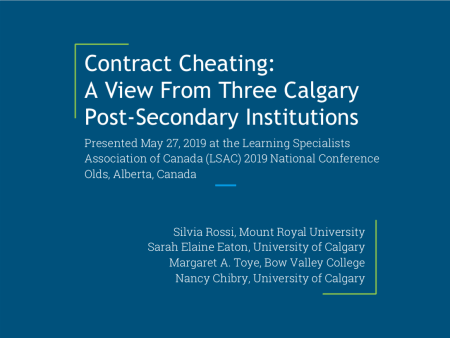
So excited to be presenting with my colleagues, Silvia Rossi (Mount Royal University), Maragaret A. Toye (Bow Valley College) and Nancy Chibry (University of Calgary) next week at the Learning Specialists Association of Canada national conference in Olds, Alberta. I am excited that sessions on contract cheating are getting accepted at national conferences in Canada. To the best of my knowledge this will be the first time that contract cheating will be talked about at this particular conference.
Rossi, S., Eaton, S. E., Toye, M. A., & Chibry, N. (2019, May 27). Contract cheating: A view from three Calgary post-secondary institutions. Paper presented at the Learning Specialists Association of Canada (LSAC) National Conference, Olds, AB.
COVID-19, Contract Cheating and Academic Integrity in Online Courses: What you need to knowhttps://wp.me/pNAh3-2rx
______________________
Share or Tweet this: Contract cheating: A view from three Calgary post-secondary institutions https://wp.me/pNAh3-2nm
This blog has had over 2 million views thanks to readers like you. If you enjoyed this post, please “like” it or share it on social media. Thanks!
Sarah Elaine Eaton is a faculty member in the Werklund School of Education, University of Calgary, Canada. Opinions are my own and do not represent those of the Werklund School of Education or the University of Calgary.
The other day I was talking with Dr. Tracey Bretag about her upcoming visit to Calgary for the Canadian Symposium on Academic Integrity. We were talking about the topics of her keynotes for the symposium and our conversation wandered around to contract cheating. I commented that contract cheating is poorly understood, in my opinion, by many faculty members and administrators in Canada. I commented that there are people on our campus who have never heard of it, or don’t believe it to be a widespread. I said that the importance of developing of academic integrity literacy was really important.
And there it was, a term that captures the idea of bringing together the values that underpin the values we are trying to teach our students on campus, with foundational skills we need our students to learn as part of academic literacy.
Weideman offers a comprehensive yet concise definition of academic literacy in this blog post. His definition includes skills such as understanding a variety of academic vocabulary in context, making distinctions between essential and non-essential information and knowing what counts as evidence (Wideman, n.d.). The skills Weideman describes are essential for success in numerous educational contexts.
I would add that academic integrity literacy necessarily goes beyond the development of skills to include an explicit understanding of the values that underpin integrity and a conscious commitment to upholding those values.
What is the difference between academic integrity and academic misconduct?
This is a question that people ask me often.
Integrity advocates differentiate academic integrity from academic misconduct for a couple of reasons. First, misconduct casts a negative lens on the issue, where as a focus on integrity shifts the conversation to a more positive and supportive view. Second, misconduct focuses on unacceptable behaviours or actions that can result in penalties.
Ryerson University explains this key concept: It is the student’s responsibility to know what is expected of them in university.
Memorizing a list of behaviours or skills could seem like an easy way to understand these expectations, but the concept of integrity is more complex than that. It is about taking responsibility for one’s actions and understanding what is acceptable and what is not.
When Julia Christensen Hughes came to our campus in 2017 to talk about academic integrity, she reminded us integrity is rooted in personal code related to morals and values, but misconduct is a violation of laws and standards of practice. She emphasized that values drive behaviour.
Others have mentioned the notion of academic integrity literacy before me. Karanauskienė and colleagues mentioned the term in their paper at a 2018 conference and in another short paper in 2018, as well. However, to the best of my knowledge, no one has yet offered up a concise definition of the term, so let me offer this one:
Definition: Academic integrity literacy is an inseparable combination of values, behaviours, ethical decision-making and skills necessary for academic success.
This is a preliminary definition and we need to talk about and develop further, but it is a place to start.
Here’s a quick video I put together for visual interest:
I’ll wrap up this post by sharing that I’ve just signed a book deal to explore into academic integrity more deeply. I’ll keep you posted on that in future posts, and you can be sure I’ll be digging into this notion as I write.
References
Christensen Hughes, J. (2017, November 24). Understanding academic misconduct: Creating robust cultures of integrity. Paper presented at the University of Calgary, Calgary.
Karanauskienė, D., Česnaitienė, V. J., Emeljanovas, A. n., Miežienė, B., & Mejeryte-Narkeviciene, K. (2018). Educating academic integrity: Obscure forms of academic misconduct at the institutions of higher education. Paper presented at the International Academic Conference, Dresden.
Share or Tweet this: Exploring the notion of academic integrity literacy https://wp.me/pNAh3-2n3
This blog has had over 2 million views thanks to readers like you. If you enjoyed this post, please “like” it or share it on social media. Thanks!
Sarah Elaine Eaton is a faculty member in the Werklund School of Education, University of Calgary, Canada. Opinions are my own and do not represent those of the Werklund School of Education or the University of Calgary.
Jonathan Muma of City News Calgary stopped by campus today to talk with me about the college admissions scandal happening in the United States. The FBI investigation has led to 50 people being charged including celebrities Lori Loughlin and Felicity Huffman.
Canadians can’t bribe their way into university. Following the US College scandal, Jonathon Muma finds out if Canadians bribe their way in. pic.twitter.com/4V3HG8NiVr
— Breakfast Television & CityNews Calgary (@BTCityNewsCGY) March 14, 2019
Many advocates of integrity and social justice have been actively discussing the scandal on social media. One key message is that parents, coaches and others in positions of authority are responsible for setting an example of integrity for young people to follow. Instead, in this case, parents and coaches have been exposed as frauds and conspirators. It begs the question: If young people can’t look up to their parents and their coaches, who can they look up to?
Not only it the entire situation a breach of institutional integrity and ethics in higher education, when we dig even deeper we can compare these stories to previous ones about African American mothers receiving jail time for trying to get their children an advantage.
This is not only a story about the corruption among the wealthy, it is also a story about white privilege and entitlement.
In the story I comment about how Canada and the US differ, but at the same time, I would add that Canada is not immune to social issues such as white privilege, entitlement or those with more money thinking they get to play by different rules. If there is one key takeaway from the college admissions scandal it is this: morality, integrity and ethics matter even before students enrol in university.
Share or Tweet this: News story: Canadians can’t bribe their way into university https://wp.me/pNAh3-2mW
This blog has had over 2 million views thanks to readers like you. If you enjoyed this post, please “like” it or share it on social media. Thanks!
Sarah Elaine Eaton is a faculty member in the Werklund School of Education, University of Calgary, Canada. Opinions are my own and do not represent those of the Werklund School of Education or the University of Calgary.
You must be logged in to post a comment.