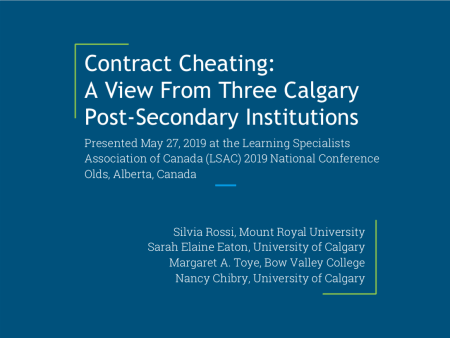
So excited to be presenting with my colleagues, Silvia Rossi (Mount Royal University), Maragaret A. Toye (Bow Valley College) and Nancy Chibry (University of Calgary) next week at the Learning Specialists Association of Canada national conference in Olds, Alberta. I am excited that sessions on contract cheating are getting accepted at national conferences in Canada. To the best of my knowledge this will be the first time that contract cheating will be talked about at this particular conference.
Rossi, S., Eaton, S. E., Toye, M. A., & Chibry, N. (2019, May 27). Contract cheating: A view from three Calgary post-secondary institutions. Paper presented at the Learning Specialists Association of Canada (LSAC) National Conference, Olds, AB.
COVID-19, Contract Cheating and Academic Integrity in Online Courses: What you need to knowhttps://wp.me/pNAh3-2rx
______________________
Share or Tweet this: Contract cheating: A view from three Calgary post-secondary institutions https://wp.me/pNAh3-2nm
This blog has had over 2 million views thanks to readers like you. If you enjoyed this post, please “like” it or share it on social media. Thanks!
Sarah Elaine Eaton is a faculty member in the Werklund School of Education, University of Calgary, Canada. Opinions are my own and do not represent those of the Werklund School of Education or the University of Calgary.
The other day I was talking with Dr. Tracey Bretag about her upcoming visit to Calgary for the Canadian Symposium on Academic Integrity. We were talking about the topics of her keynotes for the symposium and our conversation wandered around to contract cheating. I commented that contract cheating is poorly understood, in my opinion, by many faculty members and administrators in Canada. I commented that there are people on our campus who have never heard of it, or don’t believe it to be a widespread. I said that the importance of developing of academic integrity literacy was really important.
And there it was, a term that captures the idea of bringing together the values that underpin the values we are trying to teach our students on campus, with foundational skills we need our students to learn as part of academic literacy.
Weideman offers a comprehensive yet concise definition of academic literacy in this blog post. His definition includes skills such as understanding a variety of academic vocabulary in context, making distinctions between essential and non-essential information and knowing what counts as evidence (Wideman, n.d.). The skills Weideman describes are essential for success in numerous educational contexts.
I would add that academic integrity literacy necessarily goes beyond the development of skills to include an explicit understanding of the values that underpin integrity and a conscious commitment to upholding those values.
What is the difference between academic integrity and academic misconduct?
This is a question that people ask me often.
Integrity advocates differentiate academic integrity from academic misconduct for a couple of reasons. First, misconduct casts a negative lens on the issue, where as a focus on integrity shifts the conversation to a more positive and supportive view. Second, misconduct focuses on unacceptable behaviours or actions that can result in penalties.
Ryerson University explains this key concept: It is the student’s responsibility to know what is expected of them in university.
Memorizing a list of behaviours or skills could seem like an easy way to understand these expectations, but the concept of integrity is more complex than that. It is about taking responsibility for one’s actions and understanding what is acceptable and what is not.
When Julia Christensen Hughes came to our campus in 2017 to talk about academic integrity, she reminded us integrity is rooted in personal code related to morals and values, but misconduct is a violation of laws and standards of practice. She emphasized that values drive behaviour.
Others have mentioned the notion of academic integrity literacy before me. Karanauskienė and colleagues mentioned the term in their paper at a 2018 conference and in another short paper in 2018, as well. However, to the best of my knowledge, no one has yet offered up a concise definition of the term, so let me offer this one:
Definition: Academic integrity literacy is an inseparable combination of values, behaviours, ethical decision-making and skills necessary for academic success.
This is a preliminary definition and we need to talk about and develop further, but it is a place to start.
Here’s a quick video I put together for visual interest:
I’ll wrap up this post by sharing that I’ve just signed a book deal to explore into academic integrity more deeply. I’ll keep you posted on that in future posts, and you can be sure I’ll be digging into this notion as I write.
References
Christensen Hughes, J. (2017, November 24). Understanding academic misconduct: Creating robust cultures of integrity. Paper presented at the University of Calgary, Calgary.
Karanauskienė, D., Česnaitienė, V. J., Emeljanovas, A. n., Miežienė, B., & Mejeryte-Narkeviciene, K. (2018). Educating academic integrity: Obscure forms of academic misconduct at the institutions of higher education. Paper presented at the International Academic Conference, Dresden.
Share or Tweet this: Exploring the notion of academic integrity literacy https://wp.me/pNAh3-2n3
This blog has had over 2 million views thanks to readers like you. If you enjoyed this post, please “like” it or share it on social media. Thanks!
Sarah Elaine Eaton is a faculty member in the Werklund School of Education, University of Calgary, Canada. Opinions are my own and do not represent those of the Werklund School of Education or the University of Calgary.
Jonathan Muma of City News Calgary stopped by campus today to talk with me about the college admissions scandal happening in the United States. The FBI investigation has led to 50 people being charged including celebrities Lori Loughlin and Felicity Huffman.
Canadians can’t bribe their way into university. Following the US College scandal, Jonathon Muma finds out if Canadians bribe their way in. pic.twitter.com/4V3HG8NiVr
— Breakfast Television & CityNews Calgary (@BTCityNewsCGY) March 14, 2019
Many advocates of integrity and social justice have been actively discussing the scandal on social media. One key message is that parents, coaches and others in positions of authority are responsible for setting an example of integrity for young people to follow. Instead, in this case, parents and coaches have been exposed as frauds and conspirators. It begs the question: If young people can’t look up to their parents and their coaches, who can they look up to?
Not only it the entire situation a breach of institutional integrity and ethics in higher education, when we dig even deeper we can compare these stories to previous ones about African American mothers receiving jail time for trying to get their children an advantage.
This is not only a story about the corruption among the wealthy, it is also a story about white privilege and entitlement.
In the story I comment about how Canada and the US differ, but at the same time, I would add that Canada is not immune to social issues such as white privilege, entitlement or those with more money thinking they get to play by different rules. If there is one key takeaway from the college admissions scandal it is this: morality, integrity and ethics matter even before students enrol in university.
Share or Tweet this: News story: Canadians can’t bribe their way into university https://wp.me/pNAh3-2mW
This blog has had over 2 million views thanks to readers like you. If you enjoyed this post, please “like” it or share it on social media. Thanks!
Sarah Elaine Eaton is a faculty member in the Werklund School of Education, University of Calgary, Canada. Opinions are my own and do not represent those of the Werklund School of Education or the University of Calgary.
I’ve been working on a national research project with my colleagues, Jenny Miron and Laura McBrearity, at Humber College to look at what programming and supports Canadian post-secondary institutions provide to students to help them learn about academic integrity. We reviewed the websites of public higher education institutions across the country to better understand how academic integrity information is shared with students and faculty across campuses. We recently presented our findings at the conference of the International Center for Academic Integrity in New Orleans. Here’s a quick overview of our session:
Miron, J. B., Eaton, S. E., & McBrearity, L. (2019). Academic Integrity (AI) Tutorials in Canadian Post-Secondary Institutions: A National Overview. Paper presented at the International Center for Academic Integrity, New Orleans, LA.
The team at Humber College created this excellent visual infographic highlighting our methods (search strategies), lessons learned and key findings:
We have not published the full findings yet, though we plan to do so soon. Because there is so little research available about what kind of support (e.g. education, tutorials, modules) offer on academic integrity to Canadian post-secondary students, we wanted to make these preliminary results available now.
You can download a high quality version of this infographic here:
Miron, J. B., Eaton, S. E., & McBrearity, L. (2019). Searching Public Websites within Canadian Higher Education: Academic Integrity Tutorials [Infographic]. Retrieved from http://hdl.handle.net/1880/109916
Share or Tweet this: Academic Integrity (AI) Tutorials in Canadian Post-Secondary Institutions: A National Overview
This blog has had over 2 million views thanks to readers like you. If you enjoyed this post, please “like” it or share it on social media. Thanks!
Sarah Elaine Eaton is a faculty member in the Werklund School of Education, University of Calgary, Canada. Opinions are my own and do not represent those of the Werklund School of Education or the University of Calgary.
There have been reports in the media recently about Father Thomas Rosica, the priest and Vatican spokesperson who has been plagiarizing material for years (Breen 2019a, 2019b). Just a few days after the story broke, Father Rosica resigned from his position on the governing body of the Collegium of the University of St. Michael’s College, University of Toronto.
Why is plagiarism by a priest so offensive? Well, for starters, the word “plagiarism” means “literary theft”. One of Ten Commandments that underpins Christian faith is “Thou Shalt Not Steal”. Scholars of plagiarism have noted the act of plagiarism as being a transgression against Judeo-Christian values (Colon, 2001; Park, 2003).
According to the news reports (Brean, 2019a, 2019b), Father Rosica claimed that his plagiarism was unintentional, a result of having to meet demanding media deadlines. Being unable to cope with time pressure and deadlines is often one reason cited in the literature as to why students commit plagiarism.
But there’s a key difference. Father Rosica is not a student. He is a high-ranking Church official who presumably has the agency as an adult to manage his time.
And presumably, a highly educated priest should have known better. It is hard to believe this was a sin of ignorance.
According to news reports (Brean 2019a, 2019b), the optics worsened when Father Rosica allegedly cast blame towards junior staff who helped him prepare the content of his communications.
Let’s get one thing straight. It is wrong to plagiarize. It’s even worse to blame others when you are the one responsible for the communication. It seems that Father Rosica has confessed his sins and seeks forgiveness, which I have every confidence he will be granted. But forgiveness does not equate to the restoration of the public’s confidence. Nor can forgiveness fix an individual’s reputation.
Father Rosica is in a position of great moral authority and power. Plagiarism is a moral transgression, even when it isn’t a legal one. In certain professions (including priesthood), reputation is everything. I suspect that although Father Rosica may be granted the forgiveness he seeks, the damage to his reputation may be irreparable.
Colon, A. (2001). Avoid the pitfalls of plagiarism. The Writer, 114(1), 8.
Park, C. (2003). In other (people’s) words: Plagiarism by university students – literature and lessons. Assessment and Evaluation in Higher Education, 28(5), 471-488. http://www.lancaster.ac.uk/staff/gyaccp/caeh_28_5_02lores.pdf doi:10.1080/0260293032000120352
Comments Off on Father Thomas Rosica: The Priest Who Plagiarized | education, plagiarisim | Tagged: plagiarism | Permalink Posted by Sarah Elaine Eaton, Ph.D.
You must be logged in to post a comment.