Journal of Educational Thought: Special Issue on Academic Integrity and Ethics

January 14, 2020

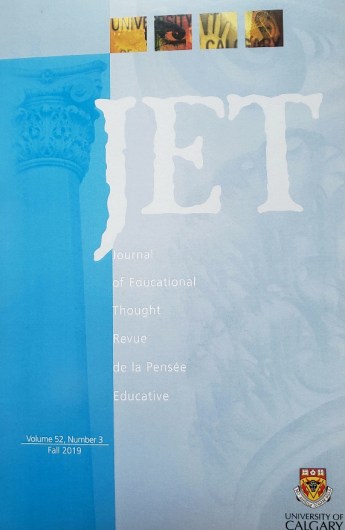
JET Cover 52(3)I am so pleased to share that the special issue of the Journal of Educational Thought dedicated to academic integrity and ethics is now out. I am excited about this work because it adds to the growing body of scholarly and research literature on these important topics, not only in Canada, but globally, too.

I was the guest Co-Editor for this special issue, together with the journal’s editor-in-chief, Ian Winchester.

Here’s an overview of what’s in the issue:

Editorials

Winchester, I. (2019). Academic integrity in the university. Journal of Educational Thought, 52(3), 187-190.

Eaton, S. E. (2019). Considerations of corruption, ethics and integrity in educational contexts: Guest editorial. Journal of Educational Thought, 52(3), 191-192.

Research articles

Lock, J., Schroeder, M., & Eaton, S. E. (2019). Designing and implementing an online academic integrity tutorial: Identifying the challenges within a post-secondary context. Journal of Educational Thought, 52(3), 193-208.

Lancaster, T., Glendinning, I., Foltýnek, T., Dlabolová, D., & Linkeschová, D. (2019). The perceptions of higher education students on contract cheating and educational corruption in South East Europe. Journal of Educational Thought, 52(3), 209-227.

Henry, R., & Gabel, C. (2019). “It’s not just a picture when lives are at stake: Ethical considerations and photovoice methods with Indigenous Peoples engaged in street lifestyles”. Journal of Educational Thought, 52(3), 229-252.

Miron, J. B. (2019). Academic integrity in a student practice environment: An elicitation study. Journal of Educational Thought, 52(3), 253-273.

All of the research articles underwent double-blind peer review.

______________________________________________________

Share or Tweet this: Journal of Educational Thought: Special Issue on Academic Integrity and Ethics

This blog has had over 2 million views thanks to readers like you. If you enjoyed this post, please “like” it or share it on social media. Thanks!

Sarah Elaine Eaton is a faculty member in the Werklund School of Education, and the Educational Leader in Residence, Academic Integrity, University of Calgary, Canada. Opinions are my own and do not represent those of the University of Calgary.


Academic Integrity: Resource for Teaching Assistants

September 16, 2019
Academic Integrity resource for teaching assistants

Academic Integrity resource for teaching assistants

As a Teaching Assistant (TA) it can be tricky to know what your responsibilities are if you suspect or observe academic misconduct. This resource is intended to help both TAs and course instructors about the roles and responsibilities teaching assistants play in upholding academic integrity at the University of Calgary.

Teaching assistants are responsible for acting with integrity, maintaining the privacy of all parties involved and reporting any suspected or actual cases of academic misconduct to the course instructor. TAs are not responsible for confronting student(s) who may be allegedly responsible for academic misconduct and nor are they responsible for imposing sanctions (discipline). It is the responsibility of the course instructor to follow the guidelines established by their faculty for responding to allegations of academic misconduct.

Open communication between course instructors and teaching assistants is key. Establishing expectations early in the term, before issues might arise can be very helpful for teaching assistants.

It is important for teaching assistants to know they are not alone when it comes to upholding academic integrity.

This one-page tip sheet is intended as a suggested guideline to help teaching assistants figure out what to do if they encounter or suspect a breach of academic integrity. This handout is not exhaustive and it may not cover all situations. This resource was developed specifically for teaching assistants at the University of Calgary and may not apply to TAs at other institutions.

Here is a link to this free and downloadable .pdf resource: U Have Integrity: Resource for Teaching Assistants.

Here is the text of the .pdf for anyone wanting a quick read:

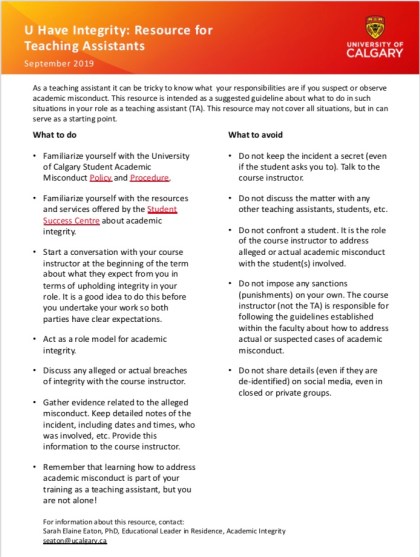
As a teaching assistant it can be tricky to know what your responsibilities are if you suspect or observe academic misconduct. This resource is intended as a suggested guideline about what to do in such situations in your role as a teaching assistant (TA). This resource may not cover all situations, but in can serve as a starting point. 

What to do 

  • Familiarize yourself with the University of Calgary Student Academic Misconduct Policy and Procedure. 
  • Familiarize yourself with the resources and services offered by the Student Success Centre about academic integrity. 
  • Start a conversation with your course instructor at the beginning of the term about what they expect from you in terms of upholding integrity in your role. It is a good idea to do this before you undertake your work so both parties have clear expectations. 
  • Act as a role model for academic integrity. 
  • Discuss any alleged or actual breaches of integrity with the course instructor. 
  • Gather evidence related to the alleged misconduct. Keep detailed notes of the incident, including dates and times, who was involved, etc. Provide this information to the course instructor. 
  • Remember that learning how to address academic misconduct is part of your training as a teaching assistant, but you are not alone! 

What to avoid 

  • Do not keep the incident a secret (even if the student asks you to). Talk to the course instructor. 
  • Do not discuss the matter with any other teaching assistants, students, etc. 
  • Do not confront a student. It is the role of the course instructor to address alleged or actual academic misconduct with the student(s) involved. 
  • Do not impose any sanctions (punishments) on your own. The course instructor (not the TA) is responsible for following the guidelines established within the faculty about how to address actual or suspected cases of academic misconduct. 
  • Do not share details (even if they are de-identified) on social media, even in closed or private groups.

Related posts:

______________________________________________________

Share or Tweet this: Academic Integrity: Resource for Teaching Assistants https://wp.me/pNAh3-2oQ

This blog has had over 2 million views thanks to readers like you. If you enjoyed this post, please “like” it or share it on social media. Thanks!

Sarah Elaine Eaton is a faculty member in the Werklund School of Education, and the Educational Leader in Residence, Academic Integrity, University of Calgary, Canada. Opinions are my own and do not represent those of the University of Calgary.


The foundations of scholarship: Original sources

September 3, 2019

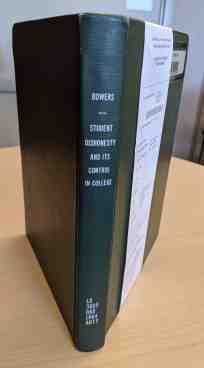
Bowers 1964-sm.jpgI am always telling my students to find and cite the original sources rather than relying on secondary sources. In the work I do on academic misconduct, the work of William Bowers is often cited as a seminal study in the field. The problem is that Bowers’s original work is hard to get your hands on. I was able to find a copy of his 1966 doctoral dissertation, but the original 1964 book seemed almost impossible to find. The two sources have exactly the same title. Although both texts are based on the same content, it is presented in different ways in both texts.

I can say this because I’ve now read both sources in their entirety.

Thanks to our amazing librarians at the University of Calgary, who were able to track down a copy of Bowers’s original 1964 work. Through the inter-library loan system, they were able to request the book from another library (thanks, University of Waterloo!) and have it sent to the university where I work so I could read it.

It is a beautiful volume, obviously produced on a typewriter with painstaking detail. This work was a true labour of love. I so appreciate having the opportunity to read it for myself. I now understand Bowers’s work much better. (I purposely do not offer a synopsis of his work in this blog post, so as to encourage others to go read the original works themselves, rather than relying on someone else’s summary!) Although more updated studies have been published since then, this nevertheless remains an important foundational book in my field. I am delighted to have had the privilege to read it.

I encourage anyone who wants to undertake deep scholarship in a particular field to find the original works upon which the field was built. If you can’t find the books, ask your friendly neighbourhood librarian for help. You might be surprised how they can help you be a better scholar.

References:

Bowers, W. J. (1964). Student dishonesty and its control in college. New York: NY: Bureau of Applied Social Research, Columbia University.

Bowers, W. J. (1966). Student dishonesty and its control in college. (Doctor of Philosophy). Columbia University, New York.

______________________________________________________

Share or Tweet this: The foundations of scholarship: Original sources https://wp.me/pNAh3-2ol

This blog has had over 2 million views thanks to readers like you. If you enjoyed this post, please “like” it or share it on social media. Thanks!

Sarah Elaine Eaton is a faculty member in the Werklund School of Education, University of Calgary, Canada. Opinions are my own and do not represent those of the Werklund School of Education or the University of Calgary.


7th Ed. APA Manual – An Academic Integrity Response

August 9, 2019

APA 7th cover.jpgLike many others, I have been eagerly awaiting the release of the the 7th edition of the Publication Manual of the American Psychological Association (affectionally known by millions as the APA Manual). I was thrilled to read the press release saying its launch has been scheduled for October 2019. Then it occurred to me that this may be problematic from an academic integrity perspective. It is important for educators and institutions to take a supportive, ethical, and instructive approach to the adoption of the latest edition of the manual. Here are some ways to do that:

Recommendations for Instructors

  1. Talk to your students about the release of the 7th edition. This is an excellent reason to review citing and referencing expectations with students.
  2. Talk to administrators about what is expected of you with regards to when and how to adopt the 7th edition of the manual. It may make more sense to start and finish the term with consistent use of the same edition of the manual and transition to a new manual at the start of a new term.

Recommendations for Institutions

  1. Develop and deliver campus-wide training programs on the differences between the 6th and 7th editions of the manual. Students, faculty and others will need explicit and supportive instruction on what’s new and how to adapt to the norms of the new edition.
  2. Develop a systematic plan for campus-wide adoption of the 7th edition. Neither instructional staff nor students should be expected to buy a new manual and adopt it during the middle of a term. This could result in both a financial burden and unnecessary stress for everyone involved. It should be OK to stick with the 6th edition of the manual for the fall term (or the spring 2019 semester for the southern hemisphere), so everyone is using the same version consistently in courses. There can (and should) be a period of transition while students and others can learn the details of the latest version in time for start of the next term. There should be clear communication to students about when they are expected to fully adopt the 7th edition, and it should not be in the middle of term.
  3. Develop a unified and supportive institutional stance towards ethical adoption of the latest edition, casting a particular lens to academic integrity breaches and policy. It is imperative that students not be penalized for academic misconduct for failing follow 7th edition in the fall 2019 semester. (This includes not being penalized for having two spaces after a period!) It is important to give students, educators, administrators and others time to learn the new conventions that with come with the latest edition.

This is an exciting time for everyone whose work intersects with the APA manual in a variety of ways, including citing, referencing and academic writing. It is important to create supportive and planned approaches to adoption of the new edition in ways that emphasize teaching, learning and the development of research and writing skills.

______________________________________________________

Share or Tweet this: 7th Ed. APA Manual – An Academic Integrity Response https://wp.me/pNAh3-2nQ

This blog has had over 2 million views thanks to readers like you. If you enjoyed this post, please “like” it or share it on social media. Thanks!

Sarah Elaine Eaton is a faculty member in the Werklund School of Education, University of Calgary, Canada. Opinions are my own and do not represent those of the Werklund School of Education or the University of Calgary.


Multilingual essay mills – New article

August 6, 2019

Notos coverMy colleague, Roswita Dressler and I have just had a new paper published. It all started when I was at an academic integrity conference a couple of years back. I was sitting next to a colleague who works in a language other than English (LOTE). The colleague suggested that contract cheating (e.g. essay mills and other forms of outsourced academic work) was a problem of the English-speaking world, asserting that there simply wouldn’t be enough of a market in other languages.

I thought to myself, “Challenge accepted!” I recruited Roswita Dressler to help me undertake a small-scale pilot study. We both have a background in language teaching and between us, we have some level of proficiency in about four languages. We were also curious about the market for academic outsourcing for younger audiences, in elementary, middle and high school.


The questions that guided our project were:

  1. What evidence exists that online providers offer academic work in languages other than English?
  2. To what degree are K-12 students targeted by these online providers?

We framed our study specifically within the Canadian context.

Our results showed that not only do commercial contract cheating companies market to specifically to students in Canada, they target children as young as Grade six (approximately 11-12 years old). And yes, we found strong evidence that contract cheating happens in languages other than English (ten of them, in fact).

To the best of our knowledge, this is the first study on contract cheating published in Canada.

The Alberta Teachers Association is the publisher and copyright holder of this article. They have given us permission to post the article in our university’s digital repository. You can access a copy of it free of charge from here:

Eaton, S. E., & Dressler, R. (2019). Multilingual essay mills: Implications for second language teaching and learning. Notos, 14(2), 4-14. Retrieved from http://hdl.handle.net/1880/110695

______________________________________________________

Share or Tweet this: Multilingual essay mills – New article

This blog has had over 2 million views thanks to readers like you. If you enjoyed this post, please “like” it or share it on social media. Thanks!

Sarah Elaine Eaton is a faculty member in the Werklund School of Education, University of Calgary, Canada. Opinions are my own and do not represent those of the Werklund School of Education or the University of Calgary.