Artificial Intelligence and Academic Integrity: The Ethics of Teaching and Learning with Algorithmic Writing Technologies
Research Team (all from the University of Calgary)
Sarah Elaine Eaton, PhD, Werklund School of Education, Principal Investigator
Robert Brennan, PhD, Schulich School of Engineering, Co-Investigator
Jason Wiens, PhD, Department of English, Faculty of Arts, Co-Investigator
Brenda McDermott, PhD, Student Accessibility Services, Co-Investigator
Helen Pethrick, MA, Project Manager
Beatriz Moya, PhD student, Werklund School of Education, Research Assistant
Jonathan Lesage, MSc student, Schulich School of Engineering, Research Assistant
Focus area (as aligned with University of Calgary research priority areas): Innovation and entrepreneurial thinking
Grant type: Scholarship of Teaching and Learning (SoTL) Grants
Project scope: This project will be conducted at the University of Calgary. Data will be collected from faculty and students, upon successful ethics approval of the project.
Funding amount: $40,000 CAD
Project duration: 2022-2025
Project status
This project just received funding and have submitted documentation to have the project set up in the university systems. We are waiting for that step to be approved. In the meantime, we are preparing our application to the Conjoint Faculties Research Ethics Board (CFREB) at the University of Calgary.
Please note: This is an internal University of Calgary grant. We are not able to include any external collaborators in this particular project.
This blog has had over 3 million views thanks to readers like you. If you enjoyed this post, please “like” it or share it on social media. Thanks!
Sarah Elaine Eaton, PhD, is a faculty member in the Werklund School of Education, and the Educational Leader in Residence, Academic Integrity, University of Calgary, Canada. Opinions are my own and do not represent those of the University of Calgary.
The notion of “integrity sciences” stuck with me. Those of you who know me will no doubt remember a story I share often in my presentations. In 2017, after applying for an internal research grant at my university, I was informed that the application was rejected on the basis that academic integrity is an administrative matter not a research topic. This was just one grant application and I am, of course, grateful to the University of Calgary, for the tremendous support they have provided for my work, including research funding that, since 2016, now exceeds $100,000 CAD across various projects. But that one grant application rejection has stuck with me because of the reasons provided for why the project did not receive funding. Since then, I have dedicated part of my work to showing that not only is academic integrity a topic, it is a field of research, policy, and professional practice.
When I first read the term “integrity sciences” it piqued my interest. I began contemplating the various areas of the field of integrity sciences: systematic and scientific inquiry investigating academic integrity; research integrity; research ethics; publication ethics; plagiarism; fraud and corruption in education and science; and so on. Similar to the way in which learning sciences studies the “an interdisciplinary field that studies teaching and learning” (Sawyer, p. 1), integrity sciences studies is a multi-, inter-, and transdiciplinary field that studies ethics and integrity.
I pointed out during my keynote speech at the 2021 European Conference on Academic Integrity and Plagiarism (ECAIP), hosted by the European Network for Academic Integrity (ENAI), that academic integrity research is transdisciplinary and multi-faceted. The idea of approaching the investigations we conduct under the umbrella of integrity sciences fits in with this notion. The term “integrity sciences” provides us with language to describe the transdisciplinary nature of academic integrity research.
I am still very much learning what Dr. Bergadaà’s conceptualization of integrity sciences might include, and I think this notion is worth discussing with colleagues not only in Europe, but also beyond, to include scholars and scientists across the world.
This blog has had over 3 million views thanks to readers like you. If you enjoyed this post, please “like” it or share it on social media. Thanks!
Sarah Elaine Eaton, PhD, is a faculty member in the Werklund School of Education, and the Educational Leader in Residence, Academic Integrity, University of Calgary, Canada. Opinions are my own and do not represent those of the University of Calgary.
First, let me tell you the story of how I got connect with these two. In the early fall of 2020, Mike Mindzak at Brock University in St. Catharine’s, Ontario (Canada) reached out to me via e-mail to introduce himself. A colleague we have in common had pointed him in the direction of my work on academic integrity. He connected the dots, that I was the person who’d left him a comment on a piece he’d written for University Affairs, entitled, “What happens when a machine can write as well as an academic?”
Mike let me know about some work he was doing with Ryan Morrison at George Brown College in Toronto related to artificial intelligence and algorithmic writing. He asked if I might be interested in collaborating with them. Naturally, I was interested, but also recognized that the field of artificial intelligence is outside of my area of expertise and the demands on time were preventing me from doing a deep dive into any new projects. I suggested that we continue to chat throughout the fall and winter, and look at a possible collaboration for 2021.
I submitted the manuscript for my book, Plagiarism in Higher Education: Tackling Tough topics in Academic Integrity in the final days of May, 2020. In the final chapter of the book I take a future-focused perspective, offering ideas about what the emerging challenges to plagiarism and academic integrity would look like in the not-too-distant future. I cite Mike’s article and contend that the role that artificial intelligence and machine learning will play with regards to ethics in teaching and learning will become a topic that we, educators and educational leaders, will have to contend with.
In late September of 2020, the three of us started working on a proposal to present at the 2021 Canadian Association for the Study of Educational Administration (CASEA). Proposals are normally due in the fall, around October, and undergo a rigorous double-blind peer review process before presenters are notified about whether their presentations have been accepted to the conference.
The three of us stayed in touch during the fall and winter months, as we all observed that the open artificial intelligence technologies (OpenAI) were developing fast. OpenAI’s latest version of its Generative Pre-Training Transformer (GPT),GPT-3 had been released in summer 2020. The technology uses machine learning to simulate human writing through text-generation. We kept an eye on news and developments about the GPT-3 technology, exchanging e-mails with links to new stories we’d seen.
By the time Mike and Ryan presented their webinar, “Exploring the Impacts of Text Generating Technologies on Academic Integrity” at the Taylor Institute of Teaching and Learningon April 9, 2021, our proposal to present at the CASEA conference had been accepted. I was excited to host them for this webinar to kick off this work. I knew the topic of artificial intelligence and machine learning truly fit the theme of the webinar series – urgent and emerging topics in academic integrity. They presented to a small but engaged crowd and as the webinar series convener and host, I watched carefully as questions poured in. As with other topics we had covered in the series, connecting the dots between the new topic and academic integrity was the key.
On June 1, 2021 we had our presentation for CASEA, a scholarly society dedicated to the study of educational administration. I’d been a member of the society since I was a PhD student, as my own supervisor had introduced me to the society and the work years before. My work has focused mainly on higher education, and many of the CASEA members focus on K-12 educational administration, so it hasn’t been a perfect fit for me, but close enough that I have stayed connected over the years. Here’s the abstract for our session:
Abstract
Paper presented at the Canadian Society for the Study of Education (CSSE) 2021 – Canadian Association for the Study of Educational Administration (CASEA) (June 1, 2021) The purpose of this paper is to provide a theoretical and conceptual discussion of the rapidly emerging field of artificial intelligence (AI) and algorithmic writing (AW). The continued development of new tools—most notably at this time, GPT-3—continues to push forward and against the boundaries between the writing of human and machine. As issues surrounding AI continue to be actively discussed by scientists, futurists and ethicists, educational leaders also find themselves front and centre of debates concerning, academic writing, academic integrity and educational ethics more broadly. Three points of focus provide the basis for this analysis. Firstly, we examine the impact of AW on student writing and academic integrity in schools. Secondly, we discuss similar issues in relation to publication and academic scholarship. Finally, taken together, we discuss the broader ethical dimensions and implications that AI and AW will, and are, quickly bringing into education and the field educational administration and leadership.
We had lots of questions and reactions in the Zoom chat, as the conference was held online this year. We have archived our slides publicly online, so anyone can access them. Here is the reference with the link:
Eaton, S. E., Mindzak, M., & Morrison, R. (2021, June 1). The impact of text-generating technologies on academic integrity: AI & AI. Paper presented at the Canadian Association for the Study of Educational Administration (CASEA), University of Alberta [online]. http://hdl.handle.net/1880/113569
We are excited to see where this work will take us next. I have a feeling that the ethics of technology is going to become inextricably intertwined with academic integrity. How that develops is yet to be determined.
This blog has had over 2 million views thanks to readers like you. If you enjoyed this post, please “like” it or share it on social media. Thanks!
Sarah Elaine Eaton, PhD, is a faculty member in the Werklund School of Education, and the Educational Leader in Residence, Academic Integrity, University of Calgary, Canada.
Opinions are my own and do not represent those of the University of Calgary or anyone else.
It’s that time of year again… performance reporting for academic staff at our university happens every two years, with reports due on June 30. There was an official communication that came out a few months back saying we would not have to submit our reports in the usual way, using the online portal system. (Thank God for that… Even with the new system we got a couple of years ago, it still takes hours and hours to fill to enter one’s activities. It’s maddening). But we still had to do a report.
In my case, I had to do two, because over the past two years I have spent half of my time in my home faculty, the Werklund School of Education, and the other half of my time as the inaugural Educational Leader in Residence, Academic Integrity, at the Taylor Institute for Teaching and Learning.
Earlier this year, the University of Calgary signed the San Francisco Declaration on Research Assessment (DORA), which I was pretty excited about. It is part of an overall commitment to assess and value research and scholarly activity in a variety of ways, beyond the traditional peer-reviewed journal articles. Indeed, much of my work I share through public scholarship, including blog posts. Now, as long as I can show some impact from that work, it can be considered as part of my scholarship. That was not always the case.
I am not going to rattle off a whole bunch of numbers about how much I did of this or that (though let me tell you, I was exhausted after reading my own report). Instead, I’m going to focus on one blog post that a senior leader and mentor said in a personal communication “arguably may have been your most important public impact that you have made”. It was the blog post I did on April 3, 2021: Analysis of plagiarism in the draft Alberta K-6 curriculum.
Let’s look at the impact of this one blog post:
Total views: 36,000+
This single blog post resulted in more than 36,000 views (see Figure 1).
Figure 1.
Viewer statistics (n = 36,147) for “Analysis of Plagiarism in the Draft Alberta K-6 Curriculum. (Screenshot date: June 30, 2021)
That’s pretty good for a blog post — at least for me. I mean, I’m a professor who researches ethics and integrity. It’s not like my blog shows off the latest fashion or offers delicious recipes. This post was was — let’s be honest – as close to viral as I’m probably ever going to get.
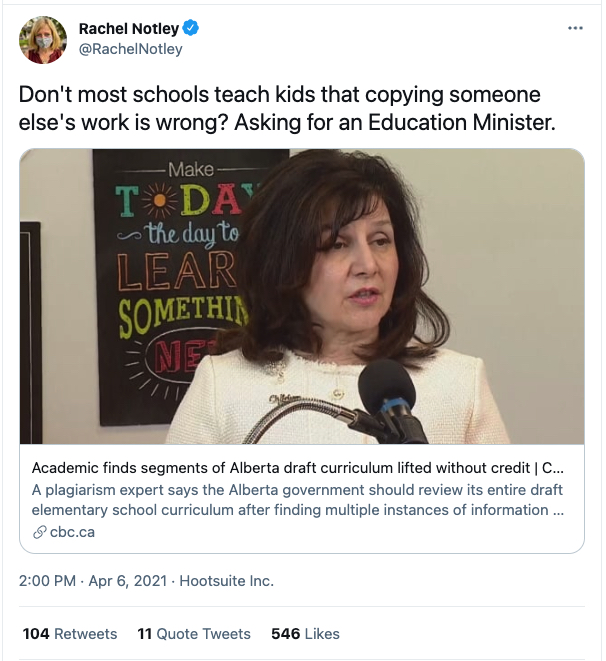
In addition, this work caught the attention of elected officials in Alberta, who shared news of the plagiarism in the draft curriculum on their social media platforms, such as this Tweet from the Hon. Rachel Notley, Leader of the Opposition. (see Figure 1).
Figure 1
Tweet from Rachel Notley, April 6, 2021.
In case you missed it, I was the “academic” quoted in the media article that the leader of opposition Tweeted out.
On April 6, 2021, the Hon. Rachel Notley, leader of the opposition, questioned the Minister of Education, the Hon. Adriana LaGrange, about the plagiarism in the draft curriculum during the official question period in the Alberta provincial legislature, as documented in the official legislative Hansard.
Although dozens and dozens of teachers and other members of the public commented on social media about the plagiarized passages in the draft curriculum, it is fair to say that my analysis of the plagiarism had an impact on all of that. It is not an impact that is easily quantified, but it is reasonable to conclude that the analysis helped to inform a broader public dialogue about the (deeply flawed) draft curriculum, plagiarism, and the need to pay attention to ethics and integrity in K-12 education.
Collaboration Resulting from the Work
This work led to a collaboration with Carla Peck, Angela Grace and others, supported by our respective Deans of Education, called the Alberta Curriculum Analysis project. Through this project, we are documenting numerous analyses of the draft curriculum, from a variety of contributors with different academic and disciplinary backgrounds. This project has become an important public artefact and act of scholarly advocacy to help hold our government accountable, as well as to inform the public.
Completely non-academic (and a little cheeky) impact
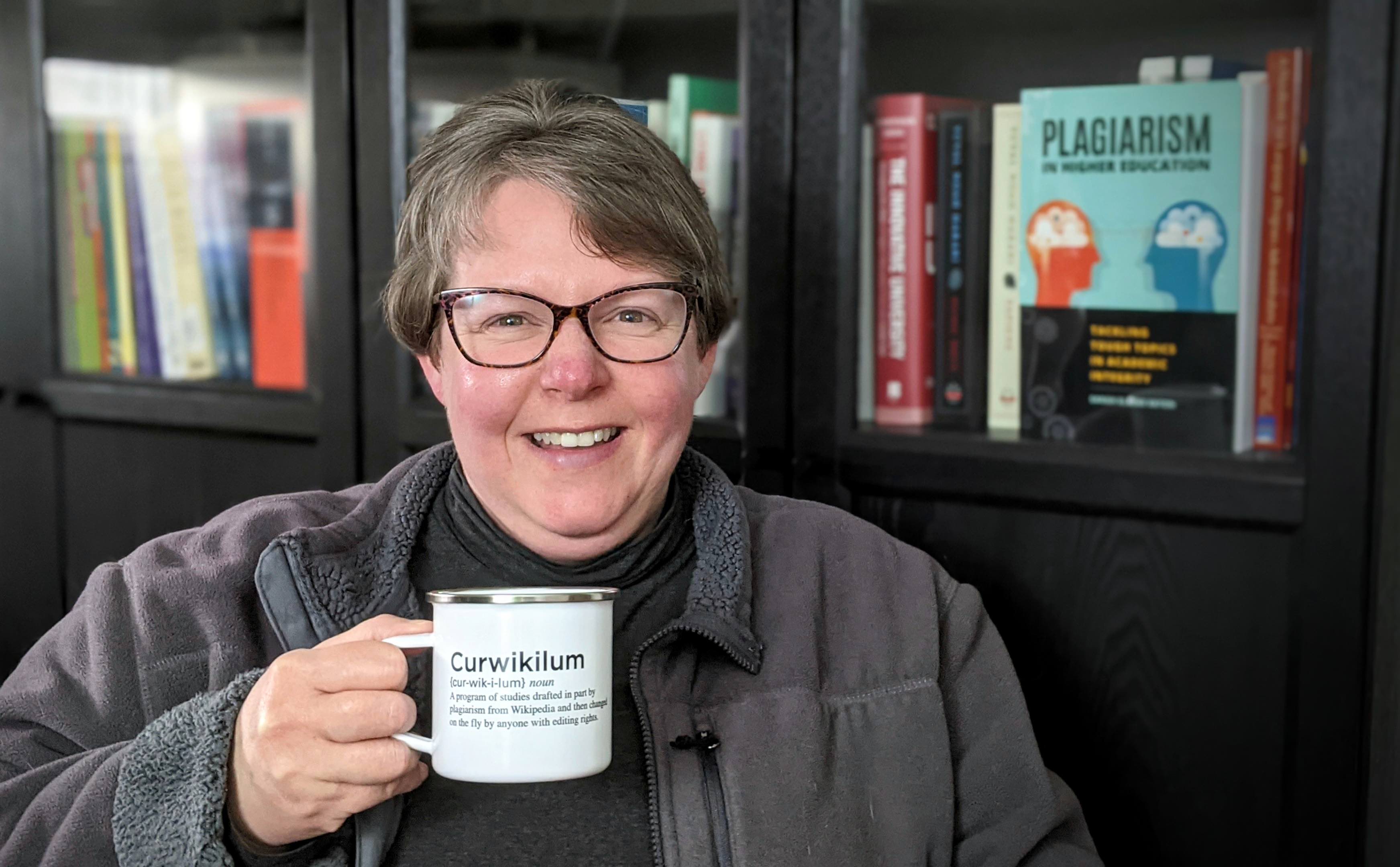
There’s a small business in Edmonton, Canada, called Fehr Play Creative that creates all kinds of custom and novelty products. Not long after I did my analysis of plagiarism in the draft curriculum, they came out with their “Curwikilum” novelty mug. A senior leader at the university bought me one as a gift and it quickly became my favourite, as you can see in this photo:
Figure 2.
Curwikilum mug produced by Fehr Play Creative in Edmonton, AB.
I didn’t ask the good folks at Fehr Play Creative to make this mug. It was entirely their idea. They did a play on words with “curriculum” and “Wikipedia”, coming up with “Curiwikilum” and defined it as: “(noun) A program of study drafted in part by plagiarism from Wikipedia and then changed on the fly by anyone with editing rights”.
It’s the perfect social commentary about what was happening with the draft curriculum… Passages lifted straight from Wikipedia and then slightly altered on the official government website in real time. This “on the fly editing” not only happened with plagiarized passages, but also other passages that members of the public and experts flagged as incorrect or objectionable.
One mug literally said it all. And in terms of impact, what can I say? I mean, man alive – Merch! How many academics can say their work has resulted (directly or indirectly) in novelty merchandise?! I honestly don’t think I’ve seen any kind of mug prior to this that talked about plagiarism. I mean — come on!! This is the area I research — and someone made a frikkin’ novelty mug about it! How utterly cool is that?! It’ll probably never happen again for the rest of my career, so I enjoyed the moment while it lasted.
Was any of this published in a peer-reviewed journal? Nope.
Was any of it reviewed by a peer in any way before I published it? Nope.
Did peers review it afterwards (voluntarily) and offer their comments on it in public forums such as Facebook and Twitter? You bet they did. (And they were very nice about it, I might add.)
Can I prove “cause and effect” with any of this?
Nope – and nor do I want to. Public scholarship isn’t about taking individual credit for work as a sole author and saying, “Hey funders (or whoever), see this causal link between my work and this great discovery?!” I don’t know of anyone who engages in public scholarship who would do that because the very idea is ludicrous.
It is imperative to push back on the notion that “impact” must equate to “cause and effect”. It doesn’t. In some cases the very idea is so reductionist it is nonsensical.
It’s not about “if A (i.e., my research) then B (i.e., some great result)”. Public scholarship is about contributing to a broad public discourse in an informed way through scientific and scholarly inquiry. It is one contribution to a great big important conversation over which few individuals (if any) have direct control, but together, we can collectively make a difference. If I can make a difference with my work that puts the focus of education squarely on ethics and integrity, then it’s all worth it.
This is the kind of scholarship I am interested in now: the kind that makes a difference. Of course, I know I still have to do the peer-reviewed journal articles. That’s part of the job. But more and more I am realizing that peer-reviewed journal articles are, ironically, the kind of work that has the least impact.
So my advice to my fellow academic integrity and ethics scholars — and academics in general — is this: Do what you need to do because your job requires it, but keep doing your public advocacy work, your blog posts, and your public scholarship because it can – and does – make a difference.
This blog has had over 2 million views thanks to readers like you. If you enjoyed this post, please “like” it or share it on social media. Thanks!
Sarah Elaine Eaton, PhD, is a faculty member in the Werklund School of Education, and the Educational Leader in Residence, Academic Integrity, University of Calgary, Canada.
Opinions are my own and do not represent those of the University of Calgary or anyone else.
It seems I have a lot of academic Integrity research projects on the go these days, so I thought I’d do a post about some of this exciting work and the amazing people I’ve been collaborating with.
Academic Integrity and Mental Well-Being
As part of my Educational Leader in Residence, Academic Integrity role, I wanted to connect some of my research to the University of Calgary’s Campus Mental Health Strategy.
Our second paper is under peer review, so stay tuned for details on that later.
Academic Integrity: Faculty Development Needs for Canadian Higher Education
This is the inaugural project associated with the D2L Innovation Guild. This project is the first of its kind in Canada. There has never before been a multi-institutional project, with representation from across multiple provinces, that has also partnered with industry in pursuit of a common unified goal with regards to academic integrity.
This collaborative, multi-institutional project included researchers from four Canadian provinces:
Sarah Elaine Eaton, PhD, Principal Investigator, University of Calgary
Katherine (Katie) Crossman, PhD, Co-Investigator and Study Coordinator, University of Calgary
Brenda M. Stoesz, PhD, Co-Investigator, University of Manitoba
Kim Garwood, PhD, Co-Investigator, University of Guelph
Amanda McKenzie, MA, Co-Investigator, University of Waterloo
You can check out our project brief, which is available as an open access report (Crossman et al., 2019). This project is now complete and we submitted our final reports to the D2L Innovation Guild Board on February 8, 2021.
Contract Cheating in Canada: National Policy Analysis
This is an exciting project that I began developing in 2018. I wanted to create opportunities for Canadian researchers to do scholarly inquiry into contract cheating. I received mentorship from Dr. Tracey Bretag in the early stages of this project. She had led a team in Australia to conduct academic integrity policy research there. She coached me on how to conduct a similar project in Canada. As a result, I launched Contract Cheating in Canada: National Policy Analysis.
The specific objectives of this project are to:
Identify existing components of academic integrity policies and procedures related to contract cheating;
Identify gaps in existing academic integrity policies and procedures related to contract cheating;
Evaluate the policies and procedures against existing standards for post-secondary education policy (i.e., Australian Government: Tertiary Education Quality and Standards Agency (TEQSA), 2017; Higher Education Academy [HEA], 2011) with a focus on supports that have been developed for students and other campus stakeholders (Bretag et al., 2011);
Compare supports available for undergraduate students and graduate students; and
Develop and communicate recommendations for policy reform.
This national project is sub-divided according to regions of Canada and types of post-secondary institutions (e.g., colleges and universities). Different teams have been involved with each of the smaller sub-projects, with individuals from a particular region studying the policies from their own regions.
We’ve already had some great publications out of this project, the most recent of which was published in Educational Policy.
Degrees of Deceit: A Study of Fake Degrees, Diploma Fraud and Counterfeit Credentials
I am working with Jamie Carmichael at Carleton University in Ottawa, Canada, on a project to better understand fake degrees and fraudulent credentials in Canadian higher education.
Check out our webinar recording about this work. Some very cool resources we have already produced out of this work include:
We are also working on an edited book on this topic. More details on that will be coming soon…
These aren’t all the projects I have on the go, just a few I wanted to highlight here. Feel free to get in touch about any of these projects. You know where to find me!
_____
Share or Tweet this: Research update: Highlights from some current projects
This blog has had over 2 million views thanks to readers like you. If you enjoyed this post, please “like” it or share it on social media. Thanks!
Sarah Elaine Eaton, PhD, is a faculty member in the Werklund School of Education, and the Educational Leader in Residence, Academic Integrity, University of Calgary, Canada.
Opinions are my own and do not represent those of the University of Calgary or anyone else.


 Posted by Sarah Elaine Eaton, Ph.D.



 Learning, Teaching and Leadership
You must be logged in to post a comment.