Blogs as Public Scholarship: An Academic Integrity Example

June 30, 2021

It’s that time of year again… performance reporting for academic staff at our university happens every two years, with reports due on June 30. There was an official communication that came out a few months back saying we would not have to submit our reports in the usual way, using the online portal system. (Thank God for that… Even with the new system we got a couple of years ago, it still takes hours and hours to fill to enter one’s activities. It’s maddening). But we still had to do a report.

In my case, I had to do two, because over the past two years I have spent half of my time in my home faculty, the Werklund School of Education, and the other half of my time as the inaugural Educational Leader in Residence, Academic Integrity, at the Taylor Institute for Teaching and Learning.

Earlier this year, the University of Calgary signed the San Francisco Declaration on Research Assessment (DORA), which I was pretty excited about. It is part of an overall commitment to assess and value research and scholarly activity in a variety of ways, beyond the traditional peer-reviewed journal articles. Indeed, much of my work I share through public scholarship, including blog posts. Now, as long as I can show some impact from that work, it can be considered as part of my scholarship. That was not always the case.

I am not going to rattle off a whole bunch of numbers about how much I did of this or that (though let me tell you, I was exhausted after reading my own report). Instead, I’m going to focus on one blog post that a senior leader and mentor said in a personal communication “arguably may have been your most important public impact that you have made”. It was the blog post I did on April 3, 2021: Analysis of plagiarism in the draft Alberta K-6 curriculum.

Let’s look at the impact of this one blog post:

Total views: 36,000+

This single blog post resulted in more than 36,000 views (see Figure 1).

Figure 1.

Viewer statistics (n = 36,147) for “Analysis of Plagiarism in the Draft Alberta K-6 Curriculum. (Screenshot date: June 30, 2021)

That’s pretty good for a blog post — at least for me. I mean, I’m a professor who researches ethics and integrity. It’s not like my blog shows off the latest fashion or offers delicious recipes. This post was was — let’s be honest – as close to viral as I’m probably ever going to get.

Media attention

This analysis of plagiarism in the draft AB curriculum caught the attention of the media worldwide, with more than 60 news outlets globally reporting on it. (See details here: https://docs.google.com/document/d/1GuyeKP26wnpFT3i0FD2ztoQOoitKbwHv6OdRVUkGLZE/edit?usp=sharing)

You can see my CTV news interview about it here: https://calgary.ctvnews.ca/examples-of-plagiarism-found-throughout-draft-curriculum-1.5378232

Political action

In addition, this work caught the attention of elected officials in Alberta, who shared news of the plagiarism in the draft curriculum on their social media platforms, such as this Tweet from the Hon. Rachel Notley, Leader of the Opposition. (see Figure 1).

Figure 1

Tweet from Rachel Notley, April 6, 2021.
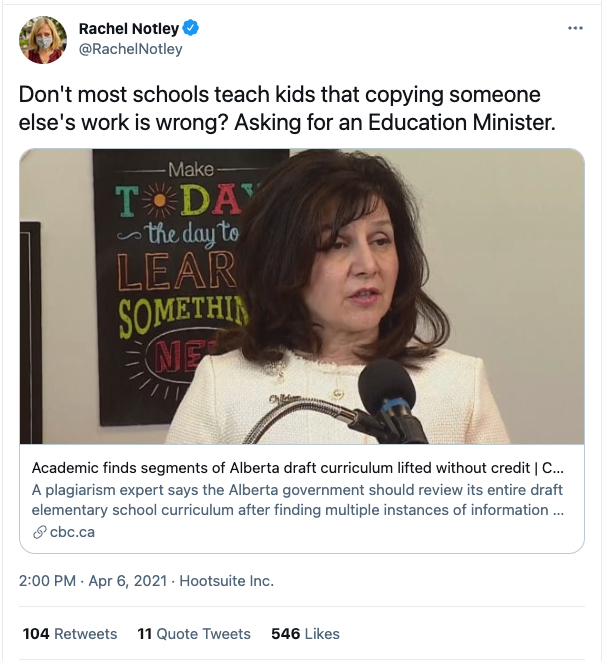
In case you missed it, I was the “academic” quoted in the media article that the leader of opposition Tweeted out.

On April 6, 2021, the Hon. Rachel Notley, leader of the opposition, questioned the Minister of Education, the Hon. Adriana LaGrange, about the plagiarism in the draft curriculum during the official question period in the Alberta provincial legislature, as documented in the official legislative Hansard.

Although dozens and dozens of teachers and other members of the public commented on social media about the plagiarized passages in the draft curriculum, it is fair to say that my analysis of the plagiarism had an impact on all of that. It is not an impact that is easily quantified, but it is reasonable to conclude that the analysis helped to inform a broader public dialogue about the (deeply flawed) draft curriculum, plagiarism, and the need to pay attention to ethics and integrity in K-12 education.

Collaboration Resulting from the Work

This work led to a collaboration with Carla Peck, Angela Grace and others, supported by our respective Deans of Education, called the Alberta Curriculum Analysis project. Through this project, we are documenting numerous analyses of the draft curriculum, from a variety of contributors with different academic and disciplinary backgrounds. This project has become an important public artefact and act of scholarly advocacy to help hold our government accountable, as well as to inform the public.

Completely non-academic (and a little cheeky) impact

There’s a small business in Edmonton, Canada, called Fehr Play Creative that creates all kinds of custom and novelty products. Not long after I did my analysis of plagiarism in the draft curriculum, they came out with their “Curwikilum” novelty mug. A senior leader at the university bought me one as a gift and it quickly became my favourite, as you can see in this photo:

Figure 2.

Curwikilum mug produced by Fehr Play Creative in Edmonton, AB.
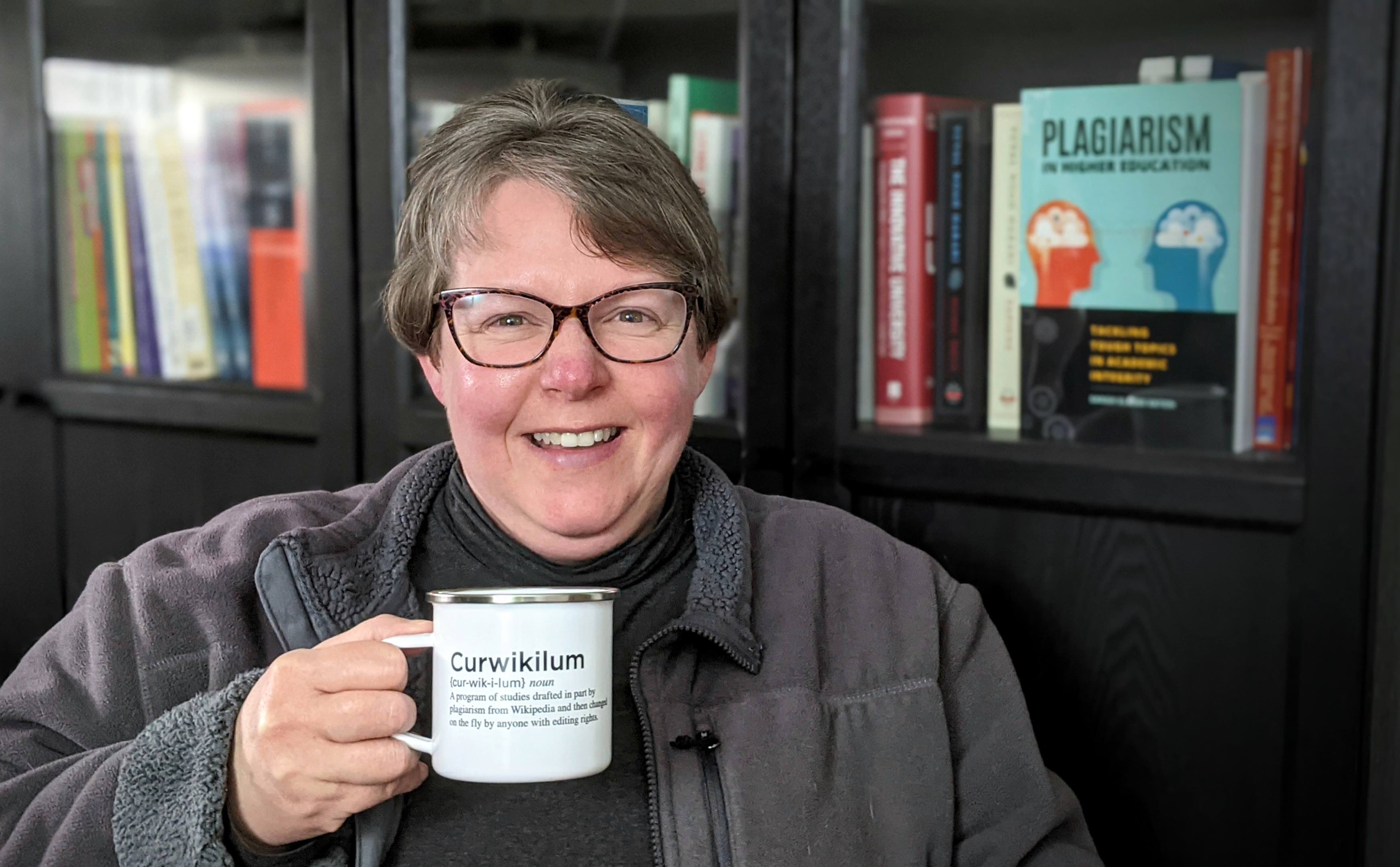
I didn’t ask the good folks at Fehr Play Creative to make this mug. It was entirely their idea. They did a play on words with “curriculum” and “Wikipedia”, coming up with “Curiwikilum” and defined it as: “(noun) A program of study drafted in part by plagiarism from Wikipedia and then changed on the fly by anyone with editing rights”.

It’s the perfect social commentary about what was happening with the draft curriculum… Passages lifted straight from Wikipedia and then slightly altered on the official government website in real time. This “on the fly editing” not only happened with plagiarized passages, but also other passages that members of the public and experts flagged as incorrect or objectionable.

One mug literally said it all. And in terms of impact, what can I say? I mean, man alive – Merch! How many academics can say their work has resulted (directly or indirectly) in novelty merchandise?! I honestly don’t think I’ve seen any kind of mug prior to this that talked about plagiarism. I mean — come on!! This is the area I research — and someone made a frikkin’ novelty mug about it! How utterly cool is that?! It’ll probably never happen again for the rest of my career, so I enjoyed the moment while it lasted.

Was any of this published in a peer-reviewed journal? Nope.

Was any of it reviewed by a peer in any way before I published it? Nope.

Did peers review it afterwards (voluntarily) and offer their comments on it in public forums such as Facebook and Twitter? You bet they did. (And they were very nice about it, I might add.)

Can I prove “cause and effect” with any of this?

Nope – and nor do I want to. Public scholarship isn’t about taking individual credit for work as a sole author and saying, “Hey funders (or whoever), see this causal link between my work and this great discovery?!” I don’t know of anyone who engages in public scholarship who would do that because the very idea is ludicrous.

It is imperative to push back on the notion that “impact” must equate to “cause and effect”. It doesn’t. In some cases the very idea is so reductionist it is nonsensical.

It’s not about “if A (i.e., my research) then B (i.e., some great result)”. Public scholarship is about contributing to a broad public discourse in an informed way through scientific and scholarly inquiry. It is one contribution to a great big important conversation over which few individuals (if any) have direct control, but together, we can collectively make a difference. If I can make a difference with my work that puts the focus of education squarely on ethics and integrity, then it’s all worth it.

This is the kind of scholarship I am interested in now: the kind that makes a difference. Of course, I know I still have to do the peer-reviewed journal articles. That’s part of the job. But more and more I am realizing that peer-reviewed journal articles are, ironically, the kind of work that has the least impact.

So my advice to my fellow academic integrity and ethics scholars — and academics in general — is this: Do what you need to do because your job requires it, but keep doing your public advocacy work, your blog posts, and your public scholarship because it can – and does – make a difference.

____

Share or Tweet this: Blogs as Public Scholarship: An Academic Integrity Example – https://drsaraheaton.wordpress.com/2021/06/30/blogs-as-public-scholarship-an-academic-integrity-example/

This blog has had over 2 million views thanks to readers like you. If you enjoyed this post, please “like” it or share it on social media. Thanks!

Sarah Elaine Eaton, PhD, is a faculty member in the Werklund School of Education, and the Educational Leader in Residence, Academic Integrity, University of Calgary, Canada.

Opinions are my own and do not represent those of the University of Calgary or anyone else.

Follow me on Twitter.


Research update: Highlights from some current projects

February 9, 2021

It seems I have a lot of academic Integrity research projects on the go these days, so I thought I’d do a post about some of this exciting work and the amazing people I’ve been collaborating with.

Academic Integrity and Mental Well-Being

As part of my Educational Leader in Residence, Academic Integrity role, I wanted to connect some of my research to the University of Calgary’s Campus Mental Health Strategy.

I’ve been working on with two terrific graduate students, Helen Pethrick and Kristal Turner on a new project, Academic Integrity and Mental Well-Being.

So far, we have one publication from this project. Exploring academic integrity and mental health during COVID-19: Rapid review was published in the Journal of Contemporary Education Theory & Research in December 2020.

Our second paper is under peer review, so stay tuned for details on that later.

Academic Integrity: Faculty Development Needs for Canadian Higher Education

This is the inaugural project associated with the D2L Innovation Guild. This project is the first of its kind in Canada. There has never before been a multi-institutional project, with representation from across multiple provinces, that has also partnered with industry in pursuit of a common unified goal with regards to academic integrity.

This collaborative, multi-institutional project included researchers from four Canadian provinces:

  • Sarah Elaine Eaton, PhD, Principal Investigator, University of Calgary
  • Katherine (Katie) Crossman, PhD, Co-Investigator and Study Coordinator, University of Calgary
  • Brenda M. Stoesz, PhD, Co-Investigator, University of Manitoba
  • Kim Garwood, PhD, Co-Investigator, University of Guelph
  • Amanda McKenzie, MA, Co-Investigator, University of Waterloo

We have publicly registered our project on the Open Science Framework. You can check out details about our project here.

You can check out our project brief, which is available as an open access report (Crossman et al., 2019). This project is now complete and we submitted our final reports to the D2L Innovation Guild Board on February 8, 2021.

Contract Cheating in Canada: National Policy Analysis

 This is an exciting project that I began developing in 2018. I wanted to create opportunities for Canadian researchers to do scholarly inquiry into contract cheating. I received mentorship from Dr. Tracey Bretag in the early stages of this project. She had led a team in Australia to conduct academic integrity policy research there. She coached me on how to conduct a similar project in Canada. As a result, I launched Contract Cheating in Canada: National Policy Analysis.

The specific objectives of this project are to:

  • Identify existing components of academic integrity policies and procedures related to contract cheating;
  • Identify gaps in existing academic integrity policies and procedures related to contract cheating;
  • Evaluate the policies and procedures against existing standards for post-secondary education policy (i.e., Australian Government: Tertiary Education Quality and Standards Agency (TEQSA), 2017; Higher Education Academy [HEA], 2011) with a focus on supports that have been developed for students and other campus stakeholders (Bretag et al., 2011);
  • Compare supports available for undergraduate students and graduate students; and
  • Develop and communicate recommendations for policy reform.

This national project is sub-divided according to regions of Canada and types of post-secondary institutions (e.g., colleges and universities). Different teams have been involved with each of the smaller sub-projects, with individuals from a particular region studying the policies from their own regions.

We’ve already had some great publications out of this project, the most recent of which was published in Educational Policy.

Degrees of Deceit: A Study of Fake Degrees, Diploma Fraud and Counterfeit Credentials

I am working with Jamie Carmichael at Carleton University in Ottawa, Canada, on a project to better understand fake degrees and fraudulent credentials in Canadian higher education.

Check out our webinar recording about this work. Some very cool resources we have already produced out of this work include:

A slide deck from our webinar session.

Counterfeit Credentials: Top 13 Recommendations for Higher Education Professionals (Infographic)

Scholarships without Scruples (Infographic)

We are also working on an edited book on this topic. More details on that will be coming soon…

These aren’t all the projects I have on the go, just a few I wanted to highlight here. Feel free to get in touch about any of these projects. You know where to find me!

_____

Share or Tweet this: Research update: Highlights from some current projects

This blog has had over 2 million views thanks to readers like you. If you enjoyed this post, please “like” it or share it on social media. Thanks!

Sarah Elaine Eaton, PhD, is a faculty member in the Werklund School of Education, and the Educational Leader in Residence, Academic Integrity, University of Calgary, Canada.

Opinions are my own and do not represent those of the University of Calgary or anyone else.


New book Series: Ethics and Integrity in Educational Contexts

February 1, 2021

A97796_EIEC_Series_Banner_P2

I am pleased to announce a new book series, Ethics and Integrity in Educational Contexts by Springer.

About this series

The aim of this series is to provide an authoritative series of books on topics relating to ethics and integrity in educational contexts. Its scope includes ethics and integrity, defined in broad and inclusive terms, in educational contexts. It focuses on higher education, but also welcomes contributions that address ethics and integrity in primary and secondary education, non-formal educational contexts, professional education, etc. We welcome books that address traditional academic integrity topics such as plagiarism, exam cheating, and collusion.

In addition, we are particularly interested in topics that extend beyond questions of student conduct, such as

  • Quality assurance in education;
  • Research ethics and integrity;
  • Admissions fraud;
  • Fake and fraudulent credentials;
  • Publication ethics;
  • Educational technology ethics (e.g., surveillance tech, machine learning, and artificial intelligence, as they are used in education);
  • Biomedical ethics in educational contexts;
  • Ethics in varsity and school sports.

This series extends beyond traditional and narrow concepts of academic integrity to broader interpretations of applied ethics in education, including corruption and ethical questions relating to instruction, assessment, and educational leadership. It also seeks to promote social justice, diversity, equity, and inclusion.

The series provides a forum to address emerging, urgent, and even provocative topics related to ethics and integrity at all levels of education, from a variety of disciplinary and geographical perspectives.

Editorial Board

I am delighted to work with an international group scholars and experts as members of the Editorial Board:

Tomáš Foltýnek, Department of Informatics, Faculty of Business and Economics, Mendel University, Brno, Czechia

Irene Glendinning, Coventry University, Coventry, UK

Zeenath Reza Khan, University of Wollongong, Dubai, United Arab Emirates

Rebecca Moore Howard, Syracuse University, New York, USA

Mark Israel, Australasian Human Research Ethics Consultancy Services, Perth, Australia

Ceceilia Parnther, St. Johns’ University, New York, USA

Brenda M. Stoesz, The Center for Advancement of Teaching and Learning, University of Manitoba, Winnipeg, Manitoba, Canada

Forthcoming and New Books

The first book to launch the series will be Academic Integrity in Canada (Eaton & Christensen Hughes, eds., forthcoming). I will share more details about this first book when we are closer to publication, which should be in mid to late 2021.

Proposals for a number of other books to join the series are underway, with authors and editors from a variety of countries.

If you have an idea for a book to be included as part of this series, please contact me.

_____

Share or Tweet this: New book Series: Ethics and Integrity in Educational Contexts https://drsaraheaton.wordpress.com/2021/02/01/new-book-series-ethics-and-integrity-in-educational-contexts/

This blog has had over 2 million views thanks to readers like you. If you enjoyed this post, please “like” it or share it on social media. Thanks!

Sarah Elaine Eaton, PhD, is a faculty member in the Werklund School of Education, and the Educational Leader in Residence, Academic Integrity, University of Calgary, Canada.

Opinions are my own and do not represent those of the University of Calgary or anyone else.


New article: Understanding the academic integrity policies of publicly funded universities in western Canada

December 23, 2020

Educational PolicyThe latest article in our project, Contract Cheating in Canada: National Policy Analysis has just been published!

Stoesz, B., & Eaton, S. E. (2020). Understanding the academic integrity policies of publicly funded universities in western Canada. Educational Policy. https://doi.org/10.1177/0895904820983032

Abstract

We examined 45 academic integrity policy documents from 24 publicly-funded universities in Canada’s four western provinces using a qualitative research design. We extracted data related to 5 core elements of exemplary academic integrity policy (i.e., access, detail, responsibility, approach, support). Most documents pointed to punitive approaches for academic misconduct and were based on the notion that academic misconduct results from a lack of morals. One university used the term “contract cheating,” although nearly all categorized the outsourcing of academic work as plagiarism. Details about educational resources and supports to increase student and staff understanding of academic integrity and prevention of academic misconduct were sparse. This study signals the continuing punitive nature of academic integrity policies in western Canadian universities, the reluctance to address contract cheating directly, and the need to revise policies with deeper consideration of educative approaches to academic integrity that support students and academic staff.

Keywords: academic integrity, Canada, contract cheating, educational supports, higher education, policy

This is an open access article and is free to read and download.

For more information about this article, or the national project, please contact me directly.

_____

Share or Tweet this: New article: Understanding the academic integrity policies of publicly funded universities in western Canada – https://drsaraheaton.wordpress.com/2020/12/23/new-article-understanding-the-academic-integrity-policies-of-publicly-funded-universities-in-western-canada/

This blog has had over 2 million views thanks to readers like you. If you enjoyed this post, please “like” it or share it on social media. Thanks!

Sarah Elaine Eaton, PhD, is a faculty member in the Werklund School of Education, and the Educational Leader in Residence, Academic Integrity, University of Calgary, Canada. Opinions are my own and do not represent those of the University of Calgary.


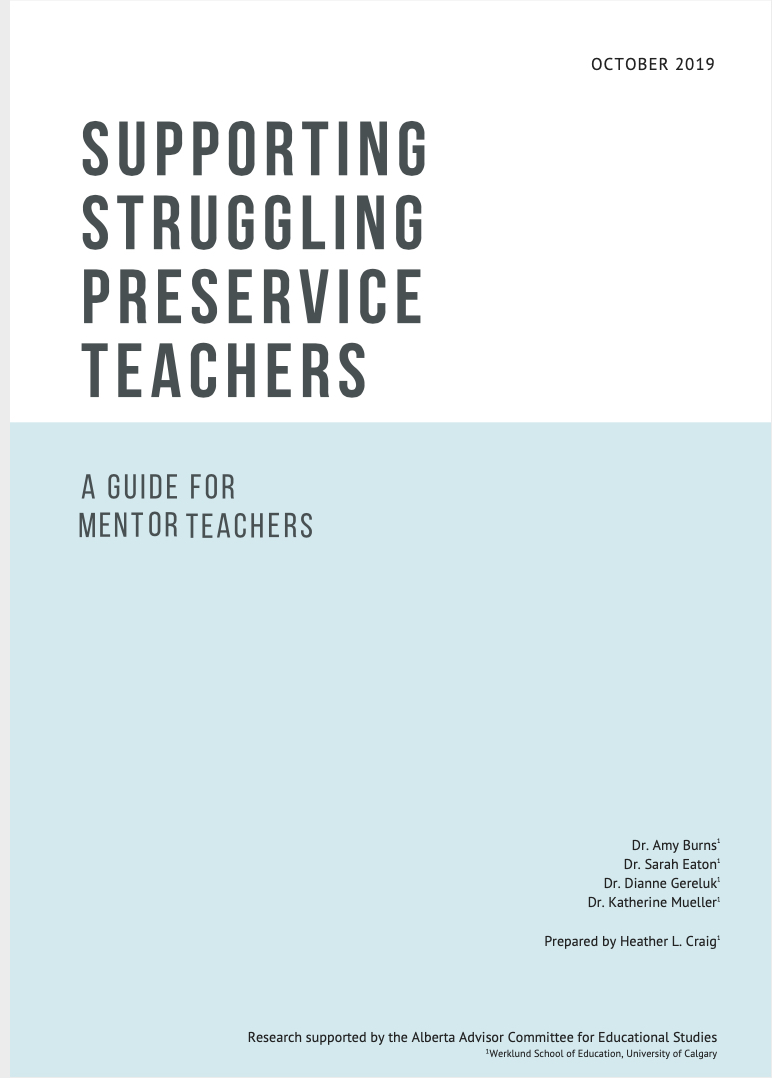
Supporting struggling pre-service teachers: A guide for mentor teachers

January 9, 2020

Cover

In 2017 I joined a project led my my colleague, Dr. Amy Burns, in the Werklund School of Education at the University of Calgary. 

The project was called “Pre-service teachers at risk: Intervention strategies for and by teachers“. It was funded by the Alberta Advisory Committee for Educational Studies (AACES).

The primary question our research addressed was: (RQ1) What strategies do in-service teachers employ to support struggling pre-service teachers in field education?

A secondary question addressed was: (RQ2) How can postsecondary institutions better facilitate placements where a pre-service teacher is struggling before the field placement begins, given the legislative restrictions that exist with regard to privacy?

The research is complete now and as a result, we have developed an entirely open access educational resource to help both pre-service teachers (e.g. teacher trainees) and the mentor teachers they work with. Here are the key themes we identified through our research:

  1. Don’t Do This Job in Isolation: Seek Support
  2. Guide and Model What You Want to See
  3. Provide Immediate and Frequent Feedback
  4. Communicate: Early, Often, Directly, Honestly, and Clearly
  5. Remember the Big Picture
  6. Set Clear and High Expectations
  7. Support Engagement in Self-Reflection
  8. Reflect on the Preservice Teacher’s Difficulties
  9. Recognize Early Warning Signs and Don’t Ignore Them
  10. Identify the Preservice Teacher’s Current Skill Level
  11. Create Goals


Download a full copy of the resource free of charge here:

Burns, A., Eaton, S. E., Gereluk, D., Mueller, K., & Craig, H. L. (2019). Supporting Struggling Pre-Service Teachers: A Guide for Mentor Teachers. Retrieved from Calgary, AB: http://hdl.handle.net/1880/111439

______________________________________________________

Share or Tweet this: Supporting struggling pre-service teachers: A guide for mentor teachers – https://wp.me/pNAh3-2pq

This blog has had over 2 million views thanks to readers like you. If you enjoyed this post, please “like” it or share it on social media. Thanks!

Sarah Elaine Eaton is a faculty member in the Werklund School of Education, and the Educational Leader in Residence, Academic Integrity, University of Calgary, Canada. Opinions are my own and do not represent those of the University of Calgary.