I’m excited to share news with you about a new article that’s just been released with co-authors Michele Jacobsen, Barb Brown, Marlon Simmons and Mairi McDermott. Here’s an overview:
Abstract
There is a global trend toward improving programs and student experiences in higher education through curriculum review and mapping of degree programs. This paper describes an action research approach to program improvement for a course-based MEd degree. The driver for continual program improvement came from actions and recommendations that arose from an institutionally mandated, year-long, faculty led curriculum review of professional graduate programs in education. Study findings reveal instructors’ perceptions about how they enacted the recommendations for program improvement, including
developing a visual conceptualization of the program;
improved connections between the courses;
articulation of coherence in goals and expectations for students and instructors;
an increased focus on action research;
increased ethics support and scaffolding for students; and
the fostering of communities of practice.
Study findings highlight strengths of the current program and course designs, action items, and research needed for continual program improvement.
___________________
This article is the result of a two-year project with our amazing team. It has been incredible to learn with and from them as we embarked on this journey together. We are eager to share what we learned about how to improve students’ experience in our Master of Education program.
Those who contribute to predatory or parasitic publications or events seem to fall into three main categories: (a) those who are too naïve to know; (b) those who know, but do not mind; and (c) those pseudo-scientists who are masquerading as legitimate scholars or researchers, but are essentially quacks or charlatans themselves (Beall n.d., 2012, 2013, 2014, 2015, 2016 a, b, c; Grove, 2017; McCrostie 2016, 2017; Nicholl & Chinn, 2015; Nolfi, Lockhart & Redgate, 2015;Ruben, 2016; Vinny, Vishnu & Lal, 2016; Xia, Harmon, Connolly, Donnelly, Anderson, & Howard, 2015):
The Naïve Contributor ultimately recognizes that their contribution will bring them little benefit and their reputation may even be damaged.
The Cognizant Contributor has a more symbiotic relationship with the parasitical publication or conference because they perceive some benefit to their own advancement.
Like the Cognizant Contributor, the Pseudo-Scientist also receives (or at least perceives) benefit because questionable conferences or publications give them a venue to proclaim their own expertise, unproven results or absurd theories. (p. 10).
Graduate students who are unfamiliar with what is expected of them in terms of higher-level research writing can easily get overwhelmed when it comes to their literature review. A literature review can form part of a larger project, such as a chapter in a thesis or dissertation, and it can also be a standalone project. Regardless of whether it is part of a project or a standalone work, we (your professors) expect certain kinds of sources.
We learned what kinds of sources to include in literature reviews when we were students, but we are not always so good at articulating what those expectations are. The result can be frustration for both students and professors. In this post, I have curated tips and information that I have been sharing with graduate students over the past several years.
These tips are intended to be a guideline, not a prescription. They are based on my experience and include a healthy dose of my own opinion. For example, I am adamant that students should avoid citing Wikipedia in their research writing. I am also unapologetically opposed to quotation websites where students have been known to cut and paste quotations from great thinkers such as Aristotle or Plato. In my view, quotations for research writing ought to come from original works (or in a pinch, a translation of an ancient text).
Your professors or research supervisors will have their own ideas about what kind of sources to include in your literature review, so be sure to consult with them. Here’s what I tell my students:
Most respected sources
Books, peer-reviewed scholarly or scientific journals from reputable publishers. Avoid predatory journals. At least 80% of the total number of sources in your literature review should be sources from this category.
Sources that are OK to use in moderation
Credible edited journals that may not be peer-reviewed, but are highly respected in a professional field; edited conference proceedings; papers from well-respected research institutes or think tanks. Usually, not more than 20% of your sources should come from this category.
Sources that should be used sparingly
Materials from highly reputable news agencies such as the BBC or the Washington Post or highly respected websites, such as the Mayo Clinic. It is not that these sources are not credible, but that you want your research literature review to be strongly focused on research materials. For that reason, I recommend that not more than 5% of sources come from this category.
Sources to avoid
I mentioned two of the big ones above: Wikipedia and online quotation sites. Also avoid predatory journals and any sites (including popular media) that is less reputable.
Here’s an infographic to help you make wise choices about what kind of material to include in your literature review.
If your topic has limited sources available in the research, find and analyze what you can, but avoid “padding” your literature review with non-scholarly sources.
When you are learning how to write a literature review, it can be tricky to figure out what kinds of sources to include. Remember, you want to focus on producing a review that is evidence-informed and research-based. The quantity of sources you consult may be important, but quality is definitely important.
Talk with your supervisor about their expectations and get guidance as you go along. The more you work with scholarly or scientific sources, the better you will get at writing literature reviews.
Here’s a longer essay I wrote on this topic if you are interested in reading more:
Eaton, S. E. (2018). Educational Research Literature Reviews: Understanding the Hierarchy of Sources. Calgary: University of Calgary. Retrieved from http://hdl.handle.net/1880/106406
Recently I was invited by the Werklund School of Education’s Writing Group, which is co-hosted by the Office of Research and the Office of Teaching and Learning, to offer a workshop on branding yourself as a researcher. I’m pretty excited because this gives me a chance to combine my passion for research with my entrepreneurial spirt that led me to have a successful career as an educational consultant before I entered academia full-time.
Branding comes from marketing, but that doesn’t mean academics should feel any disdain towards it. Think of it as learning to share your expertise with people in your field, and beyond, to a wider public audience.
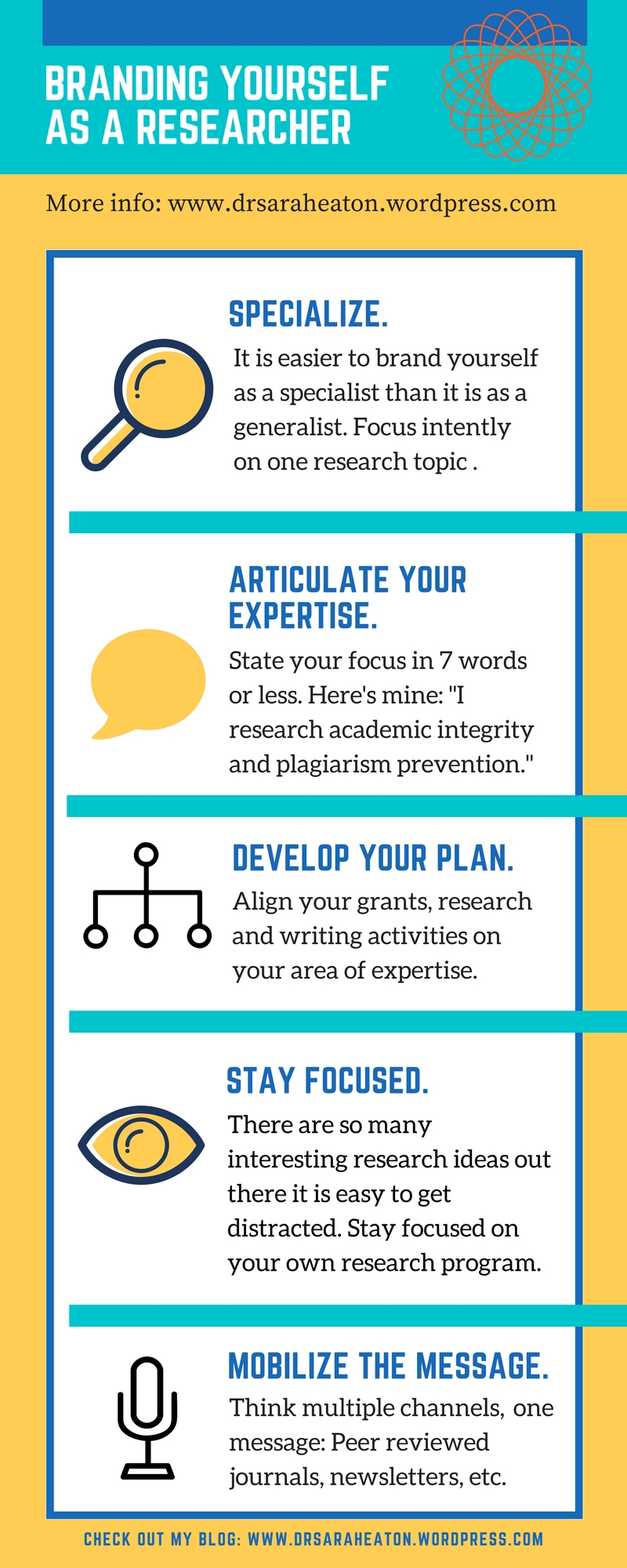
Here are the 5 key points I shared during the workshop:
Specialize.
It is easier to brand yourself as a specialist than it is as a generalist. It is normal for novice and emerging researcher to have multiple areas of interest. This works while you are still figuring out who are you are professionally, but specializing shows you are developing as a researcher. Have a clear research topic that you focus on intently.
Articulate your expertise.
Marketing experts recommend being able to state your focus in 7 words or less. Here’s mine: “I research academic integrity and plagiarism prevention.” Don’t be that academic that has to ramble on for 38 minutes non-stop to say what it is you are researching. Get to the point and make it easy for others to understand. Practice writing out and saying your research focus until it feels natural.
Develop your plan.
Plan what grants you’ll apply for and when. Develop a writing schedule and target specific journals in your field. Ensure every element of your plan aligns with your area of expertise. Mapping out your research and writing activities will help to ensure you make time for them. Once you execute this plan, you’ll be on your way to having a fully developed research program in your area of expertise.
Stay focused.
There are so many interesting research ideas out there it is easy to get distracted. Stay focused on your own research program. The most successful researchers do not jump on every project that comes along. Choose the projects you want to be involved with carefully and ensure they align with your expertise.
Mobilize your knowledge.
Have multiple channels, but one message. Think about sharing findings in both peer reviewed scholarly journals, as well as plain-language articles targeted to the general public. Think about videos, podcasts and other ways of distributing your knowledge.
The point of all this is to position yourself as an expert in both an academic audience and the public. Ensure others know you are the “go to” person on your topic. Becoming known an expert authority on a key topic not only helps you get noticed in your field, it helps you get hired, and may help you get promoted, too.
A former student and I were talking recently, and she mentioned the thesis she completed as part of her Master of Education degree at our university.
“I’m going to stop you right there,” I said. “You didn’t do a thesis. You did a capstone project.”
“What’s the difference?” she asked.
It is a common question among students. Students also ask what the difference is between a dissertation and a thesis. Three things they all have in common are:
Completed in partial fulfillment of an academic degree.
Intended to showcase the student’s knowledge on a particular topic.
Approved in some way by the institution that grants the degree.
But that’s about where the commonalities end. The definitions I offer below may vary from one country to another. I am speaking here mainly about Canada, so if you live in a different country, note that the definitions may differ where you are.
Dissertation
This is usually completed as part of a doctoral degree (e.g., PhD, EdD). The work is overseen by a professor, who is often called the ‘advisor’ or the ‘supervisor’. Often, there is a committee that also supports the work. Students are often required to pass a rigorous exam upon completion of their dissertation. This is not true in all jurisdictions, but in Canada, it is normal for examiners to make suggestions for further revisions based on their review of the work and the outcome of the exam. A doctoral dissertation is often a few hundred pages long. When the dissertation is completed and approved in its final version by all the examiners, it may become publicly available through the university library digital repository or another public database. Sometimes the terms “thesis” and “dissertation” are used interchangeably. One possible reason for this could be that the word “thesis” is easier to say.
Thesis
A thesis is usually completed as part of a research-based master’s degree or an undergraduate honours degree. The length may vary, depending on whether it is completed for the undergraduate or master’s level, but often they are about a hundred pages. The work is overseen by a professor, who is often called the advisor or the supervisor. Upon completion of their thesis, students must often pass a rigorous exam. The examiners can make suggestions for further revisions based on their review of the work and the outcome of the exam. When it is completed and approved in its final version by all the examiners, it may become publicly available through the university library or another public database.
Dissertations and theses often have many elements in common such as being supervised by a professor and requiring an exam to pass. Capstone projects, on the other hand, are a bit different.
Capstone Project
This is a project completed as part of a course-based master’s degree. It is often overseen or guided by a course instructor. Sometimes students present their work in some way, but the capstone does not usually require an examination to pass. The length and format of a capstone project can vary and some are presented as multimedia projects instead of a written report. These kinds of projects can go by different names. At our university we call them a “Collaboratory of Practice” project, but the general idea is the same.
Here’s a handy infographic to highlight some of the key ideas.
It is important to remember that these are simplified definitions to help you understand the basic differences only. When you talk about your own academic work, it is important to represent yourself accurately. You want to learn the correct term to talk about the work you have completed as part of your degree.
These explanations may not apply to every institution. If you are not sure, talk to a faculty member from your own university to get more details about how things work at your institution.
You must be logged in to post a comment.