Ever noticed how frustrating “just” can be?

April 12, 2012

I’ve been noticing the use of the word “just” in conversations lately. Here are some examples:

“I just wanted to get this off my chest…” (Meaning: What I am about to say is pretty much guaranteed to upset you, but it will make me feel better and that is really what matters to me.)

“How about we just have a conversation at the meeting, rather than have an agenda?” (Meaning: I don’t really want to take control of this meeting, with four alpha personalities… and besides, I am too lazy. I prefer mayhem. Oh, and by the way, this only a rhetorical question. I do not particularly care what you think.)

“I was just feeling a little…” (Meaning: I am overwhelmed by these feelings, to the point of near collapse, but I do not want to admit weakness, so I use the word “just” to indicate that I am much saner than I might be diagnosed…)

“I just want to get on with it!” (Meaning: I am not really interested in your feelings. Shut the heck up and let’s do our job.”)

Dictionary.com defines the word “just” in these ways:

Just  [juhst]
adjective

  1. guided by truth, reason, justice and fairness: We hope to be just in our understanding of such difficult situations.
  2. done or made according to principle; equitable; proper: a just reply.
  3. based on right; rightful; lawful: a just claim.
  4. in keeping with truth or fact; true; correct: a just analysis.
  5. given or awarded rightly; deserved, as a sentence, punishment, or reward: a just penalty.

adverb

  1. within a brief preceding time; but a moment before: The sun just came out.
  2. exactly or precisely: This is just what I mean
  3. by a narrow margin; barely: The arrow just missed the mark.
  4. only or merely: He was just a clerk until he became ambitious.
  5. actually; really; positively: The weather is just glorious.

I am guessing that when “just” is used in the examples above, it is either intended to mean “only or merely”. The sub-text seems to often indicate a deeper meaning that is often rooted in frustration, fear or anxiety. I have begun to wonder why we don’t talk about the sub-text?

Lately, I admit that I have been frustrated by the use of the word “just” in conversation, particularly when it is preceded with the word “I” or “we”.  Sometimes, the word “just” indicates a distinct lack of interest in what the other person is feeling or thinking and centers the conversation around the speaker’s wants and desires.

Sometimes, there is much more going on… There’s a difficult conversation to be had. Often, the conversation is worthwhile and valuable… but it is more difficult, so we avoid digging deeper and engaging one another in a dialogue that calls for deep listening, empathy, negotiation and ultimately, finding solutions to whatever the problem might be.

Take a moment this week to notice how “just” is used in conversation around you. What is the person really saying?

___________________________

Share or Tweet this post: Ever noticed how frustrating “just” can be?  http://wp.me/pNAh3-1lN

Update – January 2018 – This blog has had over 1.8 million views thanks to readers like you. If you enjoyed this post, please “like” it or share it on social media. Thanks!

Sarah Elaine Eaton is a faculty member in the Werklund School of Education, University of Calgary, Canada.


Today’s free webinar on marketing literacy and language schools – Developing written materials

April 11, 2012

Join us tomorrow for the fourth in a series of ten free webinars on how to market and promote your literacy program or language school.

These webinars highlight different ideas from 101 Ways to Market Your Language Program. Every week you get practical, low-cost ideas to help you promote your program. Best of all, you’ll get to connect with others on line who are also interested in the same topic, ask questions and interact.

The webinars are  30 to 60 minutes in length. Bring a pen and paper. I’m going to give you lots of ideas you can implement right away.

Webinar #4 of 10 – What to expect

Today’s webinar will focus on:

  • Written materials to support your marketing
  • Business cards
  • Stationery
  • Signage

Webinar time

Date: Wednesday, April 11, 2012

There are some time zone changes coming up around the world, so double-check these times against your local area:

Point of origin – 14:00 (2:00 p.m.) Mountain Time, March 21, 2012 – Calgary / Edmonton

16:00 (4:00 p.m.) – Eastern Time – Toronto / New York

20:00 (8:00 p.m.) – Greenwich Time – London, England

22:00 (10:00 p.m.) – Eastern European Time – Athens / Istanbul

05:00 (5:00 a.m.) – following day – Japan Standard Time – Tokyo

How to log in

There is no need to register. These webinars are free and open to everyone. Seating is limited though, so sign on early.

To join the webinar, simply click here: http://meet11548754.adobeconnect.com/saraheaton/

Will it be recorded?

You bet. I’ll record the program and post it within 24 hours or so.

No charges or fees to watch recorded programs.

What will future webinars cover?

Here’s what we’ll cover in upcoming webinars:

  • Week #5 – What makes people care about you. How to stand out from the crowd.
  • Week #6 – Specialty tips for programs at large institutions
  • Week #7 – Relationship marketing. The power of connections.
  • Week #8 – It’s how you make them feel. Adding personal touches that make all the difference
  • Week #9 – Effective follow up with your marketing and not giving up too soon.
  • Week #10 – Social media for marketing

All you have to do is block off Wednesdays in your calendar at your corresponding local time and then log in using the link above.

If you can’t make the webinar, and you’d like to ask a question about the topic, feel free to leave me a comment. I’ll do my best to answer questions that come in before the program during the webinar. You can watch the recording to get the answer to your question, or I’ll answer you back in the comment section.

Related post:

101 Ways to Market Your Language Program (10 Free webinars) http://wp.me/pNAh3-1j6

Recordings of past programs:

Webinar #1: Recording: 101 Ways to Market Your Language and Literacy Program http://wp.me/pNAh3-1jF

Webinar #2: Recording: 101 Ways to Market Your Language and Literacy Program http://wp.me/pNAh3-1kv

Webinar #3: Recording: 101 Ways to Market Your Language and Literacy Program http://wp.me/pNAh3-1ld

___________________________

Share or Tweet this post:  Today’s free webinar on marketing literacy and language schools – Developing written materials http://wp.me/pNAh3-1lG

Update – January 2018 – This blog has had over 1.8 million views thanks to readers like you. If you enjoyed this post, please “like” it or share it on social media. Thanks!

Sarah Elaine Eaton is a faculty member in the Werklund School of Education, University of Calgary, Canada.


Resources on parent engagement in schools

April 5, 2012

Last night I took part in the #ptchat on Twitter. Here are some resources that I contributed to the discussion on parent engagement in schools:

Research Brief November 2002 from the National Center for Family & Community Connections with Schools: What we mean by “family and community connections with schools?”

Family, School and Community Connections: Improving Student Learning

Turning Points: Transforming Middle Schools: Creating Partnerships, Bridging Worlds: Family and Community Engagement

Creating Communities of Learning and Excellence: Connecting schools, families, and communities for youth success

 Creating a family-friendly school environment

 Parent Engagement: Creating a Shared World

If you know of other great resources on the topic of parent engagement in schools, please let me know.

___________________________

Share or Tweet this post:  Resources on parent engagement in schools http://wp.me/pNAh3-1lu

Update – January 2018 – This blog has had over 1.8 million views thanks to readers like you. If you enjoyed this post, please “like” it or share it on social media. Thanks!

Sarah Elaine Eaton is a faculty member in the Werklund School of Education, University of Calgary, Canada.


Calling all language / literacy program managers: Want feedback on your business card?

April 4, 2012

Is your business card tired and old? Want to improve it but you just don’t know how?

In next week’s free webinar on how to market language and literacy programs we’ll be talking about some of the written marketing materials you use, such as business cards, stationery and signage. I am hoping for a couple of volunteers who are willing to share their business cards with us as samples. I’ll go over what you’re doing right and what you can improve. Here’s what I’m looking for:

  • Scan a copy of your current business card
  • E-mail it to me
  • Give me permission to give you feedback publicly during our webinar

Here’s what you’ll get:

  • An assessment of your business card
  • What can be improved
  • Ideas for design and lay-out
  • Feedback on your use of colour (or lack of it)

The cost? Nothing! You’ll be doing me a favor by sharing your card with us!

Leave a comment or send me an e-mail to participate.

These webinars highlight different ideas from 101 Ways to Market Your Language Program. Every week you get practical, low-cost ideas to help you promote your program. Best of all, you’ll get to connect with others on line who are also interested in the same topic, ask questions and interact.

Check out the recordings of past webinars

You can view the past three programs on my Archived Webinars page.

Related posts:

101 Ways to Market Your Language Program (10 Free webinars) http://wp.me/pNAh3-1j6

___________________________

Share or Tweet this post:  Calling all language / literacy program managers: Want feedback on your business card? http://wp.me/pNAh3-1lo

Update – January 2018 – This blog has had over 1.8 million views thanks to readers like you. If you enjoyed this post, please “like” it or share it on social media. Thanks!

Sarah Elaine Eaton is a faculty member in the Werklund School of Education, University of Calgary, Canada.


Letting them shine: Working with multi-organizational coalitions

April 3, 2012

A colleague and I were recently asked to facilitate a workshop for a large, multi-organizational coalition that included government, educational and non-profit stakeholders. The coalition includes over 25 organizations who have all joined forces to promote a particular aspect of education.

As facilitators, we were warned that the groups were having difficulty agreeing on a structure for their coalition network and that different stake holders came to the table with different values, philosophies and areas of expertise. Yet, they all wanted to work together. Their lack of consensus was causing concern among some members.

Traditional model of governance

The coalition had a leadership team comprised of senior members of some of the major organizations. The group had been working hard to define what the structure of their coalition would look like. Here is what they came up with:

Eaton International Consulting, Sarah Elaine Eaton, Sarah Eaton, facilitator, speaker, keynote, presenter

Characteristics of the traditional organizational structure

Org charts like this show the typical structure of a traditional organization. This chart could work for a business, a non-profit organization or a public sector organization. The characteristics that define them are fairly uniform:

  • Top-down model (Leaders are at the top)
  • Clear hierarchy
  • Orderly
  • Rigid
  • Governance-focussed
  • Straightforward and easy to understand

Why traditional models do not work for coalitions

In the traditional model there is an underlying assumption that all members who belong to the organization share the same values and that those who are lower down in the pecking order are less qualified, experienced or powerful than those at the top.

In a coalition, every member organization may have a structure like this. Or they may be a “flat organization” with very little hierarchy. In any case, in a coalition, you are bringing together collective wisdom and knowledge for a common purpose. A traditional model of governance does not work because a “pecking order” is unproductive. Members who are not at the top may feel confined and undervalued, when in fact, they have a great deal to contribute. Members at the top of the coalition may feel frustrated because they do not have all the answers and they sense disengagement from those who are lower down in the organizational structure. The result can be feelings of disempowerment, frustration, anger and ultimately, disengagement from the work that everyone has come together to do.

In addition, members may feel pressured to surrender their current organizational culture in order to become part of the new coalition. Members may feel that their identity as an organization is challenged.

The Constellation Model

We presented a different model for the member organizations to consider. This model was developed by Surman & Surman (2008). It captures the complex nature of multiple stakeholders working together based on shared interests and assets.
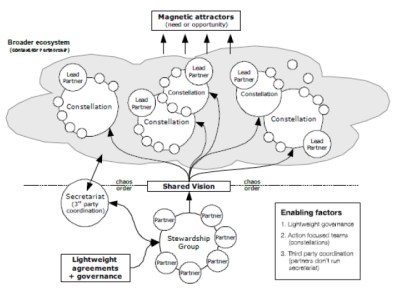
Constellation model of Social Change, Eaton International Consulting, Sarah Eaton, facilitator

At the top of the model is a “magnetic attractor”, or the purpose that caused all the groups to come together in the first place. This essentially becomes their guiding star, or in less “fluffy” language, their guiding principles. The larger group’s shared purpose is what guides them and drives their actions, defining how they will work together.

This model is light on governance. There is no separate legal entity or incorporation. Instead, action-focussed work teams called “constellations” take on the responsibility for moving certain pieces of the work forward. There is no obligation for a group to exist indefinitely. Once their work on a particular area has been completed, the constellation may be phased out, giving way to new constellations. This “phasing out” is seen as a natural progression of the work, rather than a source of anxiety. It does not mean that the foundation of the larger organization has been shaken in any way.

Instead of a traditional leadership team at the top, there is a stewardship group that serves to empower the various constellations. Their job is to set a strategic direction, monitor the coalition’s overall health. Then, it turns over the energy and power to the working groups. Each group takes the lead on a particular project or set of actions. The general terms of reference for the stewardship group are “as little process as possible”.

This model also includes a third-party secretariat whose job it is to coordinate the overall efforts of the project and troubleshoot problems. Surman and Surman point out that:

“When non-profits set up collaborative projects, they typically… (create) a secretariat within the partner who has the most capacity. This is seldom an ideal solution. Placing the coordination function within one of the partners permanently alters the power dynamic of the group. One partner takes power. The others defer responsibility and lose energy.”

In this model, the secretariat is responsible to both the stewardship team and the constellations.

Characteristics of the Constellation Model

  • Defining traits of this model are:
  • Organizationally complex
  • Lightweight governance
  • Messy
  • Exist through lightweight agreements between members
  • Fiscal and legal responsibility moves around depending on which partner is leading a constellation
  • Leadership and power are shared among members

Our process

We challenged the groups to consider the constellation model in more depth. We asked them which aspects of it resonated with them and how.

We did not tell members that their current structure was wrong or that they needed to change it. We simply presented the constellation model as a tool for further discussion.

Results

  • The group was able to engage deeply in a productive conversation about governance, leadership and structure.
  • Members gained insights into why a traditional organizational structure might not work for them.
  • Individuals who were feeling anxious and undervalued suddenly felt that they had options.
  • The group was able to acknowledge that a structure can be “messy” and still work.

Just as constellations in the sky may seem messy to the untrained eye, each functions well on its own. Sometimes stars burn out… and that is OK. In fact, it is normal and does not mean that the universe is falling apart. There is a natural ebb and flow to all work and process.

As facilitators we were astounded at the depth of conversation and levels of engagement. We brought the constellation to the table as a tool to generate dialogue. The unexpected result for us was a sense of relief, mixed in with excitement. Members felt that they had a better understanding of how many organizations could work together effectively without giving up their own identity or culture.

References:

Here are some of the resources that we drew upon in order to prepare for and deliver the workshop:

Byers, R. (2011). “Models and Elements of Collaborative Governance” from @ A Glance: A Resource of the Healthy Communities Consortium.

Cooperrider, D. L., Whitney, D., & Stavros, J. M. (2003). Appreciative inquiry handbook. Bedford Heights, OH: Lakeshore Publishers.

Koch, J. (2005). The Efficacy of Asset-Based Community Development (ABCD) in the Educational Context. (Master’s Thesis).University of Calgary, Calgary.

Kretzmann, J. P., & McKnight, J. L. (1993). Building Communities from the Inside Out: A Path Toward Finding and Mobilizing a Community’s Assets. Skokie, IL: ACTA Publications.

Kretzmann, J. P., McKnight, J. L., Dobrowolski, S., & Puntenney, D. (2005). Discovering Community Power: A Guide to Mobilizing Local Assets and Your Organization’s Capacity. from the Asset-Based Community Development Institute, School of Education and Social Policy, Northwestern University: http://www.abcdinstitute.org/docs/kelloggabcd.pdf

Storti, C. (1990). The art of crossing cultures. Yarmouth, ME: Intercultural Press, Inc.

Surman, T. (2006, March 15, 2012) Constellation Collaboration: A model for multi-organizational partnership. Retrieved from http://www.socialinnovationexchange.org/files/event/attachments/Constellation%20Model%20Description%20June%209%2706.pdf

Surman, T., & Surman, M. (2008). Listening to The Stars: The Constellation Model of Collaborative Social Change. Social Space. Retrieved from http://socialinnovation.ca/sites/default/files/Constellation%20Paper%20-%20Surman%20-%20Jun%202008%20SI%20Journal.pdf

Wheatley, M. J. (2006). Leadership and the New Science: Discovering Order in a Chaotic World (3rd. ed.). San Francisco: Berrett-Koehler Publishers, Inc.

_________________________________

Share or Tweet this post: Letting them shine: Working with multi-organizational coalitions http://wp.me/pNAh3-1kO

Update – January 2018 – This blog has had over 1.8 million views thanks to readers like you. If you enjoyed this post, please “like” it or share it on social media. Thanks!

Sarah Elaine Eaton is a faculty member in the Werklund School of Education, University of Calgary, Canada.