Event: The Intersection of Academic Integrity and Inclusion: A Fireside Chat

October 10, 2024

Next week is Academic Integrity Week at the Univeristy of Calgary. This year, I have the honour of moderating a fireside chat with one of my very own Werklund School of Education Doctor of Education (EdD) students, Colleen Fleming. 

Join us for a thought-provoking discussion during Academic Integrity Week 2024!

A poster with text in black, red, and orange. The University of Calgary logo appears at the top. On the right-hand side there is art featuring a woman wearing a headset.

Discover the crucial link between academic integrity and inclusion in higher education with our distinguished speaker, Colleen Fleming, EdD student, Werklund School of Education.

Moderated by Dr. Sarah Elaine Eaton, this conversation will explore:

  • Defining academic integrity in an inclusive context
  • Challenges in maintaining integrity across diverse student populations
  • Practical strategies for educators to promote both integrity and inclusion

Don’t miss this opportunity to gain insights from Colleen’s extensive experience as a K-12 practitioner and her cutting-edge doctoral research. Engage in a live Q&A session and contribute to this important conversation.

A bit about Colleen…

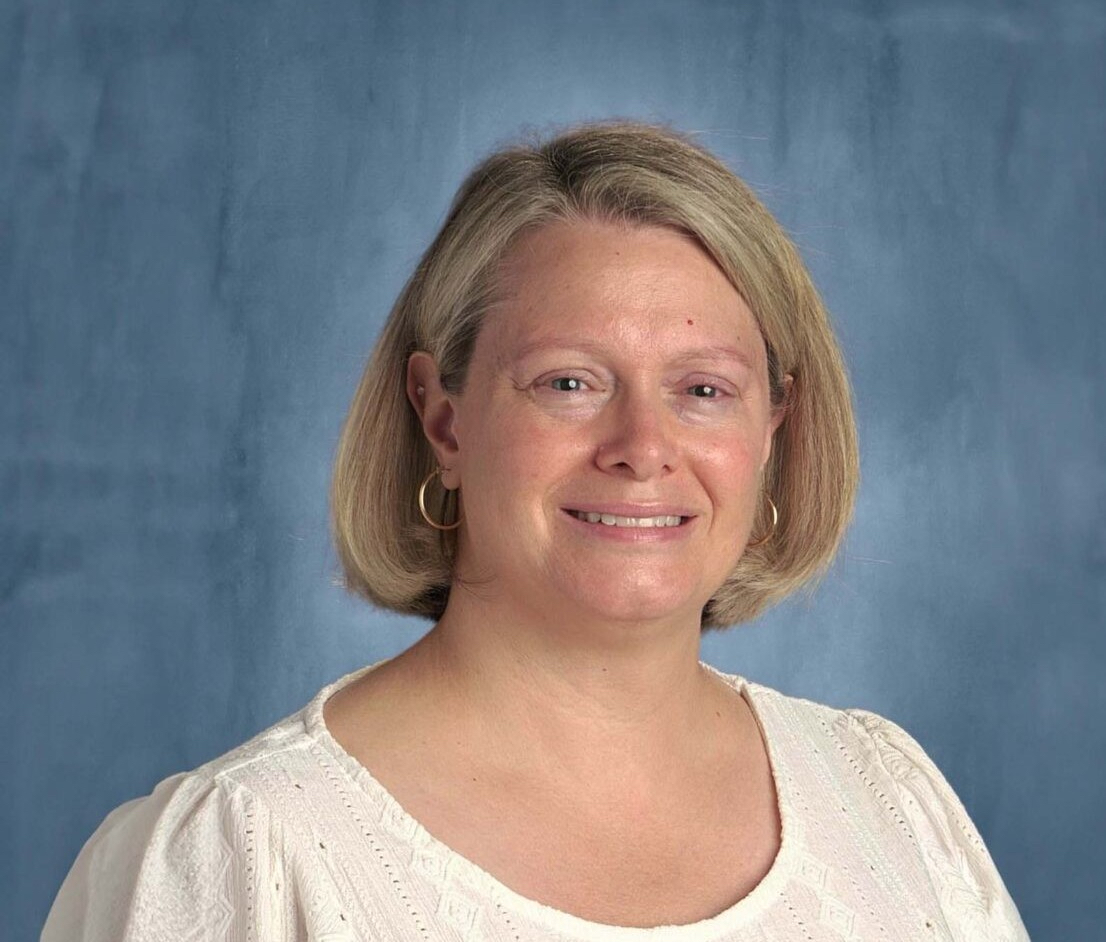
A photograph of a woman with chin-length blonde hair. She is wearing a white top. The background is blue.

Colleen Fleming (she/her/hers) is a K-12 practitioner at a designated special education school in Calgary. She has a keen interest in developing a culture of integrity among learners through the promotion of equity, diversity, and inclusion. As a Doctor of Education student at Werklund, her research involves proactively educating students about academic integrity in preparation for higher education.

Event details

Date: October 16, 2024

Time: 12:00 – 1:00 p.m.

Location: University of Calgary, Taylor Family Digital Library, Gallery Hall

https://events.ucalgary.ca/library/event/481166-academic-integrity-and-inclusion-with-colleen-fleming

This event is free and open to the public. Everyone is welcome!

________________________

Share this post: The Intersection of Academic Integrity and Inclusion: A Fireside Chat – https://drsaraheaton.com/2024/10/10/event-the-intersection-of-academic-integrity-and-inclusion-a-fireside-chat/

This blog has had over 3 million views thanks to readers like you. If you enjoyed this post, please “like” it or share it on social media. Thanks!

Sarah Elaine Eaton, PhD, is a Professor and Research Chair in the Werklund School of Education at the University of Calgary, Canada. Opinions are my own and do not represent those of my employer.


Promotion to Professor: Reflecting on a Three-Decade Journey

June 25, 2024

It has been a while since I have blogged. Life has been non-stop this year, but I wanted to take a moment to share some good news. I have been promoted to the rank of Professor, effective July 1, 2024. A few months back, I was also named as the Werklund Research Professor, which is a prestigious research chair in the Werklund School of Education.

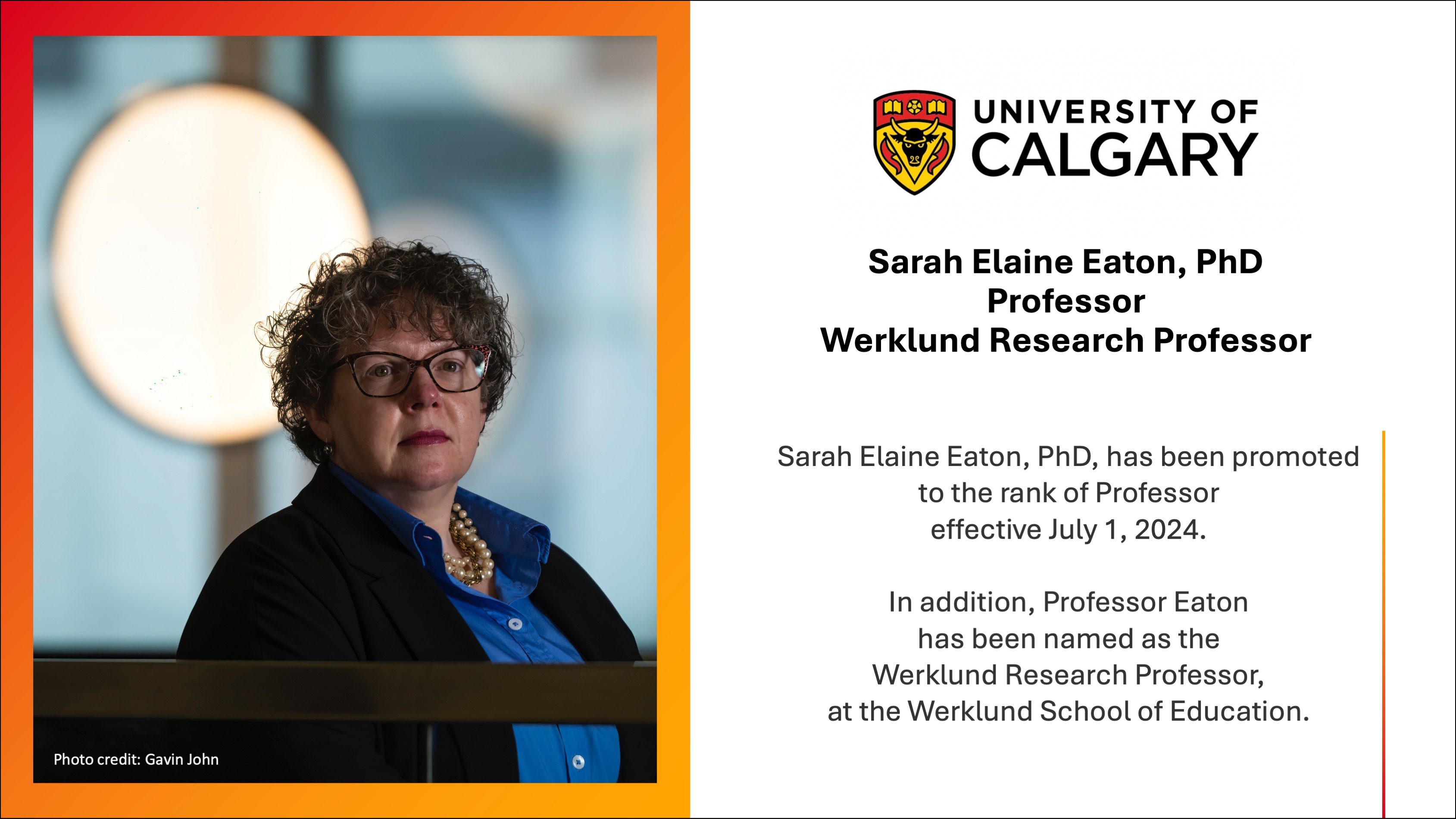
AltText: An announcement postcard. On the left is a photo of a woman with curly hair wearing glasses, a blue shirt, a black jacket and a pearl necklace. The are is an abstract background and the photo is framed in red and orange. On the right is the University of Calgary logo and black text that reads: Sarah Elaine Eaton, PhD, Professor, Werklund Research Professor. Sarah Elaine Eaton, PhD, has been promoted to the rank of Professor effective July 1, 2024.

In addition, Professor Eaton has been named as the Werklund Research Professor, at the Werklund School of Education.

I have long had a passion for integrity and ethics. I am grateful to have an opportunity to focus on ethics in my scholarship, advocacy, and leadership. The Werklund Research Professorship is a prestigious research chair, internally funded through the philanthropic generosity of Dr. David Werklund, the named patron of the Werklund School of Education. To the best of my knowledge, this is the first time anywhere in the world that a research chair role has focused on academic and research integrity. I am honoured to take up this work to advance scholarship related to ethics and integrity in higher education.

I was a first-generation student. Neither of my parents finished high school. When I was a child, my mother drilled into me that there was nothing more important than getting an education, working hard, and being independent. I have written about this, and part of my early life here. I started working when I was 15 and my first job was in a grocery store. When I first applied to university after graduating from secondary school, I had no idea how to go about filling out the application. Like many first-in-family students, I did not even know what questions to ask. I received modest scholarships throughout my studies, but I also worked, often at multiple part-time jobs, to pay the bills (including tuition), buy books, and put food on the table. I wasn’t something that I felt was a hardship, it was just something I did.

The promotion to full professor comes after 30 years of teaching at the University of Calgary. From 1994 to 2016, I taught on contract as a sessional instructor. After 22 years of precarious employment, I secured a tenure-track role in 2016. In 2020, I was promoted to associate professor with tenure. When considered in the context of the entirety of career, advancements are neither quick, nor easy. For more than two decades, I worked on semester-to-semester contracts, never knowing for sure if I would be employed in the following term until the contract actually came through. I established and successfully ran a consulting company that I maintained for twenty years, serving clients in industry, non-profit, and government. I enjoyed that work (mostly), but there were many aspects of running a business that I was horrible at.

There are plenty of things I am not good at, but I have always excelled at writing, reading, and synthesizing large amounts of information. I love working with students and I am well suited to online teaching and graduate supervision. I have not always had the luxury of being able to do work that I am good at and I recognize that it is a privilege to have a job where I can use my talents. For me, being a professor more than a job, though. It has been a lifelong dream. The reality of higher education is much harsher, more exhausting, and outright merciless than I ever imagined, and yet, I still want to be here.

One reason for this, is that there is much work to be done to preserve and sustain ethics and integrity in science, scholarly publication, teaching, learning, and educational administration. Generative artificial intelligence (Gen AI) has brought new twists on perennial challenges. Systemic barriers to academic success persist and there is plenty of research to show that corrupt and unfair systems can contribute to academic and research misconduct. Although I am interested in helping individuals uphold academic integrity, it is a fool’s errand to ignore the systemic inequities, barriers, and discrimination that are embedded into educational systems that perpetuate harm.

As I reflect back and plan forward, my goal now is to focus on doing what I can to leave the higher education system better than I found it. I plan to do this by raising awareness about systemic ethical issues and advocating for change to benefit students and staff, particularly those from equity-deserving groups. I look forward to continuing and expanding international collaborations (especially with colleagues at CRADLE Deakin University, where I hold the role of Honorary Associate Professor) and mentoring and supervising doctoral students, along with teaching and serving in leadership roles in the coming years.

____________________________

Share this post: Promotion to Professor: Reflecting on a Three-Decade Journey https://drsaraheaton.wordpress.com/2024/06/25/promotion-to-professor-reflecting-on-a-three-decade-journey/

This blog has had over 3.6 million views thanks to readers like you. If you enjoyed this post, please “like” it or share it on social media. Thanks!

Sarah Elaine Eaton, PhD, is a faculty member in the Werklund School of Education at the University of Calgary, Canada. Opinions are my own and do not represent those of my employer.

Sarah Elaine Eaton, PhD, Editor-in-Chief, International Journal for Educational Integrity


Academic Integrity Week 2021: Some Events at the University of Calgary

September 29, 2021

Academic Integrity Week 2021Institutions across Alberta and other provinces, as well as in Europe, are hosting a simultaneous Academic Integrity Week, October 18-22, 2021. At the University of Calgary we are pleased to be running multiple events, some of which are run for and by students, and others designed for educators and staff. The Taylor Institute for Teaching and Learning at the University of Calgary is hosting three webinars, which are free and open to the public. Note that all times listed are in Calgary (Mountain) time.

The Intersection of Academic Integrity and Mental Health: From Resources to Policies

Through discussions and activities, participants will examine academic integrity through a mental health lens. One of the topics addressed in this session include the impact of the academic misconduct process on student and faculty mental health. At a structural level, one of the topics highlighted will be bringing a mental health perspective to the development or review of academic integrity-related policies, processes and procedures. The session will conclude with Q&A, as well as resources to support student and faculty mental health and wellbeing.

Facilitator: Andrew Szeto, PhD
Date: Tuesday, October 19, 2021
Time: 12 – 1 p.m.

Contract Cheating in Alberta and Beyond

Join us for an eye-opening webinar about contract cheating in Alberta. We will talk about essay mills, homework completion services, unethical tutoring services, and thesis consultation services that all cross the line into academic misconduct. Learn about the size and scope of this predatory industry and how it preys on our students, including engaging in blackmail and extortion.

Facilitator: Sarah Elaine Eaton, PhD and Sheryl Boisvert
Date: Wednesday, October 20, 2021
Time: 4 – 5:30 p.m.
Locations: Online via Zoom

FOIP Training for Academic Integrity

Learn how the Freedom of Information and Protection of Privacy Act (FOIP) applies when there are suspected or actual breaches of academic integrity. Learn what information can be shared, with whom and why.

Facilitator: Katharine Kinnear (FOIP Coordinator, Legal Services) and Jennifer Sinclair (FOIP Advisor, Legal Services)
Date: Friday, October 22, 2021
Time: 12 – 1 p.m.
Location: Online via Zoom

For more details and to register, visit the website: https://taylorinstitute.ucalgary.ca/series-and-events/integrity-week

Please share this information with your networks.

______________________

Share or Tweet this: Academic Integrity Week 2021: Some Events at the University of Calgary https://drsaraheaton.wordpress.com/2021/09/29/academic-integrity-week-2021-some-events-at-the-university-of-calgary/

This blog has had over 2 million views thanks to readers like you. If you enjoyed this post, please “like” it or share it on social media. Thanks!

Sarah Elaine Eaton, PhD, is a faculty member in the Werklund School of Education, and the Educational Leader in Residence, Academic Integrity, University of Calgary, Canada.

Opinions are my own and do not represent those of the University of Calgary or anyone else.


My thoughts on the quip, “do your research” (Guest post: Astrid Kendrick)

April 23, 2021

I don’t normally have guest posts on my blog, but after reading this piece posted by my friend and colleague, Astrid Kendrick, PhD, a fellow faculty member at the Werklund School of Education, University of Calgary, I reached out to her to see if she would allow me to amplify her message by sharing it on my blog. Here is Dr. Kendrick’s post, shared with her permission.

________

My thoughts on the quip, “do your research”

Astrid Kendrick,EdD

Astrid Kendrick, EdDFacebook Status Update originally posted on April 22, 2021

I have the good fortune to be a funded (meaning paid) researcher over the past couple of years, which means I actually do my own research. It’s actually quite complicated, so here’s a brief (okay, lengthy) summary of how I “do my own research”.

Firstly, and most importantly, I have to do a comprehensive literature review on my research subject. This involves reading a ton of primary sources (e.g., peer-reviewed research articles, philosophical books). Normally, I don’t read secondary sources (e.g., news articles, websites) as those authors are only reporting on what they think primary researchers have said. If I do read about a study from a secondary source, I seek out the primary source and read that too. Often, the secondary reporting misses out on or misrepresents crucial details from the primary source.

This stage takes about 6-8 months and involves reading, understanding, and processing a lot of information. If you look at a citation page for any one of my papers, you’ll see that I usually cite about 20-50 sources. I have usually read twice the number of articles or books that I cite to figure out which actually relate to my research subject. Reading everything includes reading critique of the field to limit my bias.

Once I have read all the things – yes, all of them, including new stuff that’s published while I’m reading the old stuff – then I can apply for ethics approval to do a research study. Getting ethics takes 1-4 months, depending on how busy all my colleagues in that department are. I have to prove, as a part of this process, that my research will do no harm, I will mitigate all risks to human participants, and that I actually have read all the things about my topic. Without ethics approval, my research can’t go forward.

Once everything is read and ethics is approved, then I can do unique research, which necessitates keeping an open and flexible mind about my research subject, finding suitable participants, and collecting related policy or other documents, a stage known as collecting data. This part takes 4-5 months. In the case of my current podcasting study, data collection will take a year and for my compassion fatigue study, data collection has taken nearly 16 months.

Once the data is collected (usually by a research assistant which is why funding is great), I have to read, understand, and connect all of it (interviews, surveys, documents) and determine if what my participants have said or written lines up with all the reading I’ve already done. Not only do I have to know enough about the field to recognize when my findings reinforce already known information, but I also need enough knowledge to recognize unique or ground-breaking findings.

I then get to write about what my specific study has to say in relation to the rest of the known field, and decide if my findings are worth publishing. If I think so (in consultation with my research partners and collaborators), then I submit my writing for publication.

Being published in a quality peer-reviewed journal can take 1-2 years. The journal editors and other scholars in the field read through how my research study was constructed, how I collected ethical data, and they (also having read all the things on the topic) decide if indeed, my findings were either unique or further knowledge in the field. Normally, 2-3 reviewers read and decide if my article is well articulated, my study is valid, and then they force me to re-write it a couple more times so that it fits the standards of the publication journal.

Even those short Conversation Canada articles I’ve written are editorially reviewed and take about 1-2 months of re-writing after the initial submission to the editor. Sidebar: The Conversation only publishes articles by scholars speaking to their own unique research, so before my article is accepted, I have to demonstrate to their editors that I am writing about unique research and not simply writing an opinion.

So, “doing my research” is an exceptionally time-consuming process and tends to last several years. It rarely involves using Google, although I admit that Google Scholar can be helpful in finding newer open access articles not available through my university library.

Therefore, if you ask me about my topics of research (currently compassion fatigue, burnout, emotional labour, preservice teacher education, literacy instruction, and podcasting), you can be pretty certain that I know a lot about them, and you can trust my responses. You can even trust that if I say, “you need to read these 10 articles and three books”, it’s because I’ve read everything else, and those readings are the significant ones in the field. I’m actually saving you time from reading the hundreds of other articles that I’ve read on the subject that were irrelevant, difficult to read, or have similar findings.

If you ask me for my opinion on a hundred other topics, you’re getting just that. I’ve probably read some secondary sources on the topic, and likely even talked to some of my expert colleagues on their research and read the 10 articles they recommended, but my depth of knowledge is not the same as what I know about my research topics. I have not “done my research”, I have simply constructed an informed opinion that I’m willing to change based on new information from expert sources.

Thanks for reading, and to Sarah for posting, because now my husband, John doesn’t have to listen to my “What doing real research means!” rants on our daily walks anymore.

Follow Astrid Kendrick on Twitter.

____________

Share or Tweet this: My thoughts on the quip, “do your research” (Guest post by Astrid Kendrick) – https://drsaraheaton.wordpress.com/2021/04/23/my-thoughts-on-the-quip-do-your-research-guest-post-astrid-kendrick/

This blog has had over 2 million views thanks to readers like you. If you enjoyed this post, please “like” it or share it on social media. Thanks!

Sarah Elaine Eaton, PhD, is a faculty member in the Werklund School of Education, and the Educational Leader in Residence, Academic Integrity, University of Calgary, Canada.

Opinions are my own and do not represent those of the University of Calgary or anyone else.

Follow me on Twitter.


Webinar: Sharing is caring? Exploring academic integrity and file-sharing behaviours

July 21, 2020

Webinar: Sharing is caring? Exploring academic integrity and file-sharing behaviours

August 14, 2020

10:00 a.m. to 11:30 a.m. Mountain Time (Calgary, Canada)

Join Dr. Brenda Stoesz (University of Manitoba) and Josh Seeland (Assiniboine Community College) for an interactive session on academic file-sharing among students. Learn what some of the issues are, and how to address them from an academic integrity perspective.

This online event is part of the Academic Integrity Webinar Series, offered through the Taylor Institute for Teaching and Learning at the University of Calgary. The series is convened by Dr. Sarah Elaine Eaton, Educational Leader in Residence, Academic Integrity.

Presenter bios:

Brenda M. Stoesz currently works as a faculty specialist at The Centre for the Advancement of Teaching and Learning at the University of Manitoba in Winnipeg, MB, Canada, where she develops educational resources and professional development opportunities for post-secondary academic staff. Stoesz also conducts research on academic integrity, with a focus on academic integrity policy analysis and contract cheating. In 2019, she founded and currently chairs the Manitoba Academic Integrity Network (MAIN). Stoesz holds a PhD in Psychology and Bachelors of Education and Science. She has more than 20 years of experience teaching high school, college, and university students.

Josh Seeland works as Academic Integrity & Copyright Officer at the Assiniboine Community College (ACC) Library in Brandon, MB, Canada, where his primary duties include research initiatives and library instruction/outreach at ACC locations across Manitoba. He is a member of the Manitoba Academic Integrity Network (MAIN) and chairs ACC’s Academic Integrity Advisory Committee. Seeland holds Bachelor of Arts in History and Philosophy from the University of Manitoba and a diploma in Library and Information Technology from Red River College.

Learning Objectives:

By the end of this session, you will be able to:

  • Understand what academic file-sharing is and how it works.
  • Understand how predatory commercial file sharing sites can exploit or deceive students.
  • Discuss how educators can work with students to understand what ethical sharing means.

Register here.

This webinar is the first in a new series being offered through the Taylor Institute of Teaching and Learning at the University of Calgary.

This series will deal with timely and emergent topics that are cutting edge, provocative or high profile in nature. Each webinar can accommodate 300 live participants. All registrants will be e-mailed a link to the recorded version of the webinar for viewing after the live event.

_________________________________

Share or Tweet this: Webinar: Sharing is caring? Exploring academic integrity and file-sharing behaviours #academicintegrity #highered https://wp.me/pNAh3-2wS

This blog has had over 2 million views thanks to readers like you. If you enjoyed this post, please “like” it or share it on social media. Thanks!

Sarah Elaine Eaton, PhD, is a faculty member in the Werklund School of Education, and the Educational Leader in Residence, Academic Integrity, University of Calgary, Canada. Opinions are my own and do not represent those of the University of Calgary.