Summer 2020 Course – EDER 705: Doctoral Seminar in Educational Leadership

June 18, 2020

EDER 705 L01 2020I am excited to be teaching two summer courses starting at the end of June. One of them is this course:

EDER 705: Doctoral Seminar in Educational Leadership

Course Description:

Provides doctoral students with a contemporary Canadian focus on significant issues in educational leadership.

Extended Course Description:

This course is an introduction to educational leadership as a specialized field of scholarship and professional practice. It provides a historical overview of the study of educational leadership to develop understandings of significant perspectives, concepts, and theories as they pertain to current educational organizations.

Learner Outcomes:

The course readings, topics, and learning tasks have been chosen to help students to:

  • familiarize themselves with diverse historical and contemporary theoretical perspectives/paradigms in educational administration and leadership;
  • critically examine educational issues using current research literature to understand differing assumptions, values, and methods that are used to study and understand education; and
  • develop an in-depth understanding of their own assumptions and beliefs about the value and role of leadership practice in public education.

Course Design and Delivery: 

This course will be offered fully online, using D2L and Zoom.

This course is only available to students enrolled in the Doctor of Education program. If you are interested in learning more about our graduate program offerings, check out the Werklund School of Education web page.

Applications for next year open in September 2020. It’s not too early to start planning for 2021!

_________________________________

Share or Tweet this: Summer 2020 Course – EDER 705: Doctoral Seminar in Educational Leadership https://wp.me/pNAh3-2uO

This blog has had over 2 million views thanks to readers like you. If you enjoyed this post, please “like” it or share it on social media. Thanks!

Sarah Elaine Eaton, PhD, is a faculty member in the Werklund School of Education, and the Educational Leader in Residence, Academic Integrity, University of Calgary, Canada. Opinions are my own and do not represent those of the University of Calgary.


Journal of Educational Thought: Special Issue on Academic Integrity and Ethics

January 14, 2020

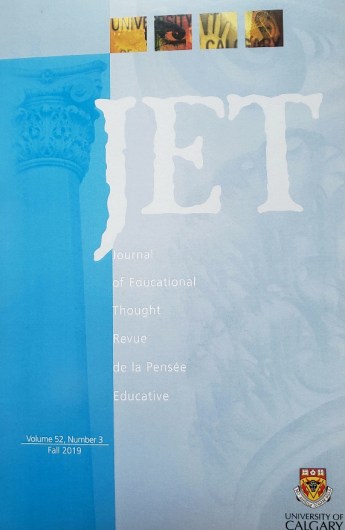
JET Cover 52(3)I am so pleased to share that the special issue of the Journal of Educational Thought dedicated to academic integrity and ethics is now out. I am excited about this work because it adds to the growing body of scholarly and research literature on these important topics, not only in Canada, but globally, too.

I was the guest Co-Editor for this special issue, together with the journal’s editor-in-chief, Ian Winchester.

Here’s an overview of what’s in the issue:

Editorials

Winchester, I. (2019). Academic integrity in the university. Journal of Educational Thought, 52(3), 187-190.

Eaton, S. E. (2019). Considerations of corruption, ethics and integrity in educational contexts: Guest editorial. Journal of Educational Thought, 52(3), 191-192.

Research articles

Lock, J., Schroeder, M., & Eaton, S. E. (2019). Designing and implementing an online academic integrity tutorial: Identifying the challenges within a post-secondary context. Journal of Educational Thought, 52(3), 193-208.

Lancaster, T., Glendinning, I., Foltýnek, T., Dlabolová, D., & Linkeschová, D. (2019). The perceptions of higher education students on contract cheating and educational corruption in South East Europe. Journal of Educational Thought, 52(3), 209-227.

Henry, R., & Gabel, C. (2019). “It’s not just a picture when lives are at stake: Ethical considerations and photovoice methods with Indigenous Peoples engaged in street lifestyles”. Journal of Educational Thought, 52(3), 229-252.

Miron, J. B. (2019). Academic integrity in a student practice environment: An elicitation study. Journal of Educational Thought, 52(3), 253-273.

All of the research articles underwent double-blind peer review.

______________________________________________________

Share or Tweet this: Journal of Educational Thought: Special Issue on Academic Integrity and Ethics

This blog has had over 2 million views thanks to readers like you. If you enjoyed this post, please “like” it or share it on social media. Thanks!

Sarah Elaine Eaton is a faculty member in the Werklund School of Education, and the Educational Leader in Residence, Academic Integrity, University of Calgary, Canada. Opinions are my own and do not represent those of the University of Calgary.


MEd Certificate in Academic Integrity

October 2, 2019

MEd Cert - Academic IntegrityThis program is situated as one component of a course-based Master of Education (MEd) Interdisciplinary. Students will undertake a 4-course topic in Academic Integrity to earn a Master’s level certificate qualification.

Program Overview: The Academic Integrity four-course topic fosters an understanding of theories of knowledge, knowledge sharing, attribution, as situated within an educational leadership context. Students will engage in research-intensive courses to understand how academic integrity is understood from the perspectives of theory and professional practice. Students will apply their knowledge in the exploration, critique and design of institutional, teaching, learning and assessment practices as they relate to academic integrity. This 4-course topic serves to develop professional autonomy and capacity at both K-12 and post-secondary contexts.

Program Goals:

  • Develop research-informed understanding of academic integrity, situated within current problems, as well as emerging trends in the field.
  • Develop and extend concepts relating to ethical decision-making, policy, academic misconduct case management.
  • Develop and extend methodological and theoretical competence in the field of academic integrity.

Format: Fully online

Program dates: July 2020 to April 2021

Applications open: November 1, 2019  Applications close: March 15, 2020

For more information about the Master of Education (MEd) Interdisciplinary: http://werklund.ucalgary.ca/gpe/

______________________________________________________

Share or Tweet this: MEd Certificate in Academic Integrity

This blog has had over 2 million views thanks to readers like you. If you enjoyed this post, please “like” it or share it on social media. Thanks!

Sarah Elaine Eaton is a faculty member in the Werklund School of Education, and the Educational Leader in Residence, Academic Integrity, University of Calgary, Canada. Opinions are my own and do not represent those of the University of Calgary.


Academic Integrity: Resource for Teaching Assistants

September 16, 2019
Academic Integrity resource for teaching assistants

Academic Integrity resource for teaching assistants

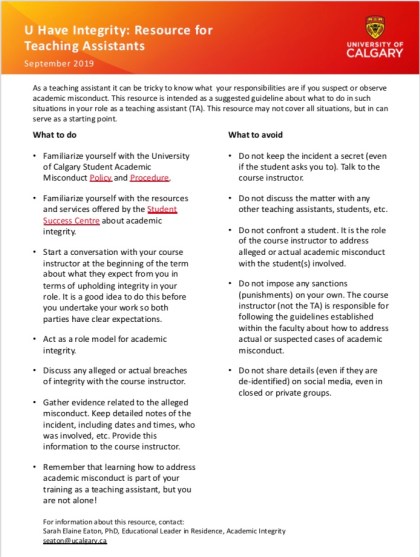
As a Teaching Assistant (TA) it can be tricky to know what your responsibilities are if you suspect or observe academic misconduct. This resource is intended to help both TAs and course instructors about the roles and responsibilities teaching assistants play in upholding academic integrity at the University of Calgary.

Teaching assistants are responsible for acting with integrity, maintaining the privacy of all parties involved and reporting any suspected or actual cases of academic misconduct to the course instructor. TAs are not responsible for confronting student(s) who may be allegedly responsible for academic misconduct and nor are they responsible for imposing sanctions (discipline). It is the responsibility of the course instructor to follow the guidelines established by their faculty for responding to allegations of academic misconduct.

Open communication between course instructors and teaching assistants is key. Establishing expectations early in the term, before issues might arise can be very helpful for teaching assistants.

It is important for teaching assistants to know they are not alone when it comes to upholding academic integrity.

This one-page tip sheet is intended as a suggested guideline to help teaching assistants figure out what to do if they encounter or suspect a breach of academic integrity. This handout is not exhaustive and it may not cover all situations. This resource was developed specifically for teaching assistants at the University of Calgary and may not apply to TAs at other institutions.

Here is a link to this free and downloadable .pdf resource: U Have Integrity: Resource for Teaching Assistants.

Here is the text of the .pdf for anyone wanting a quick read:

As a teaching assistant it can be tricky to know what your responsibilities are if you suspect or observe academic misconduct. This resource is intended as a suggested guideline about what to do in such situations in your role as a teaching assistant (TA). This resource may not cover all situations, but in can serve as a starting point. 

What to do 

  • Familiarize yourself with the University of Calgary Student Academic Misconduct Policy and Procedure. 
  • Familiarize yourself with the resources and services offered by the Student Success Centre about academic integrity. 
  • Start a conversation with your course instructor at the beginning of the term about what they expect from you in terms of upholding integrity in your role. It is a good idea to do this before you undertake your work so both parties have clear expectations. 
  • Act as a role model for academic integrity. 
  • Discuss any alleged or actual breaches of integrity with the course instructor. 
  • Gather evidence related to the alleged misconduct. Keep detailed notes of the incident, including dates and times, who was involved, etc. Provide this information to the course instructor. 
  • Remember that learning how to address academic misconduct is part of your training as a teaching assistant, but you are not alone! 

What to avoid 

  • Do not keep the incident a secret (even if the student asks you to). Talk to the course instructor. 
  • Do not discuss the matter with any other teaching assistants, students, etc. 
  • Do not confront a student. It is the role of the course instructor to address alleged or actual academic misconduct with the student(s) involved. 
  • Do not impose any sanctions (punishments) on your own. The course instructor (not the TA) is responsible for following the guidelines established within the faculty about how to address actual or suspected cases of academic misconduct. 
  • Do not share details (even if they are de-identified) on social media, even in closed or private groups.

Related posts:

______________________________________________________

Share or Tweet this: Academic Integrity: Resource for Teaching Assistants https://wp.me/pNAh3-2oQ

This blog has had over 2 million views thanks to readers like you. If you enjoyed this post, please “like” it or share it on social media. Thanks!

Sarah Elaine Eaton is a faculty member in the Werklund School of Education, and the Educational Leader in Residence, Academic Integrity, University of Calgary, Canada. Opinions are my own and do not represent those of the University of Calgary.


Language Learning and Technology (EDER 669.73): Summer 2019 course

July 2, 2019

Couse banner 2019-07I am excited to be teaching one of my favourite courses this summer: Language Learning and Technology (EDER 669.73). This is a fully online course for students registered in the Master of Education (MEd) program at the Werklund School of Education.

Course Description:

This course has been designed for students who want to learn how to effectively incorporate technology in their present and future careers as language teachers. The course will cover both theoretical and practical issues in teaching second language and the use of new technology to support and enhance the learning process.

A special emphasis will be on combining both face-to-face and the use of technologies in and beyond the classroom walls to enhance the second language learning process. Although the course may address the different types technologies such as Web 2.0 technologies (e.g., blogs, wikis; audio and video podcasting; online videos; mobile tools); mobile technology (e.g., mobile phones; MP3 players; digital cameras; camcorders), and other type of interactive technologies, the focus of the course is on the pedagogical and practical aspects of integrating new technology to face-to-face language teaching.

The course is open to second language present and future teachers at the elementary, secondary, and post-secondary level. The course also invites language teachers with limited knowledge of the target language to learn how to enhance their language teaching by integrating blended teaching into their practice.

Learner Outcomes:

The intent of this course is to explore the integration of technology to enhance language learning, particularly in in blended or distance environments.

Specific objectives include:

  • understand different learning theories informing pedagogical practices, and in particular the TPACK and SAMR models, as they apply to language learning;
  • review current research on the learning of additional languages enhanced by digital technologies;
  • explore digital mediated communication methods that can be used effectively in distance and blended language learning programs;
  • examine current and emerging trends in educational technology as they apply to language learning; and
  • design and evaluate language-learning modules integrating digital technology for online or blended environments.

______________________________________________________

Share or Tweet this: Language Learning and Technology (EDER 669.73): Summer 2019 course https://wp.me/pNAh3-2nz

This blog has had over 2 million views thanks to readers like you. If you enjoyed this post, please “like” it or share it on social media. Thanks!

Sarah Elaine Eaton is a faculty member in the Werklund School of Education, University of Calgary, Canada. Opinions are my own and do not represent those of the Werklund School of Education or the University of Calgary.