Report (Canada): “The Business Case for Lifelong Learning”: Adult education and Literacy

July 4, 2011

On Canada Day I posted about a report from the US on the impact of adult education on the American economy. I took a bit of flak for posting about the US on Canada Day, so let me make up for it by celebrating the 4th of July with a newly-released report from Canada on the very same topic.

The Ontario Chamber of Commerce (Canada) has just released, “The Business Case for Lifelong Learning and Job-Based Training”, a 28-page report on the economic impact of lifelong learning and adult education.

The report addresses:

  • Workforce learning and development: A key lever of innovation
  • The economic case for investment in workforce training
  • The role of government in a competitive education and training system
  • Recommendations

You can download a copy of the report here: http://occ.on.ca/wp-content/uploads/2011/06/Workforce-Training-Report_Electronic.pdf

Here is a video (3:17 in length) that introduces the report: http://www.youtube.com/user/OntarioChamber?feature=mhsn#p/a/u/0/jyDt9k0NLCY

Although this report deals specifically with one Canadian province, it may be useful to reference in grant applications, position papers and other research, as it helps to document current trends in the field of literacy and in particular, the economic impact of lifelong learning and adult education.

So, Happy Canada Day (belated), Happy Independence Day. Wherever you are, celebrate lifelong learning and the positive impact it makes on our world!

Related posts:

New Report: The Economic ROI of Adult Education Programs (U.S. report)

The economic impact of language programs on communities

Research: ESL programs boost Calgary’s economy by $26M+ per year

________________

Share this post: Report (Canada): “The Business Case for Lifelong Learning”: Adult education and Literacy http://wp.me/pNAh3-Nr

Update – January 2018 – This blog has had over 1.8 million views thanks to readers like you. If you enjoyed this post, please “like” it or share it on social media. Thanks!

Sarah Elaine Eaton is a faculty member in the Werklund School of Education, University of Calgary, Canada.


Strength-based approaches to evaluating literacy and language learning

July 4, 2011

Looking for new ways to assess literacy and language learning that focus on students’ strengths, instead of their weaknesses? So was I. I started digging, found some resources and compiled them into an annotated bibliography, that’s just been archived on ERIC.

Alternative and Asset-Based Evaluation and Assessment in Language Teaching and Literacy: Resources for Research, Classroom Instruction and Evaluation of Language Competence

Full text report available from ERIC. (Release date: June 1, 2011): http://1.usa.gov/lf2NvT

This annotated bibliography surveys key resources and research related specifically to language learning and literacy. It focuses on resources that will be valuable to teaching professionals and researchers who specialize in the areas of foreign and second language teaching, language arts and first and second language literacy.

Significant theoretical research and applied classroom practice has been done in the field of alternative assessment, and specifically in area of using portfolios and e-portfolios (Barrett, 2010; Brear, 2007; Dominguez, 2011; JISC, 2008; Meuller, 2011; North Carolina Regional Educational Laboratory, n.d.; Shao-Ting & Heng-Tsung).

The practice of using portfolios for second and foreign language teaching has increased in popularly, with an increased understanding and adoption of the Common European Framework of Reference for Languages (Council of Europe, 2001). Almost simultaneously, there has been a rise in the use of similar frameworks in the field of literacy (Alberta Advanced Education and Technology, 2009; Literacy BC, n.d.)

However, there is little collaboration between those who work in literacy and those who teach second and modern languages (Eaton, 2010).

This annotated bibliography is an attempt to collect, select and share resources that may be relevant, helpful and useful to professionals working in both the second language and literacy sectors. The deeper values that guide this work are predicated on the belief that researchers and practitioners working in both fields have much in common and would benefit greatly from increased dialogue and shared resources. A bibliography is included.

Related posts:

Using Portfolios for Effective Learning

27 Great Resources on Using Portfolios for Language Learning and Literacy

___________________

Share this post: Strength-based approaches to evaluating literacy and language learning http://wp.me/pNAh3-MW

Update – January 2018 – This blog has had over 1.8 million views thanks to readers like you. If you enjoyed this post, please “like” it or share it on social media. Thanks!

Sarah Elaine Eaton is a faculty member in the Werklund School of Education, University of Calgary, Canada.


New Report: The Economic ROI of Adult Education Programs

July 1, 2011

A new policy paper published by the McGraw-Hill Research Foundation that was developed in collaboration with the United States’ National Council of State Directors of Adult Education and the U.S. National Adult Education Professional Development Consortium states that “a preemptive focus on adult education actually saves governments money by reducing societal healthcare, public assistance, and incarceration costs”.

The report, “The Return on Investment from Adult Education and Training: Measuring the Economic Impact of a Better Educated and Trained U.S. Workforce,” put it in plain simple language by saying that adult education “improves and expands the nation’s available pool of human capital by helping motivated but under educated people achieve gainful employment in today’s increasingly high-tech and global job market, and at a far lower cost per learner when compared to either K-12 or higher education.”

The co-authors Dr. Lennox McLendon (Executive Director, National Council of State Directors of Adult Education and the National Adult Education Professional Development Consortium), Debra Jones (California Director of Adult Education and Chair, NAEPDC Research Workgroup) and Mitch Rosin (Editorial Director, McGraw-Hill School Education Group) have put together a solid 26-page report that is a brilliant combination of statistics and related evidence that ultimately constructs a clear picture of the economic return on investment (ROI) of adult education and literacy programs. The culmination of the evidence they present  fully supports their closing argument:

“Current federal adult education and workforce skills programs need to be better funded, but they also need to be redesigned and connected more effectively to state and local programs. We must have an integrated system of adult education and workforce development that serves millions of Americans in accessible, affordable, and accountable ways – on the job, online, and in the classroom.”

Although this report is focused on the U.S.A. it provides compelling evidence for programs in other countries, too.

This is a report that is worth looking at and sharing.  Download your free copy from here: http://www.mcgraw-hillresearchfoundation.org/wp-content/uploads/the-return-on-investment-from-adult-education-and-training.pdf

Related posts:

The economic impact of language programs on communities

Research: ESL programs boost Calgary’s economy by $26M+ per year

________________

Share this post: New Report: The Economic ROI of Adult Education Programs http://wp.me/pNAh3-Mm

Update – January 2018 – This blog has had over 1.8 million views thanks to readers like you. If you enjoyed this post, please “like” it or share it on social media. Thanks!

Sarah Elaine Eaton is a faculty member in the Werklund School of Education, University of Calgary, Canada.


The teachers we love (They’re not always the ones who know the most!)

June 29, 2011

I’ve been pondering questions of educational reform and effective learning for a long time now. I ask myself, where did the idea ever come from that teachers needed to know everything?

In a traditional classroom the teacher stands at the front of the room and imparts his or her knowledge to the students. The students take it in, write it down and memorize it. We then give them a test designed so that they must regurgitate what they have learned. Errors are marked with a red X. The teacher must then show them the “gaps” in their learning.

This is a deficit-based model of student evaluation. The tests highlight students deficiencies. Only if they get very good marks on a test do we celebrate their success. There’s this idea that if only we could stuff our students’ heads with the right information, then they’ll be successful students. Which means they’d be successful in life, of course. The higher they go in the educational system and the more tests they can pass, they smarter they are and the more successful they’ll be.

I’m a product of this system. I went through the ranks, earned a high school diploma, then a bachelor’s degree, then a master’s, then a PhD. Technically, I – and all my other PhD colleagues – are living proof that the system works.

The problem is that it propagates the idea of the teacher being the centre of all knowledge. We know today that model of education isn’t working with 21st century students. We know that collaborative approaches to education are more effective.

We know that teachers being “a guide on the side” rather than “a sage on the stage” engages students more.

There is tension between an outdated, highly revered system that puts the teacher at the front of the classroom, which effectively becomes an intellectual pedestal. It also puts incredible pressure on them to know everything. What could possibly be more intimidating? And more impossible?

Teachers are not ambulatory encyclopedias.

They do not – will not – and can not – know everything.

A teacher who makes a mistake is not a bad teacher. He or she is simply human.

Of course teachers need to hone their craft, build their knowledge and engage in personal and professional development so they learn both the depth and breadth of what they are teaching. There’s no question about that. But in today’s world where information is at our fingertips, where there are more articles, Tweets, blog posts, videos, webinars, scholarly journals and conferences on any given topic than any human could possibly absorb in one lifetime, we need to get one thing straight:

We can never know everything on a topic.

Being interested, engaged and dedicating years of deep study to a topic does not mean we’ll ever know everything on that topic.

It’s also our job to guide students and, if we’re doing our job right, to unleash their curiosity and their inner drive to discover, to challenge them and provide sufficiently safe environments for them to explore and challenge themselves further and to discover the best that they can be.

As I look back on my own years as as student, the “best” teachers… the ones who inspired, motivated and struck that oh-so-elusive balance between kicking their students in the butt and giving them healthy doses of sincere encouragement, those are the teachers I remember the most.

As this school year draws to a close, who are the teachers you remember?

_______________

Share this post: The teachers we love (They’re not always the ones who know the most!) http://wp.me/pNAh3-AG

Update – January 2018 – This blog has had over 1.8 million views thanks to readers like you. If you enjoyed this post, please “like” it or share it on social media. Thanks!

Sarah Elaine Eaton is a faculty member in the Werklund School of Education, University of Calgary, Canada.


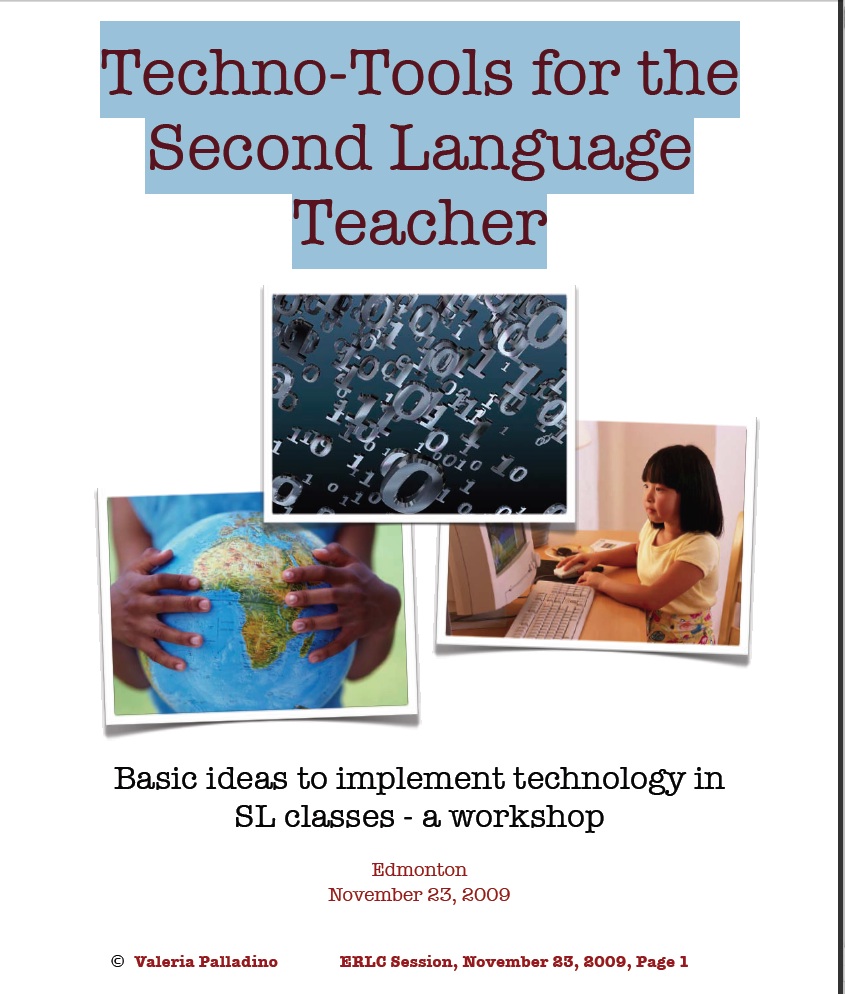
Techno-Tools for the Second Language Teacher

June 27, 2011

Valeria Palladino, a language teacher in Edmonton, Canada, has a great wiki on technology tools for second languages: http://technotoolsforslclasses.wikispaces.com/

She has also done a useful and easy to follow 29-page guide called “Techno-Tools for the Second Language Teacher“. It contains ideas on how to implement technology into second language classes. This guide is particularly useful for teachers who want to integrate tech into their second language classrooms, but are not sure where to start. Palladino explains the basics in language that is easy to understand and easy to follow.

_____________

Related posts:

Cool Apps for Language Learning http://wp.me/pNAh3-mQ

MALL (Mobile-Assisted Language Learning) http://wp.me/pNAh3-6U

__________

Share this post: Techno-Tools for the Second Language Teacher http://wp.me/pNAh3-M7

Update – January 2018 – This blog has had over 1.8 million views thanks to readers like you. If you enjoyed this post, please “like” it or share it on social media. Thanks!

Sarah Elaine Eaton is a faculty member in the Werklund School of Education, University of Calgary, Canada.