The Society of Teaching and Learning in Higher Education (STLHE) in Canada has launched a new national Committee on Academic Integrity and Contract Cheating (CAICC). With more than 40 members from universities and colleges across Canada, this committee will focus on how to promote academic integrity and take action against term paper mills and other forms of contract cheating.
In my open access book chapter “Contract Cheating in Canada: A Comprehensive Overview”, I provide details of an attempt to legislate against contract cheating. Bill 174 was brought forward in the Ontario provincial legislature by the Hon. Albert Roy on June 14, 1972. I often wonder how different things would be in Canada today if that legislation had passed.
As I was digging into that research, I looked up Albert Roy and found that after he’d left politics, he went on to practice laws and was later appointed as a judge. He appeared to be doing some work for a mediation consultancy firm, so I decided I’d drop him an e-mail to tell him about how important this attempt at legislation was, even if it failed. I never heard back, and I figured he was just busy.
After our book, Academic Integrity in Canada was published, I e-mailed him again to let him know so he could read about how contract cheating in Canada had evolved and what we were doing to take action against it. I never heard back… So a while back, I decided to be cheeky and leave him a voice mail.
Last week on Wednesday when I was attending the Society for Teaching and Learning in Higher Education (STLHE) conference in Ottawa, my phone rang just before lunch. I answered and lo and behold, it was Albert Roy calling me back! He let me know that he’d never received the e-mails but was glad that I phoned.
During our conversation I asked if he’d like me to send him a copy of the book chapter in which I’d written about contract cheating in Canada, including the legislation he’d proposed. He said yes and proceeded to give me his mailing address. After he’d finished, I said,
“You’re in Ottawa!”
“Yes,” he replied.
“I’m in Ottawa! I’m here from Calgary for a conference on teaching and learning in higher education!”
One thing led to another and with the permission of the conference organizers, I asked Albert if he’d might have time and interest to drop by my session on Friday morning. (Of course, I figured he’d be busy, off doing whatever it is that retired people do…) To my utter surprise and delight, he said yes, he’d be happy to stop by.
So, on Friday morning, just as he’d promised, Albert Roy showed up to the Ottawa conference centre and we had a few minutes to chat before the session and even agreed to offer a few remarks.
Left to right: Janice Miller-Young, Albert Roy, and Sarah Elaine Eaton. Photo taken at the 2022 STLHE conference in Ottawa on 10 June, 2022.
I went through most of my slides. (By the way, you can download a complete copy of my slides from the conference here.)
When I got to the slide about the proposed legislation, I told everyone in the audience that we had the honour of having Albert Roy with us to share some of his insights. We’d kept it under wraps and it was a surprise for just about everyone.
Albert captivated us with his recollections of being called a “radical” and a “communist” for proposing legislation that would have made term papers illegal and also for proposing other legislation mandating the use of seat belts.
Beatriz Moya, a PhD student studying with me at the University of Calgary took a video of Albert Roy’s remarks and later gave us permission to share it:
This was truly an historic moment for us and Albert Roy left us all feeling energized and inspired.
On June 14, 2022, exactly fifty years to the day after Albert Roy proposed legislation that would have made contract cheating illegal in the province of Ontario, we will have the inaugural meeting of our new national committee on academic integrity and contract cheating. We chose the date of our first meeting for its symbolism weeks before Albert Roy and I had a chance to speak on the phone. Now, this date is even more symbolic as more than 40 committee members will gather to talk about the future of academic integrity in Canada, how to protect it and how to uphold it.
I will be forever grateful to Albert Roy for the work he did as a politician and also for the inspiration he brought us fifty years later as we continue the work.
If you’d like to show your appreciation to Albert Roy for his efforts to legislate against contract cheating, join the thank you card campaign.
This blog has had over 3 million views thanks to readers like you. If you enjoyed this post, please “like” it or share it on social media. Thanks!
Sarah Elaine Eaton, PhD, is a faculty member in the Werklund School of Education, and the Educational Leader in Residence, Academic Integrity, University of Calgary, Canada. Opinions are my own and do not represent those of the University of Calgary.
Front cover of the Student Academic Integrity Faculty Handbook, published by the Taylor Institute for Teaching and Learning at the University of Calgary
This guide is intended for academic staff at the University of Calgary, though it may also be useful to others on campus including graduate and undergraduate teaching assistants (TAs) and students.
The guide begins with background sections that provide an overview of what academic integrity is, roles and responsibilities related to academic integrity, and how to speak the language of integrity. From there, content is organized into broad chronological categories that guide you through academic integrity before the semester starts (when you are planning your courses) and during the semester (when breaches of integrity are most likely to occur), concluding with a look at the end of the semester and beyond. These are not absolute chronological categories and there can be overlap. Breaches of academic integrity (i.e., academic misconduct) can happen at any time, and these breaches can be complex. This guide is not meant to address all possible situations or outcomes, but instead to provide practical support to help you understand what you can do to promote academic integrity and what to do when a case of academic misconduct arises.
A key message woven throughout this guide is that you are not alone when it comes to promoting integrity or addressing academic misconduct. Cases of misconduct are not handled by individual academic staff members or teaching assistants at the University of Calgary. Instead, cases are
investigated and managed by designated individuals within each faculty, usually an associate dean. There are units across campus that can help you promote academic integrity, and that manage alleged or actual breaches of integrity in your classes.
Acknowledgements
I acknowledge folks by name who provided an editorial review of the content at different stages of development. Additionally, I would like to thank Brandi Dickman and Alix Redmond at the Taylor Institute who provided additional leadership and support during the production process, including copy editing,
final layout, and design.
Share or Tweet this: Student Academic Integrity: A Handbook for Academic Staff and Teaching Assistantshttps://wp.me/pNAh3-2Pq
This blog has had over 3 million views thanks to readers like you. If you enjoyed this post, please “like” it or share it on social media. Thanks!
Sarah Elaine Eaton, PhD, is a faculty member in the Werklund School of Education, and the Educational Leader in Residence, Academic Integrity, University of Calgary, Canada. Opinions are my own and do not represent those of the University of Calgary.
In this post I offer my recap of this landmark event. I have noted the names and speakers and highlights the Academic Integrity and Contract Cheating: Atlantic Canada Higher Education Forum, held as a virtual event via Zoom, as I remember them. I take full responsibility for any errors or omissions. I was typing in real time as people were speaking, trying to capture the essence of what they were saying. As is my custom when I am documenting academic integrity matters in written form, I have redacted the names of particular companies or commercial entities that were referred to by name orally during the session.
Poster for Academic Integrity and Contract Cheating: Atlantic Canada Higher Education Forum
Before the event I was reflecting that it was 30 years ago this year that I graduated from the institutional host for today’s event. I did a bit of digging in the Saint Mary’s University archives shortly before the event and found it was 30 years and 2 weeks to the day after I graduated from Saint Mary’s University with a BA (Honours) in English, I returned as an alumna to join today’s event.
Event Recap
I noted at one point that we had 87 participants in the virtual Zoom meeting in real time.
The event was opened and facilitated by Dr. Tatjana Takseva Professor and Chair of the Senate Committee on Academic Integrity. Chair of the Academic Integrity Appeals Board (Saint Mary’s University). She introduced herself and welcomed participants. Tatjana provided background information about the online forum. She was very kind and mentioned that she and the team at SMU had been collaborating with me over the past two years on academic integrity matters. She introduced the event with a land acknowledgement recognizing that Saint Mary’s University sits ancestral lands of Indigenous peoples.
Dr. Robert Summerby-Murray, President, Saint Mary’s University, offered introductory remarks to open the forum. He addressed a number of points, and one that caught my attention was his attention to the influence of technology on academic integrity. He noted that in the past, sources might have been limited to what profs put on course outline, but today it is dramatically different for students. “Technology has shifted the landscape… And that has made attributing that information much more complex than ever before.” He also talked about “custom-built essays”, the “commodification of knowledge” and the “commodification of gaming the system”. These points set the stage for an invigorating and provocative discussion.
Tatjana Takseva then spoke about the conditions imposed by the global pandemic and the “scope and ease with which students are able to access so-called ‘academic services’” and the aggressive marketing of these services. She reviewed the format for the event, noting that each discussant will briefly introduce themselves and offer comments on what works well with regards to academic integrity and contract cheating and highlight one or two challenges. The facilitated discussion followed, with discussants speaking in order.
Discussants and Highlights
Jennifer Godfrey Anderson, Faculty of Education, Memorial University of Newfoundland (MUN)
Jennifer spoke about the fourth phase of our academic integrity policy research project. She spoke specifically to the results for Atlantic Canada. She noted that she was not representing MUN, but instead representing our project. Spoke about reviewing the policies of 13 publicly-funded universities. As a side note, we recently presented our results at a peer-reviewed conference and you can check out our slides, which are publicly available.)
David Creelman, Chair of the Department of Humanities and Languages. Chair of Appeals University of New Brunswick (UNB) Saint John
David spoke about hiring three students to review materials from across universities and came up with some resources, one of which was 5 ways to avoid academic misconduct and spoke in the first person which they thought would be more accessible to students.
James Cormier, Associate Professor. Academic Discipline Officer, St. Francis Xavier University (St. FXU)
James shared that at St. FX, they mainly remained open during the pandemic, with 75% of classes in person last year. He talked about how many faculty members are unclear about academic misconduct. They have an entirely faculty-run process for addressing misconduct.
Daniel Downes, Professor of Communication, University of New Brunswick (UNB), Saint John
Daniel talked about the importance of internalizing integrity so that “cheating becomes a non-issue” and having a student-centred approach.
Sarah Elaine Eaton, Associate Professor. Chair of Leadership, Policy, & Governance Specialization, Werklund School of Education, University of Calgary (U of C)
I started by saying, “I feel like I have been invited to Atlantic Canada’s Debutante Ball for Academic Integrity. The fact that this event is not only being hosted by my alma mater, but is led by a professor from the very department where I earned my Honours English degree is very special because I had excellent models of ethical decision-making and acting with integrity when I was an undergraduate student at SMU.”
I spoke about Integrity Hour as our online community of practice for Canadian higher education faculty members, administrators and staff. We have weekly participant-driven conversations on topics related to academic integrity and contract cheating.
I highlighted key challenges for academic integrity as relating to equity, diversity, inclusion, decolonization and Indigenization.
Geoffrey Lee-Dadswell Associate Professor and Provost Committee on Academic Integrity, Cape Breton University (CBU)
Geoffrey spoke about how academic misconduct differs between STEM fields and the humanities. In STEM students are still “handing in handwritten work”. The process for “policing cheating” look different in STEM fields, so students go to homework help sites. He notes that <Company> says the want to ‘help’ with policing. He shared a position paper they use at CBU regarding <Company>.
“Traditional assignments in STEM courses are largely pointless now…” because it is easy to get solutions online. The outcome has to be a change to assessment… “It needs to be about process, not product”. Talks about how students rarely look at feedback. Feedback loops are needed.
Bob Mann, MPA, LLB, University Secretariat and Manager Discipline and Appeals, Dalhousie University
Bob spoke about his role at the university, nothing that he is not an academic. His #1 recommendation is to find the right people to be involved in working on these issues. Not everyone is well suited to academic integrity work.
Bob shared how at Dalhousie they have faculty-level academic integrity officer who are accountable to their deans. He has seen that some individuals require more support than others.
He also gave a shoutout to the law school students at the university who do a lot of work to support and advocate for students in misconduct cases. This “helps our system work”.
Katarin MacLeod, Associate Professor, Chair of the Academic Integrity Committee, St. Francis Xavier University (St. FXU)
Katarin notes that she was the second speaker from St. FX, giving a shoutout to James Cormier who spoke earlier. Katarin noted that at their university they changed their committee name from “academic discipline” to “academic integrity”. This is an important distinction.
She noted that if misconduct matters needs to be reviewed by a committee, there are 4 faculty members meet to consider the evidence and issue a ruling. She shared an informal anecdote regarding the prevalence of contract cheating at St. FX, noting that about 7% of academic misconduct cases have been contract cheating. In some cases, they believe these are a direct result of the kind of assessments being given to students.
Katarin noted that at their university they have already had academic misconduct cases, specifically from the social sciences in which papers have been written by bots (i.e., artificial intelligence).
She noted that they have students complete an AI module. Staring this year, this module is mandatory. She noted that students coming from high school do not understand expectations for academic integrity. In their module will include references to two-eyed seeing. She caught my attention with this wisdom when she urged that it is not acceptable to have “a White settler approach to academic integrity”.
Claire Milton, University Secretary, Senior Legal Counsel, Privacy Officer, Saint Mary’s University (SMU)
Academic integrity has been under the purview of Senate and has been overseen by faculty members who have done “yeoman’s service”, and “off the side of the desk”. They are in the process of hiring an administrator to oversee the process.
Notes that she is a lawyer, but notes that traditional legal ways of solving problems may not work from a pedagogical and academic policy perspective.
Andrew Nurse, Professor of Canadian Studies, Mount Allison University (Mt. A)
Andrew noted that he works closely with Toni Roberts, who was also an invited discussant today. They support the idea of a broader response to academic misconduct.
Academic integrity is a topic that can be easily misconstrued. He is a historian by training and noted that the discourse focuses on the problem, observing that some see the solution as better policing, but that is not necessarily their position.
The data on academic dishonesty is “confused”, noting that that self-report data is especially problematic. As students if they have ever driven faster than the speed limit and if yes, do they consider themselves a criminal? Urges everyone to avoid a “moral panic”.
A focus on policing has resulted in longer and longer policies. He contended that adding contract cheating would add to an already lengthy policy.
Andrew emphasized that it is important to address academic integrity in class. He urged participants to consider how much time they spend in class on integrity and ethical issues. He pointed out that he has observed that faculty often do not feel equipped and knowledgeable enough to have in-class discussions relating to academic integrity. He urged participants to consider a “cultural pedagogical shift” and concluded by speaking to the need to leverage resources that already exist.
Toni Roberts. Purdy Crawford Professor of Teaching and Learning, Mount Allison University (Mt. A)
Outlined three issues they were going to talk about:
Is this a widespread problem? Questioned whether the focus on academic misconduct during the pandemic might be over-stated.
Technology – Do plagiarism detectors work? WRT to online proctoring, students see this as an invasion of privacy. The surveillance approach may not be the way to go. Talks about services that will help students circumvent these technologies.
EDID and UDL – And the intersection of these. Toni asked: How does academic integrity enforce Western ideologies?
They concluded by advocating for educational and pedagogical approaches to support academic integrity, sharing that they offer a whole module on academic integrity in his courses. Toni closed by calling for an adaptation of assessments to promote integrity.
Andy Parnaby, Associate Professor and Dean of Arts and Social Sciences, Cape Breton University (CBU)
Andy opened his comments by saying, “Pedagogy and culture may win, in the end”. He spoke about their presidential task force on academic integrity, sharing some pro-active approaches they take at CBU, including: Charter of academic citizenship.
Academic integrity handbook – Pressbook
Module
Distinguished awards for students for academic integrity
They have really stressed the aspirational and educational aspects of academic integrity.
Andy noted that an institution can’t get anything done unless you are “threading together” multiple different offices and units. They have been able to integrate and focus their efforts at CBU.
He noted a “sticky issue” as being online exams. He acknowledged tensions between those who favour surveillance technologies versus those who favour alternative assessments.
Nicolas Roulin, Associate Professor and Academic Integrity Officer, Saint Mary’s University (SMU)
Nicolas opened by sharing that he is in charge of addressing academic misconduct cases in the Faculty of Graduate Studies. He noted that at SMU, they have a balance between providing light sanctions for first offences, to help students focus on learning.
With regards to contract cheating, he noted that when they look at their cases, he believes they are only seeing the tip of the iceberg. He noted that not all instructors report cheating and then spoke to the factors that lead to student cheating. He noted that collaborating with <Company> is possible, but not always easy and can require an excessive amount of time.
Madine VanderPlaat, Professor. Academic Discipline Officer, Acting Associate Vice-President, Academic and Enrolment Management, Acting Registrar, Saint Mary’s University (SMU)
Madine spoke to the shifts at SMU that evolved over the past three years, nothing how they have moved from a committee approach to their new system. She spoke about how faculty submit a form to the registrar’s office and the case is managed by an academic integrity officer (AIO). They have a template for AIO responses, but also provide additional context for the particular case, which can be helpful. She observed that their new process works much better than their previous system.
Madine also spoke to equity issues, noting that the consequences for international students can have severe repercussions. She noted that cases of academic misconduct in the case of an international graduate student is “even more agonizing” and note the emotional labour involved in managing such cases.
Martin Wielemaker, Associate Professor, Associate Dean Strategic Initiatives, University of New Brunswick (UNB)
Martin opened by acknowledging three stakeholder groups to be considered: students, faculty, and administrators. He noted that at contract cheating is illegal in Australia. Administrators need to be involved in the conversation to effect legal changes down the road.
Martin noted that it is problematic that so many cases go unreported. This creates an issue with faculty members who don’t believe in the process or it is too much work for them, so they do not pursue it. He called for increased resources for faculty. He also spoke about the need to reduce the burden on faculty members to make it easier for them to report and also to support them with how to support academic integrity in the classroom.
General discussion and closing
After Martin spoke, we had about 30 minutes remaining and engaged in a general discussion about the issues raised, with discussants offering additional insights, references and resources.
Tatjana Takseva closed the forum by thanking everyone for attending.
Overall, I found this an energizing event. It is wonderful to see colleagues from Atlantic Canada come together to discuss these topics and contemplate how they would like to continue building their knowledge and professional capacity.
This blog has had over 3 million views thanks to readers like you. If you enjoyed this post, please “like” it or share it on social media. Thanks!
Sarah Elaine Eaton, PhD, is a faculty member in the Werklund School of Education, and the Educational Leader in Residence, Academic Integrity, University of Calgary, Canada. Opinions are my own and do not represent those of the University of Calgary.
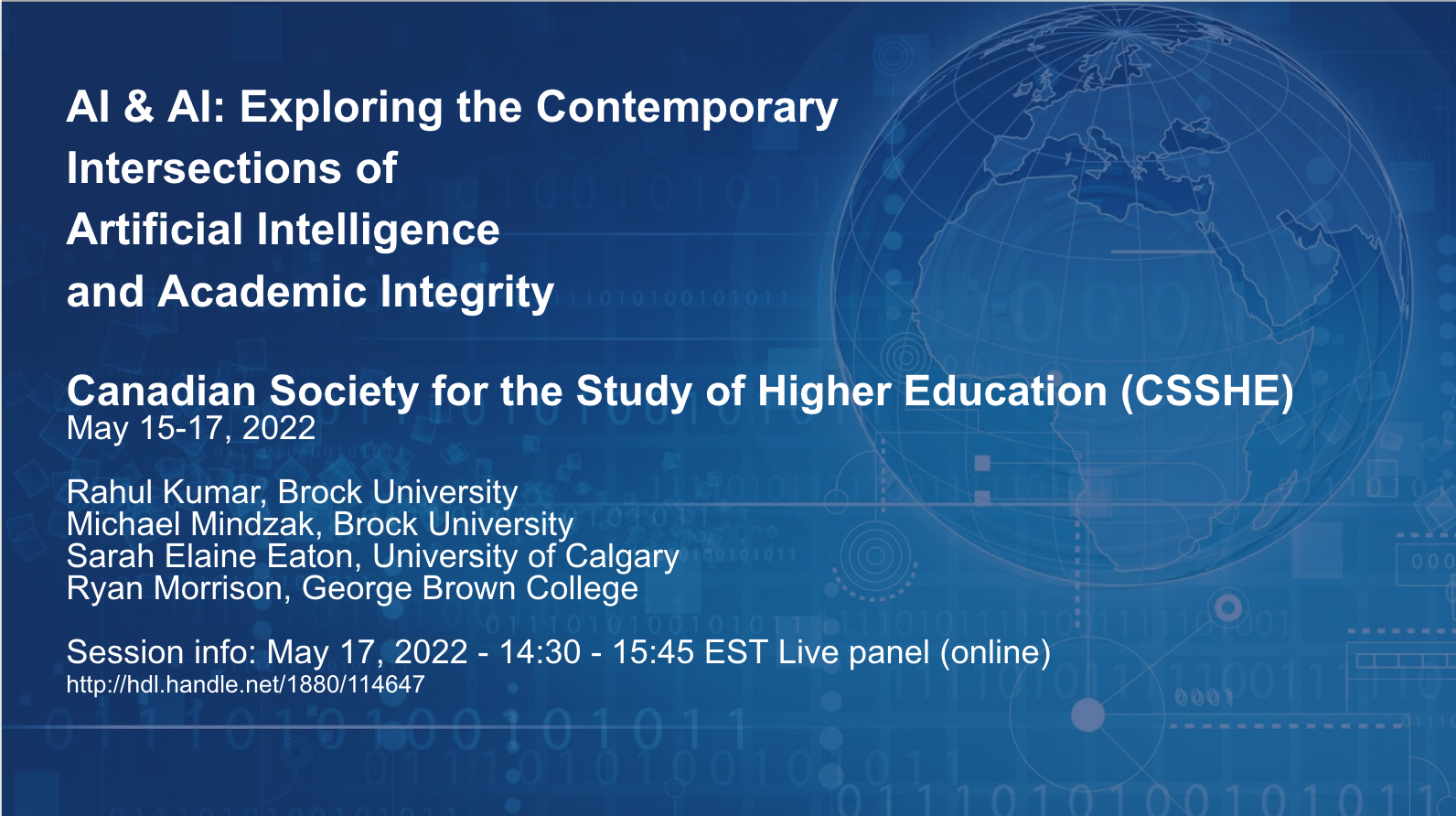
Title slide from CSSHE 2022 panel discussion: AI & AI: Exploring the contemporary intersections of artificial intelligence and academic integrity (Kumar, Mindzak, Eaton & Morrison)
For more than a year there have been small teams of us across Canada studying the impact of artificial intelligence on academic integrity. Today I am pleased to be part of a panel discussion on this topic at the annual conference of the Canadian Society for the Study of Higher Education (CSSHE), which is part of Congress 2022.
Our panel is led by Rahul Kumar (Brock University, Canada), together with Michael Mindzak (Brock University, Canada) and Ryan Morrison (George Brown College, Canada)
Here is the information about our panel:
Session G3: Panel: AI & AI: Exploring the Contemporary Intersections of Artificial Intelligence and Academic Integrity (Live, remote)
Panel Chair: Rahul Kumar
Rahul Kumar (Brock University): Ethical application with practical examples
Michael Mindzak (Brock University): Implications on labour
Ryan Morrison (George Brown College): Large language models: An overview for educators
Sarah Elaine Eaton (University of Calgary): Academic integrity and assessment
We have developed a combined slide deck for our panel discussion today. You can download the entire slide deck from the link noted in the citation below:
Kumar, R., Mindzak, M., Morrison, R., & Eaton, S. E. (2022, May 17). AI & AI: Exploring the contemporary intersections of artificial intelligence and academic integrity [online]. Paper presented at the Canadian Society for the Study of Higher Education (CSSHE). http://hdl.handle.net/1880/114647
This blog has had over 3 million views thanks to readers like you. If you enjoyed this post, please “like” it or share it on social media. Thanks!
Sarah Elaine Eaton, PhD, is a faculty member in the Werklund School of Education, and the Educational Leader in Residence, Academic Integrity, University of Calgary, Canada. Opinions are my own and do not represent those of the University of Calgary.
Our colleagues in Atlantic Canada have organized their first-ever event on academic integrity and contract cheating. If you can attend, please support them by registering and joining in. I have attached a poster you are welcome to circulate within your own networks. I have also included some of the content from the poster in this e-mail for convenience. I do not know the deadline to register, but I would encourage you to register as soon as possible so the organizers can plan accordingly. Please share this information with your networks.
Academic Integrity & Contract Cheating: Atlantic Canada Higher Education Forum
Wednesday, May 25, 2022
1:00 pm – 3:00 pm Atlantic Standard Time
Saint Mary’s University is hosting a virtual forum on academic integrity and contract cheating in the Atlantic Canadian region.
The forum will be led by members of academic staff with practical experience in the academic integrity process at their institutions. In addition to sharing knowledge and best practices, the conversation will address challenges and lessons learned from the pandemic and increased remote delivery of curriculum. The aim of the event is to begin to develop a shared framework of practice when it comes to increased student reliance on large-scale companies promoting and selling so-called ‘academic services’ to students.
To register for this event, please send an email to:
Marie Harding
marie.harding (at) smu.ca
An access link for the event will be sent to registered participants.
For information about this event, please contact:
Dr. Tatjana Takševa
Professor and Chairperson of the Saint Mary’s University Academic Senate
This blog has had over 3 million views thanks to readers like you. If you enjoyed this post, please “like” it or share it on social media. Thanks!
Sarah Elaine Eaton, PhD, is a faculty member in the Werklund School of Education, and the Educational Leader in Residence, Academic Integrity, University of Calgary, Canada. Opinions are my own and do not represent those of the University of Calgary.


 Posted by Sarah Elaine Eaton, Ph.D.


 Learning, Teaching and Leadership
You must be logged in to post a comment.