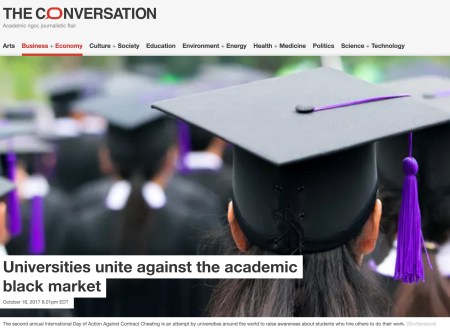
Universities unite against the academic black market

October 17, 2017

The ConversationOn the TV show Suits, Mike Ross’s character charges a hefty fee to students to take the LSAT (law school admission test) for them. Ross has a stellar memory and a remarkable ability to take tests without getting crushed by stress — he is the perfect “contract cheater.” Later, Ross builds a career as a lawyer based on fake credentials, presumably from Harvard.

Mike Ross may be fictional, but his business is only too real within universities globally. “Contract cheaters” such as Ross complete academic work on a student’s behalf — for a fee. This work includes test taking and homework services. It includes essay-writing and even PhD thesis-writing services, also known as “paper mills.”

In my role as interim associate dean of teaching and learning at the University of Calgary, and as a researcher who specializes in plagiarism prevention and academic integrity, I have been writing about contract cheating since 2010. Since then, it has become rampant at high school and post-secondary levels.

This black market for academic work is vast and little understood. Universities in Canada, and around the world, are having a very hard time trying to police it.

On Oct. 18, 2017, many universities have committed to the second International Day of Action Against Contract Cheating. This aims to tackle the issue head on — by raising awareness and sharing prevention strategies.

Read the whole article in The Conversation (originally published on Oct. 16, 2017).

Check out the radio interview I did on CBC: http://www.cbc.ca/listen/shows/calgary-eyeopener/segment/14438512

Related posts:

______________________________________________________

Share or Tweet this: Universities unite against the academic black market  http://wp.me/pNAh3-1YN

This blog has had over 1.8 million views thanks to readers like you. If you enjoyed this post, please “like” it or share it on social media. Thanks!

Sarah Elaine Eaton is a faculty member in the Werklund School of Education, University of Calgary, Canada.


2nd International Day of Action Against Contract Cheating

October 16, 2017
International Day of Action Against Contract Cheating: Graphic created by University of California at San Diego.

Graphic created by University of California at San Diego.

Contract cheating is an umbrella term used to talk about individuals or businesses that provide academic work for a fee. From imposters who take tests on behalf of others, to professional homework services and paper-writing services or “paper mills”, contract cheating is big business. This black market for academic work is becoming more prevalent, is hard to detect and harder to prove. No one knows exactly how many of these services exist, or how much money they make, but their very existence is troubling. Post-secondary educators, as well as those who aspire to a career in education, need to take action against contract cheating.

U of C logo - 2015In my role as Interim Associate Dean, Teaching and Learning at the Werklund School of Education, I have the chance to organize key events that bring people together over key issues related to teaching and learning in our school. When I heard about the 2nd International Day of Action Against Contract Cheating, I knew we had to join.

We’ll be hosting a Brown Bag Interactive Conversation for faculty and staff about what contract cheating is and what we can do about it. We’ll be sharing the Institutional Toolkit to Combat Contract Cheating and this 3-page handout that gives practical strategies on how to combat it.

More than 40 institutions from more than a dozen countries will be hosting events all over the world on October 18. I am so pleased that the University of Calgary will be among them.

We are using the hashtags #defeatthecheat and #excelwithintegrity on social media. Join the conversation on October 18!

______________________________________________________

Share or Tweet this: 2nd International Day of Action Against Contract Cheating http://wp.me/pNAh3-1Yn

This blog has had over 1.8 million views thanks to readers like you. If you enjoyed this post, please “like” it or share it on social media. Thanks!

Sarah Elaine Eaton is a faculty member in the Werklund School of Education, University of Calgary, Canada.


New article: Perceptions of ESL Program Management in Canadian Higher Education: A Qualitative Case Study

October 10, 2017

I’m pleased to share my latest article, which has been published in the International Journal of Learning, Teaching and Educational Research.

Abstract

ESL programs at post-secondary institutions must often generate revenue in addition to teaching students English. Institutions often impose explicit expectations on these programs to generate profit, creating unique challenges for those who administer them. This qualitative case study investigated challenges faced by ESL program directors at one university in Canada. Semistructured interviews were used to collect data from program directors (N = 3) on topics relating to administration, marketing, the mandate to generate revenue, and the complexities of ESL program legitimacy and marginalization in higher education contexts. Five key themes emerged from the data: (a) the necessity for directors to be highly qualified and multilingual, as well as have international experience; (b) a general lack of training, support, and resources for program directors; (c) institutional barriers such as working with marketers and recruiters with little knowledge of ESL contexts; (d) program fragmentation and marginalization on campus; and (e) reluctance to share information and program protectionism. Findings point to the need for increased training and support for ESL program directors, along with the need for institutions to elevate the profile of these programs so they are not viewed as having less value than other academic programs on campus.

Keywords: TESOL; TESL, ESL, EFL, language program management; administration; leadership; profit; revenue; marketing

Check out the full article here: https://www.ijlter.org/index.php/ijlter/article/view/980

______________________________________________________

Share or Tweet this: New article: Perceptions of ESL Program Management in Canadian Higher Education: A Qualitative Case Study https://wp.me/pNAh3-1Y8

This blog has had over 1.8 million views thanks to readers like you. If you enjoyed this post, please “like” it or share it on social media. Thanks!

Sarah Elaine Eaton is a faculty member in the Werklund School of Education, University of Calgary, Canada.


How to narrow down your research topic

September 17, 2017
Image courtesy of patrisyu at FreeDigitalPhotos.net

Image courtesy of patrisyu at FreeDigitalPhotos.net

One of the things novice and emerging researchers can struggle with is learning how to narrow down their research topic. Here are some resources that I’ve personally collected and curated to help you tackle this complex element of developing your research project. At the time of writing this post, all the links worked and none of these resources had pop-up ads, paywalls or require any kind of payment. These are freely available and should be widely accessible by students in most areas.

Written resources:

USC Libraries Research Guide – Organizing your social sciences research paper: Narrowing a Topic Idea – http://libguides.usc.edu/writingguide/narrowtopic

USU: Ways to Narrow Down a Topic – http://ocw.usu.edu/English/intermediate-writing/english-2010/-2010/narrowing-topics-skinless_view.html

Thompson Rivers University: How to Narrow Your Research Topic – https://www.tru.ca/__shared/assets/How_to_Narrow_Down_Your_Research_Topic30237.pdf

BYU LibGuide: Step-by-Step Guide & Research Rescue: Finding and Narrowing your Topic – http://guides.lib.byu.edu/c.php?g=216340&p=1428396

Temple University: Narrowing Your Topic from Subject to Thesis (1-page worksheet) – https://www.temple.edu/writingctr/support-for-writers/documents/NarrowingYourTopicfromSubjecttoThesis-Worksheet.pdf

Starting a PhD: Choosing and Developing Your Research Topic – https://100thousandwords.wordpress.com/2010/10/18/starting-a-phd-%E2%80%93-choosing-and-developing-your-research-topic/

U Penn: Plain Talk About Your Dissertation Proposal – http://www.ling.upenn.edu/advice/green_proposal.html

You Tube videos:

Kansas State University Libraries: How to Develop a Good Research Topic – https://youtu.be/nXNztCLYgxc

M. Moilanen: Now to Narrow Down your Research Topic – https://youtu.be/EcYgNV_nQjk

Laurentian University: Narrowing Your Topic – https://youtu.be/JYYQTSXq6RI

Amanda Dinscore: Narrowing Your Topic – https://youtu.be/J1eVTf974R4

Steely Library NKU: Developing a Research Question – https://youtu.be/LWLYCYeCFak

Check out these related posts on this blog:

5 Websites to avoid referencing in your research papers  http://wp.me/pNAh3-1IA

12 Phrases to Avoid in Your Academic Research Papers http://wp.me/pNAh3-1JX

Why APA formatting matters http://wp.me/pNAh3-1Hc

How many sources do you need in a literature review? http://wp.me/pNAh3-1Hu

What’s the difference between a citation and a reference? http://wp.me/pNAh3-1F9

Why “as cited in” should be avoided in academic writing http://wp.me/pNAh3-1BH

10 Great writing resources for grad students – http://wp.me/pNAh3-1Bc

How to create a research paper outline: 5 great resources http://wp.me/pNAh3-1y6

Conceptual and Theoretical Frameworks for Educational Research https://wp.me/pNAh3-1Za

______________________________________________________

Share or Tweet this: How to narrow down your research topic http://wp.me/pNAh3-1Xf

This blog has had over 1.8 million views thanks to readers like you. If you enjoyed this post, please “like” it or share it on social media. Thanks!

Sarah Elaine Eaton is a faculty member in the Werklund School of Education, University of Calgary, Canada.


Developing a Work Plan for Your Thesis

September 11, 2017

Sarah Eaton blog technology researchIn one of the graduate level courses I teach, students learn to develop a proposal for their thesis. One of the elements we talk about has nothing at all to do with the content or format of the proposal (both of which are important). It is developing a work plan for the proposal. I tell my students that in turn, the proposal work plan can be expanded upon and adapted to develop a work plan for your thesis.

Elements to include in a work plan are:

A weekly schedule, preferably aligned with the dates of your term. For example, a work plan for a 12-week semester would start with the first week of classes and end with the final week of classes.

Concrete tasks to do each week. “Read” is not a concrete task; it is a vague one. “Download and read 5 peer-reviewed articles in my topic area” is a concrete task.

Build in time to do drafts of your work. Neither a thesis, nor a proposal can be written at the eleventh hour. Building in time to outline and draft the work is crucial.

Be realistic. If you have a major life event happening in the middle of the semester, develop your work plan around that event. (For example, don’t plan on doing a significant amount of work if you or your partner is having a baby in week seven of the semester.)

Here are some of my favourite resources that I recommend to my students:

http://juxi.net/studies/SpaceMaster/Thesis/workplan.pdf

http://www.ed.ac.uk/files/atoms/files//pdpfinal_web_march_2015.pdf

http://www.sciencemag.org/careers/2002/07/writing-research-plan

http://ebeit.mandela.ac.za/ebeit/media/Store/documents/Research%20Guidelines/TopicAndTitle/Example-of-Project-Plan-for-Research-Project.pdf

Some of these resources need to be adapted to fit a proposal, rather than an entire thesis. Their usefulness likes in helping you to conceptualize and develop your own work plan, customized to your project.

Learning how to manage your available time and knowing what you have to accomplish in a finite amount of time can help you chuck out your work into more manageable pieces. Having a week-by-week plan, that you construct yourself, can help you stay on track and meet your goals.

____________________________________________________

Share this post: Developing a Work Plan for Your Thesis https://wp.me/pNAh3-1X3

This blog has had over 1.8 million views thanks to readers like you. If you enjoyed this post, please “like” it or share it on social media. Thanks!

Sarah Elaine Eaton is a faculty member in the Werklund School of Education, University of Calgary, Canada.