21st century definition of plagiarism

January 23, 2018

Not long after I started getting interested in academic integrity, I began wondering how different universities defined plagiarism in their official policy documents. That led me to do an analysis of policy documents from 20 Canadian higher education institutions, and the results were published in the peer-reviewed scholarly journal, Interchange. Basically, what I found was that there was no consistent definition of plagiarism across Canadian post-secondary institutions. In other words, we don’t agree about what actually constitutes plagiarism.

This makes it confusing for students and for professors, especially considering that students might attend one school to do their undergraduate degree and another for their graduate degree, or that professors sometimes change jobs, leaving one institution for another.

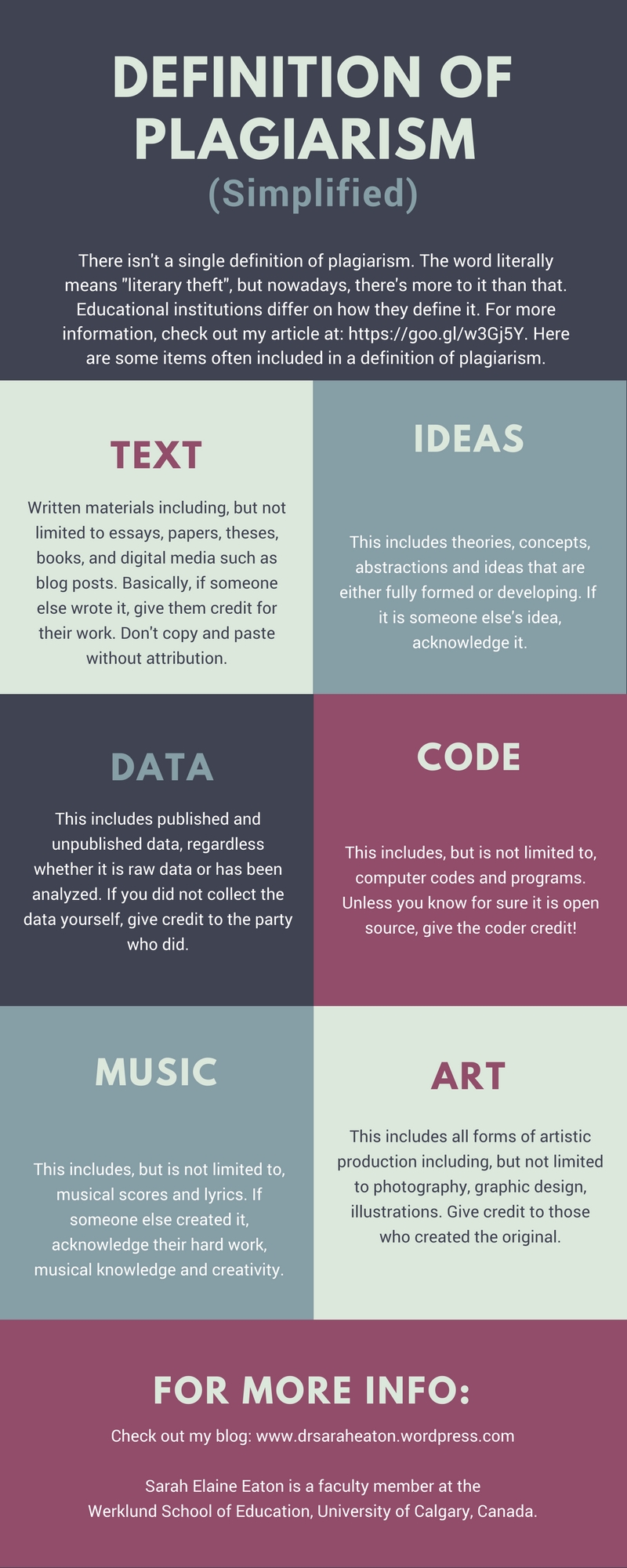
It used to be that the definition of plagiarism was simple: literary theft, but it is a lot more complicated than that in the 21st century, where digital outputs account for as much, if not more than, printed products. Students and professors have asked me, “So, how do you define plagiarism in plain and simple terms?” The answer is actually quite complex and a bit messy. But in the interest of demystifying the issue, here is a straight forward infographic that may help.

Let me say that this resource is simplified — perhaps overly so. My goal here isn’t to be reductionist and I fully acknowledge that not everyone may agree with these simplified explanations. But sometimes it can be easier to wrap your head around something simple to start and then tease out the complexities once you are more comfortable with the basic concepts.  I offer these not as the be-all-and-end-all definition, but rather as a starting point to help educators and students clarify and demystify basic concepts and also to engage in productive conversations about how to cultivate academic integrity and reduce plagiarism.

Definition of plagiarism (jpg)

Here is a free, downloadable .pdf of this infographic that you are welcome to use with your students for teaching purposes. Feel free to use it as a conversation starter to help students understand what plagiarism is and how to prevent it in their own work.

Related post:

Comparative Analysis of Institutional Policy Definitions of Plagiarism: A Pan-Canadian University Study https://wp.me/pNAh3-1LD

______________________________________________________

Share or Tweet this: 21st century definition of plagiarism https://wp.me/pNAh3-2eo

This blog has had over 1.8 million views thanks to readers like you. If you enjoyed this post, please “like” it or share it on social media. Thanks!

Sarah Elaine Eaton is a faculty member in the Werklund School of Education, University of Calgary, Canada.


Formal, Non-formal and Informal Learning (Infographic)

January 16, 2018

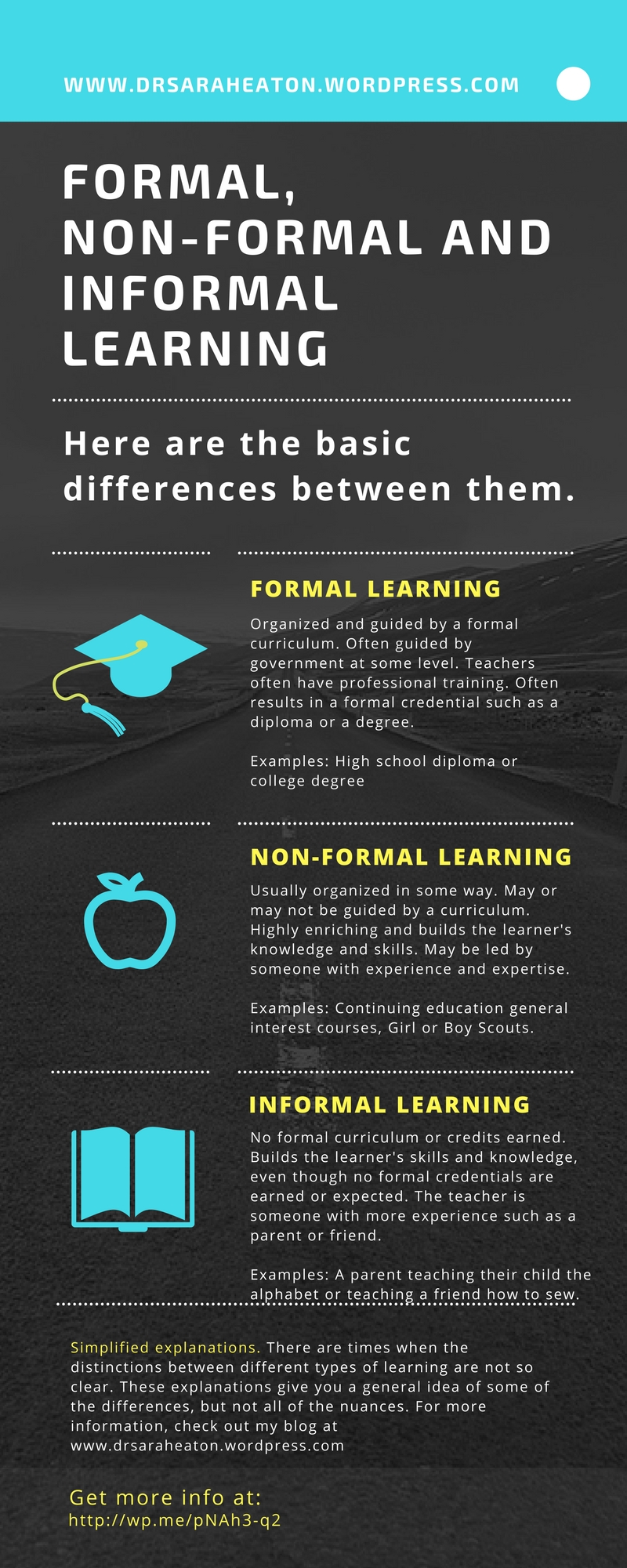
A few years ago I started exploring the differences between formal, non-formal and informal learning. The result was a couple of research reports and blog posts, including this one which has been viewed over 250,000 times. For those who like their information in bite-sized pieces, here is a quick synopsis of some of the key points for you in a handy infographic:

Formal, non-formal and informal learning.jpg

Here’s a free, downloadable .pdf of this infographic that you can use for your own research or teaching purposes: Formal, non-formal and informal learning.compressed

It is important to note that this infographic is intended to give a quick snapshot of some of the most basic differences. A quick snapshot like this gives you a quick picture, but not the whole picture. There are more differences than what one infographic can show. Also, the lines between formal, non-formal and informal learning can be blurry sometimes. Understanding the differences deeply will probably require more reading. To help you learn more, I’ve included a number of other posts, some of which link to full-length reports.

Check out these related posts:

______________________________________________________

Share or Tweet this: Formal, Non-formal and Informal Learning (Infographic) https://wp.me/pNAh3-266

This blog has had over 1.8 million views thanks to readers like you. If you enjoyed this post, please “like” it or share it on social media. Thanks!

Sarah Elaine Eaton is a faculty member in the Werklund School of Education, University of Calgary, Canada.


Avoiding Predatory Journals and Questionable Conferences: A Resource Guide

January 9, 2018
Cover art - Avoiding Predatory Journals and Questionable Conferences

Download a copy of the full report for free from the University of Calgary: https://prism.ucalgary.ca/handle/1880/106227

Not long ago, a graduate student was lured in by a conference in his precise field of study and wrote to me to let me know of his acceptance. I had never heard of the conference. I had never even come across the name of it in passing. I have worked in higher education for almost a quarter of a century and I’ve heard of many legitimate and credible conferences in my field, so I became skeptical.

I asked numerous colleagues, as well as our resident librarian. No one else had heard of the conference either. Kudos to our education librarian at the University of Calgary,  since he went to significant effort to determine if the conference was legitimate. In the end, we decided that it was not a wise use of the student’s money or time.

As a result of that experience, I started investigating the topic of predatory conferences and journals in more depth. I started this guide thinking of other graduate students and junior academics who might be at risk of being seduced into spending valuable resources on taking part, while doing nothing to advance their own learning, professional development, scholarly experience or reputation. The stakes are high for academics and the pressure to produce can be overwhelming at times. This guide is intended to help scholars make wise decisions about how to spend their time, money and resources, while simultaneously protecting and preserving their professional reputation.

The goal of this guide is to provide a clear overview of the topics of predatory journals and questionable conferences and advice on how to avoid them. This guide intentionally adopts a plain language approach to ensure it is accessible to readers with a variety English language proficiency levels.

Download a copy of the full report for free from the University of Calgary: https://prism.ucalgary.ca/handle/1880/106227

______________________________________________________

Share or Tweet this: Avoiding Predatory Journals and Questionable Conferences: A Resource Guide https://wp.me/pNAh3-26x

This blog has had over 1.8 million views thanks to readers like you. If you enjoyed this post, please “like” it or share it on social media. Thanks!

Sarah Elaine Eaton is a faculty member in the Werklund School of Education, University of Calgary, Canada.


Understanding Language Register

January 2, 2018

A few years ago I wrote a post on language register. It has become one of the most popular and often viewed posts on my blog. It is a long and fairly involved post, so for those who like their information in bite-sized pieces, here is a quick synopsis for you in the form of an infographic:

Language ReGISTER

It is important to understand the differences between registers so you can use language that is appropriate for a particular situation. If your register is too high, you may come across as being snobby, pretentious or arrogant. If your register is too low, you can come across as being inappropriately informal or too friendly.

It is not only English language learners who need to understand the difference between registers, but native speakers do too. One of the things I have observed in my work as a professor is that students sometimes write in a register that is too casual. Sometimes students do this because they do not want to come across as “stuffy” or pretentious. But casual writing in academic and professional papers can backfire. Writing that is overly casual is often not considered professional or terribly credible by the reader. It is important for students, professionals, scientists and academics to know the formal register for writing papers, theses and reports.

Here’s a free .pdf of this infographic that you can use for your own research or teaching purposes: Language Register (.pdf).

Check out these related posts:

Teaching formal and informal language register to native speakers of English http://wp.me/pNAh3-jV

Language Register and Why It Matters (Or: Why You Can’t Write An Academic Paper in Gangsta Slang) http://wp.me/pNAh3-1pr

______________________________________________________

Share or Tweet this: Understanding Language Register https://wp.me/pNAh3-25U

This blog has had over 1.8 million views thanks to readers like you. If you enjoyed this post, please “like” it or share it on social media. Thanks!

Sarah Elaine Eaton is a faculty member in the Werklund School of Education, University of Calgary, Canada.


New article: “Credit where credit is due”

December 19, 2017

Credit where credit is due - coverIn my latest article, “Credit where credit is due: How to prevent plagiarism in the 21st century classroom” I tackle the tricky question of what it means to plagiarize in the age of copy-and-paste. I also offer K-12 teachers five practical tips on how to prevent plagiarism among school-age children.

Most of my research and writing is focusing more and more on academic integrity and plagiarism prevention in higher education contexts. But it is important for K-12 teachers to be able to talk about these topics to their students, too. That’s what inspired me to write this article.

The full article was published by the EdCan Network and it is a web exclusive in their most recent edition. You can check it out here: https://www.edcan.ca/articles/credit-where-credit-is-due/

______________________________________________________

Share or Tweet this: New article: “Credit where credit is due”

This blog has had over 1.8 million views thanks to readers like you. If you enjoyed this post, please “like” it or share it on social media. Thanks!

Sarah Elaine Eaton is a faculty member in the Werklund School of Education, University of Calgary, Canada.