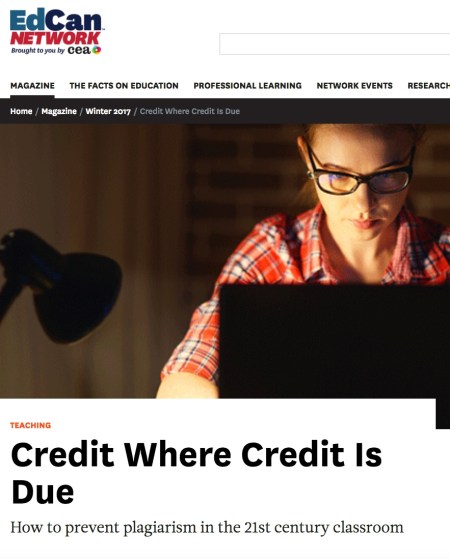
New article: “Credit where credit is due”

December 19, 2017

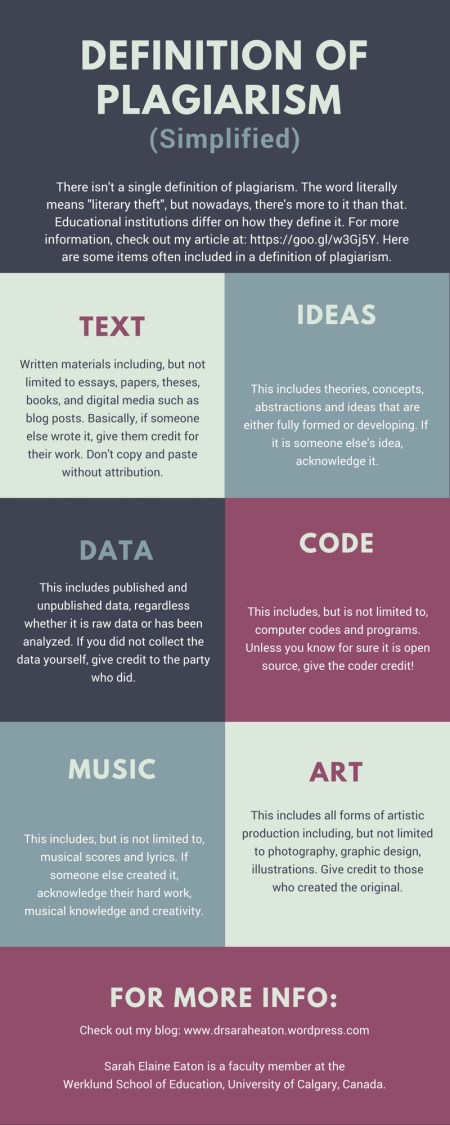
Credit where credit is due - coverIn my latest article, “Credit where credit is due: How to prevent plagiarism in the 21st century classroom” I tackle the tricky question of what it means to plagiarize in the age of copy-and-paste. I also offer K-12 teachers five practical tips on how to prevent plagiarism among school-age children.

Most of my research and writing is focusing more and more on academic integrity and plagiarism prevention in higher education contexts. But it is important for K-12 teachers to be able to talk about these topics to their students, too. That’s what inspired me to write this article.

The full article was published by the EdCan Network and it is a web exclusive in their most recent edition. You can check it out here: https://www.edcan.ca/articles/credit-where-credit-is-due/

______________________________________________________

Share or Tweet this: New article: “Credit where credit is due”

This blog has had over 1.8 million views thanks to readers like you. If you enjoyed this post, please “like” it or share it on social media. Thanks!

Sarah Elaine Eaton is a faculty member in the Werklund School of Education, University of Calgary, Canada.


Reading aloud as a strategy to improve your writing

December 1, 2017

iStock-woman at laptopOne strategy to improve the quality of your writing is to read it aloud. I’ve been doing this for years.

According to the Writing Center at University of California at Chapel Hill, reading out loud means your brain gets information in a different way. You can literally hear your errors! You can find awkward constructions or sentences that are too long, for example. You can also find words that are repeated or just do not sound right.

When I read aloud I will often print out a copy of my work first. That allows me to make quick edits and notes on the page as I go. If something sounds off, I pause, make a note on my paper, then carry on reading the work aloud.

Sometimes when I recommend this strategy to my students, they tell me they feel silly reading their own work out loud. They don’t want others in their work place or household to think they are being pretentious or too eccentric. If this is the case, go find a quiet place where you can be alone.

Another important factor is to give yourself enough time to read aloud, especially if your paper is long. You may find that you prefer to read one section at a time, taking a break in between. It can also be helpful to have a glass of water nearby.

I recommend to each of you that as you revise your term paper, thesis, report or whatever you are writing at the moment that read your own work out loud (just like I did with this blog post). You’ll be surprised how much better the final product is.

References

The Writing Center at University of California at Chapel Hill. (n.d.). Reading aloud.   Retrieved from https://writingcenter.unc.edu/tips-and-tools/reading-aloud/

Writing Center at John Carroll University. (n.d.). Why We Ask to Read The Paper Aloud.   Retrieved from https://jcuwritingcenter.wordpress.com/2017/02/17/why-we-ask-to-read-the-paper-aloud/

______________________________________________________

Share or Tweet this: Reading aloud as a strategy to improve your writing https://wp.me/pNAh3-24r

This blog has had over 1.8 million views thanks to readers like you. If you enjoyed this post, please “like” it or share it on social media. Thanks!

Sarah Elaine Eaton is a faculty member in the Werklund School of Education, University of Calgary, Canada.


Understanding academic misconduct: Special event

November 21, 2017

University of Calgary logoIn my role as Interim Associate Dean, Teaching and Learning for the Werklund School of Education at the University of Calgary, I am pleased announce we will welcome Dr. Julia Christensen Hughes to our campus for a special visit on November 24, 2017.

We have two events that are open to the public that I wanted to share with all of you:

Lunchtime Keynote: Understanding academic misconduct: Creating robust cultures of integrity

Time: 12:00 pm – 1:00 pm

Location: University of Calgary, Taylor Institute Forum

This keynote will draw from Christensen Hughes’s research with the late Don McCabe, founder of the International Center for Academic Integrity. Their work was published in 2006 the Canadian Journal of Higher Education (see http://journals.sfu.ca/cjhe/index.php/cjhe/article/view/183537 and http://journals.sfu.ca/cjhe/index.php/cjhe/article/view/183525), and they were awarded with the Sheffield Award from the Canadian Society for Studies in Higher Education (CSSHE) for their contribution.

Afternoon workshop: Strengthening a culture of integrity at the University of Calgary

Time: 3:00 pm – 4:00 pm

Location: University of Calgary, Taylor Institute Forum

This workshop will provide a deeper analysis of why academic misconduct is happening on Canadian university campuses, including from the perspectives of faculty and TAs. Working in groups, participants will discuss their experience at the University of Calgary and generate specific suggestions for what the University might do to strengthen its culture of integrity.

About Dr. Julia Christensen Hughes

jch-colour-photoDr. Julia Christensen Hughes is Dean of the College of Business and Economics (CBE) at the University of Guelph. With a career defined by advocacy, Julia has addressed the United Nations General Assembly on the need for business schools to contribute to advancing the UN’s sustainable development goals, including quality education. Previously, Julia served as President of the Society for Teaching and Learning in Higher Education, a predominantly Canadian organization committed to enhancing the quality of teaching and learning in post-secondary institutions. During this same time, she served as the Director of Teaching Support Services at the University of Guelph.

Julia Christensen Hughes’s scholarly work includes the edited book, Taking Stock: Research on Teaching and Learning in Higher Education (2010), McGill-Queen’s University Press. She has also written on ethics and integrity in the academy, with papers published in the Canadian Journal of Higher Education. Julia has received a number of awards and recognitions, including the Gold “educator” award from the Ontario Hostelry Institute (OHI); the Sheffield Award from the Canadian Society for the Study of Higher Education, for excellence in research; the University of Guelph’s John Bell Award, for distinguished educational leadership; and the “Woman of Distinction Award” from the Guelph YMCA, for outstanding contributions to education and training.

These events are open to all members of the campus community and the public.

______________________________________________________

Share or Tweet this: Understanding academic misconduct: Special event https://wp.me/pNAh3-22q

This blog has had over 1.8 million views thanks to readers like you. If you enjoyed this post, please “like” it or share it on social media. Thanks!

Sarah Elaine Eaton is a faculty member in the Werklund School of Education, University of Calgary, Canada.


Conceptual and Theoretical Frameworks for Educational Research

October 30, 2017

Sarah Eaton blog technology researchIn my experience it is not uncommon for graduate students to struggle to figure out how to develop a conceptual or theoretical framework for their thesis or capstone project.

Here’s a list of resources that may help you do just that. I have developed this list with educational research in mind. Some of the resources are from other fields, but may have strong transferability to educational research contexts. Conversely, researchers from other fields may find the resources in this list helpful.

I have curated resources that are, in my opinion, high quality and relevant to those working in post-secondary research context. I have tried to include resources that are publicly accessible and available free of charge. I have excluded resources that seemed to be (again, in my opinion) overly brief or were being sold for profit.

Remember, if you are looking for sources to cite in your research paper or dissertation, scholarly journal articles and book chapters are often preferable to other kinds of resources because they are considered more credible. If you are just trying to wrap your head around the basics, any of these resources might help you.

Web-based resources

Clarke, R. (2011). Conceptual framework basics.   Retrieved from https://youtu.be/vxA43z4B1ao

Kesterson, T. (2013). Developing Conceptual Framework: Part 1.   Retrieved from https://youtu.be/HrbL508aG4k

Maxwell, J. A. (2005). Conceptual framework: What do you think is going on? Qualitative research design: An interactive approach (3rd. ed., pp. 39-72): Sage. Retrieved from: http://www.sagepub.com/sites/default/files/upm-binaries/48274_ch_3.pdf

Metha, R. S. (2013). Theoretical and Conceptual Framework as Blue Print of a House.   Retrieved from https://www.slideshare.net/rsmehta/conceptual-and-theoretical-framework

Schneider, D. K. (2005). The research plan and conceptual frameworks.   Retrieved from https://tecfa.unige.ch/guides/methodo/edu-tech/slides/res-design-intro.pdf

Sitko, N. J. (2013). Designing a qualitative research project: Conceptual framework and research questions.   Retrieved from http://fsg.afre.msu.edu/zambia/Conceptual_Framework_and_Research_Questions.pdf

Thompson, C. J. (2017). How to use a theory to frame your research study.   Retrieved from https://nursingeducationexpert.com/theory-frame-research/

Scholarly journal articles and book chapters

If you cannot find these articles easily, contact your local librarian. Often librarians can help you access legitimate copies of materials free of charge if you are having difficulty finding them.

Green, H. E. (2014). Use of theoretical and conceptual frameworks in qualitative research. Nurse Researcher, 21(6), 34-38. doi:10.7748/nr.21.6.34.e1252

Imenda, S. (2014). Is There a Conceptual Difference between Theoretical and Conceptual Frameworks? Sosyal Bilimler Dergisi/Journal of Social Sciences, 38(2), 185-195.

Jabareen, Y. (2009). Building a conceptual framework: Philosophy, definitions, and procedure International Journal of Qualitative Methods, 8(4), 49-62. Retrieved from https://journals.library.ualberta.ca/ijqm/index.php/IJQM/article/viewFile/6118/5892

Pearson Casanave, C., & Li, Y. (2013). Novices’ struggles with conceptual and theoretical framing in writing dissertations and papers for publication. Publications, 3(2), 104-119. Retrieved from https://doaj.org/article/227a9233d0d54cfeb08379902fbc0827 doi:10.3390/publications3020104

Saunders, M., N.K., Gray, D. E., Tosey, P., & Sadler-Smith, E. (2015). Concepts and theory building. In L. Anderson, J. Gold, J. Stewart, & R. Thorpe (Eds.), A Guide to Professional Doctorates in Business and Management (pp. 35-56). London: Sage.

Related posts:

How to narrow down your research topic http://wp.me/pNAh3-1Xf

Developing a Work Plan for Your Thesis https://wp.me/pNAh3-1X3

What if you’re wrong? A question for researchers http://wp.me/pNAh3-1Vq

______________________________________________________

Share or Tweet this: Conceptual and Theoretical Frameworks for Educational Research https://wp.me/pNAh3-1Za

Update – January, 2018 – This blog has had over 1.8 million views thanks to readers like you. If you enjoyed this post, please “like” it or share it on social media. Thanks!

Sarah Elaine Eaton is a faculty member in the Werklund School of Education, University of Calgary, Canada.


Universities unite against the academic black market

October 17, 2017

The ConversationOn the TV show Suits, Mike Ross’s character charges a hefty fee to students to take the LSAT (law school admission test) for them. Ross has a stellar memory and a remarkable ability to take tests without getting crushed by stress — he is the perfect “contract cheater.” Later, Ross builds a career as a lawyer based on fake credentials, presumably from Harvard.

Mike Ross may be fictional, but his business is only too real within universities globally. “Contract cheaters” such as Ross complete academic work on a student’s behalf — for a fee. This work includes test taking and homework services. It includes essay-writing and even PhD thesis-writing services, also known as “paper mills.”

In my role as interim associate dean of teaching and learning at the University of Calgary, and as a researcher who specializes in plagiarism prevention and academic integrity, I have been writing about contract cheating since 2010. Since then, it has become rampant at high school and post-secondary levels.

This black market for academic work is vast and little understood. Universities in Canada, and around the world, are having a very hard time trying to police it.

On Oct. 18, 2017, many universities have committed to the second International Day of Action Against Contract Cheating. This aims to tackle the issue head on — by raising awareness and sharing prevention strategies.

Read the whole article in The Conversation (originally published on Oct. 16, 2017).

Check out the radio interview I did on CBC: http://www.cbc.ca/listen/shows/calgary-eyeopener/segment/14438512

Related posts:

______________________________________________________

Share or Tweet this: Universities unite against the academic black market  http://wp.me/pNAh3-1YN

This blog has had over 1.8 million views thanks to readers like you. If you enjoyed this post, please “like” it or share it on social media. Thanks!

Sarah Elaine Eaton is a faculty member in the Werklund School of Education, University of Calgary, Canada.