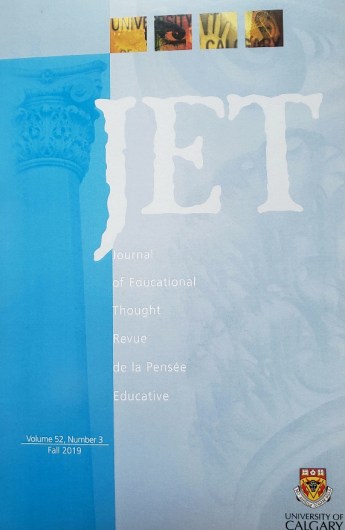
Journal of Educational Thought: Special Issue on Academic Integrity and Ethics

January 14, 2020

JET Cover 52(3)I am so pleased to share that the special issue of the Journal of Educational Thought dedicated to academic integrity and ethics is now out. I am excited about this work because it adds to the growing body of scholarly and research literature on these important topics, not only in Canada, but globally, too.

I was the guest Co-Editor for this special issue, together with the journal’s editor-in-chief, Ian Winchester.

Here’s an overview of what’s in the issue:

Editorials

Winchester, I. (2019). Academic integrity in the university. Journal of Educational Thought, 52(3), 187-190.

Eaton, S. E. (2019). Considerations of corruption, ethics and integrity in educational contexts: Guest editorial. Journal of Educational Thought, 52(3), 191-192.

Research articles

Lock, J., Schroeder, M., & Eaton, S. E. (2019). Designing and implementing an online academic integrity tutorial: Identifying the challenges within a post-secondary context. Journal of Educational Thought, 52(3), 193-208.

Lancaster, T., Glendinning, I., Foltýnek, T., Dlabolová, D., & Linkeschová, D. (2019). The perceptions of higher education students on contract cheating and educational corruption in South East Europe. Journal of Educational Thought, 52(3), 209-227.

Henry, R., & Gabel, C. (2019). “It’s not just a picture when lives are at stake: Ethical considerations and photovoice methods with Indigenous Peoples engaged in street lifestyles”. Journal of Educational Thought, 52(3), 229-252.

Miron, J. B. (2019). Academic integrity in a student practice environment: An elicitation study. Journal of Educational Thought, 52(3), 253-273.

All of the research articles underwent double-blind peer review.

______________________________________________________

Share or Tweet this: Journal of Educational Thought: Special Issue on Academic Integrity and Ethics

This blog has had over 2 million views thanks to readers like you. If you enjoyed this post, please “like” it or share it on social media. Thanks!

Sarah Elaine Eaton is a faculty member in the Werklund School of Education, and the Educational Leader in Residence, Academic Integrity, University of Calgary, Canada. Opinions are my own and do not represent those of the University of Calgary.


Academic Integrity: Resource for Teaching Assistants

September 16, 2019
Academic Integrity resource for teaching assistants

Academic Integrity resource for teaching assistants

As a Teaching Assistant (TA) it can be tricky to know what your responsibilities are if you suspect or observe academic misconduct. This resource is intended to help both TAs and course instructors about the roles and responsibilities teaching assistants play in upholding academic integrity at the University of Calgary.

Teaching assistants are responsible for acting with integrity, maintaining the privacy of all parties involved and reporting any suspected or actual cases of academic misconduct to the course instructor. TAs are not responsible for confronting student(s) who may be allegedly responsible for academic misconduct and nor are they responsible for imposing sanctions (discipline). It is the responsibility of the course instructor to follow the guidelines established by their faculty for responding to allegations of academic misconduct.

Open communication between course instructors and teaching assistants is key. Establishing expectations early in the term, before issues might arise can be very helpful for teaching assistants.

It is important for teaching assistants to know they are not alone when it comes to upholding academic integrity.

This one-page tip sheet is intended as a suggested guideline to help teaching assistants figure out what to do if they encounter or suspect a breach of academic integrity. This handout is not exhaustive and it may not cover all situations. This resource was developed specifically for teaching assistants at the University of Calgary and may not apply to TAs at other institutions.

Here is a link to this free and downloadable .pdf resource: U Have Integrity: Resource for Teaching Assistants.

Here is the text of the .pdf for anyone wanting a quick read:

As a teaching assistant it can be tricky to know what your responsibilities are if you suspect or observe academic misconduct. This resource is intended as a suggested guideline about what to do in such situations in your role as a teaching assistant (TA). This resource may not cover all situations, but in can serve as a starting point. 

What to do 

  • Familiarize yourself with the University of Calgary Student Academic Misconduct Policy and Procedure. 
  • Familiarize yourself with the resources and services offered by the Student Success Centre about academic integrity. 
  • Start a conversation with your course instructor at the beginning of the term about what they expect from you in terms of upholding integrity in your role. It is a good idea to do this before you undertake your work so both parties have clear expectations. 
  • Act as a role model for academic integrity. 
  • Discuss any alleged or actual breaches of integrity with the course instructor. 
  • Gather evidence related to the alleged misconduct. Keep detailed notes of the incident, including dates and times, who was involved, etc. Provide this information to the course instructor. 
  • Remember that learning how to address academic misconduct is part of your training as a teaching assistant, but you are not alone! 

What to avoid 

  • Do not keep the incident a secret (even if the student asks you to). Talk to the course instructor. 
  • Do not discuss the matter with any other teaching assistants, students, etc. 
  • Do not confront a student. It is the role of the course instructor to address alleged or actual academic misconduct with the student(s) involved. 
  • Do not impose any sanctions (punishments) on your own. The course instructor (not the TA) is responsible for following the guidelines established within the faculty about how to address actual or suspected cases of academic misconduct. 
  • Do not share details (even if they are de-identified) on social media, even in closed or private groups.

Related posts:

______________________________________________________

Share or Tweet this: Academic Integrity: Resource for Teaching Assistants https://wp.me/pNAh3-2oQ

This blog has had over 2 million views thanks to readers like you. If you enjoyed this post, please “like” it or share it on social media. Thanks!

Sarah Elaine Eaton is a faculty member in the Werklund School of Education, and the Educational Leader in Residence, Academic Integrity, University of Calgary, Canada. Opinions are my own and do not represent those of the University of Calgary.


Multilingual essay mills – New article

August 6, 2019

Notos coverMy colleague, Roswita Dressler and I have just had a new paper published. It all started when I was at an academic integrity conference a couple of years back. I was sitting next to a colleague who works in a language other than English (LOTE). The colleague suggested that contract cheating (e.g. essay mills and other forms of outsourced academic work) was a problem of the English-speaking world, asserting that there simply wouldn’t be enough of a market in other languages.

I thought to myself, “Challenge accepted!” I recruited Roswita Dressler to help me undertake a small-scale pilot study. We both have a background in language teaching and between us, we have some level of proficiency in about four languages. We were also curious about the market for academic outsourcing for younger audiences, in elementary, middle and high school.


The questions that guided our project were:

  1. What evidence exists that online providers offer academic work in languages other than English?
  2. To what degree are K-12 students targeted by these online providers?

We framed our study specifically within the Canadian context.

Our results showed that not only do commercial contract cheating companies market to specifically to students in Canada, they target children as young as Grade six (approximately 11-12 years old). And yes, we found strong evidence that contract cheating happens in languages other than English (ten of them, in fact).

To the best of our knowledge, this is the first study on contract cheating published in Canada.

The Alberta Teachers Association is the publisher and copyright holder of this article. They have given us permission to post the article in our university’s digital repository. You can access a copy of it free of charge from here:

Eaton, S. E., & Dressler, R. (2019). Multilingual essay mills: Implications for second language teaching and learning. Notos, 14(2), 4-14. Retrieved from http://hdl.handle.net/1880/110695

______________________________________________________

Share or Tweet this: Multilingual essay mills – New article

This blog has had over 2 million views thanks to readers like you. If you enjoyed this post, please “like” it or share it on social media. Thanks!

Sarah Elaine Eaton is a faculty member in the Werklund School of Education, University of Calgary, Canada. Opinions are my own and do not represent those of the Werklund School of Education or the University of Calgary.


Contract cheating: A view from three Calgary post-secondary institutions

May 24, 2019

LSAC - (Cover slide) Rossi, Eaton, Toye & Chibry

So excited to be presenting with my colleagues, Silvia Rossi (Mount Royal University), Maragaret A. Toye (Bow Valley College) and Nancy Chibry (University of Calgary) next week at the Learning Specialists Association of Canada national conference in Olds, Alberta. I am excited that sessions on contract cheating are getting accepted at national conferences in Canada. To the best of my knowledge this will be the first time that contract cheating will be talked about at this particular conference.

Check out our slides on Slideshare:

Handouts:

How to cite this presentation (APA, 6th ed.):

Rossi, S., Eaton, S. E., Toye, M. A., & Chibry, N. (2019, May 27). Contract cheating: A view from three Calgary post-secondary institutions. Paper presented at the Learning Specialists Association of Canada (LSAC) National Conference, Olds, AB.

Related posts:

______________________

Share or Tweet this: Contract cheating: A view from three Calgary post-secondary institutions https://wp.me/pNAh3-2nm

This blog has had over 2 million views thanks to readers like you. If you enjoyed this post, please “like” it or share it on social media. Thanks!

Sarah Elaine Eaton is a faculty member in the Werklund School of Education, University of Calgary, Canada. Opinions are my own and do not represent those of the Werklund School of Education or the University of Calgary.


Canadian Symposium on Academic Integrity: Archive of Sessions

May 7, 2019

CSAI logo copy

I am pleased to share this digital archive of materials and artefacts from the Canadian Symposium on Academic Integrity, which took place April 17-18, 2019 at the University of Calgary

The program contains the full schedule from the 1.5-day event, along with information on the keynote and feature sessions; 23 peer-reviewed papers; 5 posters; and 3 interactive workshops. Unlike other programs that include only a schedule and brief description, our program also includes full abstracts for each presentation, making this a useful artefact from the conference that serves to document the topics discussed and the research occurring across Canada on various topics related to academic integrity.

The slide decks archived here are shared with the permission of the author(s). We have only posted those we received permission to share, so it is not a complete list as some authors opted not to share their slides.

We are grateful to everyone who presented and shared their knowledge at the symposium. We also offer our thanks to colleagues at the University of Calgary Library and Cultural Resources who took the time to post these materials in our institutional digital repository.

Program and Abstracts

Canadian Symposium on Academic Integrity: Program and Abstracts. (2019). In S. E. Eaton, J. Lock, & M. Schroeder (Eds.). Calgary, Canada: University of Calgary. Retrieved from http://hdl.handle.net/1880/110293

Pre-conference session

Bretag, T. (2019). Academic integrity and embracing diversity. Pre-conference keynote  presented at the Canadian Symposium on Academic Integrity, Calgary, Canada. Retrieved from http://hdl.handle.net/1880/110278

Keynote presentations

Bretag, T. (2019). Contract cheating research: Implications for Canadian universities. Keynote address presented at the Canadian Symposium on Academic Integrity, Calgary, Canada. Retrieved from http://hdl.handle.net/1880/110279

Bretag, T. (2019). Academic integrity: A global community of scholars. Keynote address  presented at the Canadian Symposium on Academic Integrity, Calgary, Canada. Retrieved from http://hdl.handle.net/1880/110280

Feature presentation

Lancaster, T. (2019). Social Media Enabled Contract Cheating. Feature session  presented at the Canadian Symposium on Academic Integrity, Calgary, Canada. https://www.slideshare.net/ThomasLancaster/social-media-enabled-contract-cheating-canadian-symposium-on-academic-integrity-calgary-18-april-2019

Peer-reviewed presentations

Blackburn, J. (2019). A question of trust? Educator’s views of contract cheating. Paper presented at the Canadian Symposium on Academic Integrity, Calgary, Canada. Retrieved from https://www.slideshare.net/JamesBlackburn7/a-question-of-trust-educators-views-of-contract-cheating

Crossman, K., Paul, R., Behjat, L., Trifkovic, M., Fear, E., Eaton, S. E., & Yates, R. (2019). Engineering integrity: Using text-matching software in a graduate-level engineering course. Paper presented at the Canadian Symposium on Academic Integrity, Calgary, Canada. http://hdl.handle.net/1880/110670

Dressler, R. & Eaton, S.E. (2019). Multilingual essay mills: And other forms of contract cheating in languages other than English. Paper presented at the Canadian Symposium on Academic Integrity, Calgary, Canada. Retrieved from http://hdl.handle.net/1880/110327

McKenzie, A. (2019). Enhancing academic integrity through quality assurance. Paper presented at the Canadian Symposium on Academic Integrity, Calgary, Canada. Retrieved from http://hdl.handle.net/1880/110296

Openo, J. (2019). The international dimension of academic integrity: An integrative literature review. Paper presented at the Canadian Symposium on Academic Integrity, Calgary, Canada. Retrieved from http://hdl.handle.net/1880/110295

Workshops

Ridgley, A., Miron, J. B., & McKenzie, A. (2019). Building a regional academic integrity network: Profiling the growth and action of the Academic Integrity Council of Ontario. Paper presented at the Canadian Symposium on Academic Integrity, Calgary, Canada. Retrieved from http://hdl.handle.net/1880/110308

Singleton, P., & Ricksen, M. (2019). Your guide to recognizing various forms of plagiarism and gaining insights from technology. Workshop presented at the Canadian Symposium on Academic Integrity, Calgary, Canada. Retrieved from http://hdl.handle.net/1880/110294

Related posts:

______________________

Share or Tweet this: Canadian Symposium on Academic Integrity: Archive of Sessions – https://wp.me/pNAh3-2nh

This blog has had over 2 million views thanks to readers like you. If you enjoyed this post, please “like” it or share it on social media. Thanks!

Sarah Elaine Eaton is a faculty member in the Werklund School of Education, University of Calgary, Canada. Opinions are my own and do not represent those of the Werklund School of Education or the University of Calgary.