I am in the middle of a small war with the management company of our condo complex. As the board president, I constantly liaise with our property manager about problems that need to be solved on the property. A recent issue is an excellent example of the difference between management and leadership.
There are 110 town homes in our condo complex that are approaching 40 years old. Structural wear and tear is starting to be a problem. This year, one unit had a major ant infestation. We got an exterminator to deal with the problem immediately. He said that the ants were entering through small holes under the kitchen window and in addition to his extermination services, he recommended that we fix the exterior by plugging up the holes that the ants use as entry points to the house.
Since the beginning of August I have been sending in requests to get the holes around the exterior of the windows fixed. I am not an expert in windows or building envelopes or exterior structures, but it was pretty clear where the holes were. I sent in a request to have the caulking around the outside of the window
The property manager has a construction company that they send out on a regular basis to do jobs on the property. I have met them and they are actually great guys. They know what they are doing. They arrive on time, they do a good job, they clean up after themselves, and they are pleasant to all the residents who live here. It doesn’t really get much better than that.
But this ant issue has recently turned into an all out war.
Last month I said, “I have been asking for this to be done for 3 months. Please have the work done.”
His reply, “I have talked to the contractor. He says the work has been done.”
Yesterday I looked at the unit. The entry points for the ants are still visible.
I wrote again, saying “Four months have now passed since I sent in this work request. This work has not yet been completed. Please have the work done.”
The reply came back, “The contractor assures me that he has caulked around the window. Can I give the contractor your phone number and you can deal with him directly?”
I went outside and looked. Indeed, the area around the metal frame had been caulked, but the entry points for the ants were still wide open. I took some pictures. I highlighted the areas where ants were entering:
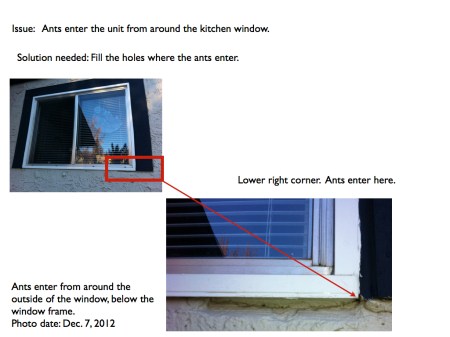
Here is the second photo:

I sent the photos together with this letter:
Dear John:
I’ve been thinking about this. If you say to a guy, “Go caulk around the window.” He’s going to come over and caulk around the window. The job is done because the job was “to caulk around the window”.
If you say to the guy, “This place has an ant problem. The kitchen wall is covered with thousands of ants. The exterminator says they are coming in from outside, specifically from around the kitchen window. Go over there and have a look at the outside of the kitchen window. Figure out every possible entry point for the ants to get in around that window. Plug each and every last one of those holes up, so the little buggers can’t get in.”
The job is done when the window is turned into an ant version of Fort Knox. No one — not one little ant — gets in.
That is an entirely different job than, “Go caulk around this window.”
The job we need to have done is the second one — plug up every possible entry point for ants from around that kitchen window.
If you need to give the contractor my number to explain that, then go ahead, but I’m pretty sure you get the idea about what we are after here, which is a solution to the problem of blocking how the ants get into the unit.
Every time you send a guy — or a couple of guys — to our property to do a job, they are not just checking off items from a “to do” list. They are solving problems for the people who live here. In doing that, they are making their life better.
I’m not trying to be melodramatic here, but every time one of your guys comes to our property to fix a problem for a resident, they get a chance to be somebody’s hero. They do that by solving a problem that the owner can not solve by themselves, because they either do not know how or they do not have the skills, expertise, materials, or maybe just the time. That’s one reason people live in condos.
I guarantee you that the single lady who lives in that unit does not have the skills or materials to fix this problem herself — or she would have already.
Your guys have all that — skills, talent, expertise and materials. We rely on you to hire smart guys and you do that. We see it time and time again. They’re smart, they’re capable and they can solve problems. In a small way, they can be somebody’s hero.
So tell your guy that this is his chance to be a hero for Marilyn, the lady who lives there.
Thanks,
Sarah
When it comes to leadership, it is important to give people all the information they need to solve a problem. If you hire smart people, then do not simply give them items to check off their “to do” list. Engage people’s skills, expertise and problem-solving abilities to make them part of the solution. In doing so, you are likely to make their work more meaningful… and both they — and their work — will have a greater impact on those they are helping.
I believe deeply in people’s capacity to solve problems, help others and do meaningful work.
Checking items off a “to do” list does very little to connect the work to the people who may benefit from it. Besides, work that only involves checking items off a “to do” list often lacks meaning, especially when that list is assigned to you by someone else.
Engaging smart people to develop sustainable solutions helps everyone over the long term.
_________________
Share or Tweet this: How checking things off your “to do” list is different than solving problems http://wp.me/pNAh3-1×6
Update – January 2018 – This blog has had over 1.8 million views thanks to readers like you. If you enjoyed this post, please “like” it or share it on social media. Thanks!
Sarah Elaine Eaton is a faculty member in the Werklund School of Education, University of Calgary, Canada.


 Posted by Sarah Elaine Eaton, Ph.D.



 Learning, Teaching and Leadership
You must be logged in to post a comment.