Book launch: Fake Degrees and Fraudulent Credentials in Higher Education

March 7, 2023

Carleton University Innovation Hub is pleased to host this public event.

Fake Degrees and Fraudulent Credentials in Higher Education

Join editors/authors Sarah Elaine Eaton, Jamie J. Carmichael, and Helen Pethrick in the Innovation Hub on Friday March 24, 2023 for the launch of their new book Fake Degrees and Fraudulent Credentials in Higher Education. This hybrid event will feature reading from the book and continue an important conversation facing many people in the world today.

Event Date: March 24th, 11:00 am – 12:00 (Eastern Standard Time)  

Event Location: Innovation Hub, 2020 Nicol Building, Carleton University or online

Hybrid Option:  A zoom Link will be provided via email to event registrants.

For more information or to register – https://carleton.ca/innovationhub/book-launch/

Related posts

_________________________________

Share or Tweet this: Book launch: Fake Degrees and Fraudulent Credentials in Higher Education https://wp.me/pNAh3-2SD

This blog has had over 3 million views thanks to readers like you. If you enjoyed this post, please “like” it or share it on social media. Thanks!

Sarah Elaine Eaton, PhD, is a faculty member in the Werklund School of Education, and the Educational Leader in Residence, Academic Integrity, University of Calgary, Canada. Opinions are my own and do not represent those of the University of Calgary.


Fake Degrees and Fraudulent Credentials in Higher Education: A Synopsis of the Book

January 28, 2023

Fake Degrees and Fraudulent Credentials in Higher Education was published by Springer Nature in January, 2023. It features over a dozen chapters on various topics related the broad theme of credential fraud.

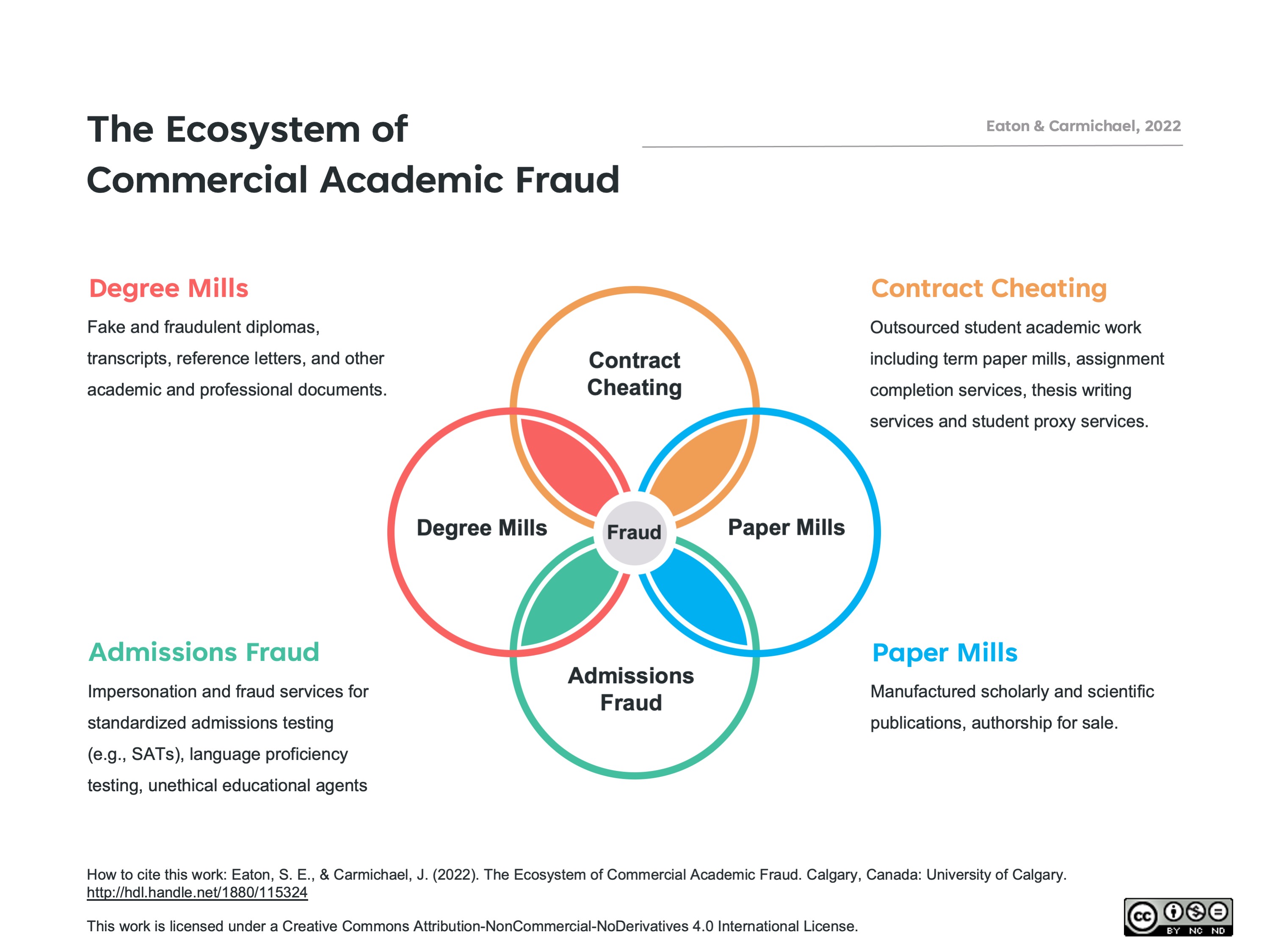
The introductory chapter includes an overview and historical perspectives of key issues. In this opening chapter, the authors connect the dots between the industries that supply fake degrees and fraudulent academic documents (including but not limited to bogus reference letters and tampered transcripts) to the contract cheating industries (e.g., term paper mills, student proxy services, and examination impersonators who take tests on behalf students) and to the admissions fraud industry. In addition, a connection is made to the scholarly paper mill industry which includes various violations of scientific publication ethics including fake data, fabricated scholarly articles and authorship for sale.

We present these connected industries through our Ecosystem of Commercial Academic Fraud model (Eaton & Carmichael, 2022). They synthesize what is known about the size and scope of the industry, estimating its valuation to be at least $21 Billion USD.

In Chapter Two, Jamie Carmichael and I (who are Canadian) argue that Canada is vulnerable to admission and credential fraud. This argument will be substantiated through (i) a survey that spanned coast-to-coast within Canada, (ii) media review that targeted the response to Operation Varsity Blues in Canadian newspapers, and (iii) a comparative analysis with another survey on this topic to gauge how Canada is fairing compared to others across the globe. This data triangulation resulted in an in-depth examination of admissions fraud in Canada, with 14 recommendations for practitioners, researchers, and those involved in policy reform.

In the third chapter, FBI Special Agent (retired), Allen Ezell, takes readers on a tour of “Axact, the world’s largest diploma mill”. Ezell has more than 40 years of experience investigating “fake high schools, colleges, universities, and counterfeiters” (p. 53). He writes that, “Axact is a classic example of a criminal enterprise. Even its own employees refer to it as the tower of frauds and house of lies.” (p. 49). This chapter is the longest in the book by far, spanning 49 pages, complete with concrete details, photos, and insider information not available anywhere else. Ezell explains that diploma mills, “are professional operations that take planning, preparation, and organization to run smoothly. Like legitimate businesses, they have business models, conduct market studies, have financial forecasts, perform cost analyses, set daily/ weekly/monthly sales goals, and offer sales incentives. They constantly survey their competition, and actions by law enforcement and regulators, to determine the direction the wind is blowing.” (p. 53)

Chapter Four, by Joanne Duklas, addresses how “digitization and technology have improved electronic exchange practices in the areas of document and data management and reduced occurrences of fraud thereby encouraging greater trust in the verification and assessment process for admission and transfer” (p. 95). Duklas discusses how background checks regularly show evidence of misrepresentation and fraud. Duklas’s in-depth exploration of  key issues related to electronic exchange processes. She provides details about Canada’s national document exchange network, MyCreds™ | MesCertif™, launched in 2020. She notes that, “Building solid bridges (technical infrastructure, standards, legislation, policies, and procedures) between issuers and receivers of official documents remains important for a trusted, quality assured ecosystem. Various technology solutions are solving credential fraud and creating greater trust in the chain of custody and bone fides of official documents.” (p. 110)

In Chapter 5, Kirsten Hextrum “considers how legal athletic admissions mirror the largest college admission conspiracy in US history: Operation Varsity Blues (OVB)” (p.  115). Hextrum analyzed 1487 college athletes’ demographic data; 47 life- history interviews with college athletes; and admission-related documents. Her results reveal how athletes invest to develop athletic talent, disputing college leaders’ claims that athletic admissions create diverse cohorts. She addresses important issues related to equity, diversity, and inclusion, as her findings show that “athletic investments create homogenous cohorts as White, middle-class youth are overrepresented as college athletes.” (p. 115). In addition, Hextrum discusses, “how colleges authenticate athletes’ credentials” (p. 115), finding that “universities use inconsistent and arbitrary measures—sometimes admitting athletes with little sport experience” (p. 115). Hextrum’s findings indicate that “athletic admissions misalign with the public’s interest because they are fixed to favour White, middle-class athletes and remain vulnerable to fraud” (p. 115).

In the next chapter, Stella-Maris Orim and Irene Glendinning, write about “Corruption in Admissions, Recruitment, Qualifications and Credentials” from the perspective of quality assurance. They draw on research conducted in 2017–2018 for the Council of Higher Education Accreditation’s International Quality Group (CIQG) “into how Accreditation and Quality Assurance Bodies (AQABs) respond to corruption” (p. 133). They address the question: Who is responsible for reducing corruption in education and research? (p. 133). They present findings from their empirical research, leading them to their evidence-informed conclusion that “higher education providers around the world are aware of corruption, fraud and malpractice in student assessment.”, but that “that much less attention has been given by institutions to the types of integrity breaches that we have looked at in this chapter, fraud in admissions and recruitment and in credentials and qualifications” (p. 145).

Chapter 7, by Özgür Çelik and Salim Razı, addresses favouritism and professorial recruitment practices in Turkish higher education institutions. They address the issue of fraud and corruption indirectly, through an analysis of 66 news stories that address favourtism in Turkish universities. They discuss how favouritism erodes public trust, noting that “the negative consequences of favouritism are far-reaching” (p. 154). Their findings showed that nepotism, cronyism, and patronage, were key areas of concern. They found that when specific individuals were identified for academic positions that customized job descriptions can be written so that only that particular individual could be deemed qualified. Although their chapter focuses specifically on Turkey, there are lessons that are transferrable to other countries with regards to corrupt hiring practices in higher education and other sectors.

The next two chapters address fraud in standardized English-language proficiency testing. Soroush Sabbaghan and Ismaeil Fazel’s chapter aims to “shed light on the complexities and the apparent disconnect between equity, integrity, fairness, and justice in standardized language proficiency tests and the integrity issues that can arise as a result” (p. 169). They point out that “at their core, standardized procedures imposed by testing centers ignore the fact that test-takers come from different socio-economic and sociocultural backgrounds with different interests, motivations and experiences of learning and using English” (p. 171). For those interested in exploring issues related to equity, diversity, and inclusion of international students, this chapter is a must read.

Angela Clark continues the discussion of fraud and corruption in English-language proficiency exams in her chapter that explores fraudulent test scores. Clark argues that “relying on a single language proficiency test score to determine an individual’s readiness is problematic, and also problematic is the lack of related academic research and data to help guide admissions decision-making” (p. 187). Clark presents concrete recommendations for “institutional stakeholders with ways to become better informed about these tests and their impact and approaches to help international NNES [non-native English-speaker] students succeed within their new academic disciplines and new academic culture” (p. 187) that include reconsidering admission criteria (p. 199) and instituting a post-entry language assessment (PELA) (p. 199).

In Chapter Ten, Brendan DeCoster uses systems theory to address admissions fraud. DeCoster explores the “culture of admissions fraud” in the United States. He proposes “a five-level framework for analyzing admissions fraud, noting how individuals, small groups and firms, larger firms, institutions, and political entities all play roles in establishing definitions of fraud, investigating fraud, prosecuting fraud, committing fraud, abetting fraud, and countering fraud” (p. 209). The five levels include micro, metaxy, meso, macro, and acro, and he provides examples for each level in his chapter.

Next, Jamie Carmichael leads a chapter on topic modelling, “an unsupervised machine learning technique commonly used in computer science as a research method” (p. 227). In this novel study, “data from 30 websites selling fake degrees were manually scraped, observations noted, and a topic model was built to identify risks within the dataset”, demonstrating that “that topic modeling can identify security risks by providing an environmental scan of the threat.” (p. 227). Twenty evidence-based recommendations are offered for higher education security professionals, senior leaders, and researchers.

In the penultimate chapter, together with Jamie Carmichael, I explore “what can happen when professor and educational leaders have fake or fraudulent degrees or other qualifications. We present four key issues: (a) the threat to institutional reputation; (b) the threat to the credentials awarded by the institutions; (c) the impact on students; and (d) material costs to the organization. Then, we propose seven recommendations to prevent or address academic qualification fraud: (a) verify applicant credentials; (b) develop or update internal risk assessment plans; (c) conduct an internal qualifications audit; (d) develop or update institutional codes of conduct; (e) develop an internal process to investigate allegations of credential fraud; (f) develop and follow internal quality assurance processes for courses, programs, and curricula; and (g) Develop or update crisis communications plans to include credential fakery or fraud. We conclude by emphasizing that moral outrage will not solve the problem of academic credential fraud.” (p. 251).

In our final chapter, we summarize key findings from the book, grouping them into “seven main categories: (a) historical perspectives and terminology; (b) a trend of global indifference; (c) criminal enterprises and security; (d) fraud in standardized language proficiency testing; (e) athletic credentialism; (f) the role of the institution; (g) hiring, and (h) technology. We discuss the significance and limitations of the book, concluding with calls to action for more research and resources to better understand and address the growing problem of the ecosystem of academic fraud that continues to grow” (p. 269).

This book was a passion project that we undertook during COVID-19. We hope it is useful to others who are dedicated to upholding academic integrity and raising awareness about the threats posed to higher education by fake degrees, fraud, corruption, and quackery.

Related posts

Just published! Fake Degrees and Fraudulent Credentials in Higher Education

Fake Degrees and Fraudulent Credentials: Research Project Update

Scholarships Without Scruples: 3 Signs of Bogus Scholarships and Scams

Why Universities and Colleges Need Clear Policies to Deal with Fake COVID-19 Vaccination Records and Test Results

Degrees of Deceit: A Webinar

_________________________________

Share or Tweet this: Fake Degrees and Fraudulent Credentials in Higher Education: A Synopsis of the Book https://drsaraheaton.wordpress.com/2023/01/28/fake-degrees-and-fraudulent-credentials-in-higher-education-a-synopsis-of-the-book/

This blog has had over 3 million views thanks to readers like you. If you enjoyed this post, please “like” it or share it on social media. Thanks!

Sarah Elaine Eaton, PhD, is a faculty member in the Werklund School of Education, and the Educational Leader in Residence, Academic Integrity, University of Calgary, Canada. Opinions are my own and do not represent those of the University of Calgary.


Contract Cheating and Freedom of Expression: How the Chicago Principles Can Help You Promote Academic Integrity on Your Campus

October 4, 2022
woman wearing brown shirt carrying black leather bag on front of library books
Photo by Abby Chung on Pexels.com

It’s that time of the year again, when contract cheating and unethical tutoring companies hand out flyers to students as they enter classrooms and leave them all over campus – littered in classrooms, strewn on benches, tacked to bulletin boards, and so on. Historically, it has been difficult for some schools to have these advertisements removed because the companies behind them have claimed censorship and threatened legal action against the institution. However, there is reason for hope, especially if your school as a Statement on Free Expression. Let me explain.

Although the original Chicago statement – and others that were modelled on it – were created to support freedom of expression, there is a small but important detail about the limitations of free speech on campus that is relevant to academic integrity. In the original version of the Chicago Principles of Freedom of Expression, it states:

“The freedom to debate and discuss the merits of competing ideas does not, of course, mean that individuals may say whatever they wish, wherever they wish. The University may restrict expression that violates the law, that falsely defames a specific individual, that constitutes a genuine threat or harassment, that unjustifiably invades substantial privacy or confidentiality interests, or that is otherwise directly incompatible with the functioning of the University.” (Chicago Principles of Freedom of Expression, p. 2, emphasis added.)

I am not a lawyer, but I am a policy scholar. (You can find out more about my academic work on higher education policy here, here, and here, for example.) When examining policy, the devil is in the details, as they say. In this case, there is an argument to be made that when contract cheating companies and unethical tutoring businesses advertise on our campuses, they are acting in a manner that is directly incompatible with the functioning of the university. As such, the institution has a right to remove advertisements from campus that promote academic misconduct.

Every school that has developed its own statement of free expression based on the Chicago principles may have this important detail included that gives it leverage to curtail the blatant advertising of contract cheating services the school, including those in Canada. For example, in 2019, the Alberta government mandated that all post-secondary institutions in the province develop a statement to affirm freedom of expression that aligned with the Chicago Principles on Free Speech. Like all higher education institutions in the province of Alberta, the University of Calgary followed the government mandate, making a formal public announcement on December 16, 2019 that it had published its Statement on Free Expression. Our institutional Statement on Free Expression is publicly available. For quick reference, here is the .pdf statement: https://www.ucalgary.ca/provost/sites/default/files/StatementonFreeExpression.pdf 

The University of Calgary statement includes this sentence: “Free expression is subject to limitations imposed by law and, on our campuses, by University policies and procedures related to the functioning of the University.”

I brought this detail to the attention of our Provost at the time, Dr. Dru Marshall, pointing out that this could give the university leverage to reasonably remove advertisements for contract cheating services.  The Provost agreed and informed me that she would instruct Caretaking to have the advertisements on campus removed on this basis. We currently have an Interim Provost, Dr. Penny Werthner and I recently brought this information to her attention and she responded that she too, would take action.

Any post-secondary institution that has a Statement on Free Expression based on the Chicago principles, may be in a position to mandate the removal of advertisements that promote academic misconduct. Of course, this would need the agreement of the Provost or equivalent. I am sure that some lawyers could debate the nuances of some of this language and its implications. As I said, I am not a lawyer, but it would seem to me that in the case of Alberta at least, given that the provincial government mandated that every post-secondary institution in the province develop its own Statement on Free Expression based on the Chicago principles, and that universities and colleges across North America have widely adopted such statements that would have no doubt been scrutinized by lawyers ad nauseam, this is a policy loophole that could actually work in favour of the institution. There is a strong argument to be made that removal of advertisements that promote academic misconduct is not censorship, because communications that interfere with the functioning of the university (and that includes communications that promote academic misconduct) can reasonably be removed. This is not censorship; it is protecting the integrity of the institution.

If you live in jurisdiction that does not have legislation prohibiting the supply or advertisement of contract cheating services, but your school has a statement on free expression based on the Chicago principles, here are 5 things you can do:

  • Share this blog post with your Provost / Vice-President Academic (or equivalent). Let them consider how the school’s statement can help to promote academic integrity.
  • Ask the Provost (or equivalent) to instruct the head of caretaking that custodial should be instructed to remove the flyers and other advertisements that litter the classrooms and other areas of campus.
  • Ask the Provost to inform the others on the executive leadership team (e.g., vice provost of student affairs, vice provost of teaching and learning, and so on) and deans to share this information with others in their respective units.
  • Request that this information be shared at the next meeting of the University Senate (or in Alberta, the General Faculties Council) to ensure it is widely communicated.
  • Ask how you can help. If your school has an academic committee or task force, offer to join and actively contribute to the ongoing work of upholding academic integrity at your own institution.

Institutions can take action against contract cheating. The annual International Day of Action Against Contract Cheating is fast approaching. It’s on October 19 this year. If your school hasn’t already signed up, you can still do so. Widespread removal of contract cheating advertisements could be a campus-wide event that students, staff, and administrators all participate in on that day, and every day.

_______________________________

Share or Tweet this: Contract Cheating and Freedom of Expression: How the Chicago Principles Can Help You Promote Academic Integrity on Your Campus – https://drsaraheaton.wordpress.com/2022/10/04/contract-cheating-and-freedom-of-expression-how-the-chicago-principles-can-help-you-promote-academic-integrity-on-your-campus/

This blog has had over 3 million views thanks to readers like you. If you enjoyed this post, please “like” it or share it on social media. Thanks!

Sarah Elaine Eaton, PhD, is a faculty member in the Werklund School of Education, and the Educational Leader in Residence, Academic Integrity, University of Calgary, Canada. Opinions are my own and do not represent those of the University of Calgary.


Now Published: Contract Cheating in Higher Education

August 11, 2022
Eaton, Curtis, Clare, Stoesz, Seeland & Rundle cover

Now published: Contract Cheating in Higher Education: Global Perspectives on Theory, Practice, and Policy (Eaton, Curtis, Stoesz, Clare, Rundle, & Seeland, 2022). This volume, published by Palgrave MacMillan, includes twenty chapters from contributors across Australia, North America, and Europe:

  1. Introduction: Contract cheating and introduction to the problem. – Curtis, G. J., Clare, J., Rundle, K., Eaton, S. E., Stoesz, B. M., & Seeland, J.
  2. What can we learn from measuring crime when looking to quantify the prevalence and incidence of contract cheating? – Clare, J., & Rundle, K.
  3. Limitations of contract cheating research. –  Krásničan, V., Foltýnek, T., & Dlabolová, D. H.
  4. Essay mills and contract cheating from a legal point of view. – Draper, M.
  5. Leveraging college copyright ownership against file-sharing and contract cheating websites. – Seeland, J., Eaton, S. E., & Stoesz, B. M.
  6. The encouragement of file sharing behaviours through technology and social media: Impacts on student cheating behaviours and academic piracy. – Rogerson, A. M.
  7. Higher education assessment design. – Sutherland-Smith, W., & Dawson, P.
  8. Critical thinking as an antidote to contract cheating. – Stoesz, B. M., Eaton, S. E., & Seeland, J.
  9. Contract cheating and the Dark Triad traits. – Baran, L., & Jonason, P. K.
  10. Contract cheating: The influence of attitudes and emotions. – Curtis, G. J., & Tindall, I. K.
  11. Applying situational crime prevention techniques to contract cheating. – Clare, J.
  12. Presentation, Properties and Provenance: the three Ps of identifying evidence of contract-cheating in student assignments. – Crockett, R.
  13. “(Im)possible to prove”: Formalising academic judgement evidence in contract cheating cases using bibliographic forensics. – Ellis, C., Rogerson, A. M., House, D., & Murdoch, K.
  14. Aligning academic quality and standards with academic integrity – Glendinning, I.
  15. Addressing contract cheating through staff-student partnerships. – Lancaster, T.
  16. The extortionate cost of contract cheating. – Veeran-Colton, T., Sefcik, L., & Yorke, J.
  17. The rise of contract cheating in graduate education. –  Parnther, C.
  18. Listening to ghosts: A qualitative study of narratives from contract cheating writers from the 1930s onwards. – Eaton, S. E., Stoesz, B. M., & Seeland, J.
  19. Assessment brokering and collaboration: Ghostwriter and student academic literacies. – Thacker, E. J.
  20. Conclusion – Eaton, S. E., Stoesz, B. M., Seeland, J. Curtis, G. J., Clare, J., & Rundle, K. 

Updates:

October 4, 2022 – The final proofs have been submitted to the publisher. The book now moves into production and should be available very soon!

October 28, 2022 – The book has now been published!

_______________________________

Share or Tweet this: New Book Coming Soon: Contract Cheating in Higher Education – https://drsaraheaton.wordpress.com/2022/08/11/new-book-coming-soon-contract-cheating-in-higher-education/

This blog has had over 3 million views thanks to readers like you. If you enjoyed this post, please “like” it or share it on social media. Thanks!

Sarah Elaine Eaton, PhD, is a faculty member in the Werklund School of Education, and the Educational Leader in Residence, Academic Integrity, University of Calgary, Canada. Opinions are my own and do not represent those of the University of Calgary.


Marking the 50-year anniversary of an attempt to legislate against contract cheating in Canada

June 14, 2022

The Society of Teaching and Learning in Higher Education (STLHE) in Canada has launched a new national Committee on Academic Integrity and Contract Cheating (CAICC). With more than 40 members from universities and colleges across Canada, this committee will focus on how to promote academic integrity and take action against term paper mills and other forms of contract cheating.

In my open access book chapter “Contract Cheating in Canada: A Comprehensive Overview”, I provide details of an attempt to legislate against contract cheating. Bill 174 was brought forward in the Ontario provincial legislature by the Hon. Albert Roy on June 14, 1972. I often wonder how different things would be in Canada today if that legislation had passed.

As I was digging into that research, I looked up Albert Roy and found that after he’d left politics, he went on to practice laws and was later appointed as a judge. He appeared to be doing some work for a mediation consultancy firm, so I decided I’d drop him an e-mail to tell him about how important this attempt at legislation was, even if it failed. I never heard back, and I figured he was just busy.

After our book, Academic Integrity in Canada was published, I e-mailed him again to let him know so he could read about how contract cheating in Canada had evolved and what we were doing to take action against it. I never heard back… So a while back, I decided to be cheeky and leave him a voice mail.

Last week on Wednesday when I was attending the Society for Teaching and Learning in Higher Education (STLHE) conference in Ottawa, my phone rang just before lunch. I answered and lo and behold, it was Albert Roy calling me back! He let me know that he’d never received the e-mails but was glad that I phoned.

During our conversation I asked if he’d like me to send him a copy of the book chapter in which I’d written about contract cheating in Canada, including the legislation he’d proposed. He said yes and proceeded to give me his mailing address. After he’d finished, I said,

“You’re in Ottawa!”

“Yes,” he replied.

“I’m in Ottawa! I’m here from Calgary for a conference on teaching and learning in higher education!”

One thing led to another and with the permission of the conference organizers, I asked Albert if he’d might have time and interest to drop by my session on Friday morning. (Of course, I figured he’d be busy, off doing whatever it is that retired people do…) To my utter surprise and delight, he said yes, he’d be happy to stop by.

So, on Friday morning, just as he’d promised, Albert Roy showed up to the Ottawa conference centre and we had a few minutes to chat before the session and even agreed to offer a few remarks.

A group photo with Janice Miller-Young, Albert Roy, and Sarah Elaine Eaton
Left to right: Janice Miller-Young, Albert Roy, and Sarah Elaine Eaton. Photo taken at the 2022 STLHE conference in Ottawa on 10 June, 2022.

We snapped the photo above just before my presentation started. At the beginning of the session I was introduced by Julia Christensen Hughes, who co-edited Academic Integrity in Canada: An Enduring and Essential Challenge with me.

I went through most of my slides. (By the way, you can download a complete copy of my slides from the conference here.)

When I got to the slide about the proposed legislation, I told everyone in the audience that we had the honour of having Albert Roy with us to share some of his insights. We’d kept it under wraps and it was a surprise for just about everyone.

Albert captivated us with his recollections of being called a “radical” and a “communist” for proposing legislation that would have made term papers illegal and also for proposing other legislation mandating the use of seat belts.

Beatriz Moya, a PhD student studying with me at the University of Calgary took a video of Albert Roy’s remarks and later gave us permission to share it:

This was truly an historic moment for us and Albert Roy left us all feeling energized and inspired.

On June 14, 2022, exactly fifty years to the day after Albert Roy proposed legislation that would have made contract cheating illegal in the province of Ontario, we will have the inaugural meeting of our new national committee on academic integrity and contract cheating. We chose the date of our first meeting for its symbolism weeks before Albert Roy and I had a chance to speak on the phone. Now, this date is even more symbolic as more than 40 committee members will gather to talk about the future of academic integrity in Canada, how to protect it and how to uphold it.

I will be forever grateful to Albert Roy for the work he did as a politician and also for the inspiration he brought us fifty years later as we continue the work.

If you’d like to show your appreciation to Albert Roy for his efforts to legislate against contract cheating, join the thank you card campaign.

Related posts:

New book: Academic Integrity in Canada

Contract Cheating in Canada: Exploring Legislative Options

_______________________________

Share or Tweet this: Marking the 50-year anniversary of an attempt to legislate against contract cheating in Canada https://drsaraheaton.wordpress.com/2022/06/14/marking-the-50-year-anniversary-of-an-attempt-to-legislate-against-contract-cheating-in-canada/

This blog has had over 3 million views thanks to readers like you. If you enjoyed this post, please “like” it or share it on social media. Thanks!

Sarah Elaine Eaton, PhD, is a faculty member in the Werklund School of Education, and the Educational Leader in Residence, Academic Integrity, University of Calgary, Canada. Opinions are my own and do not represent those of the University of Calgary.