How parents help their kids cheat in school

March 6, 2018

I recently heard an acquaintance complain about how tired they were at work one morning. The reason? “I was up all night working on my kid’s science project.”

The parent was adamant that their child had to “do well” on the science project. To that parent, “doing well” meant getting a good grade and receiving praise (and possibly a prize) from the judges. It wasn’t about if or how much their child learned during the process.

That got me thinking about the various ways I’ve observed parents helping their kids cheat in school. Here are a few:

Doing the work for them

When parents do their kids’ homework for them, students don’t learn.

Fixing all the mistakes

When parents fix all the mistakes so their child can hand in a perfect assignment, it doesn’t show the teacher how the student needs to improve.

Re-writing it

When parents re-write a student’s work to make it sound better, the end product does not reflect the student’s current writing ability.

Re-designing it

When parents re-work the slide deck or improve the design of a project, the end product shows what the parent can do, not the child.

Doing all the research

Parents are not helping their kids learn when they do all the background research for a project.

5 Ways parents help their kids cheat in school.jpg

Parents need to stop equating doing their children’s school work as an act of service that shows their children how much they love them. Doing a child’s school work does not send the message, “I love you!” Instead, it enables the child to avoid learning things for themselves.

When parents to school work on behalf of their children, it is a form of cheating. In fact, it is part of special kind of academic dishonesty called “contract cheating”. This is when a student has someone else do their work on their behalf. Contract cheating can happen when students buy their school work off the internet for money, or when they agree to have anyone else do their work for them, even if no money is exchanged. There is still an implicit contract in place: Someone else is doing the work on behalf of the student.

Parents can be active partners in their child’s success when they focus on learning as a process, not as an end product. That is why it is important for parents to help children learn skills like writing, designing and researching and to improve their skills over time. Learning isn’t about being perfect; it is a lifelong process that keeps going long after students leave school.

I am not saying this is easy. The temptation to “help” a child succeed can be strong. It is important for parents to understand that helping does not mean doing the student’s work for them.

______________________________________________________

Share or Tweet this: How parents help their kids cheat in school https://wp.me/pNAh3-2hd

This blog has had over 1.8 million views thanks to readers like you. If you enjoyed this post, please “like” it or share it on social media. Thanks!

Sarah Elaine Eaton is a faculty member in the Werklund School of Education, University of Calgary, Canada.

Opinions are my own and do not represent those of the Werklund School of Education or the University of Calgary.


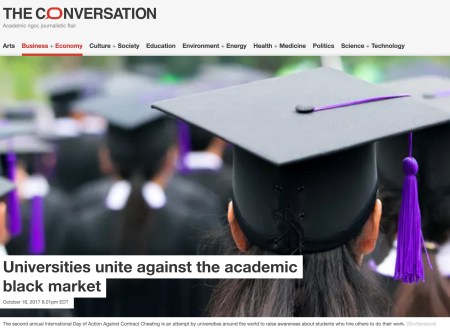
Universities unite against the academic black market

October 17, 2017

The ConversationOn the TV show Suits, Mike Ross’s character charges a hefty fee to students to take the LSAT (law school admission test) for them. Ross has a stellar memory and a remarkable ability to take tests without getting crushed by stress — he is the perfect “contract cheater.” Later, Ross builds a career as a lawyer based on fake credentials, presumably from Harvard.

Mike Ross may be fictional, but his business is only too real within universities globally. “Contract cheaters” such as Ross complete academic work on a student’s behalf — for a fee. This work includes test taking and homework services. It includes essay-writing and even PhD thesis-writing services, also known as “paper mills.”

In my role as interim associate dean of teaching and learning at the University of Calgary, and as a researcher who specializes in plagiarism prevention and academic integrity, I have been writing about contract cheating since 2010. Since then, it has become rampant at high school and post-secondary levels.

This black market for academic work is vast and little understood. Universities in Canada, and around the world, are having a very hard time trying to police it.

On Oct. 18, 2017, many universities have committed to the second International Day of Action Against Contract Cheating. This aims to tackle the issue head on — by raising awareness and sharing prevention strategies.

Read the whole article in The Conversation (originally published on Oct. 16, 2017).

Check out the radio interview I did on CBC: http://www.cbc.ca/listen/shows/calgary-eyeopener/segment/14438512

Related posts:

______________________________________________________

Share or Tweet this: Universities unite against the academic black market  http://wp.me/pNAh3-1YN

This blog has had over 1.8 million views thanks to readers like you. If you enjoyed this post, please “like” it or share it on social media. Thanks!

Sarah Elaine Eaton is a faculty member in the Werklund School of Education, University of Calgary, Canada.


2nd International Day of Action Against Contract Cheating

October 16, 2017
International Day of Action Against Contract Cheating: Graphic created by University of California at San Diego.

Graphic created by University of California at San Diego.

Contract cheating is an umbrella term used to talk about individuals or businesses that provide academic work for a fee. From imposters who take tests on behalf of others, to professional homework services and paper-writing services or “paper mills”, contract cheating is big business. This black market for academic work is becoming more prevalent, is hard to detect and harder to prove. No one knows exactly how many of these services exist, or how much money they make, but their very existence is troubling. Post-secondary educators, as well as those who aspire to a career in education, need to take action against contract cheating.

U of C logo - 2015In my role as Interim Associate Dean, Teaching and Learning at the Werklund School of Education, I have the chance to organize key events that bring people together over key issues related to teaching and learning in our school. When I heard about the 2nd International Day of Action Against Contract Cheating, I knew we had to join.

We’ll be hosting a Brown Bag Interactive Conversation for faculty and staff about what contract cheating is and what we can do about it. We’ll be sharing the Institutional Toolkit to Combat Contract Cheating and this 3-page handout that gives practical strategies on how to combat it.

More than 40 institutions from more than a dozen countries will be hosting events all over the world on October 18. I am so pleased that the University of Calgary will be among them.

We are using the hashtags #defeatthecheat and #excelwithintegrity on social media. Join the conversation on October 18!

______________________________________________________

Share or Tweet this: 2nd International Day of Action Against Contract Cheating http://wp.me/pNAh3-1Yn

This blog has had over 1.8 million views thanks to readers like you. If you enjoyed this post, please “like” it or share it on social media. Thanks!

Sarah Elaine Eaton is a faculty member in the Werklund School of Education, University of Calgary, Canada.


Outsourcing is the new plagiarism: What teachers need to know

September 28, 2010

In a recent post, I gave some resources for teachers to find out if their students are plagiarizing. I’ll be blunt though. Plagiarizing is soooo 20th century! (Yawn.)

Some students make a game of staying one step ahead of “the system”. In the 21st century, the really clever cheaters aren’t plagiarizing, they’re outsourcing their assignments. It’s kind of like getting your Mom, Dad or best friend to do your homework for you, only more sophisticated. Any student with a credit card  can do it.

And if you think you’re safe because your students are too young to have credit cards of your own, think again. The pre-paid credit card Aunt Mabel gave to little Johnny last Christmas will work just fine, thanks very much.

So, how do they do it?

There are Internet services out there who sole purpose is to match those who provide freelance or outsourced services with those who need them. (I won’t list them here, as that might be considered unethical for someone who is employed as a part-time university faculty member.) Legitimate small business owners will use such services to find virtual assistants, transcribers, typists, graphic designers, web designer and other providers of easily outsourced work. Such sites post all kinds of disclaimers about what type of work is or isn’t allowed to be offered or solicited. That doesn’t stop people from plainly saying what services they want or will provide.

For someone who lives in a developed country, outsourcing your work to India, the Philippines or other countries where workers get paid much less has become the norm in some businesses. Leaving the ethics and politics of globalization aside, the key message here is that it’s not just companies who are outsourcing work any more. Students are, too.

I recently saw an ad that looked something like this:

“Assignment: Write a 10-page history paper for a 300-level university course on the military strategies employed during the American Civil War. The paper must be ten double-spaced pages, written in Times New Roman, 12-point font with one-inch margins. At least 15 references are needed and citations are required in APA format. Must be written in perfect English, spell-checked and grammar-checked. Due: three weeks from the posting date of this ad.”

Suppliers bid on the project. At the time I saw the ad, bids had come in from a variety of countries and hovered around $30 USD. India seemed to be a popular country for outsourced academic papers, it seems. But suppliers from a variety of other countries were evident, too. Some bidders stated that they had PhDs themselves and would guarantee a well-written paper. It is safe to say that those who bid on such projects are  likely highly educated, fluent in academic English and think that $30 USD is worth the effort.

This is all done, of course, using anonymous e-mail addresses that can’t be traced back to the student. The work is all done on line. It’s not plagiarized. Rather, it is custom-written by an outsourced ghost writer thousands of miles away.

The paper is e-mailed to the student by the supplier, making all the plagiarism detectors that I mentioned in the previous post completely irrelevant. Those papers can never be found on the Internet. They haven’t been purchased by a service who has a bank of papers on numerous topics, ready to be shipped out to buyers. Instead, outsourced papers are specifically written according to the exact criteria given by the student (who re-iterates what his or her instructor has told him).

Let’s do the math:

A student works at a local pizza take-out and makes $15 per hour. If we take taxes and other payroll deductions into account, that students would have to work for about three hours – or maximum, four hours – to earn about $30 to pay the outsourced paper writer.

How long would it take him to write his own paper? At least 10 hours, but more likely 12 or 15, if he writes an excellent paper that merits an A grade.

Simple economics shows that the student benefits financially from outsourcing his paper. The supplier to whom the paper is outsourced benefits, as he is making a decent wage in comparison to whatever he or she might earn in a comparable time period in their local currency. Who loses? Well, the student loses out on the opportunity to learn research techniques and skills involved in writing a paper, of course. But mostly, it’s the current academic system and those who work in it who lose. The ideals that they hold regarding ethics, integrity and academic honour are thrown out the window.

Once the student has established a relationship with his outsourced ghost writer, he can contract the same academic-on-demand to write all his papers for the same course, thus ensuring that there is consistency in the tone, writing style and research skills of all his assignments.

My guess is that academic papers will become a thing of the past. Only those who sincerely enjoy research and the process of learning will be encouraged — or perhaps even allowed — to undertake academic research. Rather than demanding that students produce papers for marks, we may reserve the right to teach advanced research skills to those who are willing to commit to and engage in the entire process.

The question isn’t “How do we stop our students from plagiarizing or outsourcing?” but rather, “How do we teach students the value, joy and benefit of learning for themselves?”

Related posts:

_____________

Share or Tweet this: Outsourcing is the new plagiarism: What teachers need to know http://wp.me/pNAh3-lc

Update – January 2018 – This blog has had over 1.8 million views thanks to readers like you. If you enjoyed this post, please “like” it or share it on social media. Thanks!

Sarah Elaine Eaton is a faculty member in the Werklund School of Education, University of Calgary, Canada.