Unveiling the Handbook of Academic Integrity (2nd ed.) in Dubai

December 28, 2023
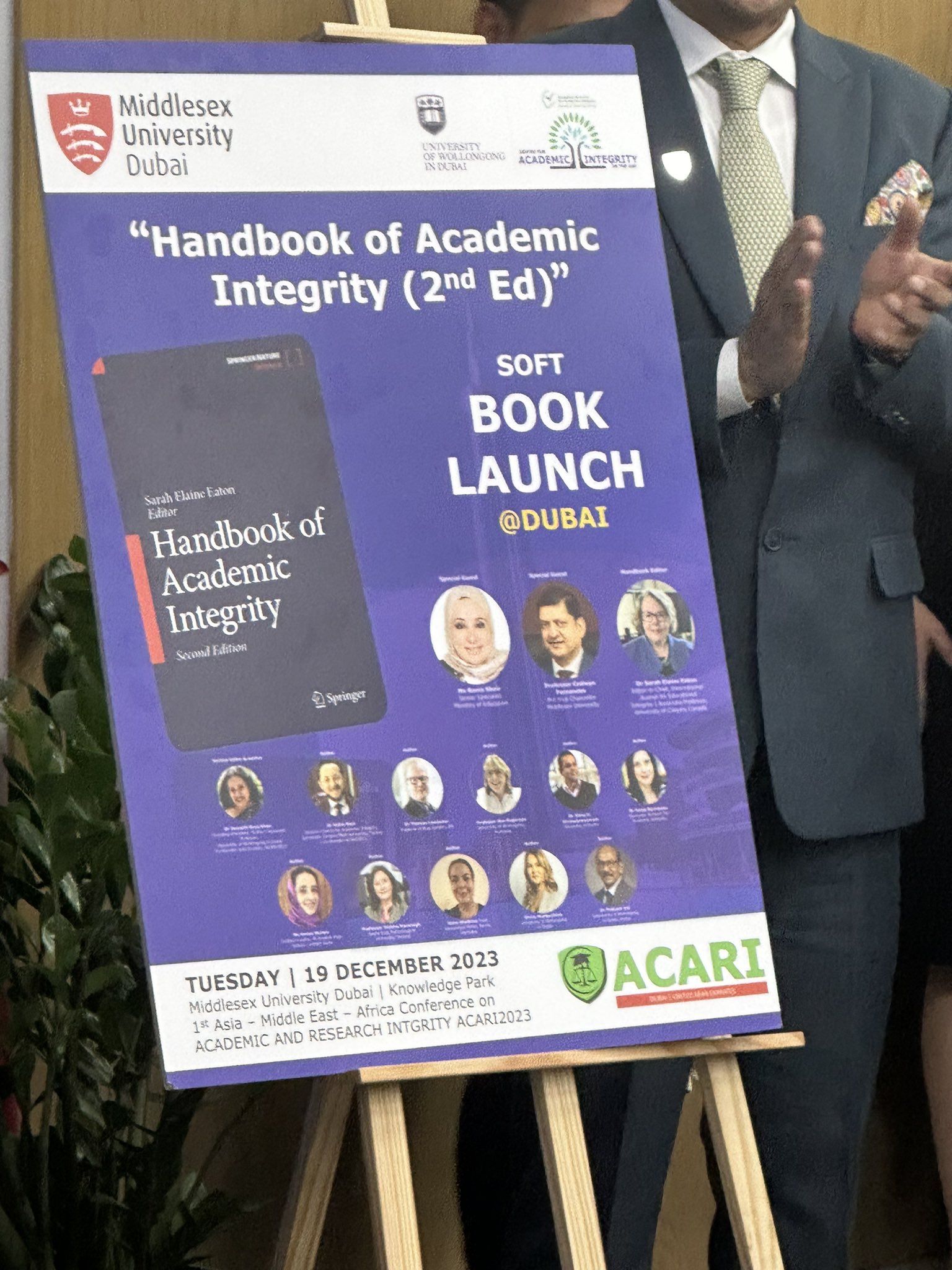
A poster with a blue background. There is a white banner at the top with university logos. The poster contains an image of a book cover and faces of individuals associated with the book.

The 1st Asia -Middle East – Africa Conference on Academic and Research Integrity (ACARI) 2023, 17-19 December at Middlesex University Dubai. It was against this backdrop that the highly anticipated Handbook of Academic Integrity (2nd ed.), published by Springer, was unveiled at a dazzling soft launch, marking a milestone in the book’s journey and the evolution of academic integrity knowledge-sharing and community-building.

The handbook is now in its final stages of production, and the standalone second edition will be released in hard copy in January, 2024. To celebrate, Dr. Zeenath Reza Khan, who serves as one of the handbook’s section editors and contributors, and was a co-chair of the 1st Asia -Middle East – Africa Conference on Academic and Research Integrity (ACARI) 2023, 17-19 December led the organization of the soft launch for the handbook during the conference.

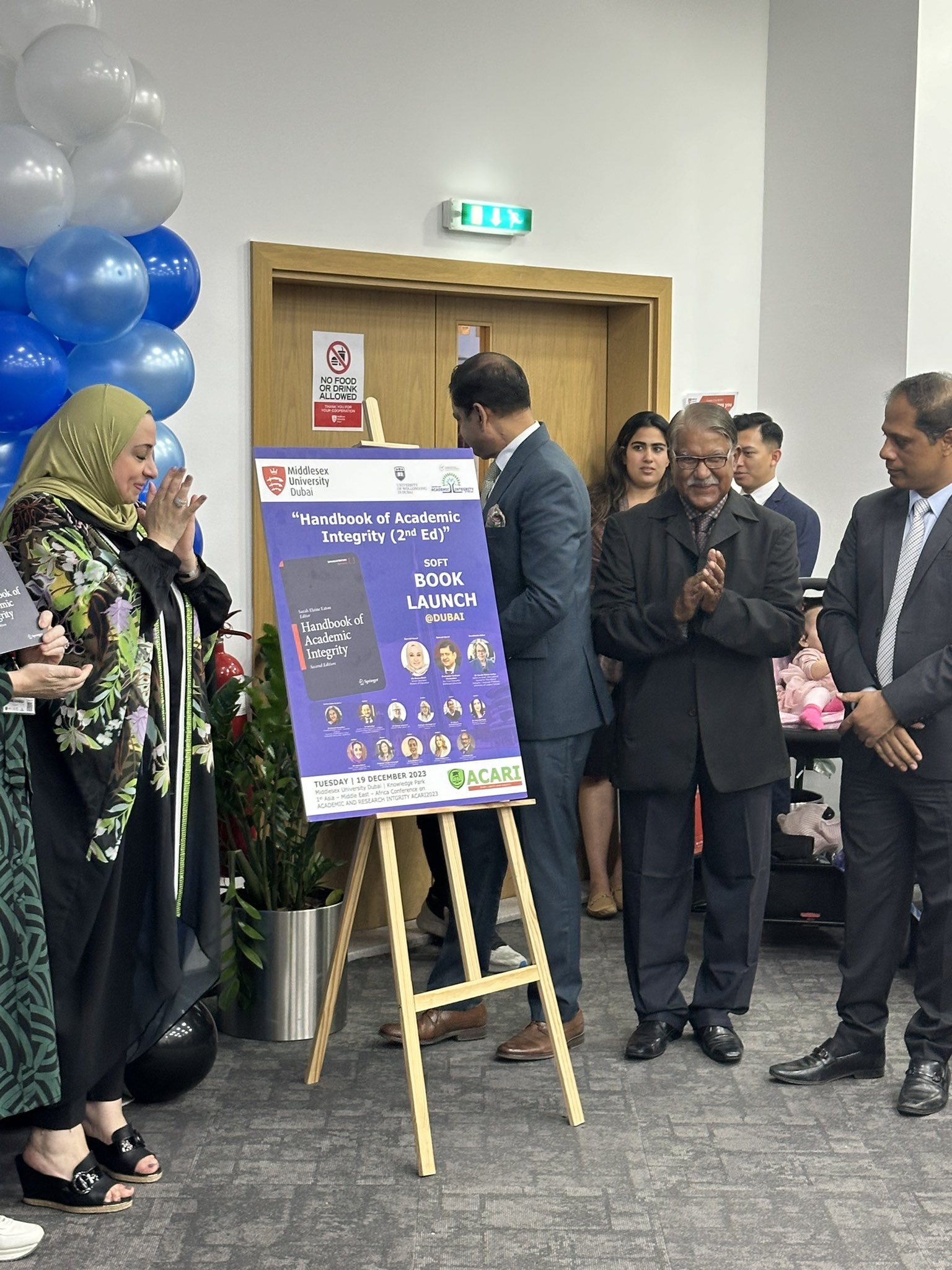
The launch was held during the closing ceremony of the conference on the final day in an auditorium at the prestigious Middlesex University Dubai, was both festive and scholarly, as it brought together educators, researchers, and advocates for academic integrity. In addition to conference delegates, a number of esteemed dignitaries attended including, His Excellency, Jamal Hossain, Consul General of Bangladesh to UAE; Dr. Mohammad Ali Reza Khan, Award-winning Expert Wildlife Specialist, Dubai Municipality, along with Professor Cedwyn Fernandes, Pro Vice Chancellor of Middlesex University and Director of Middlesex University Dubai. Special thanks to Ms. Rania Sheir, Senior Specialist, Entrepreneurship and Innovation, Ministry of Education, UAE, who not only attended the launch, but also posted about it on LinkedIn.

 A screenshot of a LinkedIn post.

The Handbook, meticulously curated by leading experts in the field, is a compendium of insights, strategies, and best practices aimed at upholding the ethical practices in academia and research. It covers a diverse range of topics, from plagiarism to artificial intelligence, to the promotion of ethical behaviour in academic research, and much more. The multidimensional approach of the Handbook of Academic Integrity  ensures that it caters to the needs of educators, administrators, and students alike.

A number of contributing authors were in attendance, including:

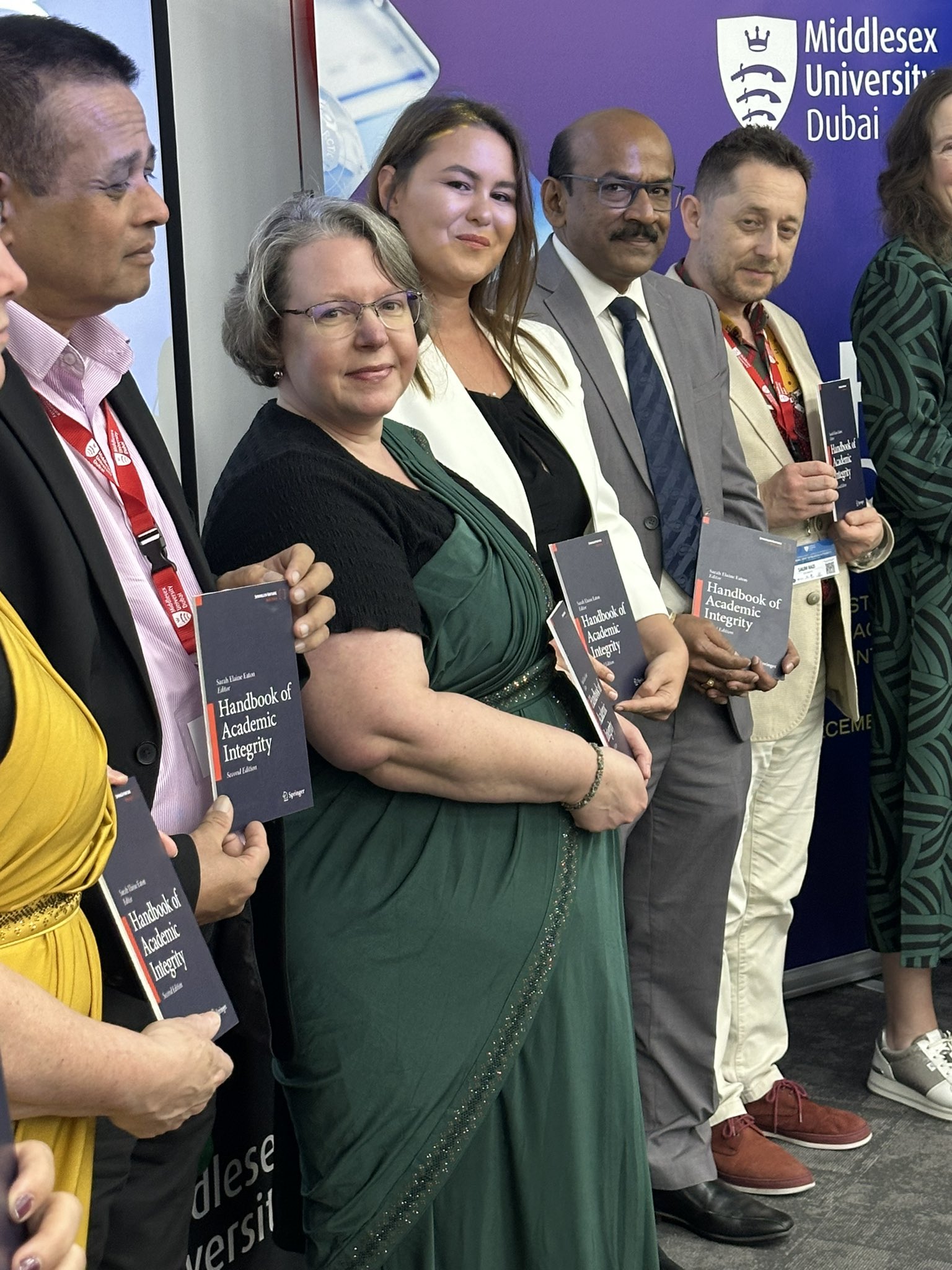
Dr. Zeenath generously gifted two colleagues and me with authentic saris that we wore during the closing ceremony and the launch. As you can see from the photo below, I was given one in dark green and I just love it! I had an opportunity to say a few words about the book and its importance in the field, and to thank the organizers and authors. Each contributor was gifted a symbolic souvenir cut-out of the front cover of the handbook and following the formalities, we signed the back of one another’s covers.

The book launch culminated in a celebratory atmosphere, with attendees leaving inspired. The Handbook of Academic Integrity (2nd ed.), now poised to be a cornerstone in the field, builds on the first edition and stands as a testament to the collective commitment to nurturing a culture of integrity throughout every level of education and research.

Photo gallery:
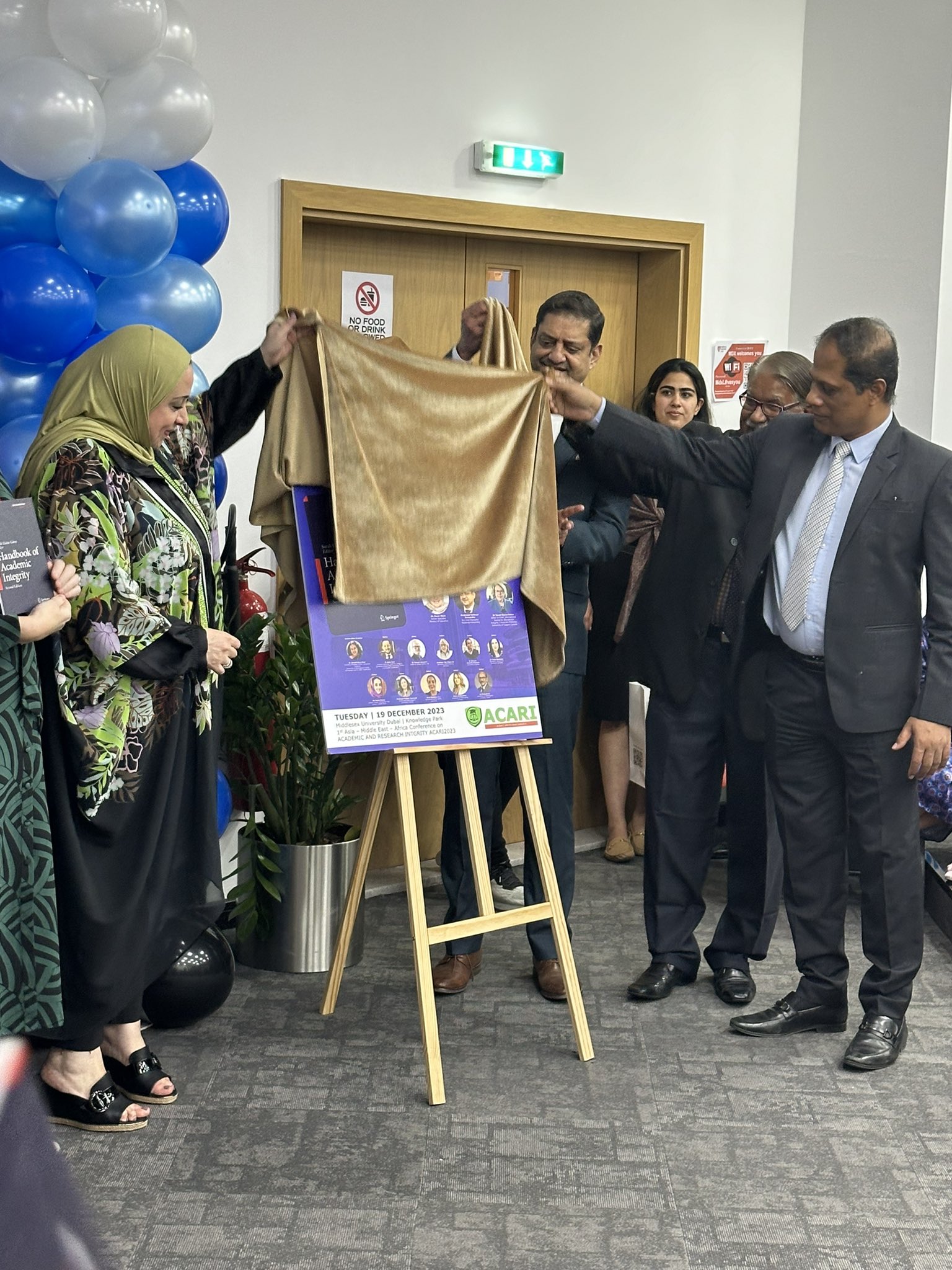
Unveiling of the Handbook of Academic Integrity (2nd ed.) Two people are removing a gold-coloured cover from a poster featuring the book cover. People are standing in the background. There are blue and white balloons on the left edge of the frame.
A group of people standing around a large easel. On the easel is a poster.
An easel showing a large poster.
A photo with a group of people. Each person is holding a cardboard cutout of a book cover.
A photo of a group of people. There is an easel with a poster in the centre.
A photo of a group of people. Each person is holding a cardboard cutout of a book cover.

____________________________

Share this post: Unveiling the Handbook of Academic Integrity (2nd ed.) in Dubai – https://drsaraheaton.wordpress.com/2023/12/28/unveiling-the-handbook-of-academic-integrity-2nd-ed-in-dubai/

This blog has had over 3 million views thanks to readers like you. If you enjoyed this post, please “like” it or share it on social media. Thanks!

Sarah Elaine Eaton, PhD, is a faculty member in the Werklund School of Education at the University of Calgary, Canada. Opinions are my own and do not represent those of my employer.


Multilingual Essay Mills: Understanding Contract Cheating among Second Language Learners – Workshop

February 1, 2019

U of C logo - 2015As many of you know, I’ve been developing a research program on academic integrity over the past few years. Last year I began collaborating with my friend and colleague, Dr. Roswita Dressler, on a project that brings together our combined expertise in academic integrity and language learning.

It started when I noticed that almost all of the research that I’d seen about contract cheating was focused almost exclusively on services provided in English. That led us to ask ourselves what the market was students of second languages. We undertook a rapid review to help us get a general sense of the landscape. We wrote up the results and they have been accepted for publication in a peer-reviewed journal. I’ll post about it when the publication comes out later this year.

We are also doing a workshop at the University of Calgary’s Language Research Centre  to help teachers of second languages build their understanding of what the contract cheating industry is and why they need to pay attention.

Workshop description

Contract Cheating_Poster - LRC WorkshopContract cheating happens when students have a third party complete academic work on their behalf. The term was coined by UK researchers Clarke and Lancaster (2006). It includes, but it not limited to essay mills and homework completion services. Suppliers of this form of “black market” academic work exist mainly online. Students can simply upload a digital copy of their assignment instructions to a website, insert a delivery date and pay for the work by credit card. Contract cheating is big business. Owings and Nelson (2014) found the essay mill industry in the United States alone to be valued at a minimum $100 million USD. Estimates show that over 71,000 post-secondary students in Canada buy academic work online (Eaton, 2018). There is growing evidence to suggest that contract cheating is not limited to academic work completed in English, but also in a variety of world languages.
In this workshop, you will learn more about what contract cheating is, how it happens, and how second language learners can order homework tasks, essays and even theses from online providers, customized to the exact instructions of an assignment. We will discuss strategies for prevention and detection, along with an examination of what to do if you suspect a case of contract cheating among your students.

Date and time: Friday, February 15, 3:00 – 4:00 p.m.

Location: Craigie Hall, 4th floor, Room D-420

This workshop is open to the public and is free to attend.

References:

Clarke, R., & Lancaster, T. (2006). Eliminating the successor to plagiarism: Identifying the usage of contract cheating sites. Paper presented at the Second International Plagiarism Conference, Gateshead, United Kingdom.

Eaton, S. E. (2018). Contract cheating: A Canadian perspective.  Retrieved from http://blogs.biomedcentral.com/bmcblog/2018/07/24/contract-cheating-a-canadian-perspective/

Owings, S., & Nelson, J. (2014). The essay industry. Mountain Plains Journal of Business and Economics, 15, 1-21. http://www.mountainplains.org/articles/2014/General%20Research/Mountain_Plains_Journal_of_Business_and_Economics_Volume_15_2014_1-21_General_Research_Owings.pdf

______________________________________________________

Share or Tweet this:  Multilingual Essay Mills: Understanding Contract Cheating among Second Language Learners – Workshop https://wp.me/pNAh3-2mk

This blog has had over 2 million views thanks to readers like you. If you enjoyed this post, please “like” it or share it on social media. Thanks!

Sarah Elaine Eaton is a faculty member in the Werklund School of Education, University of Calgary, Canada.

Opinions are my own and do not represent those of the Werklund School of Education or the University of Calgary.


Website Hijacking by Contract Cheating Companies

April 17, 2018

For a while now I’ve been working on projects related to preventing and addressing violations of academic integrity such as plagiarism and contract cheating. Contract cheating is a complex form of cheating, but it basically boils down to someone else doing the work on behalf of a student. The term “contract cheating” was coined more than a decade ago, in 2006, by Clarke and Lancaster in the U.K.

There are companies whose entire business model is focused on helping students cheat. They can go by different names depending on the services they offer. They have been called “essay mills”, “paper mills” or “homework completion services”. The companies make their money in different ways. They might charge by the page or charge a flat fee for an entire assignment.

To the surprise of many teachers and educational administrators, contract cheating is big business. Studies have found that this industry is likely worth a minimum of $100 Million USD in the United States (Owings and Nelson, 2014). Studies in the UK and New Zealand also estimate the contract cheating industry to be worth millions in those countries, too (Draper & Newton, 2017; Yorke, 2017).

These companies lure in students with offers of “help” and promises of making their lives easier. Their rhetoric is that of persuasion and manipulation. They try to trick students into believing that there is nothing wrong with paying a company to do academic work on their behalf when nothing could be further from the truth. The language contract cheating companies use in their advertising seems benevolent, but the primary focus is for them to make money, not to help students. These companies are driven by profit first and foremost. They have sophisticated marketing methods that can be both aggressive, insidious, and sometimes, even illegal.

I had heard anecdotally that contract cheating companies sometimes hijack other websites, putting their own ads on the site. Presumably, it is cheaper for them to hire a hacker to get into a less secure site than to pay to have their ads posted legitimately online. Last week, I accidentally found one such website. The website seemed to belong to a small, well-meaning community organization in the United States.

I have redacted the information to avoid the possibility of legal action, but here is a screen shot showing what it looked like:

Contract cheating website hack

Figure 1: Screen shot of redacted webpage compromised by a contract cheating company.

Upon analyzing the situation more deeply, it looked like the hijackers had gone into the organization’s web site and created several sub-pages. The original pages of the organization such as the home page and sub-pages created by the legitimate website owner were completely intact and untouched. It looked to me as if the hijackers had gone into the background of the site and created additional, publicly available sub-pages where they then posted ads for a contract cheating company, complete with links that re-directed to the contract cheating company’s website. Upon inspecting the website further, I found that the metadata of the page had been populated hidden keywords such as “essay writing”, “plagiarism-free” and “thesis assistance”. This means that students searching for those terms might be led to the advertisement on the newly-created sub-pages, which they would then click on to be re-directed to the contract cheating website. If that was the case, then this an unsuspecting community organization might not have found the newly-created sub-pages for some time.

Small non-profits and community organizations often lack awareness and resources about how companies like this can compromise their websites. In an excellent article on nonprofit cybersecurity, Sheela Nimishakavi (2018) notes “all nonprofits need to implement appropriate security measures”. Julie Campbell (2018) offers some excellent tips on how nonprofits can fight cyber-attacks. Here are a couple of Campbell’s recommendations:

  1. Upgrade your computers and software.
  2. Train and inform employees and volunteers.
  3. Focus on passwords.

A website owner, whether they are an individual or an organization, may be completely unaware when a contract cheating company compromises their site. If you see an ad for a contract cheating company, look at the website address. If it looks like it might belong to a person or an organization who is not at all affiliated with exploiting students, contact the website owner to let them know. In this case, I found the contact information for the website owner and e-mailed them to let them know their site had been compromised.

References

Campbell, J. (2018). 8 ways nonprofits can fight cyber attacks. The Balance. Retrieved from https://www.thebalance.com/better-nonprofit-cyber-security-2502537

Clarke, R., & Lancaster, T. (2006, June). Eliminating the successor to plagiarism: Identifying the usage of contract cheating sites. Paper presented at the Second International Plagiarism Conference, Gateshead, United Kingdom.

Draper, M. J., & Newton, P. M. (2017). A legal approach to tackling contract cheating? International Journal for Educational Integrity, 13(1), 1-16. doi:10.1007/s40979-017-0022-5

Nimishakavi, S. (2018). It’s 2018: Do you know where your nonprofit’s cybersecurity is? Nonprofit Quarterly. Retrieved from https://nonprofitquarterly.org/2018/01/26/2018-know-nonprofits-cybersecurity/

Owings, S., & Nelson, J. (2014). The essay industry. Mountain Plains Journal of Business and Economics, 15, 1-21. Retrieved from http://www.mountainplains.org/articles/2014/General%20Research/Mountain_Plains_Journal_of_Business_and_Economics_Volume_15_2014_1-21_General_Research_Owings.pdf

Yorke, H. (2017, January 13). More than 20,000 university students buying essays and dissertations as Lords call for ban on ‘contract cheating.’ The Telegraph. Retrieved from https://www.telegraph.co.uk/education/2017/01/13/20000-university-students-buying-essays-dissertations-lords/

Note: This blog post is a reprint of a full report that is archived in the University of Calgary digital repository. Here is the citation for the original:

Eaton, S.E. (2018). Website Hijacking by Contract Cheating Companies. Calgary: University of Calgary. Retrieved from http://hdl.handle.net/1880/106494

______________________________________________________

Share or Tweet this: Website Hijacking by Contract Cheating Companies https://wp.me/pNAh3-2i6

This blog has had over 1.8 million views thanks to readers like you. If you enjoyed this post, please “like” it or share it on social media. Thanks!

Sarah Elaine Eaton is a faculty member in the Werklund School of Education, University of Calgary, Canada.

Opinions are my own and do not represent those of the Werklund School of Education or the University of Calgary.


Workshop: Essay Mills, Theses-On-Demand and Contract Cheating

March 27, 2018

I recently attend the 2018 International Center for Academic Integrity conference in Richmond, Virginia, where I moderated a panel on contract cheating. Panelists included Tricia Bertram Gallant (UCSD), Christopher Lang (University of Toronto) and Mark Ricksen (Turnitin).

Workshop description

How do you know if your students are buying their work from the Internet? How prevalent is this practice, anyway? How do you talk to your students about the issue of contract cheating? Get answers to these questions and more in this interactive workshop. Find out the latest research and get practical resources to help you with your own students.

Learning outcomes

Participants will:

  • Gain insights into how contract cheating really works (and how easy it is for students to buy papers or even a complete thesis online).
  • Learn what the latest research says.
  • Learn practical tips on how to detect contract cheating and how to talk to students about it.

This workshop is free of charge and open to everyone.

Contract cheating workshop


More info: http://www.ucalgary.ca/taylorinstitute/events-workshops/essay-mills-theses-demand-and-contract-cheating-latest-research-and-resources

______________________________________________________

Share or Tweet this: Workshop: Essay Mills, Theses-On-Demand and Contract Cheating https://wp.me/pNAh3-2hO

This blog has had over 1.8 million views thanks to readers like you. If you enjoyed this post, please “like” it or share it on social media. Thanks!

Sarah Elaine Eaton is a faculty member in the Werklund School of Education, University of Calgary, Canada.

Opinions are my own and do not represent those of the Werklund School of Education or the University of Calgary.