Race-based data in student conduct: A call to action – Report now available

June 8, 2020

Cover - Race-based data in student conductIt is essential to take a strong stand against systemic racism and discrimination. This includes a commitment to identify and address racism and discrimination in matters relating to academic and non-academic student misconduct. In this report I synthesize existing resources and issue a call to action to collect more race-based data relating to student conduct for the purposes of identifying and addressing systemic injustices perpetuated by existing higher education reporting, policies and procedures.

Abstract

Purpose: This report highlights ways in which race-based data can be used to combat systemic racism in matters relating to academic and non-academic and student misconduct.

Methods: Information synthesis of available information relating to race-based data and student conduct.

Results: A summary and synthesis of how and why race-based data can be used to identify and combat discrimination of students with regards to academic and non-academic misconduct.

Implications: Through this report, an argument is made for more attention to fair and equitable treatment of students in matters relating to academic and non-academic misconduct regardless of race, colour, language or country of origin.

Additional materials: 21 references.

Document type: Report

Keywords: equity, diversity, inclusion, racism, discrimination, student conduct, student affairs, academic integrity, race-based data

This report is available free of charge as an open access resource. Download your complete copy of this report here: http://hdl.handle.net/1880/112157

Related posts:

_________________________________________

Share or Tweet this: Race-based data in student conduct: A call to action – Report now available  https://wp.me/pNAh3-2uD

This blog has had over 2 million views thanks to readers like you. If you enjoyed this post, please “like” it or share it on social media. Thanks!

Sarah Elaine Eaton, PhD, is a faculty member in the Werklund School of Education, and the Educational Leader in Residence, Academic Integrity, University of Calgary, Canada. Opinions are my own and do not represent those of the University of Calgary.


E-Proctoring: Understanding the debate about invigilating remote exams

May 12, 2020

There has been a lot of talk in the news recently about the rush for secondary and post-secondary institutions to implement digital solutions for proctoring of remote and online exams. In this post, I share helpful resources, articles and news to help you better understand the current debate about what’s good, what’s bad and what’s ugly. This post is not meant to be exhaustive, but instead to curate and share some of the key resources I have found particularly helpful.

Back to the future

Interestingly, the debate is not entirely new. In 2018, Rory McCorkle predicted more students would be taking exams remotely in the future. Welcome to 2020, where the Coronavirus has changed everything.

Students stressed out

Math students at Laurier University were described as furious after their department required them to buy external web cams for their exams. Rebecca Heilweil shares the perspective of University of Washington student, Marium Raza, who shared concerns about the lack of transparency about how their recorded video will be used or who will see it. The heightened use of surveillance to monitor students’ every move is a recurring theme in these stories.

Faculty disgruntled

Faculty are also concerned about surveillance and an invasion of students’ privacy. References to George Orwell’s 1984 have been made in more than one news article, such as this one by Colleen Flaherty in Inside Higher Ed, and this one by Shawn Hubler in the New York Times.

Michael Sankey of Griffith University has described the rapid move to e-exams as driving headlong towards a cliff.

Human rights considerations

An article in the Washington Post describes how some students get so stressed out by the heightened surveillance of remote proctoring that they throw up into their waste bins while on camera because they have been told they cannot leave the room during the exam. (This begs the question: Is there a human rights violation here? I mean, shouldn’t students be allowed to vomit into a toilet?)

Concordia University has included guidance in their rollout of e-proctoring that: “Any proctored online exam that goes beyond two hours may include a break for students.” They are basically sending a message to faculty to have exams of a reasonable and humane duration, which is a good place to start.

Glitches in the matrix

A recent news story out of Australia detailed how over 250 candidates taking a TAXAU120 required special consideration after their remote exam provider, ProctorU reported that they experienced “a momentary connectivity issue”, leading to them being disconnected from their exam.

Hacking the system

There are ample resources available to students about how to beat or hack e-proctoring software. This post talks about how easy it is for students to load up a virtual machine to beat the system. There are also plenty of online videos dedicated to showing students how to beat e-proctoring system. Let’s be clear: There is no completely foolproof way to ensure students do not cheat on exams. There will always be a small percentage of students who spend more time and effort trying to find creative ways to cheat instead of putting that same effort into preparing for their exams.

Resources: Webinar Recordings

A couple of publicly accessible webinar recordings you might find useful are:

Academic Integrity in Online Exams – This session was presented by Tod Denham and the team at Thompson Rivers University (TRU) Open Learning did for us at the University of Calgary.

Implementing remotely invigilated online exams at scale, presented by Kylie Day as part of the  Transforming Assessment Webinar Series is also worth a watch.

Additional Resources

E-CampusOntario – ProctorTrack Instructor Support Guide (open access pressbook)

Fourteen Simple Strategies to Reduce Cheating on Online Examinations – Excellent article by Stephanie Smith Budhai

What the research says

For those interested in scholarly perspectives on the topic, a couple of journal articles worth looking up include:

Cramp et al. (2019) – Lessons learned from implementing remotely invigilated online exams.

González-González et al. (2020) – Implementation of E-Proctoring in Online Teaching: A Study about Motivational Factors

I will update this post as I collect and curate more information that I think will be helpful to educators and administrators as we learn more about this brave new world of remote learning during COVID-19. (All literary and cultural references to sci fi and dystopian future(s) are most definitely intentional).

Related posts:

_________________________________________

Share or Tweet this: E-Proctoring: Understanding the debate about invigilating remote exams https://wp.me/pNAh3-2sH

This blog has had over 2 million views thanks to readers like you. If you enjoyed this post, please “like” it or share it on social media. Thanks!

Sarah Elaine Eaton is a faculty member in the Werklund School of Education, and the Educational Leader in Residence, Academic Integrity, University of Calgary, Canada. Opinions are my own and do not represent those of the University of Calgary.

Last updated: 8 June 2020


Alberta’s MacKinnon Report: Academic Integrity Implications?

September 5, 2019

Cover - MacKinnon report 2019When I reviewed my Twitter feed this morning, I saw comments and questions about how recommendations in a recently-released report from the Alberta government might impact academic integrity in our province. The document is the “Report and recommendations: Blue Ribbon Panel on Alberta’s Finances“. It was released by the Treasury Board and Finance branch of the Alberta government on September 3, 2019.

Naturally, when I saw the chatter on social media, my immediate reaction was concern. I looked at some of the news stories that had been released on the report over the past few days and my concern escalated into alarm. But before engaging in the social media debate, I opted first to consult the original report myself. After all, since I blog about the importance of consulting original sources, I thought it only fair to find and read the document before offering my commentary.

I reviewed the report this morning over two rather large mugs of coffee. I focused my attention on what the report said about education, casting a particular lens on the implications for academic integrity.

The report presents an overview of recommendations for K-12 education and advanced education:

On Education: The Panel recommends that the government should:

Recommendation 5: Work with education stakeholders to decrease the percentage of government funding that goes to administration and governance (currently 24 .6%) to a level comparable to British Columbia (17%).

Recommendation 6: Completely review and revise the current education funding formula to ensure enrolment growth is addressed and to provide incentives for sharing services and achieving better education outcomes for students.

On Advanced Education: The Panel recommends that the government should:

Recommendation 7: Consult with post-secondary stakeholders to set an overall future direction and goals for the post-secondary system along with appropriate governance models.

Recommendation 8: Work with post-secondary stakeholders to achieve a revenue mix comparable to that in British Columbia and Ontario, including less reliance on government grants, more funding from tuition and alternative revenue sources, and more entrepreneurial approaches to how programs are financed and delivered. This includes lifting the current freeze on tuition fees.

Recommendation 9: Assess the financial viability of Alberta’s post-secondary institutions. The government should move quickly to address the future of those post-secondary institutions that do not appear to be viable in future funding scenarios. (p. 6-7)

More details are provided on pages 33-38 for K-12 education and pages 39-43 for advanced education. As I read through the details of the report, I would say it seems clear that deep cuts to education funding seem imminent, including cuts to educators’ salaries.

With regards to K-12 education the report states, “A number of school boards that have very high to high expenses per student have student achievement outcomes that are below 50%” (p. 36). The report seems to indicate that a shift from a funding model that would fund schools based on enrolment numbers alone might shift to one based on “outcomes achieved” (p. 37). The report does not explicitly say this would be a pay-for-performance model. Nor does it elaborate on what these “outcomes” might look like.

The objection that has arisen in the media seems to centre around Recommendation #6 which talks about “achieving better outcomes for students”. I find the high-level language vague and leaves much open to interpretation.

When I turned my attention to the section on Advanced Education, I found this point jumped out at me:

Not all Alberta’s post-secondary institutions are successful at getting students to complete their studies and graduate over a seven-year period subsequent to beginning their course of study . Nine of twenty-six institutions fell below an average completion rate of 60% and one institution had a completion rate of 40%. (p. 40)

This would seem to indicate that we might expect a more intense focus on students completing their programs as a measure of success. If anything, I might be concerned that program quality or standards might end up being lowered in advanced education programs to ensure more students complete their programs, but I am speculating.

There are other aspects of the report that I found interesting (even concerning), but I will refrain from commenting on those, because I examined the report specifically through the lens of academic integrity.

In short, I think we need to pay attention. Funding cuts to education seem imminent. From what I read, it would seem that our government will put a more intense focus on institutional and student outcomes and achievement, but how that will unfold is unclear. In terms of the potential impact of all this on academic integrity, I was unable to draw informed conclusions at this point.

Let me be clear though, that I unequivocally support a commitment to student learning — and students having opportunities to learn — no matter where they live, how much money they (or their parents) have, or what their age is. Those are my values as an educator, a researcher and a human being, so naturally, I will be keeping an eye on this. I am interested to know how the report is interpreted and used as a tool for the government to make decisions. I believe the content of this report, as it relates to education, will no doubt impact students, parents, educators, educational researchers and administrators at every level.

I would encourage all Albertans, and educators in particular, to read the original report. Fill up your coffee cup (twice if you need to) and dig into it. There are places we can read between the lines, speculate and surmise. At the very least, the report seems to provide the government with a clear mandate to cut costs to the public sector, including education, but don’t believe me (or the media). Read the report for yourself and draw your own conclusions.

Reference:

MacKinnon, J., & Percy, M. (2019, September 3). Report and recommendations: Blue Ribbon Panel on Alberta’s Finances. Edmonton: Treasury Board and Finance, Government of Alberta. Retrieved from https://open.alberta.ca/publications/report-and-recommendations-blue-ribbon-panel-on-alberta-s-finances

______________________________________________________

Share or Tweet this: Alberta’s MacKinnon Report: Academic Integrity Implications? 

This blog has had over 2 million views thanks to readers like you. If you enjoyed this post, please “like” it or share it on social media. Thanks!

Sarah Elaine Eaton is a faculty member in the Werklund School of Education, University of Calgary, Canada. Opinions are my own and do not represent those of the Werklund School of Education or the University of Calgary.


News story: Canadians can’t bribe their way into university

March 14, 2019

Jonathan Muma of City News Calgary stopped by campus today to talk with me about the college admissions scandal happening in the United States. The FBI investigation has led to 50 people being charged including celebrities Lori Loughlin and Felicity Huffman.

Many advocates of integrity and social justice have been actively discussing the scandal on social media. One key message is that parents, coaches and others in positions of authority are responsible for setting an example of integrity for young people to follow. Instead, in this case, parents and coaches have been exposed as frauds and conspirators. It begs the question: If young people can’t look up to their parents and their coaches, who can they look up to?

Not only it the entire situation a breach of institutional integrity and ethics in higher education, when we dig even deeper we can compare these stories to previous ones about African American mothers receiving jail time for trying to get their children an advantage.

This is not only a story about the corruption among the wealthy, it is also a story about white privilege and entitlement.

In the story I comment about how Canada and the US differ, but at the same time, I would add that Canada is not immune to social issues such as white privilege, entitlement or those with more money thinking they get to play by different rules. If there is one key takeaway from the college admissions scandal it is this: morality, integrity and ethics matter even before students enrol in university.

______________________________________________________

Share or Tweet this: News story: Canadians can’t bribe their way into university https://wp.me/pNAh3-2mW

This blog has had over 2 million views thanks to readers like you. If you enjoyed this post, please “like” it or share it on social media. Thanks!

Sarah Elaine Eaton is a faculty member in the Werklund School of Education, University of Calgary, Canada. Opinions are my own and do not represent those of the Werklund School of Education or the University of Calgary.


Academic Integrity (AI) Tutorials in Canadian Post-Secondary Institutions: A National Overview

March 11, 2019

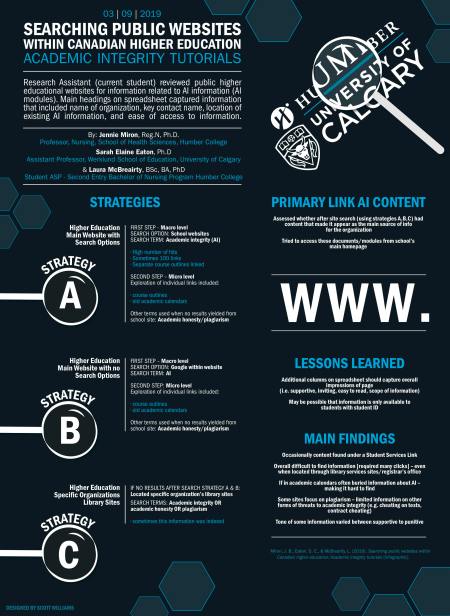
I’ve been working on a national research project with my colleagues, Jenny Miron and Laura McBrearity, at Humber College to look at what programming and supports Canadian post-secondary institutions provide to students to help them learn about academic integrity. We reviewed the websites of public higher education institutions across the country to better understand how academic integrity information is shared with students and faculty across campuses. We recently presented our findings at the conference of the International Center for Academic Integrity in New Orleans. Here’s a quick overview of our session:

Miron, J. B., Eaton, S. E., & McBrearity, L. (2019). Academic Integrity (AI) Tutorials in Canadian Post-Secondary Institutions: A National Overview. Paper presented at the International Center for Academic Integrity, New Orleans, LA.

The team at Humber College created this excellent visual infographic highlighting our methods (search strategies), lessons learned and key findings:

JPG (small) - Miron, Eaton & McBrearity - 2019 Final Infographic copy

We have not published the full findings yet, though we plan to do so soon. Because there is so little research available about what kind of support (e.g. education, tutorials, modules) offer on academic integrity to Canadian post-secondary students, we wanted to make these preliminary results available now.

You can download a high quality version of this infographic here:

Miron, J. B., Eaton, S. E., & McBrearity, L. (2019). Searching Public Websites within Canadian Higher Education: Academic Integrity Tutorials [Infographic]. Retrieved from http://hdl.handle.net/1880/109916

______________________________________________________

Share or Tweet this: Academic Integrity (AI) Tutorials in Canadian Post-Secondary Institutions: A National Overview

This blog has had over 2 million views thanks to readers like you. If you enjoyed this post, please “like” it or share it on social media. Thanks!

Sarah Elaine Eaton is a faculty member in the Werklund School of Education, University of Calgary, Canada. Opinions are my own and do not represent those of the Werklund School of Education or the University of Calgary.