This post situates academic integrity within the scholarship of teaching and learning (SoTL) discourse. The 4M framework frames integrity through a four interrelated organizational lenses: (a) micro (individual); (b) meso (departmental); (c) macro (institutional); and (d) mega (community).
Keywords: academic integrity, scholarship of teaching and learning (SoTL), pedagogy, 4M framework, systems theory.
Introduction
Using a framework to understand complex issues, such as those relating to academic integrity, can be helpful while avoiding being overly reductionist. For a long time scholars and educators haven calling for more pro-active and pedagogical approaches to academic integrity (Eaton et al., 2017; Howard, 2002; Morris, 2016). One scholar has even called academic integrity a “teaching and learning imperative” (Bertram Gallant, 2008). In addition, the position that academic integrity is solely a student responsibility is now considered outdated, as advocates call for multi-stakeholder approaches that engage various members of the learning community including students, educators, and administrators, in different but interconnected ways (Eaton et al., 2017; Morris, 2016).
To help us understand how all these different stakeholders play a role, a systems approach to academic integrity can be helpful (Bertram Gallant, 2016; Bertram Gallant & Kalichman, 2011; Drinan & Bertram Gallant, 2008).
Systems thinking is not new; it has been around for more than half a century, if not longer (Bronfenbrenner, 1976; 1981; von Bertalanffy, 1968).
The 4M Framework
Systems theory helped to inform the conceptualization of the 4M Framework, which was developed within the Scholarship of Teaching and Learning (SoTL) community to help educators understand teaching and learning inquiry (Friberg 2016; Kalu et al., 2018; Kenny et al., 2016; Poole & Simmons, 2013; Simmons, 2016; Williams et al., 2013). The framework consists of four nested levels: micro, meso, macro, and mega.

The 4M Framework: Micro, Meso, Macro, and Mega Levels
The Micro Level: Individual
Individual students and educators are at the heart of the 4M framework. Each person’s conceptual understanding of academic integrity, as well as practical skills such as paraphrasing, citing, and referencing, develop at an individual level. But this learning does not happen in isolation. It is impacted by other individuals within the system, as well as the system itself.
Individual educators also operate at the micro level when they are preparing course content, lessons and activities. Research has shown over and over again that students are more likely to care about academic integrity when educators show that it matter to them, too (Bertram Gallant, 2018; McCabe et al., 2012; Eaton et al., 2017). It is at this level that educators can have a direct and lasting impact on teaching students how to engage in ethical decision making and also how to build practical skills such as paraphrasing, citing and referencing.
The Meso Level: Departmental
At this level, academic departments and support units, such as the library or the student affairs office, provide resources and learning opportunities that allow academic integrity to be operationalized. At this level support for academic integrity can be hands-on and pro-active in the form of workshops, tutorials, and practical resources.
The Macro Level: Learning Organization
The learning organization (e.g., college or school) is responsible for setting the institutional direction and culture for academic integrity. This includes having clearly articulated policies and procedures that can be applied fairly and equitably across the institution. Leaders at this level can also act as champions who set the tone for the entire school (McCabe et al, 2012).
The Mega Level: Community
This level includes stakeholders who are connected with the school, but who may not be involved on a day-to-day basis. This includes government bodies, alumni, parents and others who can be engaged to as partners in promoting academic integrity and ethical conduct in a variety of ways.
It is important to engage with colleagues from other institutions to form networks of professional practice (Kenny et al., 2016). This helps us to expand our understanding, push our boundaries and learn with and from one another. When we engage with colleagues outside of our institutions, we are engaging at the mega level. This is essential for those working in academic integrity contexts, where there might be only a handful of individuals directly engaged with this work on a day-to-day basis. Ongoing engagement with a network of like-minded professionals is key to continuing our professional learning in a sustained and sustainable way.
Conclusions
The 4M lens helps us to understand who the various stakeholders are and how they can play a role in upholding and enacting academic integrity in our learning communities. Creating a culture of integrity cannot happen if only certain individuals are engaged (McCabe et al., 2012). Instead, creating a culture of integrity requires intentional and sustained effort across a variety of different stakeholder groups within the institution.
Discussion Questions
- Who are some of the stakeholders actively engaged in promoting academic integrity at your school?
- How are you engaging stakeholders at every level of your school to uphold and enact academic integrity?
- How are you creating a culture of integrity at your school?
References
Bertram Gallant, T. (2008). Academic integrity in the twenty-first century: A teaching and learning imperative. Hoboken, NJ: Wiley.
Bertram Gallant, T. (2016). Systems approach to going forward: Introduction. In T. Bretag (Ed.), Handbook of Academic Integrity (pp. 975-977). Singapore: Springer Singapore.
Bertram Gallant, T., & Kalichman, M. (2011). Academic ethics: A systems approach to understanding misconduct and empowering change in the academy. In T. Bertram Gallant (Ed.), Creating the ethical academy: A systems approach to understanding misconduct and empowering change in higher education (pp. 27-44). New York: Routledge.
Boyer, E. L. (1990). Scholarship reconsidered: Priorities of the professoriate. New York: The Carnegie Foundation for the Advancement of Teaching.
Bronfenbrenner, U. (1976). The Experimental Ecology of Education. Paper presented at the American Educational Research Association (AERA), San Francisco, CA
Bronfenbrenner, U. (1981). The ecology of human development: Experiments by nature and design. Cambridge: Cambridge: Harvard University Press.
Drinan, P. M., & Bertram Gallant, T. (2008). Plagiarism and academic integrity systems. Journal of Library Administration, 47(3-4), 125-140. doi:10.1080/01930820802186472
Eaton, S. E., Guglielmin, M., & Otoo, B. (2017). Plagiarism: Moving from punitive to pro-active approaches. In A. P. Preciado Babb, L. Yeworiew, & S. Sabbaghan (Eds.), Selected Proceedings of the IDEAS Conference 2017: Leading Educational Change Conference (pp. 28-36). Calgary, Canada: Werklund School of Education, University of Calgary. https://prism.ucalgary.ca/handle/1880/52096
Friberg, J. C. (2016). Might the 4M Framework Support SoTL Advocacy? (July 11). Retrieved from https://illinoisstateuniversitysotl.wordpress.com/2016/07/11/might-the-4m-framework-support-sotl-advocacy/
Howard, R. M. (2002). Don’t Police Plagiarism: Just TEACH! The Education Digest, 67(5), 46-49.
Kenny, N., Watson, G. P. L., & Desmarais, S. (2016). Building sustained action: Supporting an institutional practice of SoTL at the University of Guelph. New Directions for Teaching and Learning, 2016(146), 87-94. doi:10.1002/tl.20191
Kalu, F., Dyjur, P., Berenson, C., Grant, K. A., Jeffs, C., Kenny, N., & Mueller, R. (2018). Seven voices, seven developers, seven one things that guide our practice. To Improve the Academy, 37(1), 111-127. doi:10.1002/tia2.20066
McCabe, D. L., Butterfield, K. D., & Treviño, L. K. (2012). Cheating in college: Why students do it and what educators can do about it. Baltimore, MD: Johns Hopkins University Press.
Morris, E. J. (2016). Academic Integrity: A Teaching and Learning Approach. In T. Bretag (Ed.), Handbook of Academic Integrity (pp. 1037-1053). Singapore: Springer Singapore.
Poole, G., & Simmons, N. (2013). Contributions of the scholarship of teaching and learning to quality enhancement in Canada. In R. Land & G. Gordon (Eds.), Enhancing quality in higher education international perspectives (pp. 278-298). London: London: Routledge.
Simmons, N. (2016). Synthesizing SoTL institutional initiatives toward national impact. New Directions for Teaching and Learning, 2016(146), 95-102. doi:10.1002/tl.20192
von Bertalanffy, L. (1968). General system theory: Foundations, development, applications. New York: George Braziller.
Williams, A. L., Verwoord, R., Beery, T. A., Dalton, H., McKinnon, J., Strickland, K., . . . Poole, G. (2013). The Power of social networks: A model for weaving the scholarship of teaching and learning into institutional culture. Teaching & Learning Inquiry: The ISSOTL Journal, 1(2), 49-62. doi:10.2979/teachlearninqu.1.2.4
_____________________
To cite this post in your own work, refer to the original report archived online:
Eaton, S. E. (2020). Understanding Academic Integrity from a Teaching and Learning Perspective: Engaging with the 4M Framework. Calgary: University of Calgary. http://hdl.handle.net/1880/112435
For a deeper dive into this topic, read more in:
Eaton, S. E. (2021). Plagiarism in higher education: Tackling tough topics in academic integrity. Santa Barbara, CA: Libraries Unlimited.
_________________________________
Share or Tweet this: Understanding Academic Integrity from a Teaching and Learning Perspective: Engaging with the 4M Framework https://drsaraheaton.wordpress.com/2020/08/27/understanding-academic-integrity-from-a-teaching-and-learning-perspective/
This blog has had over 2 million views thanks to readers like you. If you enjoyed this post, please “like” it or share it on social media. Thanks!
Sarah Elaine Eaton, PhD, is a faculty member in the Werklund School of Education, and the Educational Leader in Residence, Academic Integrity, University of Calgary, Canada. Opinions are my own and do not represent those of the University of Calgary.


 Posted by Sarah Elaine Eaton, Ph.D.
  Pretty excited to see that my upcoming book now has an official webpage on the publisher site! The manuscript has been officially approved by my editor, the wonderful Jessica Gribble. The next steps are for it to move into production. The scheduled release date is early 2021.
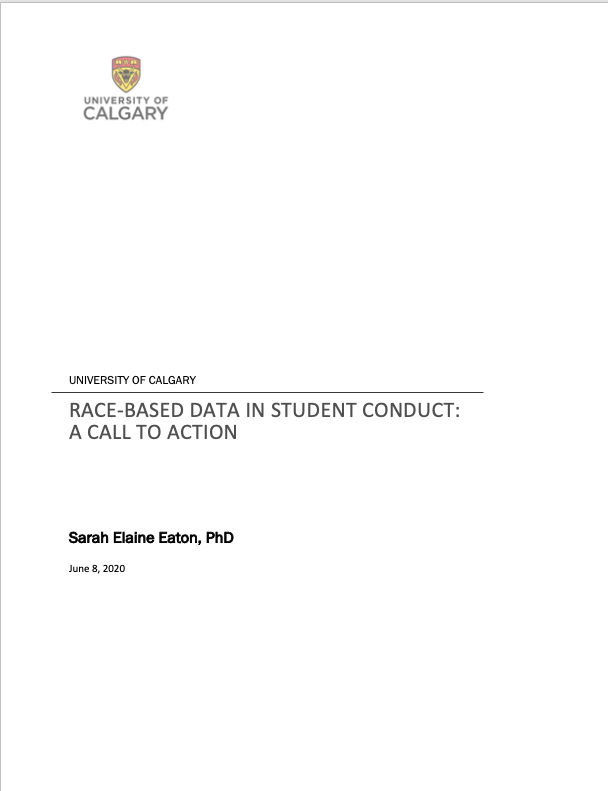 It is essential to take a strong stand against systemic racism and discrimination. This includes a commitment to identify and address racism and discrimination in matters relating to academic and non-academic student misconduct. In this report I synthesize existing resources and issue a call to action to collect more race-based data relating to student conduct for the purposes of identifying and addressing systemic injustices perpetuated by existing higher education reporting, policies and procedures.


You must be logged in to post a comment.