Tomorrow’s free webinar on marketing literacy and language schools – Setting marketing goals, target markets, budgets

March 27, 2012

Join us tomorrow for the second in a series of ten free webinars on how to market and promote your literacy program or language school.

These webinars highlight different ideas from 101 Ways to Market Your Language Program. Every week you get practical, low-cost ideas to help you promote your program. Best of all, you’ll get to connect with others on line who are also interested in the same topic, ask questions and interact.

The webinars are  30 to 60 minutes in length. Bring a pen and paper. I’m going to give you lots of ideas you can implement right away.

Webinar #2 of 10 – What to expect

Tomorrow’s webinar will focus on:

  • How to set marketing goals
  • How to identify a target market
  • The difference between “end users” and “target market”
  • How to budget for marketing and promotion

There are some time zone changes coming up around the world, so double-check these times against your local area:

Wednesday, March 28, 2012

Point of origin – 14:00 (2:00 p.m.) Mountain Time, March 21, 2012 – Calgary / Edmonton

16:00 (4:00 p.m.) – Eastern Time – Toronto / New York

20:00 (8:00 p.m.) – Greenwich Time – London, England

22:00 (10:00 p.m.) – Eastern European Time – Athens / Istanbul

05:00 (5:00 a.m.) – following day – Japan Standard Time – Tokyo

To join the webinar, click here: http://meet11548754.adobeconnect.com/saraheaton/ — There is no need to register. These webinars are free and open to everyone. Seating is limited though, so sign on early.

I’ll record the and post it so you can view it later, too.

Here’s what we’ll cover in upcoming webinars:

Week #3 – Focus on benefits, writing marketing materials

Week #4 – Business cards, newsletters, signs and other communications

Week #5 – What makes people care about you. How to stand out from the crowd.

Week #6 – Specialty tips for programs at large institutions

Week #7 – Relationship marketing. The power of connections.

Week #8 – It’s how you make them feel. Adding personal touches that make all the difference

Week #9 – Effective follow up with your marketing and not giving up too soon.

Week #10 – Social media for marketing

All you have to do is block off Wednesdays in your calendar at your corresponding local time and then log in using the link above.

If you can’t make the webinar, and you’d like to ask a question about the topic, feel free to leave me a comment. I’ll do my best to answer questions that come in before the program during the webinar. You can watch the recording to get the answer to your question, or I’ll answer you back in the comment section.

Related posts:

Webinar recording: 101 Ways to Market Your Language and Literacy Program (#1) http://wp.me/pNAh3-1jF

101 Ways to Market Your Language Program (10 Free webinars) http://wp.me/pNAh3-1j6

___________________________

Share or Tweet this post:  Tomorrow’s free webinar on marketing literacy and language schools – Setting marketing goals, target markets, budgets http://wp.me/pNAh3-1k6

Update – January 2018 – This blog has had over 1.8 million views thanks to readers like you. If you enjoyed this post, please “like” it or share it on social media. Thanks!

Sarah Elaine Eaton is a faculty member in the Werklund School of Education, University of Calgary, Canada.


101 Ways to Market Your Language Program (10 Free webinars)

March 14, 2012

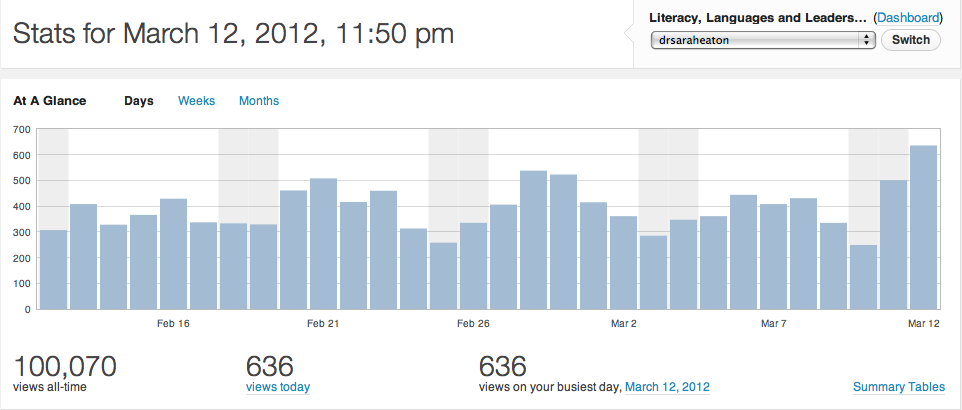
What an amazing week! My blog is just over 2 years old and this week, we topped 100,000 all-time views and 200 subscribers.

It’s definitely time to celebrate.

10 Free Webinars on How to Market and Promote Your Language or Literacy Program

Over the next 10 weeks, I’m going to host a free webinar every week. Each one will highlight different ideas from 101 Ways to Market Your Language Program. Every week you’ll get practical, low-cost ideas to help you promote any language or literacy program. Best of all, you’ll get to connect with others on line who are also interested in the same topic, ask questions and interact.

The webinars will be 30 to 60 minutes in length. Bring a pen and paper. I’m going to give you lots of ideas you can implement right away.

We’ll do the webinars for the next ten Wednesdays: March 21 to May 23, 2012

There are some time zone changes coming up around the world, so double-check these times against your local area:

Point of origin – 14:00 (2:00 p.m.) Mountain Time, March 21, 2012 – Calgary / Edmonton

16:00 (4:00 p.m.) – Eastern Time – Toronto / New York

20:00 (8:00 p.m.) – Greenwich Time – London, England

22:00 (10:00 p.m.) – Eastern European Time – Athens / Istanbul

05:00 (5:00 a.m.) – following day – Japan Standard Time – Tokyo

To join the webinar, click here: http://meet11548754.adobeconnect.com/saraheaton/ — There is no need to register. These webinars are free and open to everyone. Seating is limited though, so sign on early.

I’ll record each webinar and post it so you can view it later, too.

This is essentially a 10-week course designed to take you through the entire book from beginning to end. I’ll include some marketing “best practices” and show you how to start thinking about promoting your programs to ensure they are sustainable over the long term. I’ll share some case studies and stories, along with lots of practical “how to” information that you can use right away.

Here’s what we’ll cover

Week #1 – How to develop your marketing strategy and plan

Week #2 – Setting marketing goals, target markets, budgets

Week #3 – Focus on benefits, writing marketing materials

Week #4 – Business cards, newsletters, signs and other communications

Week #5 – What makes people care about you. How to stand out from the crowd.

Week #6 – Specialty tips for programs at large institutions

Week #7 – Relationship marketing. The power of connections.

Week #8 – It’s how you make them feel. Adding personal touches that make all the difference

Week #9 – Effective follow up with your marketing and not giving up too soon.

Week #10 – Social media for marketing

All you have to do is block off the next 10 Wednesdays in your calendar at your corresponding local time and then log in using the link above. It’s that easy. And it’s my way of showing my appreciation to you.

Thank you to everyone who has viewed the blog, left a comment or subscribed. I really love the work I do and being able to share with you, learn from you and engage with you inspires me every single day.

___________________________

Share or Tweet this post: 101 Ways to Market Your Language Program (10 Free webinars) http://wp.me/pNAh3-1j6

Update – January 2018 – This blog has had over 1.8 million views thanks to readers like you. If you enjoyed this post, please “like” it or share it on social media. Thanks!

Sarah Elaine Eaton is a faculty member in the Werklund School of Education, University of Calgary, Canada.


Is being a language teacher dangerous to your health?

March 13, 2012

Do you work in poor, run-down conditions? Or an old building that’s falling apart?

Amelia’s story

Amelia Labbe Sarah Eaton University of CalgaryWhen I started my Master’s degree in Spanish at the University of Calgary, I heard staff and professors complaining about the air quality and run down conditions in Craigie Hall, the building where the modern language departments are housed. I never really thought about it much, since I head my head buried in my books and I was learning to live in a new city and adjust to the pressures of being a young graduate student.

One of the first people to welcome me into the department was Amelia Labbé. A native of Bolivia, Amelia ran the university’s Centro de Tertulia (Spanish Centre). Officially, Amelia’s job was to provide opportunities for conversation with a native speaker. Unofficially, the Centro de Tertulia became a place where students would gather, socialize in Spanish, help one another with their homework, listen to music in Spanish and sometimes even watch telenovelas.  There was only one rule: When you crossed the threshold in to the Centro, it was Spanish only. No English. No French. Solamente español. It was her one rule and she stuck to it.

Amelia also became a mentor and unofficial advisor to many students who sought her council and words of wisdom, even though it was not part of her job. Officially, the university has designated student advisors and anyone who is not a designated advisor is not supposed to offer guidance to students. But that didn’t stop students from asking her what she thought and seeking her advice. Students trusted her. They could tell that she cared deeply about them… In fact, she cared more about the students than she did about regulations or rules. Over the course of her career, she touched the lives of thousands of students who studied Spanish at the University of Calgary, including mine.

Last fall, Amelia fell ill. She blamed it on the building where she worked, which was known to have asbestos in it. On November 8, 2011, Amelia passed away from pulmonary fibrosis. Along with many of my friends and colleagues, I attended the celebration of her life on November 19.

Faculty and staff complaints about poor air quality are blown off

Since then, twenty years of complaints about the state of the building and questions about its air quality have erupted into a full-scale war. I have gone from being a Master’s student to working in the Language Research Centre, where I now have the privilege of being a Research Associate and an Adjunct Assistant Professor, after finishing my Ph.D.

An informal investigation was held a few years ago when it was determined that an extraordinarily high percentage of the faculty and staff had been diagnosed with cancer. Many of them pointed to their physical working conditions as a factor in their illness. Tests were done. Faculty and staff were told that everything was fine. Sadly, the incidence of cancer diagnosis among language faculty continued. Others were diagnosed with asthma and unknown allergies. No one could prove any correlation between the physical environment and the incidence of illness.

Following Amelia’s passing, some faculty members and staff insisted that a full investigation be conducted. Today, the CBC published, “Teacher’s lung disease death prompts U of C building worries: But officials say Craigie Hall air quality not compromised by asbestos“. The story documents reactions to Amelia’s health issues and subsequent passing, and speculations that her physical work environment were the root cause of her death. Amelia’s husband and my colleague and mentor, Dr. Rachel Schmidt, publicly offered commentary to reports.The university released a statement declaring that “air quality and environment are within the acceptable guidelines“.

Language programs: Between a rock and a hard place

In my Ph.D. research I found that it is not uncommon for language programs at large institutions to be marginalized both politically and in terms of their physical placement on a campus.

Here’s an excerpt from my Ph.D. thesis:

Language programs, because they are not necessarily seen as academic in nature, do not always have a prominent place on campus. While it would be logical for ESL programs to be physically positioned in places that are easily accessible by foreign students who struggle with the language, “many … programs are housed in temporary bungalows, in basements, or on the periphery of our campuses” (Stoller, 1997, p. 40).

This assertion is echoed more recently by Quay Connection (2000, p. 14) whose research shows that “Many providers say their facilities are too run down, too small, impermanent, unattractive.” This speaks to the question of the legitimacy of such programs, which is discussed later on. For now it is enough to note that the physical placement of such programs on a campus is one indicator of how they are viewed by administration (Stoller, 1997). Program managers must often advocate for improved space and facilities for their programs. (Eaton, 2009, pp. 66-67).

My thesis dealt specifically with ESL programs. In the case of one of the programs I studied, it had just recently been relocated to the main floor of the building. Previous to that, it was located on the 14th floor of the building. The very odd thing about that particular building was that the 14th floor was accessible only by taking the elevator to the 13th floor and then taking the stairs up one more floor. So, non-native speakers of English were required to navigate a complex procedure in order to get to the program offices. Even native speakers had trouble figuring out how to get to their offices.

Even though the Department of French, Italian and Spanish has been renovated now, the Department of Germanic, Slavic and East Asian languages is still in need of renovations. Both language departments remain in an unattractive and outdated building with an elevator that is often broken down. The building is known to have asbestos.

A jumping off point

It seems that there is some evidence that shows that language programs are located in physical spaces that are far from ideal. In the work I have done with language programs at high schools, colleges and universities, this seems to be a common complaint… but with little to no research to identify whether or not this is indeed a problem in the field of language teaching. My guess is that large scale studies about the physical marginalization of language programs at institutions have never been done. (If you know of any such studies, please leave a comment!)

Language programs should not be relegated to old, run down buildings or pushed into basements. Language program administration and management includes advocating for programs and courses. As faculty and staff, it is our responsibility to advocate for one another, too. Some recommendations to consider:

  1. Have conversations with colleagues about the physical conditions in which you work. Are they adequate? Does your physical space promote health and well-being?
  2. Advocate for an improved location on your campus. Particularly in the case of ESL programs, students need to be able to find your offices.
  3. Engage in conversations and dialogue with faculty committees and administrators.
  4. If you suspect health issues that are due to your physical environment, keep detailed records and write it all down. Without documentation, it is more difficult to make a case for further investigation.
  5. Draw on support from your faculty association or union, if you have one. These bodies exist to protect workers’ rights, including their health.
  6. Take care of yourself. If  you are suffering ill effects and you believe that your work environment may be a contributing factor, do what you need to do to keep yourself healthy. I have colleagues in Craigie Hall who work as much as possible from home, one now works in another building and another brought in her own air filtration machine for her office. None of these is a perfect solution, but they may help. If nothing else, they give the employees a sense of empowerment, which is essential when you’re fighting cancer, or another life-threatening illness.

I’ve now watched a friend and colleague die and an alarming number of other friends have been diagnosed with cancer or asthma. No one knows for sure what the cause is. They’re all pretty convinced that the building where they work is a factor.

How’s the physical space where your language program is located?

References:

Eaton, S.E. (2009). Marketing of Revenue-generating ESL Programs at the University of Calgary: A qualitative study. Thesis. University of Calgary, Canada.

Quay-Connection. (2000). Marketing ACE in Victoria. Annadale (Australia): Adult, Community and Further Education Board, Melbourne (Australia).

Stoller, F. L. (1997). The catalyst for change and innovation. In M. A. Christison & F. L. Stoller (Eds.), A handbook for language program administrators (pp. 33-48). Burlingame, CA: Alta Book Center Publishers.

Update on this story: On March 21, I was quoted in the Calgary Herald’s article, “Craigie Hall Asbestos Level Normal: Review“. The article was written after the university released a report stating that everything was fine with the air quality in the building. Still though… it is puzzling why so many staff complain of health concerns?

____________

Share or Tweet this post: Is being a language teacher dangerous to your health? http://wp.me/pNAh3-1iJ

Update – January 2018 – This blog has had over 1.8 million views thanks to readers like you. If you enjoyed this post, please “like” it or share it on social media. Thanks!

Sarah Elaine Eaton is a faculty member in the Werklund School of Education, University of Calgary, Canada.


Inspiring: Schools in Australia join forces to rescue languages

February 9, 2012

Sarah Eaton, speaker, keynote, second languages, literacy, Canada, foreign languagesIs the language program at your school gasping for its last breath? If so, you are not alone. Language programs across the globe are suffering from decreased enrollments, diminished interest from students and perhaps most frustrating, lack of money to keep the program going.

Schools in Victoria, Australia, have banded together to turn all that around after enrollment in language programs plummeted in the area. The stats look something like this:

Primary students taking languages in Victoria, Australia

1999 – 89%

2010 – 69%

Secondary students taking languages in Victoria, Australia

1999 – 54%

2010 – 41%

That is an alarming drop in enrollment. The new program, Content and Language Integrated Learning (CLIL), is slated to change all that. The initiative is so innovative, it made the local paper. The new program takes a content-based language teaching (CBLT) approach to second languages, teaching core subjects such as math, science and humanities in a second language. Schools will share resources and even share teachers, to ensure that children have access to the best quality learning experience possible.

The article reports that:

The government so far has funded 14 language clusters involving 102 primary and secondary schools across the state to trial the system over 18 months until the end of this year.

The languages chosen are Italian, Indonesian, German, Japanese, French, Chinese and Auslan, with schools offering one to three of those. Each cluster has a lead school that works to ensure standards are met and to co-ordinate the distribution of resources.

The government is also chipping in for 25 annual professional development scholarships for language teachers who want to upgrade their skills, and 45 scholarships for undergraduate students studying to become language teachers.

This is a brand new program, so there is no way to tell yet if it will be successful. What is inspiring though, is the collective commitment on the part of the schools and supported by the government, to make language learning a priority. The fact that they are also offering scholarships to teachers-in-training shows that they are not only thinking about today, but they are also thinking about tomorrow by investing in the education of aspiring language teachers.

Kudos to you, our friends in Victoria, Australia. You are finding creative ways to collaborate and turn a dismal and down-spiraling situation into inspired education for the 21st century.

Check out the original article, by Amanda Dunn, published in The Age.

____________________________

Share this post: Schools in Australia join forces to rescue languages http://wp.me/pNAh3-1dY

Update – January 2018 – This blog has had over 1.8 million views thanks to readers like you. If you enjoyed this post, please “like” it or share it on social media. Thanks!

Sarah Elaine Eaton is a faculty member in the Werklund School of Education, University of Calgary, Canada.


5 key tips for language and literacy programs on how to use letterhead and envelopes effectively

December 30, 2011

It makes me crazy when I receive a letter with the printed address crossed out because the organization moved and is trying to save paper by using outdated letter head. Your program deserves its own letterhead, with matching envelopes.

Even worse, I shudder when I receive a poorly formatted letter from an organization that prides itself on helping others build their skills through language and literacy education.

Among the 9 Literacy and Essential Skills, one of them is writing. It is important for language and literacy organizations to lead by example when it comes to written communications. Not only does this help you with your organizational branding and marketing, it also helps to ensure that you are demonstrating leadership when it comes to the art and business of written communications.

Tip #1 – Letterhead must contain your contact information

Proper letterhead will include organizational information such as:

  • your mailing address, including the postal code
  • telephone and fax numbers, including the area code
  • organizational logo, if you have one
  • general e-mail address for the organization (e.g. info@…)
  • your website address

It is also becoming common to include social media contact information such as your organizational Twitter account or Facebook page, but these are less critical than your basic contact information.

If your program is housed within a larger organization, ensure that your specific mailing address, including the location of your program office, is indicated on your letterhead. If this information is left out, written correspondence is more likely to get lost or take longer to arrive because it can be delivered to the wrong office in error.

Tip #2 – Have matching envelopes in different sizes

All too often, I have seen literacy or language program letterhead with matching standard-size letter envelopes, but when it comes to mailing out program information and brochures, only plain brown envelopes are used. And worse, sometimes in the busy office environment, staff may forget to make labels for the return address.

If costs are prohibitive and your program can not afford envelopes printed in a variety of sizes, at the very least, buy some inexpensive labels that can be printed off at your office that contain your contact information. Ensure that all staff, including part-time or evening staff who are allowed to send mail on behalf of the organization, have access to organizational stationery, including return address labels.

Tip #3: Include the date and the recipient’s information near the top of the letter

Traditionally, this information is printed on the left-hand side of the letter. If you do not use a word-processing template that automatically tells you where to insert this information, insert 6 to 10 lines before writing the date. Start with the date and follow it with the recipient’s address.

Abbreviations of the date are not usually used in letters. There are two generally accepted formats:

North American format: December 30, 2011

European format: 30 December 2011

The North American format includes a comma between the day and the year. The European format contains no comma.

Two or three lines below this, the recipient’s information is written in this format:

Name (write out their full first and last name)

Title or position

Address Line 1

Address Line 2 (if necessary)

City, State (or Province), postal code, Country

There are accepted variations on this format, but it is important to include the date and the recipient’s information in a relatively standardized way that it is used consistently across the organization.

Tip #4: Fold letters appropriately

For letters that are inserted into a standard-size envelope (in North America, that is a #10 envelope), they should be folded twice, so that the end result is a piece of paper that is divided neatly into thirds.

The proper method is to fold the letter into thirds starting and the bottom and ending at the top, so that when the process is reversed and the letter is unfolded, the top third of the letter is what shows first. In other words, when the flap of the first fold opens outwards, it reveals the recipient’s name and address. The reason for this is rooted in office traditions where a secretary would receive and open all the mail for an organization. Envelopes were generally opened all at the same time using a letter opener. The letter opener was slid along the long side of the envelope, which had been sealed by the sender. Letters were taken out of their envelopes one by one.

In the event that a letter had been received by the wrong recipient in error, the secretary would know immediately, when she (and it was usually a she) opened the first flap of the letter. The intended recipient’s name and address would be visible, but the main body of the letter would remain hidden, due to the fact that the letter had only been unfolded part way.

Knowing immediately that the letter had been received in error, the discreet secretary would refold the letter (supposedly without bothering to open it the rest of the way and read it) and then ensure that the letter was delivered to its intended recipient.

If the folds are reversed so that the first flap reveals the senders signature, the entire letter has to be fully opened before any errors might be detected.

Tip #5: Use proper salutations and closings in your letters

Business letters traditionally start this way:

Dear (Title – e.g. Mr., Ms., Dr., etc.) (Recipient’s surname):

Business letters use a colon, not a comma, after the recipient’s name. Commas are used in personal, hand-written letters.

Though it has become common place in North America to use a person’s first name in the salutation of a business letter, the tradition with a typed or computer-printed letter is to write out the person’s title and last name. If the sender knows the recipient well and they are on a first name basis, then the sender strikes out the title and last name with a pen, and writes the person’s first name by hand above their printed name. This shows  formal respect, acknowledgement of the first-name relationship and attention to detail on the part of the sender. Ideally, this is done with the same pen that the sender uses to sign the letter.

Having said that, I have been known to opt for the increasingly accepted method of addressing a letter to a colleague whom I know well by his or her first name. When I do though, it is a conscious choice on my part, rather than accepted standard. It is important for those working in literacy and educational organizations to know the proper standards in order to make informed professional choices.

I have also taught this tradition to students in my Effective Learning courses, as all too often, they seem to think it is acceptable to start a letter with salutations such as: “Dear Miss” (no name, just “Miss”), “Dear Teacher” or “Hi”. Heaven help them if they start a letter with “Hey there!” Once you know the proper way, you can make your own choices from there, but at least they are informed choices. There is a difference between breaking the rules and not knowing them in the first place. Language and literacy professionals, in my professional opinion, should be the last to plead ignorance in matters relating to writing. (Boy, that sounded snotty, didn’t it? Well, so be it…)

Moving right along, appropriate closings for business letters are:

Sincerely,

Yours truly,

Best regards,

Closings are followed by a comma. Four or five lines are left below the closing for the signature. Then, the sender’s name is computer-printed. His or her title or position may be written on the line below, if desired.

There are minor variations on these guidelines and some readers might think that I’ve suddenly become very stuffy or nit-picky by suggesting that letters need to be folded in a particular way. I confess to a certain amount of sadness and dismay when I receive letters on letter head that has an address from two office moves ago, envelopes with no return address or letters folded so that the body of the letter shows on the outside of the folds, rather than the inside of the fold. When these gaffes happen in letters from literacy and educational organizations, they make me downright me crazy.

Your program stationery is part of your organizational marketing and branding. If you intend to market your program effectively, start with the basics. Ensure that you have a complete set of stationery with up-to-date contact information.

Your organizational image, however, goes beyond having letterhead with your logo stamped on it. Insist that everyone working in the office use official stationery for all office correspondence and use it in a way that demonstrates high levels of text literacy and leadership in the art of writing professionally.

This post is adapted from “Idea #19: Have letterhead and matching envelopes made for your program ” in 101 Ways to Market Your Language Program

________________

Share or Tweet this post: 5 key tips for language and literacy programs on how to use letterhead and envelopes effectively http://wp.me/pNAh3-wC

Update – January 2018 – This blog has had over 1.8 million views thanks to readers like you. If you enjoyed this post, please “like” it or share it on social media. Thanks!

Sarah Elaine Eaton is a faculty member in the Werklund School of Education, University of Calgary, Canada.