Marketing tip: Ask your students where they heard about you

August 20, 2011

This is a simple way of determining which method of marketing works for your language or literacy program: Ask your students how they heard about you. Do most of your students find out about you through the Internet? …word of mouth? …your brochure? … trade fairs? Once you figure out what has proven most successful, you will know where to focus more of your marketing dollars.

I suggest getting this valuable information in writing. Whether it is through an evaluation form or an exit interview where the results are recorded, get the information in concrete written form. Compare it from year to year. See if your most successful marketing strategy changes over time.

Of course, we know that word of mouth is the most powerful way to market your program. If the majority of your students come to you through word of mouth, then you are very lucky. Most language schools need to combine word of mouth with other marketing efforts.

But what other marketing efforts are successful for you? You may be surprised. You may be pouring thousands of dollars into a fancy brochure and find out that 85% of your students used the Internet to find you. If that is the case, you would want to drive more of your marketing dollars into the Internet (maybe pay for a higher ranking on a search engine or get a banner ad onto other people’s sites). Once you know what has proven successful, you can use that information to generate even more interest and registrations.
Marketing materials: tools and tips to do the job better

This post is adapted from “Idea #18” in 101 Ways to Market Your Language Program

________________

Share or Tweet this post: Marketing tip: Ask your students where they heard about you http://wp.me/pNAh3-wA

Update – January 2018 – This blog has had over 1.8 million views thanks to readers like you. If you enjoyed this post, please “like” it or share it on social media. Thanks!

Sarah Elaine Eaton is a faculty member in the Werklund School of Education, University of Calgary, Canada.


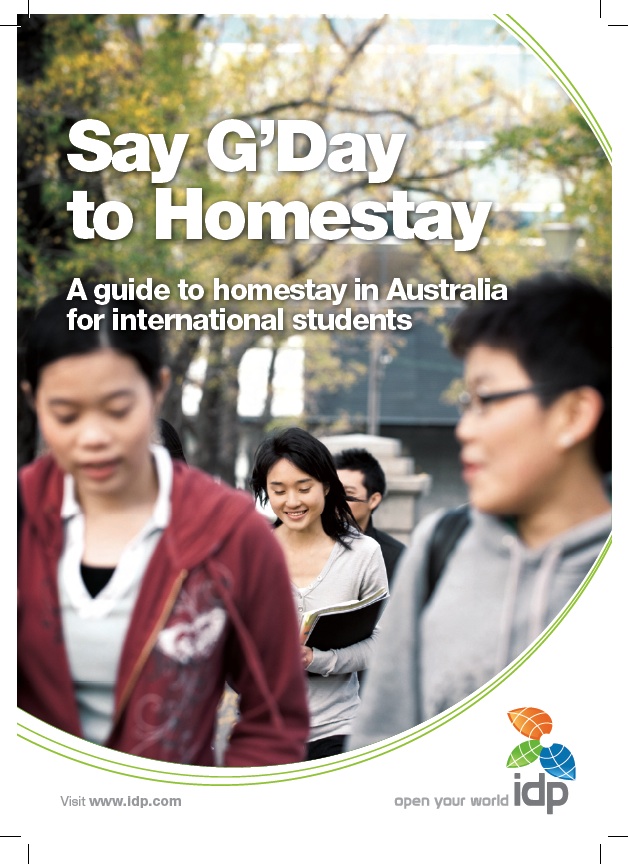
Resource: “Say G’Day to Homestay”

July 27, 2011

G'Day to HomestayIDP is an Australian organization specializing in international education services for Australia. One of those resources is a homestay guide called Say G’Day to Homestay. It is for Australia-bound international students who will be living with a local family.  This is a brilliant guide. It answers questions about everyday life in Australia that foreigners may not know such as:

  • How do I get to school?
  • What will I eat?
  • How do I dispose of household waste?

It also offers tips on laundry, lights, heating, using the telephone, home security, smoking and pets.

These are topics that locals take for granted because they seem second nature to us. The same issues confound and confuse the foreigner who may have no idea of what is expected or appropriate.

This guide is specifically for students going to Australia. If you’re not in Australia, go check it out anyway. Then ask yourself how you can provide a similar guide to your international students that will help them understand the same issues in your local area.

Here’s the link to the guide: http://www.idp.com/PDF/Say%20Gday%20to%20Homestay.pdf

Related posts:

___________________

Share this post: Resource: “Say G’Day to Homestay” http://wp.me/pNAh3-PP

Update – January 2018 – This blog has had over 1.8 million views thanks to readers like you. If you enjoyed this post, please “like” it or share it on social media. Thanks!

Sarah Elaine Eaton is a faculty member in the Werklund School of Education, University of Calgary, Canada.


New Report: The Economic ROI of Adult Education Programs

July 1, 2011

A new policy paper published by the McGraw-Hill Research Foundation that was developed in collaboration with the United States’ National Council of State Directors of Adult Education and the U.S. National Adult Education Professional Development Consortium states that “a preemptive focus on adult education actually saves governments money by reducing societal healthcare, public assistance, and incarceration costs”.

The report, “The Return on Investment from Adult Education and Training: Measuring the Economic Impact of a Better Educated and Trained U.S. Workforce,” put it in plain simple language by saying that adult education “improves and expands the nation’s available pool of human capital by helping motivated but under educated people achieve gainful employment in today’s increasingly high-tech and global job market, and at a far lower cost per learner when compared to either K-12 or higher education.”

The co-authors Dr. Lennox McLendon (Executive Director, National Council of State Directors of Adult Education and the National Adult Education Professional Development Consortium), Debra Jones (California Director of Adult Education and Chair, NAEPDC Research Workgroup) and Mitch Rosin (Editorial Director, McGraw-Hill School Education Group) have put together a solid 26-page report that is a brilliant combination of statistics and related evidence that ultimately constructs a clear picture of the economic return on investment (ROI) of adult education and literacy programs. The culmination of the evidence they present  fully supports their closing argument:

“Current federal adult education and workforce skills programs need to be better funded, but they also need to be redesigned and connected more effectively to state and local programs. We must have an integrated system of adult education and workforce development that serves millions of Americans in accessible, affordable, and accountable ways – on the job, online, and in the classroom.”

Although this report is focused on the U.S.A. it provides compelling evidence for programs in other countries, too.

This is a report that is worth looking at and sharing.  Download your free copy from here: http://www.mcgraw-hillresearchfoundation.org/wp-content/uploads/the-return-on-investment-from-adult-education-and-training.pdf

Related posts:

The economic impact of language programs on communities

Research: ESL programs boost Calgary’s economy by $26M+ per year

________________

Share this post: New Report: The Economic ROI of Adult Education Programs http://wp.me/pNAh3-Mm

Update – January 2018 – This blog has had over 1.8 million views thanks to readers like you. If you enjoyed this post, please “like” it or share it on social media. Thanks!

Sarah Elaine Eaton is a faculty member in the Werklund School of Education, University of Calgary, Canada.


How to Market Your Literacy or Language Program (Free 5-part video series)

May 30, 2011

I’m happy to share this 5-part video series that was recorded live at the 2010 Spotlight on Learning Conference, held in Toronto, Canada by the Ontario Literacy Coalition.

I did a one-hour presentation on how to promote literacy and language programs. The conference organizers videotaped the session and are sharing it publicly. You can consider this a one-hour crash course in marketing:

Low-cost High-Impact Marketing for Literacy Programs – Part 1

Low-cost High-Impact Marketing for Literacy Programs – Part 2

Low-cost High-Impact Marketing for Literacy Programs – Part 3

Low-cost High-Impact Marketing for Literacy Programs – Part 4

Low-cost High-Impact Marketing for Literacy Programs – Part 5

Related posts:

______________

Share this post: How to Market Your Literacy or Language Program (Free 5-part video series) http://wp.me/pNAh3-Gq

Update – January 2018 – This blog has had over 1.8 million views thanks to readers like you. If you enjoyed this post, please “like” it or share it on social media. Thanks!

Sarah Elaine Eaton is a faculty member in the Werklund School of Education, University of Calgary, Canada.


How ESL and other Language Schools Can Use Webinar Technology

April 30, 2011

The word webinar is being used today to refer to all kinds of online training and virtual presentations.

More and more literacy and language schools are adding a component of e-learning to their programs. It’s the 21st century way to learn!

Webinars are relatively easy to put on. Some of the language is a bit different from face-to-face environments, so it’s helpful to know that instructors, facilitators and teachers are mostly referred to as “presenters” in the webinar environment. Students, learners and clients are generally called “participants”.

Both presenters and participants need to have basic technology and computer literacy in order to take part in a webinar. This may mean that your current teachers and facilitators require some training before moving into an e-learning environment. Your participants may benefit from an orientation prior to the content to familiarize them with how webinars work.

Assuming that both parties have the technology literacy to move forward, here are some ideas on how you can make the most of webinar technology in your organization.

For Participants

Online group classes

Bring participants together in an e-learning class not only to teach them new content and skills, but also to learn how to work together in an online environment.

Online tutoring

Do you have learners in rural and remote areas? Or single parents who find it hard to get a sitter? Online tutoring provides a way for otherwise isolated learners to connect with tutors from the comfort and convenience of their own home. This is a super way to reach out to people who might otherwise not engage with learning.

Information sessions

If you offer information sessions about your programs in a live setting (your office space, a public library or elsewhere), you can adapt your content and host virtual information sessions. Information sessions are for prospective students and have a slight marketing component. A word of caution though… don’t try to “sell” in a webinar. Instead, demonstrate your expertise and what makes you unique.

Orientation sessions

When you bring new students into your organization, do you give them an orientation on  what to expect and how things work there? Photos, maps, and other materials can also be used in an online environment to give a virtual orientation. Though I’m a big fan of doing live webinars, this is one that you could record and use over again.

Pre-arrival workshops

If you offer classes for international students coming to learn English as a Second Language, an online pre-arrival workshop can be very helpful. Using photos, you can demonstrate what kind of clothes to bring (e.g. warm sweaters and winter boots), photos of the airport and what it will look like when they arrive, photos of what a typical airport arrival day looks like, and whatever other information you’d like them to know before they get to the program.

Follow-up workshops

Webinars are a great way to keep relationships going once the opportunity for face-to-face interaction has passed. A value-added webinar one month after the course ends is a super way to stay connected. Use the next upcoming holiday as a theme for your class and have everyone learn about it in the virtual classroom. In cases where participants already know one another, the online interaction is usually fun and very dynamic.

For staff and volunteers

Volunteer information sessions

Do you like the idea of having virtual teachers or tutors? Then set the stage by offering online information sessions for prospective teachers and volunteers about your organization. Review the programs that you offer, the opportunities you and the benefits of working with your organization. This is a great time to have current staff members and volunteer tutors chime in with what they love about working with you!

Volunteer training

Do you train your staff in intensive sessions that jam in loads of information? You can break it up into a series of online training workshops. The material is easier to absorb if you divide it into “chunks”. If you have ongoing workshops, your volunteers get ongoing training, which keeps building their skills. As an organization, ongoing training for them means you give offering them something back for their time and expertise.

Staff development workshops

Do your staff currently get all their professional development at an annual conference? I love conferences because of the chance to connect with old friends. But wouldn’t it be great to offer ongoing training and development for your staff throughout the year? The cool thing about this is that you don’t have to organize all the sessions yourself. Check out the Centre for Interactive Learning and Collaboration (CILC). They specialize in  offering online PD for educators. They have literally hundreds of programs to choose from, ranging from free to expensive.

For the community

A Virtual Open House

Share what you do with the community, your stakeholders and donors through a virtual open house. Include photos of your facilities and your staff. A video that uses digital storytelling to celebrate the success of your learners makes it even more dynamic.

These are just a few ideas for literacy and language programs to use webinars in their organizations. I’m a big fan of using this technology in the non-profit and educational sectors. It offers a lot of value for everyone – staff, volunteers, learners and students, as well as community stake holders. How many non-profits still lag behind when it comes to their own technology literacy? Implementing the use of webinars positions your organization as a leader in terms of technology. You lead by example, showing others how virtual and online learning is an important part of 21st century of education and professional capacity building.

___________________

Share or Tweet this post: How ESL and other Language Schools Can Use Webinar Technology http://wp.me/pNAh3-sH

Update – January 2018 – This blog has had over 1.8 million views thanks to readers like you. If you enjoyed this post, please “like” it or share it on social media. Thanks!

Sarah Elaine Eaton is a faculty member in the Werklund School of Education, University of Calgary, Canada.