The 50 Top Leadership Blogs to Watch in 2013

October 22, 2012

Top 50 Leadership Blog to Watch in 2013A friend just sent me a message to say, “Did you know you are on this list?” I went to check out Evan Carmichael’s blog and sure enough, there I am, #29 out of 50.

Considering Dale Carnegie, Robin Sharma and Franklin Covey are in the top 10, I’m especially honoured to be in the top 20. I am not sure how Evan chose his Top 50 Leadership Blogs to Watch in 2013, but I can say that it was a real treat to the beginning of the week to find out I was on his list. I am going to check out the other leadership blogs he mentions. No doubt I’ll subscribe to at least a few of them.

Sometimes people say to me, “I don’t get blogging. Why do you do it?” My answer is that I blog for the same reasons I would engage in a hallway conversation or water cooler chat if I worked in a traditional office: to connect, to share ideas and stories. For me, blogging is a way to reach out to others and engage in dialogue about what matters deeply to me.

Thank you, Evan, for this honour. You’ve got me thinking about what leadership topics I’ll be blogging about in 2013!

_______________

Share or Tweet this: The 50 Top Leadership Blogs to Watch in 2013 http://wp.me/pNAh3-1va

Update – January 2018 – This blog has had over 1.8 million views thanks to readers like you. If you enjoyed this post, please “like” it or share it on social media. Thanks!

Sarah Elaine Eaton is a faculty member in the Werklund School of Education, University of Calgary, Canada.


Doing work that matters: Letting values drive how you earn your living… and love your life.

September 27, 2012

Sarah Elaine Eaton leadership speakerAbout a year and a half ago I made a decision that changed my life, both professionally and personally. I made a decision to “do work that matters”; and more specifically, to ONLY “do work that matters”. That is a pretty fuzzy concept and people close to me did not hesitate to let me know.

A good friend with a shrewd business sense who has a high-level position in corporate Calgary put the screws to me by saying, “That’s all well and good, but how do you plan to get ‘work that matters’? Shouldn’t you really define what that means before you decide that you are going to do that and only that? Besides, you are an entrepreneur. Sometimes you have to do work that pays the bills.”

I knew that for too long, I had done work that pays the bills.  Modesty aside, I have a fair number of employable skills, including office skills, technical skills and writing and editing skills. I have also spent almost two decades teaching and facilitating. Then there is the research work… But something shifted. I felt compelled to stop focussing on the skills I have, and start focussing on the values I hold.

I also knew she was right about defining what “work that matters” means. So I asked myself, “What matters?” Here is my answer:

  • Doing work that relates specifically to education, leadership, community and literacy.
  • Working with others to create transformative change for the better.
  • Building capacity in others, helping them grow and realize their potential.
  • Using a strength-based, asset-based approach in all my work.
  • Working with like-minded, highly capable people who share similar values.

The last one turned out to be the most important. Not long after I declared that doing strength-based work matters deeply to me, I was asked to do a project focussed on a Needs Assessment. That is really a fancy term for, “Help us figure out what we need.” The idea is that after the needs have been identified, that you can go about meeting the needs.

A strength-based approach says, “Let’s start by assessing what we already have. Let’s start with the question, what is working well?”

This kind of thinking turns everything on its head. When you insist on examining what is already working well and conducting an inventory all your assets, the result is strangely powerful. The conversation shifts away from what is lacking, what is wrong, what problems there are to be fixed and how terrible things are, to a conversation deeply rooted in strength, resilience and hope.

I started having conversations with friends and colleagues about using strength-based approaches at work, at home and in just about any situation. At first, the conversations were difficult and awkward. I felt like people thought I was naive and out of touch with the real work. I kept reading and educating myself on the notion of asset-based approaches to work, community, leadership and education.

I started partnering with others who were interested in doing similar kinds of work. We began looking at Requests for Proposals (RFPs) for projects that we thought were a precise fit with both our technical skills and our values, in terms of using a strength-based approach to our work.

I can’t give exact details yet because we have not signed the contract yet, but I got word this week that I will get to lead a team of consultants on a major project that fits with all the values that I outlined just over a year ago. The work is amazing. The people we will get to work with are visionaries. The possibility for change is high.

We have all the technical skills we need to do the job. That was not enough though. What ultimately landed us the contract was our clear emphasis on our values. We put a stake in the ground and said, “This is who we are and what we stand for!” Every single one of the values I outlined above come into play for this project.

I think I have finally figured out that a combination of excellent technical skills, solid experience and unapologetic declaration of values is really what allows a person to love the work they do… and do work that matters.

_______________

Share or Tweet this: Doing work that matters: Letting values drive how you earn your living… and love your lifehttp://wp.me/pNAh3-1uE

Update – January 2018 – This blog has had over 1.8 million views thanks to readers like you. If you enjoyed this post, please “like” it or share it on social media. Thanks!

Sarah Elaine Eaton is a faculty member in the Werklund School of Education, University of Calgary, Canada.


10 Characteristics of Community Leaders

August 21, 2012

Traits of a good leader are common across disciplines, professions and geographical regions. Community leadership is unique in its approach and goals. Community leadership is not about managing or even coordinating. And it is certainly not about dictating or imposing your own ideas onto others.

In addition to traits of superior leadership in any discipline, such as integrity and responsibility, here are ten characteristics that are particular to excellent community leaders:

1. Maximize Individuals’ Strengths

Community leaders often work with volunteers. They may be elected by members of the community,  assigned to work with a group, or they simply step forward and want to help. In any case, community leaders rarely have the luxury of choosing who they work with.

Your job involves being able to identify the strengths and interests of each person on your leadership team and maximize those talents and skills in a way that keeps your team engaged in the work. Your fellow leaders need to feel that they are making a meaningful contribution to the group, the community and the work.

2. Balance the Needs of Your Leadership Group

Some individuals may have a strong need for control. Others may have a deep need to be appreciated for their time and service. As a community leader, your job is to balance everyone’s needs, as well as keep your sights focussed on the work that needs to be done for the group to move forward.

3. Work as a Team

Let’s face it, community leadership is slow work. It is much less efficient than, say, military leadership, where underlings simply obey the orders of their superior officers. Community leadership means that one person does not do it all.

It can be useful to teach your leadership team the difference between efficiency and effectiveness. An efficient leader will take a task away from someone who is not completing their work in a timely manner. An effective leader will ensure that the person gets the support they need to complete the task. Effectiveness often takes more time than efficiency. Community leadership is about building relationships and working together. Being patient with one another and supporting one another process builds capacity and relationships. But be forewarned, this takes much more time than simply being efficient.

4. Mobilize Others

Even a leadership team can not do it all. You will likely have to work with staff and volunteers to undertake big projects. Community leadership is part education, part inspiration, part motivation and part mobilization.

Mobilizing others is not about telling them what to do, barking orders at them or dictating  how things need to get done. It is about finding a balance between what needs to be done, who can do it, who is willing and has time to do it, assigning the work and then showing appreciation for others’ efforts. Learning to have some fun while you work together is an important aspect of mobilizing and motivating others.

5. Pitch In

There is a myth that leaders lead, and do-ers do. But in a community, leading by example is often the most effective way to get full buy-in for projects. Don’t schedule a community clean-up unless you are willing to get out there with a garbage bag yourself.

Community leaders are rarely have the luxury of focussing only on policy and governance. This kind of work involves arriving early, staying late, cleaning up, and generally rolling up your sleeves to pitch in.

6. Practice Stewardship

This is about getting people to take responsibility for their physical space and surroundings. This includes natural areas, structures and spaces. Stewardship means working together to protect, preserve and take care of your community. This involves renewing, repairing, rebuilding and constantly reviewing your physical community to ensure that it is healthy, strong and well-maintained.

7. Be Accountable to the Community

Above all else community leadership is about the people who live with you and near you. The people who form the community are the beneficiaries, but also those who whom you, as a leadership are accountable.

Community leadership is not just about policies, processes or procedures. More than anything, it is about people.

Often when I guide community leaders in my work, I will ask “What do you think will happen at the next Annual General Meeting if this does — or does not — move forward?” This keeps the leadership team focussed on why they are doing what they do, and why they are really making decisions.

8. Think forward

There is a saying in some Aboriginal communities about thinking five generations ahead. Being a community leader means not only thinking for today, or even tomorrow, but being able to make wise decisions that will still benefit the residents long after the current leadership team is gone.

9. Recruit and Mentor New Leaders

Speaking of the current leadership team being gone, community leaders often get so caught up in all the work that needs to be done today, that they forget to think about tomorrow. Planning for the future is an important aspect of community leadership. Having a healthy base of volunteers and having individuals ready to take on new positions are indicators of a healthy community.

Community leadership work means building a succession plan to keep the community strong as you move forward into the future.

10. Walk Beside, Don’t Lead From Above

In some models, leadership is a position in a hierarchy. Those at the top of the hierarchy have the power and make the decisions. Community leadership is about developing every persons capacity for leadership, starting with self-leadership and self-responsibility. Those who have positions of leadership must demonstrate principles and practices of good leadership by living the example. So, the community leader does not take the prime parking spot out of a sense of entitlement. There are no special privileges that put community leaders above others who live in the community. Every member of the community has responsibilities and rights. Community leaders walk beside others and listen to them.

A community leader’s job is not to take on all the problems of the world themselves and fix everything, but rather to work together with everyone in the community, to mobilize and guide others, to facilitate solutions and thing about the long-term health of the community and its people.

__________________

Update: April 17, 2017 – This is one of the more popular posts on my blog. As of this update, it has had more than $55,000 views. If you liked it, please share or Tweet it:

10 Characteristics of Community Leaders http://wp.me/pNAh3-1tI

Update – January 2018 – This blog has had over 1.8 million views thanks to readers like you. If you enjoyed this post, please “like” it or share it on social media. Thanks!

Sarah Elaine Eaton is a faculty member in the Werklund School of Education, University of Calgary, Canada.


A leader’s job: How I handle complaints from a volunteer board

July 23, 2012

Sarah Eaton - leadership blogThis year, I took on the role of President for a non-profit board that I sit on. I have sat on boards before and held the position of President before. At that time, I was in my early 30s. Now, a decade later, with a completely different board, it feels very different. I feel less “attached” to the position itself, but feel a deeper responsibility to lead wisely.

I often ponder the Native American concept about considering the impact our decisions we make today will have on the people living seven generations in the future. This shifts my perspective from the idea of trying to balance everyone’s input and views today to a more complex model that also considers the long-term impact of our decisions, into a future that we can neither know, nor predict.

The decisions we make today are not just about us as a board. Our decisions are not even about our members. They are about both the elected directors and the members we represent; and not only those who are involved today but those whose lives may be impacted in the future. Our leadership decisions impact not only our work today, but also the future.

I recently had a board member come to me with a complaint. He seemed angry and insistent that his ideas be heard and implemented immediately.

As a younger leader, I may have gotten angry with another board member insisting that I do something a certain way. Or I may have caved into his insistence and done what he wanted without thinking it through, in an attempt to keep the peace.

Now, I think that my first job is to listen. Instead of being emotionally involved, I am curious as to what he has to say. I am wondering about his point of view, his insights and his concerns. I did not promise that I would agree with him and I also promised that I would not ignore him. I promised to listen.

After I have listened, I have said that I will do one of the following:

  1. Address the concerns in a fair and just manner (take action).
  2. Explain why the concerns cannot be addressed in the exact manner that the complainant would like (give a clear explanation that is solidly grounded in evidence).
  3. If I lack adequate expertise, then take the concerns to either a governing body (i.e. the rest of the board) or a specialist with more more depth of experience (e.g. staff, outside consultants, etc.) who can offer guidance, provide additional knowledge and/or propose a course of action.
I take a strength-based approach to my leadership work. That means that I start with the assumption that everyone brings strengths, talent and expertise to the table.

Starting with that assumption changes the leadership game. It means that rather than reacting immediately, that I take the time to consider the strength that the individual brings to the situation. This often means setting my own opinions and feelings aside. I may be angry or frustrated, but I still have a job to do.

Being in a leadership position doesn’t mean that we have all the answers. I means that others are trusting us to be wise and fair.

I believe that as leaders, our first job is always to listen. Then ask questions. Then think seven generations ahead. Then either seek more advice or take action.

______________
Share or Tweet this post:  A leader’s job: How I handle complaints from a volunteer board http://wp.me/pNAh3-1se

If you are interested in booking me (Sarah Eaton) for a presentation, keynote or workshop (either live or via webinar) contact me at sarahelaineeaton (at) gmail.com. Please visit my speaking page, too.


Letting them shine: Working with multi-organizational coalitions

April 3, 2012

A colleague and I were recently asked to facilitate a workshop for a large, multi-organizational coalition that included government, educational and non-profit stakeholders. The coalition includes over 25 organizations who have all joined forces to promote a particular aspect of education.

As facilitators, we were warned that the groups were having difficulty agreeing on a structure for their coalition network and that different stake holders came to the table with different values, philosophies and areas of expertise. Yet, they all wanted to work together. Their lack of consensus was causing concern among some members.

Traditional model of governance

The coalition had a leadership team comprised of senior members of some of the major organizations. The group had been working hard to define what the structure of their coalition would look like. Here is what they came up with:

Eaton International Consulting, Sarah Elaine Eaton, Sarah Eaton, facilitator, speaker, keynote, presenter

Characteristics of the traditional organizational structure

Org charts like this show the typical structure of a traditional organization. This chart could work for a business, a non-profit organization or a public sector organization. The characteristics that define them are fairly uniform:

  • Top-down model (Leaders are at the top)
  • Clear hierarchy
  • Orderly
  • Rigid
  • Governance-focussed
  • Straightforward and easy to understand

Why traditional models do not work for coalitions

In the traditional model there is an underlying assumption that all members who belong to the organization share the same values and that those who are lower down in the pecking order are less qualified, experienced or powerful than those at the top.

In a coalition, every member organization may have a structure like this. Or they may be a “flat organization” with very little hierarchy. In any case, in a coalition, you are bringing together collective wisdom and knowledge for a common purpose. A traditional model of governance does not work because a “pecking order” is unproductive. Members who are not at the top may feel confined and undervalued, when in fact, they have a great deal to contribute. Members at the top of the coalition may feel frustrated because they do not have all the answers and they sense disengagement from those who are lower down in the organizational structure. The result can be feelings of disempowerment, frustration, anger and ultimately, disengagement from the work that everyone has come together to do.

In addition, members may feel pressured to surrender their current organizational culture in order to become part of the new coalition. Members may feel that their identity as an organization is challenged.

The Constellation Model

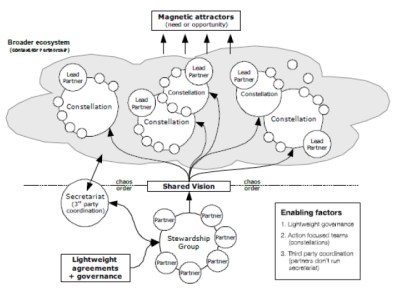
We presented a different model for the member organizations to consider. This model was developed by Surman & Surman (2008). It captures the complex nature of multiple stakeholders working together based on shared interests and assets.
Constellation model of Social Change, Eaton International Consulting, Sarah Eaton, facilitator

At the top of the model is a “magnetic attractor”, or the purpose that caused all the groups to come together in the first place. This essentially becomes their guiding star, or in less “fluffy” language, their guiding principles. The larger group’s shared purpose is what guides them and drives their actions, defining how they will work together.

This model is light on governance. There is no separate legal entity or incorporation. Instead, action-focussed work teams called “constellations” take on the responsibility for moving certain pieces of the work forward. There is no obligation for a group to exist indefinitely. Once their work on a particular area has been completed, the constellation may be phased out, giving way to new constellations. This “phasing out” is seen as a natural progression of the work, rather than a source of anxiety. It does not mean that the foundation of the larger organization has been shaken in any way.

Instead of a traditional leadership team at the top, there is a stewardship group that serves to empower the various constellations. Their job is to set a strategic direction, monitor the coalition’s overall health. Then, it turns over the energy and power to the working groups. Each group takes the lead on a particular project or set of actions. The general terms of reference for the stewardship group are “as little process as possible”.

This model also includes a third-party secretariat whose job it is to coordinate the overall efforts of the project and troubleshoot problems. Surman and Surman point out that:

“When non-profits set up collaborative projects, they typically… (create) a secretariat within the partner who has the most capacity. This is seldom an ideal solution. Placing the coordination function within one of the partners permanently alters the power dynamic of the group. One partner takes power. The others defer responsibility and lose energy.”

In this model, the secretariat is responsible to both the stewardship team and the constellations.

Characteristics of the Constellation Model

  • Defining traits of this model are:
  • Organizationally complex
  • Lightweight governance
  • Messy
  • Exist through lightweight agreements between members
  • Fiscal and legal responsibility moves around depending on which partner is leading a constellation
  • Leadership and power are shared among members

Our process

We challenged the groups to consider the constellation model in more depth. We asked them which aspects of it resonated with them and how.

We did not tell members that their current structure was wrong or that they needed to change it. We simply presented the constellation model as a tool for further discussion.

Results

  • The group was able to engage deeply in a productive conversation about governance, leadership and structure.
  • Members gained insights into why a traditional organizational structure might not work for them.
  • Individuals who were feeling anxious and undervalued suddenly felt that they had options.
  • The group was able to acknowledge that a structure can be “messy” and still work.

Just as constellations in the sky may seem messy to the untrained eye, each functions well on its own. Sometimes stars burn out… and that is OK. In fact, it is normal and does not mean that the universe is falling apart. There is a natural ebb and flow to all work and process.

As facilitators we were astounded at the depth of conversation and levels of engagement. We brought the constellation to the table as a tool to generate dialogue. The unexpected result for us was a sense of relief, mixed in with excitement. Members felt that they had a better understanding of how many organizations could work together effectively without giving up their own identity or culture.

References:

Here are some of the resources that we drew upon in order to prepare for and deliver the workshop:

Byers, R. (2011). “Models and Elements of Collaborative Governance” from @ A Glance: A Resource of the Healthy Communities Consortium.

Cooperrider, D. L., Whitney, D., & Stavros, J. M. (2003). Appreciative inquiry handbook. Bedford Heights, OH: Lakeshore Publishers.

Koch, J. (2005). The Efficacy of Asset-Based Community Development (ABCD) in the Educational Context. (Master’s Thesis).University of Calgary, Calgary.

Kretzmann, J. P., & McKnight, J. L. (1993). Building Communities from the Inside Out: A Path Toward Finding and Mobilizing a Community’s Assets. Skokie, IL: ACTA Publications.

Kretzmann, J. P., McKnight, J. L., Dobrowolski, S., & Puntenney, D. (2005). Discovering Community Power: A Guide to Mobilizing Local Assets and Your Organization’s Capacity. from the Asset-Based Community Development Institute, School of Education and Social Policy, Northwestern University: http://www.abcdinstitute.org/docs/kelloggabcd.pdf

Storti, C. (1990). The art of crossing cultures. Yarmouth, ME: Intercultural Press, Inc.

Surman, T. (2006, March 15, 2012) Constellation Collaboration: A model for multi-organizational partnership. Retrieved from http://www.socialinnovationexchange.org/files/event/attachments/Constellation%20Model%20Description%20June%209%2706.pdf

Surman, T., & Surman, M. (2008). Listening to The Stars: The Constellation Model of Collaborative Social Change. Social Space. Retrieved from http://socialinnovation.ca/sites/default/files/Constellation%20Paper%20-%20Surman%20-%20Jun%202008%20SI%20Journal.pdf

Wheatley, M. J. (2006). Leadership and the New Science: Discovering Order in a Chaotic World (3rd. ed.). San Francisco: Berrett-Koehler Publishers, Inc.

_________________________________

Share or Tweet this post: Letting them shine: Working with multi-organizational coalitions http://wp.me/pNAh3-1kO

Update – January 2018 – This blog has had over 1.8 million views thanks to readers like you. If you enjoyed this post, please “like” it or share it on social media. Thanks!

Sarah Elaine Eaton is a faculty member in the Werklund School of Education, University of Calgary, Canada.