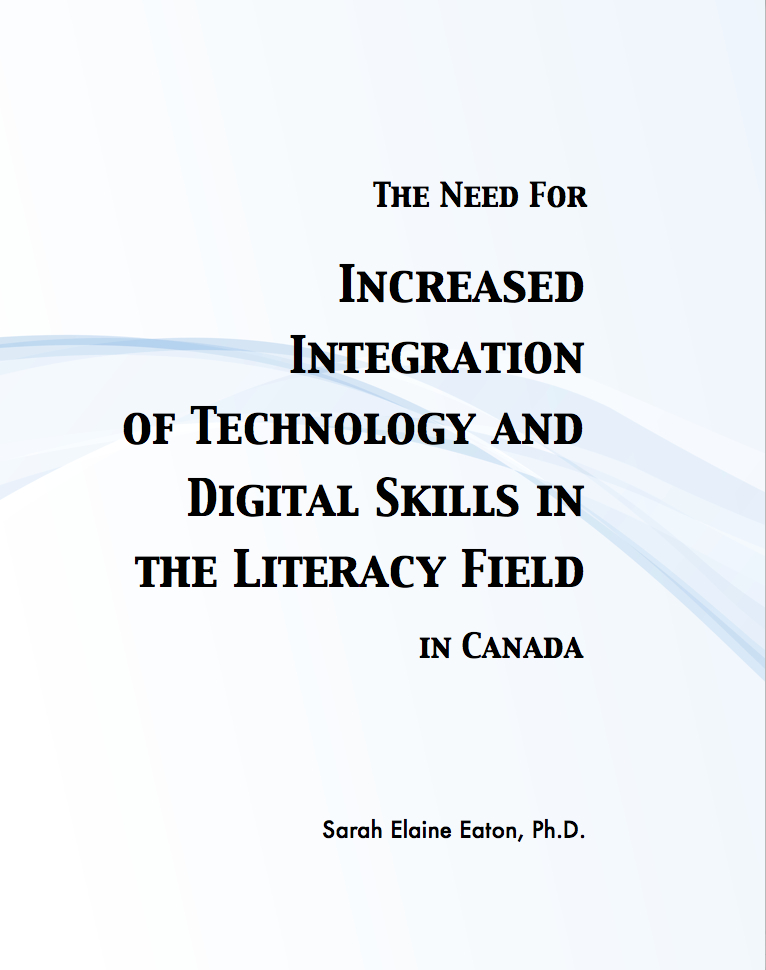
The Need For Increased Integration of Technology and Digital Skills in the Literacy Field in Canada

December 2, 2011

Need for Increased Tech in Literacy by Sarah Elaine Eaton, Calgary, CanadaIt’s here! The Need For Increased Integration of Technology and Digital Skills in the Literacy Field in Canada has just been released.

Technology does not need to be adopted because it is fashionable, but because the face of learning worldwide has changed dramatically over the past several decades at all levels, from early childhood education to workforce training. When literacy professionals integrate technology in meaningful ways, they ultimately help learners prepare for long-term success.

This report highlights the changing landscape of Canadian education and training (though the findings may relate to other regions, too). It offers recommendations for literacy organizations, managers, coordinators, staff, volunteer tutors and other practitioners to incorporate technology into professional practice in an easily accessible manner that focuses on building professional competencies.

Topics covered include:

  • The changing nature of education and training.
  • The current state of literacy instruction.
  • Emerging models of technology integration in the literacy field.
  • The need for continuing professional development.
  • Recommendations.

Bibliography contains 36 references. Get your copy here: http://www.onatepress.com/titles/the-need-for-technology-in-literacy/

This publication is also available through the ERIC database: http://www.eric.ed.gov/PDFS/ED526087.pdf

______________

Like this post? Share or Tweet it: The Need For Increased Integration of Technology and Digital Skills in the Literacy Field in Canada  http://wp.me/pNAh3-12r

Update – January 2018 – This blog has had over 1.8 million views thanks to readers like you. If you enjoyed this post, please “like” it or share it on social media. Thanks!

Sarah Elaine Eaton is a faculty member in the Werklund School of Education, University of Calgary, Canada.

Social Media Challenges in the Workplace – CIRA panel discussion

November 24, 2011
CIRA Dinner Calgary

(Left to Right) John Moreau, Tom Hesse, Sarah Eaton and Andy Robertson debating social media challenges in the workplace

Tonight I took place on a panel discussion in Calgary on the issue of social media challenges in Calgary. The dinner event was hosted by the Southern Alberta chapter of the Canadian Industrial Relations Association (CIRA), and organized by Dr. Kelly Williams-Whitt, who is a professor of Labour Relations at the University of Lethbridge (Calgary Campus) and serves in a leadership role with CIRA.

My fellow panelists were:

  • Andy Robertson, Partner, Macleod Dixon LLP
  • Tom Hesse, United Food and Commercial Workers Canada (UFCW) 401
  • John Moreau, Arbitrator

Dr. Whitt presented us with three Canadian labour cases including:

  1. A female employed in the health care sector who posted photos of patients without their permission on her blog, discussing their conditions and making disparaging remarks about her fellow employees, her workplace and her bosses. (She was later dismissed from her job.)
  2. A male employee with documented mental health issues who blogged about his Neo-Nazi beliefs, his hatred of certain racial groups, the desecration of animal remains that he took part in, the anti-depressants he was on and other assorted topics. He mentioned the name of his employer in his blog. (He was suspended from work and then reinstated.)
  3. A male employee who circulated pornography to his co-workers and was later found to have over 3000 pornographic images and some porn videos in his work e-mail account. (He was suspended from work and then reinstated).

Each panelist gave commentary on the cases, based on their respective experience. My point of view was mainly “pro” social media. My main arguments were:

  • Most companies do not train their employees adequately on how to use social media effectively and responsibly.
  • Organizations need to make their expectations about online behaviour very clear to employees.
  • Everyone who engages in social media leaves a “digital footprint”. Employees and employers need to be aware of what this is and what it can mean over the long term.
  • Digital citizenship is in an important skills to learn in the 21st century.
  • Online reputation management is becoming more important for both employees and employers.

Here’s a clip of my commentary:

It was a lively and invigorating discussion that touched on topics such as personal freedoms, organizational control, common sense and personal responsibility. My fellow panelists were articulate, well-informed and thoughtful in their responses. Being neither a lawyer, nor a union voice, I was honoured to take part in the discussion.

____________

Share this post: Social Media Challenges in the Workplace – CIRA panel discussion http://wp.me/pNAh3-129

Update – January 2018 – This blog has had over 1.8 million views thanks to readers like you. If you enjoyed this post, please “like” it or share it on social media. Thanks!

Sarah Elaine Eaton is a faculty member in the Werklund School of Education, University of Calgary, Canada.


Best resources of the week (Nov. 13 to 19, 2011)

November 20, 2011

Here are my favorite resources of the week, curated from my Twitter account.

Social Media

Social media increasingly used to guage public health – by Christine Moyer, American Medical News

How to Create a Social Media Marketing Schedule – by John D. Leavy

Literacy and Essential Skills

What have you learned about teaching others to read? Share your story – Educational Leadership seeks 200-word stories of wisdom from educators. Add yours.

What You Don’t Know Can Hurt You: Literacy’s Impact on Workplace Health and Safety by Alison Campbell, Conference Board of Canada

Education News

Foreign languages ‘essential for our children’s future’ – Published by The Financial

More Foreign Language Classes Use Online Education – by Catherine Groux, U.S. News

Exam approach fails many – Edmonton Journal

____________________________

Share this post: Best resources of the week (Nov. 13 to 19, 2011) http://wp.me/pNAh3-11B

Update – January 2018 – This blog has had over 1.8 million views thanks to readers like you. If you enjoyed this post, please “like” it or share it on social media. Thanks!

Sarah Elaine Eaton is a faculty member in the Werklund School of Education, University of Calgary, Canada.


How technology has changed reading in the 21st century

November 18, 2011

Alice in WonderlandWhat would you do if your favorite little child begged you to write down the story you had told him or her orally? Would you go to the computer and start typing? Would you print it out on paper? Turn it into a slide presentation with engaging visuals? Put it onto an iPad to share together as you sit on the sofa?

C.M. Rubin ponders this question in her fascinating article “How Will We Read? – The Book Given”. She writes:

“On November 26, 1864, Lewis Carroll gave my relative, Alice Pleasance Liddell, a book he had written for her… If the book given to Alice in 1864 was given today, just imagine the variety of different ways a creative chap like Lewis Carroll might have presented it to his Alice.  Quantum leaps in technology have completely changed the way we write, illustrate, publish, market, promote and consume books.” Read the full article.

There is no question that the act of reading is changing. Just over a year ago, I blogged about an article from the Smithsonian about how digital technologies physically change the act of reading.

While bibliophiles like me may love to hold a paper book in their hand, the children of the twenty first century will also need to know how to understand and work with written text presented in a digital format. If you’re a language or literacy teacher, or even a parent who snuggles up with your little one to read a bedtime story, are you incorporating digital technologies to help the children you care about learn how to read with technology?

Related post: Teaching reading the 21st century way http://wp.me/pNAh3-cb

___________

Share this post: How technology has changed reading in the 21st century http://wp.me/pNAh3-11P

Update – January 2018 – This blog has had over 1.8 million views thanks to readers like you. If you enjoyed this post, please “like” it or share it on social media. Thanks!

Sarah Elaine Eaton is a faculty member in the Werklund School of Education, University of Calgary, Canada.


How to market your language or literacy program: Build trust over time

October 30, 2011

If you send prospective students a brochure or answer an e-mail, they are not very likely to register in your program. Here’s why…

Marketers tell us that we need to see an advertisement or hear a message at least seven times before we are likely to buy a product. Sales professionals say that it can take anywhere between five and 27 “touches” or contact with a prospective buyer before they are convinced to make a purchase from you.

What does that mean for language programs and literacy organizations? It means that we can not simply send out a brochure to a student and reasonable expect that suddenly he or she will want to register in our program.

The “drip theory” recommends regular, repeated contact – at least six or seven times – with a prospect to ensure that your name sticks in her mind. This does not mean sending out six or seven copies of the same brochure! There is a difference between “dripping” and “bombarding” or worse yet, “stalking”.

Each “touch” needs to be different — and still relevant. For example, connecting via e-mail, followed by sending a brochure, followed a week later by an invitation to register, followed by a couple of monthly newsletters.

The timing of each contact is also important. Bombarding someone in seven different ways in a very short period of time is more likely to turn them off than to convince them that they want to join your program. There is no one perfect formula for how often you should connect with your prospects… Once a week or a few times a week seems to be an accepted norm in the educational and non-profit sectors. There seems to be a lower tolerance for repeated contact in a short period of time with prospects in the social sectors than there is in the business sectors.

In my PhD research, I found that it can take anywhere from two to five years to get a new language program off the ground. That is the “sales cycle” for English as an Additional Language (ESL / EFL / EAL / ESOL) programs. It can also take up to two years to convert a prospective student into a current student.

In Guerrilla Marketing for NonProfits, authors Jay Conrad Levinson, Frank Adkins and Chris Forbes talk about how non-profit organizations often give up too soon. They expect to see results NOW. If they do not get an immediate response (which is highly unlikely) they give up. In fact, they say that most non-profits give up on new programs just before they hit the point of success.

If you get an e-mail address for the prospect and you can send monthly updates about what is going on in your program, you will be using yet another medium to show your prospects that you have not forgotten about them.

Ideally, you want to combine different types of contact: social media, mail, e-mail, phone calls and personal contact. This is not always easy in an international marketplace, but do try for repeated contact in a variety of ways.

If you don’t get any response after several tries, then you can change the prospect from active to inactive in your database. In any case, you are more likely to get more registrants by using the drip effect than by sending an initial brochure and nothing else.

Here are seven ways to help you market your language or literacy program consistently

1) List all of the methods you use to connect with your prospective learners (phone, e-mail, drop-in, brochures, etc.).

2) Set up a spreadsheet with each method of contact across the top.

3) Every time a prospect contacts you, ask for his or her contact information.

4) Note the date that you made contact under the appropriate column.

5) Make an effort to stay in touch with the prospective learner, at least once a week, using a different method each time.

6) If a prospective student shows a preference for a particular type of communication, use that one more often. For example, if a prospective student does not respond to e-mails, but calls or Skypes, then make a note of it. At least once, take the initiative to connect with the prospect in the way that they prefer. It’s about them, after all.

7) Track how many prospective students actually end up enrolling in your program and how long it takes. You may be surprised to find that it take  longer than you think it will, or longer than you would like it to. This does not mean that should try to accelerate that cycle. That can often backfire and turn prospects off. It is useful, however, to show you how long prospective learners may take to make a decision.

It’s not about trying to force them to make a decision faster. It is about cultivating trust and building a relationship with them so that when they are ready to make a decision, they choose your program because they feel that they know you and that you care about them. When the time comes for them to make their decision, trust will often be the factor that sways people one way or another. If you haven’t built the trust with them over time, they may never register. That takes time. In the long run, it is worth it.

___________________

This post is adapted from “Idea #17: Be a Drip ” in 101 Ways to Market Your Language Program

________________

Share or Tweet this post: How to market your language or literacy program: Build trust over time http://wp.me/pNAh3-wx

Update – January 2018 – This blog has had over 1.8 million views thanks to readers like you. If you enjoyed this post, please “like” it or share it on social media. Thanks!

Sarah Elaine Eaton is a faculty member in the Werklund School of Education, University of Calgary, Canada.