How checking things off your “to do” list is different than solving problems

December 7, 2012

I am in the middle of a small war with the management company of our condo complex. As the board president, I constantly liaise with our property manager about problems that need to be solved on the property. A recent issue is an excellent example of the difference between management and leadership.

There are 110 town homes in our condo complex that are approaching 40 years old. Structural wear and tear is starting to be a problem. This year, one unit had a major ant infestation. We got an exterminator to deal with the problem immediately. He said that the ants were entering through small holes under the kitchen window and in addition to his extermination services, he recommended that we fix the exterior by plugging up the holes that the ants use as entry points to the house.

Since the beginning of August I have been sending in requests to get the holes around the exterior of the windows fixed. I am not an expert in windows or building envelopes or exterior structures, but it was pretty clear where the holes were. I sent in a request to have the caulking around the outside of the window

The property manager has a construction company that they send out on a regular basis to do jobs on the property. I have met them and they are actually great guys. They know what they are doing. They arrive on time, they do a good job, they clean up after themselves, and they are pleasant to all the residents who live here. It doesn’t really get much better than that.

But this ant issue has recently turned into an all out war.

Last month I said, “I have been asking for this to be done for 3 months. Please have the work done.”

His reply, “I have talked to the contractor. He says the work has been done.”

Yesterday I looked at the unit. The entry points for the ants are still visible.

I wrote again, saying “Four months have now passed since I sent in this work request. This work has not yet been completed. Please have the work done.”

The reply came back, “The contractor assures me that he has caulked around the window. Can I give the contractor your phone number and you can deal with him directly?”

I went outside and looked. Indeed, the area around the metal frame had been caulked, but the entry points for the ants were still wide open. I took some pictures. I highlighted the areas where ants were entering:
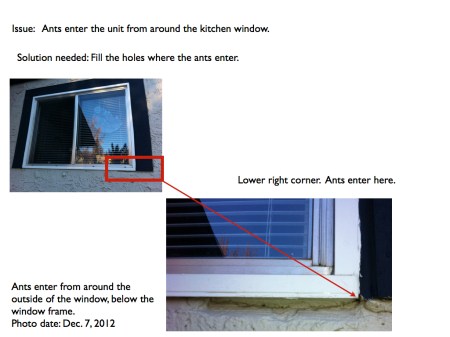
Ant photos.001

Here is the second photo:

Ant photos.002

I sent the photos together with this letter:

Dear John:

I’ve been thinking about this. If you say to a guy, “Go caulk around the window.” He’s going to come over and caulk around the window. The job is done because the job was “to caulk around the window”.

 If you say to the guy, “This place has an ant problem. The kitchen wall is covered with thousands of ants. The exterminator says they are coming in from outside, specifically from around the kitchen window. Go over there and have a look at the outside of the kitchen window. Figure out every possible entry point for the ants to get in around that window. Plug each and every last one of those holes up, so the little buggers can’t get in.”

The job is done when the window is turned into an ant version of Fort Knox. No one — not one little ant — gets in.

That is an entirely different job than, “Go caulk around this window.”

The job we need to have done is the second one — plug up every possible entry point for ants from around that kitchen window.

If you need to give the contractor my number to explain that, then go ahead, but I’m pretty sure you get the idea about what we are after here, which is a solution to the problem of blocking how the ants get into the unit.

Every time you send a guy — or a couple of guys — to our property to do a job, they are not just checking off items from a “to do” list. They are solving problems for the people who live here. In doing that, they are making their life better.

I’m not trying to be melodramatic here, but every time one of your guys comes to our property to fix a problem for a resident, they get a chance to be somebody’s hero. They do that by solving a problem that the owner can not solve by themselves, because they either do not know how or they do not have the skills, expertise, materials, or maybe just the time. That’s one reason people live in condos.

I guarantee you that the single lady who lives in that unit does not have the skills or materials to fix this problem herself — or she would have already.

Your guys have all that — skills, talent, expertise and materials. We rely on you to hire smart guys and you do that. We see it time and time again. They’re smart, they’re capable and they can solve problems. In a small way, they can be somebody’s hero.

So tell your guy that this is his chance to be a hero for Marilyn, the lady who lives there.

Thanks,

Sarah

When it comes to leadership, it is important to give people all the information they need to solve a problem. If you hire smart people, then do not simply give them items to check off their “to do” list. Engage people’s skills, expertise and problem-solving abilities to make them part of the solution. In doing so, you are likely to make their work more meaningful… and both they — and their work — will have a greater impact on those they are helping.

I believe deeply in people’s capacity to solve problems, help others and do meaningful work.

Checking items off a “to do” list does very little to connect the work to the people who may benefit from it. Besides, work that only involves checking items off a “to do” list often lacks meaning, especially when that list is assigned to you by someone else.

Engaging smart people to develop sustainable solutions helps everyone over the long term.

_________________

Share or Tweet this: How checking things off your “to do” list is different than solving problems http://wp.me/pNAh3-1×6

Update – January 2018 – This blog has had over 1.8 million views thanks to readers like you. If you enjoyed this post, please “like” it or share it on social media. Thanks!

Sarah Elaine Eaton is a faculty member in the Werklund School of Education, University of Calgary, Canada.


5 Easy Christmas Blogging Ideas for Literacy and Language Teachers

December 5, 2012

With Christmas right around the corner, teachers are scrambling to finish up the semester before the holidays. If you are a blogger, you probably do not have much time for your blog at the moment. Here are five easy ideas to keep you blogging through this busy time of year:

1. A guide to Christmas away from home

Do you have students from other countries who are missing their family and friends back home? Write a post with your top suggestions on how to survive the holidays away from home.

2. Local Christmas traditions and events

Many areas have special events such as craft fairs, light displays or free ice skating to celebrate the holidays. Tap into your local community to find out what is going on. Write a post that highlights some free or low-cost options for your students and their families.

3. Christmas crafts for young and old

Believe it or not, doing crafts can be an excellent way to build literacy and language skills. You must read instructions, follow directions and use a step-by-step method to complete a task.

Create a post with links to simple crafts that are appropriate for the ages and language proficiency of the group you teach. A link to a YouTube video is always a great idea.

4. Christmas carols for language learning

Sarah Eaton blog photoAs children we learn Christmas carols without really thinking about the words. What does it mean to “deck the halls with boughs of holly”, anyway? If you live in an area where holly does not grow then you may have never seen real holly.

Write a blog post that de-mystifies some of the language and phrases in common Christmas songs.

5. Multicultural Christmas traditions

When I was a teenager my Mom befriended a lady from El Salvador. That first Christmas we exchanged stories about our different Christmas traditions. Marta told us that setting off fireworks after their turkey dinner was part of their tradition. We had a wonderful conversation as we learned about what the similarities and differences were between our two cultures.

Write a blog post that highlights some of the traditions of your students, friends or family members.

Christmas time is one of the busiest times of the year for many people. Keep your blog posts simple and light during this time of year. Focus on joy and sharing and you’ll continue to enjoy your own blogging through the holiday season.

_____________________

Share or Tweet this: 5 Easy Christmas Blogging Ideas for Literacy and Language Teachers http://wp.me/pNAh3-1wP

Update – January 2018 – This blog has had over 1.8 million views thanks to readers like you. If you enjoyed this post, please “like” it or share it on social media. Thanks!

Sarah Elaine Eaton is a faculty member in the Werklund School of Education, University of Calgary, Canada.


Webinar recording: Creating Space for Strength

November 30, 2012

Our research team is thrilled to share the recording of our webinar “An Introduction to Creating Space for Strength: An Asset-Based Community Development and Research Project Focused on Calgary’s North Central Communities”.

We had over 40 people sign up for the webinar. The program lasted approximately 45 minutes and included chat dialogue from many community participants.

Thank you to everyone who attended and contributed. As promised, here is the recording. Feel free to share it with others.

5 Great resources on asset-based community development (ABCD) http://wp.me/pNAh3-1xJ
______________

Share or Tweet this: Webinar recording: Creating Space for Strength http://wp.me/pNAh3-1wI

Update – January 2018 – This blog has had over 1.8 million views thanks to readers like you. If you enjoyed this post, please “like” it or share it on social media. Thanks!

Sarah Elaine Eaton is a faculty member in the Werklund School of Education, University of Calgary, Canada.


3 Handy Checklists for APA Style and Formatting

November 27, 2012

As my students are getting ready to hand in their final research papers, they are struggling to learn APA (American Psychological Association) standards for formatting, citations and references. Here are three handy checklists I have shared with them. They find them very helpful:

APA Style Checklist – http://www2.indwes.edu/ocls/apa/apastylechecklist.pdf

Checklist for APA Style (from Elmhurst) – http://library.elmhurst.edu/files/2010/02/ChecklistAPA.pdf

APA Format Checklist (from SLU) – http://www.slu.edu/Documents/student_development/student_success_center/APA_Format_Checklist_Handout.pdf

______________

Share or Tweet this: 3 Handy Checklists for APA Style and Formatting  http://wp.me/pNAh3-1wD

Update – January 2018 – This blog has had over 1.8 million views thanks to readers like you. If you enjoyed this post, please “like” it or share it on social media. Thanks!

Sarah Elaine Eaton is a faculty member in the Werklund School of Education, University of Calgary, Canada.


An Introductory Public Webinar: Creating Space for Strength An Asset-Based Community Development and Research Project Focussed on Calgary’s North Central Communities

November 21, 2012

Creating space for strength in Calgary - Eaton International Consulting Inc.Our new community development project is underway! We are hosting an introductory webinar that will share an overview of an exciting project we are involved in.

There are 3 of us from Eaton International Consulting Inc. (www.eatoninternationalconsulting.com), working on this study: Lee Tunstall, Ph.D., Vilma Dawson and me. We are studying strength-based community development in a number of Calgary’s North Central communities including:

  • Harvest Hills
  • Coventry Hills
  • Country Hills
  • Country Hills Village
  • Panorama Hills
  • Creekside
  • Evanston
  • Hidden Valley
  • MacEwan
  • Sandstone

Come and learn about a research project designed to find out what our communities’ strengths and assets are, what can be improved, and how. We are particularly interested in hearing your opinions about our strengths, some of the problems faced by our community, particularly in terms of space, and what solutions we can generate to build an even greater community.

There are plans for interviews with interested community members this fall and winter and roundtable discussions will take place in February 2013.

We are interested in hearing your voice!  This is your community and your opinions, suggestions and advice will help create recommendations on how to move ahead with space issues in the community.

Webinar

Join us on Thurs. November 29, 2012, 7:00 – 8:00 p.m. for an online webinar explaining the project and how you can get involved. Space in the webinar is limited, so participants are asked to register at:

http://creatingspace.eventbrite.ca

There is no cost to attend the webinar. Everyone is welcome. A computer with a sound card and high-speed Internet connection are necessary to join the webinar.

If you know someone who is interested in community development in these areas, please feel free to share this invitation with them. We can accommodate up to 100 people in the webinar and there is no cost to attend.

If you cannot make the webinar in person, a link will be available through the Northern Hills Community Association website afterwards.

With thanks to those organizations who made this project happen:

Project OriginsNorthern Hills Constituency

Project FundersGovernment of Alberta (CFEP Grant); United Way of Calgary and Area; Aspen Family and Community Network Society; Northern Hills Community Association

Project SupportersNorthern Hills Constituency; City of Calgary; Aspen Family and Community Network Society; Northern Hills Community Association; United Way of Calgary and Area

___________________

Share or Tweet this: An Introductory Public Webinar: Creating Space for Strength An Asset-Based Community Development and Research Project Focussed on Calgary’s North Central Communities http://wp.me/pNAh3-1wq

Update – January 2018 – This blog has had over 1.8 million views thanks to readers like you. If you enjoyed this post, please “like” it or share it on social media. Thanks!

Sarah Elaine Eaton is a faculty member in the Werklund School of Education, University of Calgary, Canada.