Tomorrow’s free webinar on marketing literacy and language schools: Focussing on what makes you unique

April 17, 2012

I’m so excited about tomorrow’s free webinar program! It’ll be the fifth in a series of ten free webinars on how to market and promote literacy programs and language schools.

Each webinars highlight different ideas from 101 Ways to Market Your Language Program. Every week you get practical, low-cost ideas to help you promote your program. Best of all, you’ll get to connect with others on line who are also interested in the same topic, ask questions and interact.

The webinars are  30 to 60 minutes in length. Bring a pen and paper. I’m going to give you lots of ideas you can implement right away.

Webinar #5 of 10 – What to expect

Tomorrow’s webinar will focus on:

  • How to set yourself apart from other programs.
  • Horizontal vs. vertical markets.
  • How to present or “package” your programs in a way that gets their attention.
  • I’m going to share tips on how to figure our what makes your program unique. This is what professional sales people call your “unique selling proposition”, but we don’t need sales lingo, do we? We’ll help you figure it out in ways that make sense for educators.
  • Determine which marketing strategies actually work best for you. Not what other people say should work, but what has actually proven successful for you. Sometimes it means going against the grain… Come and find out why.

Webinar time

Date: Wednesday, April 18, 2012

There are some time zone changes coming up around the world, so double-check these times against your local area:

Point of origin – 14:00 (2:00 p.m.) Mountain Time, March 21, 2012 – Calgary / Edmonton

16:00 (4:00 p.m.) – Eastern Time – Toronto / New York

20:00 (8:00 p.m.) – Greenwich Time – London, England

22:00 (10:00 p.m.) – Eastern European Time – Athens / Istanbul

05:00 (5:00 a.m.) – following day – Japan Standard Time – Tokyo

How to log in

There is no need to register. These webinars are free and open to everyone. Seating is limited though, so sign on early.

To join the webinar, simply click here: http://meet11548754.adobeconnect.com/saraheaton/

Will it be recorded?

You bet. I’ll record the program and post it within 24 hours or so. No charges or fees to watch these recorded programs.

What will future webinars cover?

Here’s what we’ll cover in upcoming webinars:

  • Week #6 – Specialty tips for programs at large institutions
  • Week #7 – Relationship marketing. The power of connections.
  • Week #8 – It’s how you make them feel. Adding personal touches that make all the difference
  • Week #9 – Effective follow up with your marketing and not giving up too soon.
  • Week #10 – Social media for marketing.

All you have to do is block off Wednesdays in your calendar at your corresponding local time and then log in using the link above.

If you can’t make the webinar, and you’d like to ask a question about the topic, feel free to leave me a comment. I’ll do my best to answer questions that come in before the program during the webinar. You can watch the recording to get the answer to your question, or I’ll answer you back in the comment section.

Related post:

101 Ways to Market Your Language Program (10 Free webinars) http://wp.me/pNAh3-1j6

Recordings of past programs:

#1 Webinar recording: 101 Ways to Market Your Language and Literacy Program 

#2 Webinar recording: 101 Ways to Market Your Language and Literacy Program

#3 Webinar recording: 101 Ways to Market Your Language and Literacy Program

#4 Webinar recording: 101 Ways to Market Your Language and Literacy Program

___________________________

Share or Tweet this post:  Tomorrow’s free webinar on marketing literacy and language schools: Focussing on what makes you unique http://wp.me/pNAh3-1mR

Update – January 2018 – This blog has had over 1.8 million views thanks to readers like you. If you enjoyed this post, please “like” it or share it on social media. Thanks!

Sarah Elaine Eaton is a faculty member in the Werklund School of Education, University of Calgary, Canada.


Free webinar: Learning the 21st century way: Making sense of how to use social media for learning

April 16, 2012

Over the past decade social media has changed how individuals connect online and share information and how organizations interact with stakeholders and customers. Did you know that social media is now being incorporated into learning programs from Kindergarten right on up through adult education? Does it really add any value to the learning process?

Join Literacy Nova Scotia and me for a 60-minute webinar on Wednesday, April 18. I’ll share exactly how I incorporated social media into one of my classes, what worked, what didn’t and what you can do in your own teaching or training practice to effectively integrate social media — and why you might want to.

Participant Outcomes

By the end of this program you will:

  • Have a basic understanding of how social media can add value to your learning programs
  • Gain insight into how to incorporate social media into a lesson plan
  • Get ideas on how to assess activities using social media
  • Get ideas on how to incorporate social media into your own learning programs

Webinar content

  1. Emerging technology trends in education. Where have we come from and where are we going?
  2. Case study: How I successfully incorporated Twitter into a university-level Effective Learning class.
  3. The pedagogical value of social media: What’s in it for the learners?
  4. Assessment of learning activities that use social media. What works, what doesn’t and why.
  5. Tips on how to incorporate social media into your own teaching practice.

Participant materials (provided to all registrants)

  • Twitter for Teachers – 25-page .pdf manual to help you get started with Twitter.
  • Sample Twitter activity.
  • Sample evaluation for a social media activity.

Requirement: A high-speed Internet connection with a sound card (so you can hear me).

Date and time: April 18, 2012, 12:00 noon – 1:00 p.m. Atlantic Time

Thanks to Literacy Nova Scotia’s generous sponsorship, this is event is free for participants. You need to register though, as space is limited.

___________________________

Share or Tweet this post: Free webinar: Learning the 21st century way: Making sense of how to use social media for learning http://wp.me/pNAh3-1mH

Update – January 2018 – This blog has had over 1.8 million views thanks to readers like you. If you enjoyed this post, please “like” it or share it on social media. Thanks!

Sarah Elaine Eaton is a faculty member in the Werklund School of Education, University of Calgary, Canada.


3 Keys to persuading an audience: ethos, logos and pathos

April 16, 2012

Recently I was coaching a group of high school students for a public speaking competition.

The art of persuasion dates back to the ancient Greeks. Aristotle identified the three main elements of persuasion as ethos, logos and pathos. We talked about these classical rhetorical devices that are considered the keys to a persuasive speech:

Ethos (Ethical appeal)

The English word “ethics” is derived from this Greek word.

Your audience must find you ethical and believable. As a speaker, it is your job to convince your audience that you are credible and that you are worth listening to.

Speak with authority, but not arrogance. Be confident, but not condescending. Be the best version of your truly authentic yourself.

An audience’s respect must be earned. Do not take it for granted.

But your credibility alone is not enough. You also need these other elements:

Logos (Logical appeal)

The English word “logic” is derived from this Greek word.

A well-crafted speech is well organized. It has a logical flow. The message is consistent. It can be helpful out outline a speech as part of your preparation. Check that every element of the speech relates to the point you are trying to make.

Do not ramble or go off on tangets. Focus on the point you want to make and stick to your topic.

Scientists and academics will often have a speech that is laden with logical arguments, but forget to include this next critical element…

Pathos (Emotional appeal)

The English words “passion”  and “compassion” are derived from this Greek word.

Your speech must appeal to the audience on an emotional level. Engage their imagination. Take them on a journey of hope. Say something they will remember and that will impact them on a deep level.

End your speech on a positive note to ensure that you are using pathos for maximum effect. Just remember to include your ethical appeal and a logical argument to balance off a passionate delivery.

Together, ethos, logos and pathos are considered the perfect trifecta of a persuasive speech.  Do you incorporate all three when you’re trying to convince someone of your point of view?

For those of you who are teachers: When you teach presentation skills to students do you teach them about ethos, pathos and logos?

___________________________

Share or Tweet this post: 3 Keys to persuading an audience: ethos, logos and pathos http://wp.me/pNAh3-1mA

Update – January 2018 – This blog has had over 1.8 million views thanks to readers like you. If you enjoyed this post, please “like” it or share it on social media. Thanks!

Sarah Elaine Eaton is a faculty member in the Werklund School of Education, University of Calgary, Canada.


Call for papers: Multidisciplinary Approaches in Language Policy and Planning Conference 2012

April 15, 2012

University of CalgaryAre you interested in language policy and related research? I’m on the organizing committee for this upcoming conference in Calgary and promised I’d share this call for papers. We’d love to have you submit a proposal!

Multidisciplinary Approaches in Language Policy and Planning Conference 2012

September 6 – 8, 2012

University of Calgary, Alberta, Canada

Plenary Speakers

  • Francois Grin, University of Geneva
  • Elana Shohamy, Tel Aviv University
  • Peter Ives, University of Winnipeg

Call for papers

This international conference will be held at the University of Calgary, Canada.  We invite papers that approach language policy from a variety of theoretical and methodological perspectives, and in a variety of contexts, from the local/institutional to national/global.  We invite abstracts (500 words maximum) for papers in any of the following areas:

  • Language policy and political theory
  • Official language policies
  • Language policy and lingua franca
  • Heritage language policies
  • Language policy and globalization
  • Ideologies and language policies
  • Language policies in school settings
  • National identities and language policies
  • Language policy and the economics of the workplace
  • Non-official languages in mainstream classrooms
  • Language policies and social mobility
  • Language attrition, language revitalization and language policies
  • Language policies and transnational communities

Abstracts should be 500 words maximum including all references. The deadline for submissions is June 1, 2012.

Abstracts will be reviewed anonymously by at least two experts in the field. Final decisions will be sent to authors by June 15, 2012.

Each paper presentation should be 20 minutes, with 10 minutes for discussion. You can submit a maximum of two contributions, one as author and one as co-author or discussant.

Principal conference organizers: Dr. Tom Ricento and Dr. Mary O’Brien.

Go here to submit your proposal: http://www.educ.ucalgary.ca/lpp/call-for-papers

Conference website: http://www.educ.ucalgary.ca/lpp/

Click here for a downloadable poster for the conference.

Conference Twitter hashtag: #malpp

___________________________

Share or Tweet this post: Call for papers: Multidisciplinary Approaches in Language Policy and Planning Conference 2012 http://wp.me/pNAh3-1mp

Update – January 2018 – This blog has had over 1.8 million views thanks to readers like you. If you enjoyed this post, please “like” it or share it on social media. Thanks!

Sarah Elaine Eaton is a faculty member in the Werklund School of Education, University of Calgary, Canada.


Thrilled to be nominated for a TechRev Award

April 14, 2012

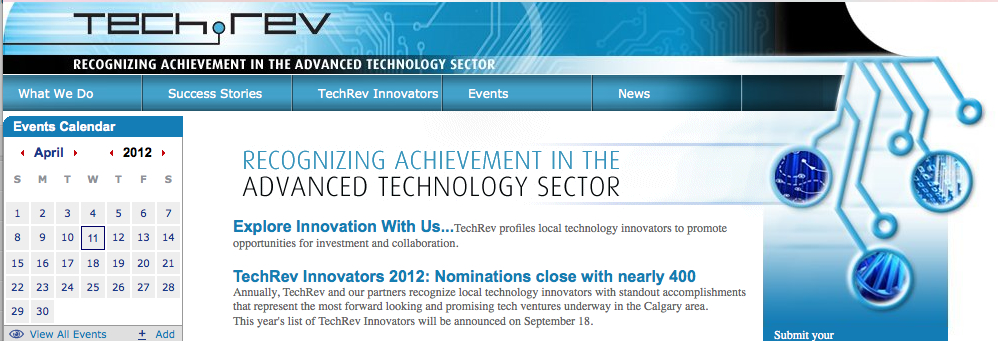
TechRev Award, nomination Exceptional Webinars, Sarah Eaton, Sarah Elaine Eaton, Calgary, webinar, webinarsOne of the projects I’m involved in is Exceptional Webinars, where we run train-the-trainer programs on how to develop and deliver great webinars. We started in 2011 and have run live courses and workshops, as well as e-learning training programs.

Since we started, we’ve had almost 200 people through the various programs, working with teachers, non-profit organizations, professional speakers, workshop facilitators, adult educators and corporate trainers.

Last week, we were honoured and thrilled to receive a notice saying that we have been nominated for a TechRev Award. Those who are selected as TechRev Innovators meet these criteria:

TechRev Innovators may be at any stage in their company’s life cycle. We are pleased to include those companies who are pre-commercial as well as those who are firmly established with a history of success.
Companies from across the broad spectrum of advanced technology innovation are eligible to be considered for TechRev Innovator recognition.
Global trend analysis may suggest greater potential in certain key sub-sectors such as geomatics, clean tech and wireless, while companies in ICT, life science technologies and advanced engineering among others are also considered important to regional innovation sustainability.
The winners are announced in September. For now, we are honoured to be nominated for the award.
___________________________

Share or Tweet this post: Thrilled to be nominated for a TechRev Award http://wp.me/pNAh3-1lV

Update – January 2018 – This blog has had over 1.8 million views thanks to readers like you. If you enjoyed this post, please “like” it or share it on social media. Thanks!

Sarah Elaine Eaton is a faculty member in the Werklund School of Education, University of Calgary, Canada.